Import jQuery

Showing posts with label yeshua. Show all posts

How sure are we that Jesus' real name is Yeshua? (And not Yeshu?)

I had an interesting conversation this week with some Jewish folks over Twitter. It started with an open-ended question: Almost immediately I thought of Jesus. No Jewish families name their kids "Jesus!" 😊 I knew that reply would come up. And sure enough:

But that's a bit oversimplified, isn't it? "Jesus" isn't Jesus' real name. His parents and contemporaries would have called him by his real name. And there were no hard "J" sounds in 1st century Hebrew or Aramaic. His real name couldn't have been "Jesus" - the language didn't support it!

I replied,

This has been my long held understanding. Someone pushed back:


Here, Chanan asserts with great snark that Jesus' real name was Yeshu ישו. Is he right?

For sure, Jews today call him Yeshu. And Israelis in general do as well. Most Israelis call him Yeshu ("YEH-shu), though Messianic Jews everywhere call him Yeshua (yeh-SHU-ah). Not long ago, Israeli Prime Minister Benjamin Netanyahu was giving a speech in Hebrew about Jewish and Christian friendship in Israel. During the speech, he referred to Jesus as Yeshu.

Does it matter? Not in significant ways. But it's worth finding out the truth.

Revisiting how the name was given, look at Matthew 1, the very first chapter of the Gospels:

Now the birth of Jesus Christ took place in this way. When his mother Mary had been betrothed to Joseph, before they came together she was found to be with child from the Holy Spirit. And her husband Joseph, being a just man and unwilling to put her to shame, resolved to divorce her quietly. But as he considered these things, behold, an angel of the Lord appeared to him in a dream, saying, “Joseph, son of David, do not fear to take Mary as your wife, for that which is conceived in her is from the Holy Spirit. She will bear a son, and you shall call his name Jesus, for he will save his people from their sins.”

It's that last line we should pay attention to. It's a sentence that doesn't make much sense in English. Call his name "Jesus" because he will save his people from their sins? In English, that doesn't follow; what does this name have to do with saving people?

But in Hebrew this makes a bit more sense. 

Summarizing Ernest Kline's A Comprehensive Etymological Dictionary of the Hebrew Language:

The name [Jesus] is related to the Biblical Hebrew form Yehoshua`(יְהוֹשֻׁעַ‎), which is a theophoric name first mentioned in the Bible in Exodus 17:9 referring to one of Moses' companions and his successor as leader of the Israelites. This name is usually considered to be a compound of two parts: יהו‎ Yeho, a theophoric reference to YHWH, the distinctive personal name of the God of Israel, plus a form derived from the Hebrew triconsonantal root y-š-ʕ or י-ש-ע "to liberate, save". There have been various proposals as to how the literal etymological meaning of the name should be translated, including:

  • YHWH saves
  • YHWH is salvation
  • ...etc
So the Scripture becomes, "You should call his name [YHVH saves] because he will save his people from their sins."

That makes good sense. Salvation and saving people are closely related. In the Hebrew Bible, when the psalmist cries out for salvation from his enemies, he's asking God to literally save him from death. 

In the New Testament, the meaning of salvation is expanded to include participation in the Messianic era, the Kingdom of Heaven. The people who follow Jesus as God's messiah will be raised from the dead. They're saved from death. Salvation, saving people, the name "Yeshua." It all clicks together.

What about "Yeshu"?


So where does this "Yeshu" come from? From two possible sources: the Talmud and language evolution.

The Babylonian Talmud, finalized a few hundred years after Yeshua's life, contains a disturbing reference to a figure named "Yeshu". It's believed by many to be referring to Jesus. In the story, a man uses necromancy to summon the spirit of a dead man, Yeshu, who is being punished for his crimes in hell. Many scholars think this "Yeshu" figure is intended to be Jesus of Nazareth. The passage may have been written as an anti-Christian polemic response to the Church of the 400s, which was fully engulfed in anti-Jewish polemics. The Church's anti-Semitism may have spurred the final editors of the Babylonian Talmud to include such a story to warn religious Jews against following Jesus of Nazareth as the Jewish messiah.

Others have noted "Yeshu" may be a derogatory acronym in the Talmud. Y S U corresponding to the Hebrew letters י-ש-ו (yud, shin, vav) as an acronym for ימח שמו וזכרו(נו): Yimakh shemo v'zichrono / may his name and his memory be erased. And there is some evidence to support this. In one passage in the Babylonian Talmud, Yeshu is written with special punctuation marks to indicate it's an acronym. But there are other places in the Talmud where Yeshu is written without the punctuation marks, so it's uncertain.

Another possible source for "Yeshu" is language evolution. The name "Yeshua" ends in a double vowel sound: "ooh-ah". This diphthong may have been shortened to a single vowel sound as Hebrew and Aramaic evolved, shortening Yeshua to Yeshu.  Some language scholars have suggested certain dialects of Hebrew and Aramaic dropped the sound of the final letter ע‎ (ayin), which had no counterpart in Koine Greek. For example, Biblical scholar Hugh Schonfield argues in The History of Jewish Christianity that northern dialects of Hebrew and Aramaic dropped the final ayin sound in their pronunciation of Yeshua, resulting in Yeshu. 

And it's not uncommon for language to evolve like this. Even in the Hebrew-speaking world today, there are multiple strains of Hebrew. For example, one strain pronounces the word "sabbath" as the Hebrew word "shabbat" שבת, but another pronounces it as "shabbas". And that's because the two strains diverged in pronunciation of an ending Hebrew letter ת: one strain uses pronounces it with a "t" sound, another with an "s" sound.

My unimportant layperson opinion: It's reasonable to imagine an early Christian community comprised of Greek and Hebrew/Aramaic speakers simplifying terms that cross languages. And by the time the Babylonian Talmud was finalized, Jewish anti-Christian works assigned a derogatory acronym to this already-establish pronunciation of "Yeshu."

James Ossuary


One artifact from the historical record, the James Ossuary, suggests Jesus' name was originally Yeshua ישוע, not Yeshu ישו.

Experts agree this bone box is from 20-70 AD. However, experts are conflicted about the authenticity of the inscription on the box. The Aramaic inscription reads: 

יעקוב בר יוסף אחוי דישוע

Transliterated: 
Ya'akov bar Yoseph achui d'Yeshua

Translated:
Jacob (James) son of Joseph, brother of Yeshua

A picture of the James Ossuary with the inscription on the side.

A better view of the inscription, courtesy this paper on the authenticity of the James Ossuary inscription. The paper argues that both the ossuary and its inscription are authentic to the 1st century.


A magnified closeup of the inscription on the James Ossuary. The final ע ayin in ישוע (Yeshua) is clearly visible on the left.


If authentic, this inscription would suggest the person whose bones were in the box was remarkable because his brother was a man named Yeshua. We know that James, the half-brother of Yeshua, was actually called Ya'akov or Jacob. This means this ossuary may have held the bones of James the Just, brother of Jesus.

More relevant to our investigation here, it strengthens the case of Jesus' original name being Yeshua rather than Yeshu.

How did we get the name "Jesus"?


This question is less controversial. It's widely agreed by language scholars, Bible scholars, and historians that his original name went through several language transliterations and evolution to get to "Jesus".

In short:

  1. Hebrew/Aramaic: ישוע. This was likely the name given to Jesus of Nazareth at his birth. It makes the passage in the Gospels, "You shall call his name Yeshua because he will save his people from his sins", actually make sense, as the name in Hebrew means "YHWH saves".
  2. Koine Greek Ἰησοῦς (Iēsous). As Christianity spreads outside of Judea, Greek is the vehicle for widespread understanding of the Gospel. In translating the Hebrew ישוע to Greek, translators translate the name letter-by-letter, filling in close approximations where necessary. Greek had no ש (Hebrew letter shin) "sh" sound, so they translated it with the Greek letter σ sigma. They add an final sigma ς as well for a masculine, singular ending.
  3. Middle English: Iesu. From 1000-1400 AD, English speakers took the Greek Iesous and the Latin IESVS into the English Iesu, a rather straightforward hop. By the 15th and 16th century, English began to distinguish the "J" sound from "I". (Remnants of this old name still exist, e.g. the hymn Jesu, Joy of Man's Desiring.)
  4. Modern English: Jesus. The first King James Bible, published in 1611, still had "Iesus". But by the end of that century, the English "J" entered common use. Iesus becomes Jesus.
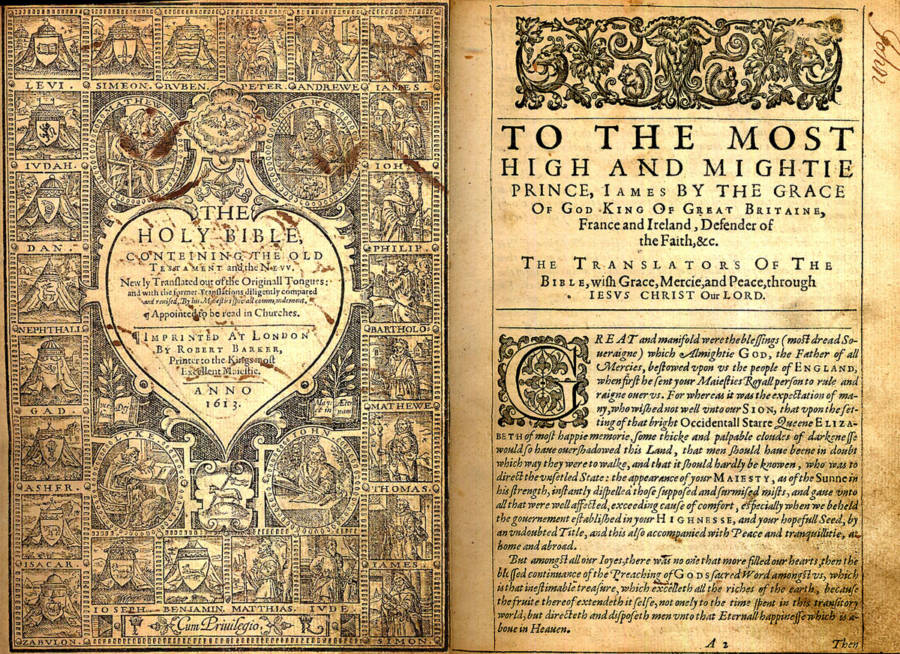
The original 1611 King James (Iames?) Bible, with "I" instead of "J". Left page, top right, renders James as "Iames".

Hebrew Roots hallucinations of the name


It's worth addressing two other claims I've heard in relation to the name of Jesus inside Hebrew Roots Christianity: Zeus and "Yahshua."

Zeus: A fringe theory in the Hebrew Roots world claims the name "Jesus" is supposedly a form of the Greek "Zeus". This is simply not supported by evidence. The Greek term for Zeus doesn't sound like the later English Jesus, and there is no historical or textual evidence supporting the name "Jesus" deriving from the Greek word for Zeus. It's just paganoia run amok, untouched by reality. 😄 

Yahshua: The name "Yahshua" and its variants are not supported by the evidence. To my knowledge, there is no written record of that name anywhere in antiquity. It's an attempt by Hebrew Roots Christians to insert the divine name of God into the Messiah's name, but without understanding of Hebrew language rules. As discussed above, Yeshua ישוע already means "YHWH is salvation." There is no need to inject the divine name into it, it's already there.

Conclusion


Did we answer the question in the post? How sure are we that Jesus' real name is Yeshua?

The evidence favors Jesus' original name to be either Yeshua or its longer form Yehoshua. Language evolution and polemics are probably responsible for "Yeshu". If I had to put a percentage on it, I'd say I'm 85% certain that Jesus' original name was Yeshua, not Yeshu.

Yeshua/Yehoshua fits best with a name given to mean "saving people from their sins." 

It seems to fit better with the transliteration into Greek. (Any New Testament Greek students reading? I'd love to hear your opinion.)

Yeshu was likely a shortened version of Yeshua/Yehoshua, driven by dialects of Hebrew/Aramaic that lost pronunciation of the ending ע ayin, shortening the diphthong "ooh-ah" to "ooh". It may have been especially driven by Christian communities containing both Aramaic and Greek speakers, where Greek didn't support the precise vocal sounds that Hebrew and Aramaic have.

Yeshu may have been driven by Jewish anti-Christian polemical works. A derogatory acronym was ascribed to ישו (YSU), which may have been a common Aramaic pronunciation of the original name by the 4th century. It gets written in the Babylonian Talmud during its finalization stage during the 400-500s AD. This in turn influences modern Judaism and Israelis today to use "Yeshu" to refer to Jesus.

It's possible we're wrong, and that Yeshu was the original. (It's even possible, as certain Church fathers asserted, that the Greek name Iesous was the original!) But this seems unlikely given the textual, linguistic, historical, and archeological evidence.

Does it matter?

With regards to faith, it doesn't really matter! I'm quite certain that God knows whom we speak of when we call his son by Jesus, Jesu, Yeshua, Yeshu, Yehoshua. (Or even the made-up, not-actually-Hebrew name "Yahshua".)

With regards to truth and accuracy, I suppose it matters to some extent. It is interesting and perhaps useful to know the real name of the most influential Jew who ever lived, whom we revere as the Messiah and Son of God. Yes, that's worth knowing, even if it doesn't ultimately matter in daily faith practice.

Dismantling myths about Jesus and his Judaism

If there ever was a series of posts every Messianic believer should read, it’s Yeshua Reconstructed.

In it, Messianic Jewish pioneer Stuart Dauermann dismantles, with articulate precision, popular myths and beliefs about Yeshua. Popular views like,

  • “Jesus was good Jewish rabbi, not a gentile god”
  • “Jesus threw away Judaism and started a new religion”
  • “Jesus never existed, he was a myth invented by politically-charged gentiles”

Dauermann acknowledges the wide, varying popular opinions about who Jesus of Nazareth is, and piques us to reexamine and reconsider these.

Why? What’s the basis for reexamining your idea of who Jesus is?

Modern scholarship and its growing consensus about who, exactly, Jesus was. Dauermann, always the eloquent writer, puts it like this:

You could say that our agenda on this matter is three-fold: reexamining  what we think of when we think “Yeshua of Nazareth,” reconsidering whether those are really valid or only established opinions, and reconstructing Yeshua in our hearts, minds, and lives so that the Yeshua “in here” corresponds more closely to the Yeshua “out there.”

We are saying that old assumptions about Yeshua/Jesus are falling like just so many pins in a 300 game. And the bowling ball that is knocking them over is the consensus of recent scholarship.

Modern scholarship’s growing consensus on Jesus undermines some of the popular-but-wrong opinions about him. Such myths include:

  • That Jesus never claimed to be the Messiah
  • That the New Testament was written hundreds of years later by people who didn’t even know the Yeshua of history.
  • That the idea of a Divine Messiah, as God in human flesh, was a marketing ploy to sell Jesus to the pagan world.
  • That the idea of the Messiah as a Suffering Servant was a Christian assault on the Jewish consensus that the passage speaks of the sufferings of Israel, not the Messiah.
  • That Jesus and the apostles jettisoned the Torah, Shabbat and Kashrut, disassembling Judaism as we know it.

Dauermann shows, via a growing consensus among Bible scholars, that these widely-believed statements are shown to be false, “despite their long gray beards.”

We now know:

  • Jesus claimed to be the Messiah, the Son of David, King of Israel;
  • The New Testament with the possible exception of two or three books, was written within the lifetime of eye witnesses of the events it describes, with some of Paul’s letters written as early as AD 49 into the 50s, within 25 years of the events described, and the first of the gospels, Mark, written shortly after the destruction of the Temple in Jerusalem, 70 CE.
  • The idea of a Divine Messiah, as God in human flesh, was a bonafide Jewish opinion of the day, supported by fully respectable midrashic uses of Scripture;
  • The idea of the suffering Messiah was old and well attested in Jewish life, and even after the time of Jesus, the rabbis of the Talmud still spoke of the Messiah in these terms, as did many rabbis later in history.
  • Jesus was a defender of Torah against what he viewed to be revisionist abuses by the Scribes and Pharisees. None of his practice or his teachings may rightly be viewed as overturning Shabbat, and Kashrut, both of which he upheld in word and practice.

Reconstructing Yeshua sums up all these points beautifully, the post itself a culmination of a several weeks of posts building the evidence:

  1. Game-Changing Ideas from a Jewish Scholar
  2. ‘Son of God’ Doesn’t Mean What You Think It Means!
  3. ‘Son of Man’ and the Deity of Yeshua
  4. Boundaries: Can They Change and Be Renegotiated?
  5. Did Jesus Come So Jews Could Eat a Cheeseburger? (How the 1st century Pharisees and Scribes were Torah innovators, how this got them into trouble with Yeshua, and how Yeshua’s objections to their innovations have become conflated with objections to the Torah itself.)
  6. Is Jesus a Goyishe Fraud? (Answering the common myth that Jesus was just a Jewish rabbi, and the New Testament was written hundreds of years later by overzealous gentile followers, who turned him into a god.)
  7. Reconstructing Yeshua 

Hats off to Rabbi Dauermann for highlighting the large quantity of convincing scholarship on the historical Jesus! It’s a step towards jettisoning the atheist-driven pseudo-scholarship on the mythical Jesus. And it’s a step towards renegotiating those old, human-erected boundaries between Judaism and Christianity. Yes!

Soaking in over the last few weeks Rabbi Dauermann’s articulation of Messianic hope in light of modern scholarship has strengthened my own faith – yes! – and I hope the same for you, fine Kineti readers.

7 things we know about Yeshua from non-Biblical sources

Intellectually dishonest atheists and anti-missionaries will claim there is no evidence outside of the New Testament for the historical Jesus.

The reality is, multiple witnesses attest to the person of Jesus in Israel in the 1st century, with followers from Israel and eventually the nations worshiping him as both Messiah and God.

The Great Cloud of Witnesses blog has assembled a nice list of early evidence of Messiah and his followers outside the New Testament, supplemented here with quotations.

  1. Yeshua was executed in Judea during the period when Tiberius was emperor (A.D. 14-37) and Pontius Pilate was governor (A.D. 26-36).  Tacitus [Annals 15.44.2-5]
    Nero fastened the guilt and inflicted the most exquisite tortures on a class hated for their abominations, called Christians by the populace. Christus, from whom the name had its origin, suffered the extreme penalty during the reign of Tiberius at the hands of one of our procurators, Pontius Pilatus, and a most mischievous superstition, thus checked for the moment, again broke out not only in Judaea, the first source of the evil, but even in Rome, where all things hideous and shameful from every part of the world find their centre and become popular. Accordingly, an arrest was first made of all who pleaded guilty; then, upon their information, an immense multitude was convicted, not so much of the crime of firing the city, as of hatred against mankind. Mockery of every sort was added to their deaths. Covered with the skins of beasts, they were torn by dogs and perished, or were nailed to crosses, or were doomed to the flames and burnt, to serve as a nightly illumination, when daylight had expired. Nero offered his gardens for the spectacle, and was exhibiting a show in the circus, while he mingled with the people in the dress of a charioteer or stood aloft on a car. Hence, even for criminals who deserved extreme and exemplary punishment, there arose a feeling of compassion; for it was not, as it seemed, for the public good, but to glut one man's cruelty, that they were being destroyed.
  2. The movement spread from Israel to the nations. Tacitus [Ibid.]
  3. His followers worshipped him and sang hymns to him “as to a god.” Pliny [Letters from Bithynia, c. A.D. 110]
    They asserted, however, that the sum and substance of their fault or error had been that they were accustomed to meet on a fixed day before dawn and sing responsively a hymn to Christ as to a god, and to bind themselves by oath, not to some crime, but not to commit fraud, theft, or adultery, not falsify their trust, nor to refuse to return a trust when called upon to do so. When this was over, it was their custom to depart and to assemble again to partake of food--but ordinary and innocent food.
  4. He was called “the Messiah.” Josephus [Antiquities 20.197-203—an undisputed passage]
    Festus was now dead, and Albinus was but upon the road; so he assembled the sanhedrin of judges, and brought before them the brother of Jesus, who was called Christ, whose name was James, and some others, [or, some of his companions]; and when he had formed an accusation against them as breakers of the law, he delivered them to be stoned.
  5. In Roman lingua franca, Yeshua’s followers were called “Christians.” Tacitus, Pliny [see above]
  6. They were numerous in Bithynia and Rome. Tacitus, Pliny [see above]
  7. His brother was James. Josephus [see above]

Problematic for the atheist and anti-missionary, these historical, often secular accounts of Jesus align with the New Testament’s record.

What we know about the deity of Messiah

The deity of Yeshua – the idea that Jesus is God – is a stumbling block for some, particularly religious Jews who believe the messiah will be human only.

Here’s an example from the other week, where well-known Jewish blogger DovBear objected to the idea that Yeshua has turned gentiles to the God of Israel. Why? Because he believes gentiles don’t worship the God of Israel, they just worship Jesus:

image

(I didn’t continue the conversation; Twitter is not a great place for theological digging.)

Many religious Jews see Christians this way: not worshiping the God of Israel, Judaism’s God; instead they worship Jesus!

If the divinity of Messiah is such a stumbling block to Jews, is there budging room in Messianic faith to allow for a non-divine Jesus? Are we misinterpreting the New Testament, retroactively reading into it the deity of Messiah?

The Messiah's relationship to God is, I think, largely mystery, with the gospels giving us only hints of understanding.

But there are some things we can say for sure:

  • Messiah is called 'God' in the gospels. The apostle Thomas, upon seeing Messiah raised from the dead, says to Yeshua, “My Lord, and my God!” If Messiah was not divine, but only a human prophet, this was the time for Messiah to rebuke Thomas for erroneously calling him “God”, yet Messiah instead said, “Blessed are those who believe without seeing.”
  • Messiah is worshiped in the gospels by his disciples. If Yeshua was not God, he would have objected to being worshiped.
  • Messiah is worshiped in heaven by all creation, according to Revelation. Again, Messiah/God doesn’t object to being worshiped. Contrast this with Revelation 22, where John bows and worships an angel, who rebukes him saying, “Do not! I’m only a servant like you. Worship God alone!”
  • John’s mystical introduction in his gospel calls Messiah “God”: “In the beginning was the Word, and the Word was with God, and the Word was God. He [Messiah] was with God in the beginning, and through Him  all things were made.”
  • Paul’s epistles are more silent on the matter, much to the chagrin of Jewish anti-missionaries who often claim Christianity was invented by Paul. But we do have evidence of the deity of Yeshua in Paul’s letters: he records that every knee will bow to honor Messiah, and every tongue confess that Messiah is Lord, and again that “In Messiah is the fullness of the Godhead in human form.
  • In Revelation, the Messianic throne of the Lamb and the throne of God are one and the same. Worship is directed to “Him”, singular.

Bottom line: the New Testament supports the idea of Messiah's deity; including worship directed to Messiah.

Either that's idolatry, or Messiah is God. 

We cannot be faulted for worshiping Messiah; it’s intrinsic to the New Testament. We cannot be faulted for putting an unnecessary stumbling block in front of Jewish people; it’s actually a necessary part of our faith!

In fact, the issues of the deity of Messiah is a crux of Messianic faith: if Yeshua is not God, and we worship him, then it’s idolatry. But if Yeshua is God, and we refuse to worship him, then it’s blasphemy. Getting this understanding right is crucial, then: veering off to the left being a form of blasphemy, off to the right being a form of idolatry. The gospels show a proper path, one that includes worship of Messiah.

Simply put, according to the New Testament, Messiah is God.

Is Messiah part of God? All of God? Fully God in human form? One of 3 persons of God? One God but many forms? I think that's where it gets fuzzy/mystical, and the New Testament is largely silent; the term “trinity” doesn’t appear in the New Testament. I don't believe we should take hard positions on issues where the Scriptures leave wiggle room.

What we can say for certain is, Messiah is Lord, God, and worthy to receive worship.

What do religious Jews think of the Lord’s Prayer?

Over at Jewish Life & Learning, a new Jewish Q&A site, the question came up, “Is a Jew permitted to say the Lord’s Prayer?

"Our Father who art in heaven, hallowed be thy name. Thy kingdom come. Thy will be done on earth as it is in heaven. Give us this day our daily bread, and forgive us our trespasses, as we forgive those who trespass against us, and lead us not into temptation, but deliver us from evil."

This is the Catholic English version of the "Lord's Prayer." Its direct antecedent can be found in the New Testament and according to their tradition, was basically said by Jesus as a prayer to God.

Would a Jew be permitted to say this as a prayer?

The answers were fascinating.

One commented that the prayer is familiar:

I don't know Greek so I don't know what the original says or what "Thy kingdom come" means but it looks to my untrained eye like some of the things we do pray for every morning before p'suke d'zimra.

The same commenter did think the line “forgive us as we forgive others” was fishy, saying it was foreign to ask God to emulate us.

I responded that Yeshua may not have been suggesting God emulate humanity, but rather, God reward human forgiveness with divine forgiveness. I cited Gamaliel II:

Whoever has mercy on other people, Heaven will have mercy upon him; whoever does not have mercy on other people, Heaven will not have mercy upon him.

Another commenter, giving the accepted answer, found nothing wrong in Messiah’s Prayer itself, instead suggesting that Jews should not pray the prayer simply because it’s from another religion:

We find that there are in fact practices in prayer (kneeling, raising our hands) that are attested in Tanach but were later abandoned as Jewish practices, precisely because non-Jewish religions made these parts of their own rituals. How much more so, then, that we shouldn't adopt prayers that they originated!

Another commenter, also unable to find fault in the actual prayer, appealed to the sufficiency of the Torah:

Why does anyone need such a prayer, anyway? The Torah has everything that's needed. Saying this 'prayer' would seem to be conferring tacitly some legitimacy on the entire concept of a so-called 'new testament'.

Another commenter rejected it because it gave legitimacy to Christianity, a religion that actively converts Jews:

I am certainly not paskening here, but it is essentially a sectarian prayer, and gives credence to that religion. What is the motivation in saying it? Breaking down boundaries in this area is surely a slippery slope, when dealing with a religion that actively wishes to convert Jews. So it is, at the least, a very bad idea.

Another commenter also used the “Christianity is idolatry!” argument:

Even if you hold that Christians worship HaShem in some ludicrous way and aren't worshiping an idol, it still is not the JEWISH way of worshiping. As such, Jews may not participate, join, copy, or in any way emulate this practice.

It's at best Hukath HaGoyim [decree of gentiles], at worst 'Avodah Zarah [idolatry].

What I found particularly interesting here is, no one really found fault with Messiah’s prayer by itself.

One commenter at first protested,

The ‘arting in heaven’ for one thing seems a step away from anthropomorphism to me.

However, another commenter quickly replied that “Our Father who art in Heaven” is actually a Hebrew phrase, Avinu Shebashamayim, common in many of Judaism’s own prayers.

Another commenter, perhaps grasping at straws to find fault with Messiah’s prayer, could only find problems if the prayer was applied in all circumstances:

One could pick apart various parts of this prayer. For example, "forgive us our trespasses, as we forgive those who trespass against us". This seems akin to Jesus saying "judge not, lest ye be judged." But there are places this applies and where it does not. The gemara in Bava Kamma 50a states “Kol HaOmer HKB”H Vatran Hu, Yevatru Chaiyav”, “Anyone who says Hashem is a pushover, Hashem will push over his life”.

Ultimately, the answers given by these knowledgeable religious Jews were enlightening: Jews don’t have a problem with Messiah’s Prayer so much as they have a problem with Christianity.

And try as some did, ultimately the arguments against Messiah’s Prayer were really arguments against Christianity.

This reminds me of how, even among militant atheists, the best arguments against Yeshua are not really against Yeshua himself, but against Christianity:

Note that the Salvation Army gets defended even by atheists. Why? Because they do what Yeshua taught.

This says something, something great, about Messiah’s life, I think. Even those who oppose him can find little of his life or ethics to oppose.

A Warning to Those Who Follow Yeshua

If I could force every Messianic to read just a single blog post, it would be this one:

Should scholarship undermine experience?

What do I mean by this?  I am referring to our brothers and sisters who study themselves out of belief in Yeshua as the Messiah, or study so that he becomes just another possible “candidate” for Messiah.  This, I believe, is our most serious enemy in the Torah “movement.”  I have seen countless people, all who truly love Hashem and pursue truth, yet the stone of stumbling, Yeshua, becomes the obstacle offense for a “true” Judaic theology. 

Yeshua and his identity as G-d’s Son are huge impediment to people who want to totally identify and become a part of today’s Judaism who has rejected him across the board.  I can also attest to this because it happened to me, and only through a true miracle of G-d did I overcome this difficulty.  During this time of struggle, I became a lame duck believer; a believer in name only but not in faith.  I became an ineffectual and paralyzed part of the body of Messiah and wanted to leave this “messy- antic” movement so that I could blend in with Judaism who seems to have all the answers. It would have been easy; I am a Jew and I have the blood of Aaron coursing in my veins.  It should have been easy; but it wasn’t at all, it was crippling.

I have seen this same transition among other Messianics, both Jew and gentile.

It goes like this:

  • Torah is great!
  • Torah is the truth!
  • Judaism is the One True Religion!
  • Judaism doesn’t like Christianity.
  • Christianity is not from God!
  • Christianity has false beliefs!
  • The New Testament is heavily redacted!
  • The New Testament isn’t reliable.
  • Yeshua is a messiah.
  • Yeshua might not be divine.
  • Yeshua might not be the messiah.
  • Jesus is a false messiah.
  • Jesus is an idol, and Christianity is an idolatrous religion, the New Testament is a book of lies.

Vine of David’s defense of Yeshua

Much effort has been made in some church circles to distance Christians from the Jewish foundations of their faith—yet even more has been done in regards to defaming Yeshua as the Messiah within Judaism. Every Messianic prophecy concerning the Messiah has been reinterpreted or challenged; the extremes of anti-Semitism within the church have been consistently presented; the anti-Jewish and anti-Torah doctrines that developed Christian understandings have been used against us (and Yeshua); and a general suspicion has been planted in the Jewish mind regarding the motives of believers.

To assist in defending Yeshua to Jewish people and authenticating our faith from a Jewish view of Scripture and through Jewish sources, we spend great effort to define or defend core beliefs and the tenets of our faith.

-Boaz Michael on the purpose of Vine of David organization, from the November 2010 Messiah Magazine

They called him “Lord”

There was once a Jewish follower of Yeshua. He loved Torah. His love for Torah naturally grew into a love for the religion of Torah: Judaism.

His life was good.

But over time, he became distressed at seeing just how ostracized he was as a follower of Yeshua. “My God!”, he said, “they call me an idolator!”

Even voicing his convictions was grounds for getting the boot from the community.

This created a conflict in himself: without giving up – or keeping quiet about – his convictions, he would not be accepted in the only real Torah community in the world: the Jewish observant world.

He naturally desired to be part of that community. Yeshua-centered communities didn’t seem focused on Torah; their devotion to Yeshua inevitably led to assimilation into the church, it seemed.

It was during these turbulent times that the young man would repeatedly hear of the Christian problem. The church invented their own holy days, obsoleted the Torah, reimagined Yeshua as a commandment-destroying Roman, rendered meaningless Jewish identity, oh, and let’s not forget of the millions of Jews killed by Christians in the name of Christ. Maybe it’s like the anti-missionaries say, he thought, maybe the church is Edom, the eternal enemy of the Jewish people.

Whatever degree of truth in that, one thing was certain: The church was wrong, and there was no getting around it.

The turbulence in his mind worsened.

Despair set in. It persisted until something dawned on him. Something big.

“They say I’m an idolator”, he mused, “because I worship Yeshua.”

He confirmed this to himself.

“Isn’t it possible, then, that I shouldn’t be worshipping Yeshua?”

“After all”, he justified, “the church has been wrong about so much! Isn’t it plausible the church was wrong about Yeshua being God?”

Oh, but this couldn’t be. Yeshua was one with the Father…right? Yeshua was an emanation of God, the glory of HaShem.

“They called him, “Lord”! My God, they called him Lord.”

Was there any wiggle room here, any at all? He hoped there was; if he could only make this work, he would no longer despair, he would no longer be ostracized.

Looking for confirmation, he found no shortage of Jewish sources telling him it was so: the worship of anyone besides the creator was idolatry. He knew this to be true. Jesus should not be worshiped, because he was a man, and, as the Torah states, “God is not a man…”

“Christians are misinterpreting Yeshua’s words!”, he thought to himself. And it wouldn’t have been the first time, he noted.

This all started to make more sense to him: Jesus isn’t the creator, therefore Jesus should not be worshipped. Yeshua may be divine, but not the Creator himself. Therefore, Yeshua should not be worshipped.

This had to be true. He wanted to believe it. His acceptance in the only true Torah community depended on it.

But something nagged at him: what about all those times in the New Testament when Yeshua is worshipped? What about those claims Yeshua made about being the only way to God? What about the part where Yeshua says, “If you reject me, you reject my Father in heaven?” What about the clear, brazen claims Yeshua made, claiming to sit at the right hand of God, claiming to be the glorified Son of God? What about his claims that “anyone who believes my words will have eternal life”? What about that?

But the young man was too far down the road to turn back now.

Searching for validation of the things he wanted to believe, he surrounded himself with confirming voices. These voices whispered new revelations: now, he is told, Christians are actually editing the Tenakh to fit their prophecies about Jesus. Now, he is told, Christians redacted the New Testament. The New Testament isn’t reliable, because Christians changed it; Yeshua never really said those things.

And that settled it. If the New Testament was unreliable, his problem was solved.

At last, how happy he was: accepted by the only true Torah community, and…uhhh…a kind-of-follower-of-Yeshua-but-not-really. He realized it: though he still loved Yeshua, he had come to deny him.

Yes, he had to reject everything about Yeshua: every book written of his works. Every detail of his miracles. The accounts of the witnesses who gave their lives in upholding the record. That miraculous, sacrificial work, taking the sin of humanity as whip lashes on his back. That great work after which the Temple –and the world – was never the same. That act that sparked billions from the nations following the God of Israel.

Thrown out.

All of it.

To reach the goal, it had to be thrown out.

“But”, he justified, “at least now I am accepted.”

Yeshua as worshiped Lamb

[The book of] Revelation is a bad place for those who deny the deity of Jesus.

Not only do you have him identified as the First and the Last, Beginning and End, Alpha and Omega, but he is explicitly worshiped along with God in Revelation, the 5th chapter.

The very same worship that goes to God the Father goes to Jesus; either he is God, or that’s idolatry. […] And when you get to the end of Revelation, 22:3, the throne of God and of the Lamb will be in the city and his servants will serve Him. God and the Lamb are one entity.

-Dr. Michael Brown, in the deity of Yeshua podcast.

Yeshua: Judaism’s Heretic?

Folks in the Messianic movement like to fancy ourselves as a Judaism, distinguishing ourselves from Christianity.

I sometimes question that approach, and it was questioned again today:

Daniel at Christian4Moses asked his readers,

What branch of Judaism would the Messiah belong to were he here today?

Anachronistic and all, sure, but it got me thinking: Yeshua himself was a kind of heretic within Judaism. Messiah operated within Judaism, but was considered a heretic by the major sects of his time.

Yet more interesting still is the kind of dual thrusts of Yeshua’s actions: he was a force against the religious authorities of his time, and yet, a strengthener of the very commandments those religious authorities based themselves on.

Consider this:

Is there any form of Judaism today that rejects the heavy yoke of the ultra religious leadership, chiding them for missing the weightier matters of the commandments, while at the same time, lifting up the commandments, strengthening, applying them inwardly?

It’s a peculiar thing: Both chiding the religious establishment for their heavy yoke and their missing-the-point-of-it-all, but strengthening and amplifying the commandments themselves. Yeshua did that.

On one hand, that’s Reform Judaism — rebelling against the harsh, stringent religious establishment. On the other hand, that’s ultra-religious: strengthening and amplifying the commandments.

I don’t think there is any kind of Judaism today that practices this staple of Yeshua.

I don’t think Yeshua would be a member of any branches of Judaism were he here today. The religious establishment would throw him out, and if he shook things up enough, they’d conspire against him. Church or synagogue, same difference.

What do you think? Would Yeshua practice Judaism? Christianity? Obviously some paradoxes here, but it’s an interesting question nonetheless.

Yeshua is the Son of God, part 2

In the past God spoke to our forefathers through the prophets at many times and in various ways, but in these last days he has spoken to us by his Son, whom he appointed heir of all things, and through whom he made the universe.

The Son is the radiance of God's glory and the exact representation of his being, sustaining all things by his powerful word. After he had provided purification for sins, he sat down at the right hand of the Majesty in heaven.

-Hebrews 1

Here’s what jumps out at me from this text:

  • To Yeshua belongs everything. Echoes the gospels when Yeshua says, “All power in heaven & earth have been given unto me.”
  • The universe was made through Yeshua.
  • Yeshua is the exact representation of God.
  • Yeshua was not a created being, but has always existed.
  • Yeshua is God’s glory.
  • Yeshua sustains all. I take this to mean life, seasons, humanity, even natural laws.
  • Yeshua provides purification for sins.
  • Yeshua is at the right hand of God.
  • Yeshua exists in the heavenlies.
  • Yeshua is divine.
  • Yeshua is God’s own son.

Did Messiah Practice Judaism?

301026-Western-Wall-1

Thomas Jefferson, a founding father of the United States and a rather un-Christian Deist, once called Jesus “the benevolent and sublime reformer of Judaism.” Reading that quote as a young teen, I thought how misled Jefferson must have been in his Deism to come to such an erroneous conclusion. But now…now I’m not so sure.

It’s easy for most Christians to concede that, yes, Jesus didn’t come to start a new religion. It makes us feel good in our faith to say, “Yeppers! Jesus didn’t start a new religion! It’s the old faith of Abraham still chuggin’!” It gives this Messiah-based faith a kind of ancient tie and legitimacy beyond 2 millennia. When it comes to religion, older is better, or so the thinking goes.

On the other hand, it’s difficult for Christians, and even some independent Messianics, to admit Messiah Yeshua practiced Judaism. If Jesus practiced Judaism, they say, then what the hell are we doing with this Christianity thing? Oh noes! Now my faith and beliefs are delegitimized, and the thing I love so dearly, the church and all its paraphernalia, are now abased.

Or the independent Messianic, having had his full of organized religion and its sick abuses, who now tirelessly avoids it, may think that Yeshua could never have practiced such an organized religion.

Defining Judaism

In Messiah’s day, faith in the God of Israel had become known as Judaism. Judaism was the religion of the nation of Judah (or in Roman terms, Judea). It’s capital was in Jerusalem, and it centered around the Temple therein.

The Judaisms of the first century were different in some ways than the Judaisms of today: with the Temple still intact, the whole Torah was more or less able to be carried out. Sacrifices and covering of sin was provided for through the Temple. Each year, Jews from all over the world would make mass exodus to the Temple for the Feasts. Contrast this with Judaism of today, where replacements must be had for the sacrifices, for the burnt offerings, for the sin covering. Judaism, battle-hardened thanks to Christianity’s persecution and 2000 years of dispersion, went into survivalist mode long ago – creating its own calendar that doesn’t require one to be in the land, creating prayers meant to weed out the missionizers and imposters, accumulating tradition designed to inundate the follower with Judaism, Judaism, and more Judaism! So much that its observant adherents can’t get up in the morning, put on his shoes, eat a meal, or take 5 head-uncovered-steps, without first performing a mandate of Judaism. This is survivalist Judaism, and this is what Judaism is today.

On the other hand, the Judaisms of Messiah’s time weren’t all that different than Judaisms of today: there existed numerous sects and varying beliefs, both lenient and strict.  Today’s Orthodox, Conservative and Reform sects are countered by yesteryear’s Pharisaical, Sadducean, and Essene sects of Messiah’s time. Both modern and 1st century Judaisms look forward to the Messiah who would restore Israel, gathering even those Israelites lost in the Assyrian captivity back to Israel. Both fully expected Messiah to reign as King and institute malchut shamayim – the Kingdom of Heaven.

Yeshua was an adherent of this 1st century Judaism: he taught his talmidim within the Temple grounds, he kept the Torah – and not just the moral laws! Messiah expounded upon the teachings in the Torah; strengthened the laws of Judaism: now, looking at a woman in lust was on par with adultery. Now, being angry with your brother was akin to murder.

As was often a custom for Judaism’s sages, this rabbi and teacher of Judaism spoke through parables to his followers. When a young man asked Yeshua how to gain eternal life, Yeshua replied with an answer that Judaism would be proud of: “Obey the commandments!”

Yeshua’s own teachings seem to be influenced by Judaism’s great sages. Consider, for example, Yeshua’s “golden rule” statement with that of the greatest rabbi of the 2nd Temple period, Hillel, whose own teachings inspired the Pharisee sect, and who died when Yeshua was a young boy:

Yeshua: [When asked what is the greatest commandment in the Torah] Yeshua replied: "'Love the Lord your God with all your heart and with all your soul and with all your mind.' This is the first and greatest commandment. And the second is like it: 'Love your neighbor as yourself.' All the Law and the Prophets hang on these two commandments."

Hillel: [When challenged by a gentile who asked that the Torah be explained to him while he stood on one foot] Hillel said: "What is hateful to you, do not do to your fellow: this is the whole Torah; the rest is the explanation; go and learn."

What Yeshua said was a core principle of faith is strikingly similar to that of Judaism’s.

The coming Kingdom of Heaven, the Kingdom of God, was an idea among Judaism’s sages that dominated Yeshua’s own teachings and parables; one can hardly read the New Testament without hearing Yeshua’s words, “The Kingdom of Heaven is like…”

Yeshua was so Judaism-focused, he refused to associate or teach gentiles for virtually all his ministry. Even to the partial-Israelite Samaritans he refused to go, telling his followers to remain teaching within Israel to the lost sheep of Israel.

It must have been quite the surprise to his shlichim to hear Yeshua say, before he ascended into heaven: “Go into all the nations and teach them everything I have commanded you.”

Yet even after this, this faith remained a Judaism: the New Testament records his disciples kept the Feasts in Jerusalem even after Messiah was gone. These same disciples had trouble deciding what to do with the massive influx of gentiles that came into the faith – some had gone as far to suggest getting them circumcised and ritually converting to Judaism.

There can hardly be any greater evidence of Yeshua’s Judaism than this: Yeshua taught that the anyone who practices Torah will be called great in the Kingdom of Heaven, and anyone who teaches others to break commandments or disregard even the least commandment will be considered least in the coming Kingdom of Heaven.

Do not think that I have come to abolish the Law or the Prophets; I have not come to abolish them but to fulfill them. I tell you the truth, until heaven and earth disappear, not the smallest letter, not the least stroke of a pen, will by any means disappear from the Torah until everything is accomplished. Anyone who breaks one of the least of these commandments and teaches others to do the same will be called least in the kingdom of heaven, but whoever practices and teaches these commands will be called great in the kingdom of heaven. For I tell you that unless your righteousness surpasses that of the Pharisees and the teachers of the law, you will certainly not enter the kingdom of heaven.


But didn’t Yeshua have disputes with Judaism?

Many people see Yeshua’s disputes with the Pharisees and Sadducees as him rejecting Judaism and building this new religion around a new entity, the Church. Judaism & Israel is now Christianity & Church. This is a reasonable conclusion at first, because many of the disputes were over matters of the Torah, around which Judaism is built.

However, if one looks at the disputes with more than a cursory skim, one realizes that Yeshua never dropped God’s Law; never did Yeshua say, “Hey guys. Never mind that old junk – I’m here now, and you can forget all that law keeping stuff.” Rather, he always corrected wrongful application of the Torah:

  • In the dispute regarding the tax collector, when Pharisees objected to his associating with tax collectors and sinners, Yeshua said he came for the sinners, not for the righteous.
  • In the dispute regarding the paralytic, when the religious leaders objected to his forgiving a man’s sin on the grounds only God can forgive sin, Yeshua said the Messiah has authority to forgive sin.
  • In the dispute regarding picking grain to eat on the Sabbath, Yeshua stated that shabbat was made for man, and that David found no harm to eat the showbread in the Tabernacle when he and his companions were in need – essentially arguing that preservation of life is of more weight than shabbat rest -- and finally, that the Messiah is the Master of shabbat.
  • In another dispute with the Pharisees, Yeshua went on the offensive and said they were doing much to the lesser matters of Torah, such as tithing, but little in the way of the weightier matters of the Torah: justice, mercy, and faithfulness. This caused Yeshua to say, “You should have practiced the latter, without neglecting the former.”

A common theme throughout his disputes were that the religious teachers were misapplying a commandment or were otherwise misdirected or unbalanced in their observance of Torah. Never once did Yeshua break a commandment or teach others to do so.

Conclusions

You might be thinking, “So what? What if Yeshua did practice Judaism? Why does it even matter now?”

And that, fine blog readers, will be a question to ponder until the next post: what if Yeshua practiced Judaism? Does it matter to you, fine blog readers? Would it matter at all to us if Yeshua was indeed a Jewish practitioner and teacher of Judaism?

Yeshua HaMoshiach

Some tunes for Messiah as we enter His shabbat,

Yeshua HaMoshiach
Is the name above every name
Alpha, Omega
Beginning and the end

Yeshua HaMoshiach
Offspring of David
Holy One of Israel
Son of Abraham

I love how this song just lays on Him these pronouncements: anointed one, first, last, beginning, end, David’s offspring, Holy One, Abraham’s seed. Amen amen.

Shabbat shalom, fine blog readers.

Weekend Thought

Now may the God of Peace
Who brought up from the dead
Our Y'shua
That Great Shepherd of the Sheep
Make you complete
In all you do
As you do His will


Marty Goetz - God of Peace.mp3


Shabbat shalom, fine blog readers.

More Orthodox Persecution of Messianics In Israel


Last year, I showed a video documenting how Ultra-Orthodox Jews in Israel were persecuting Messianic Jews by personally harassing and stalking Messianic Jews.

This year, a state-wide teen Bible knowledge competition, initially promoted by rabbis, was soon boycotted by many rabbis as they found that one of the winners was a Messianic Jew.

Also earlier this year, the Israeli Ministry of Interior was revoking the citizenship of Messianic Jews in Israel, forcing them to leave the country.

In March of 2008, a young Messianic Jewish teen, Amiel Ortiz, son of a Messianic pastor, was critically injured as he opened up an exploding package delivered to their home. The blast of the bomb shattered the windows of their home and the nearby automobiles, sending nails and over 100 pieces of shrapnel to permeate the boy's body. Amazingly, if not miraculously, the boy remains alive. The security cameras which Amiel's father installed on their home after an anonymous firebombing last year caught a well-known Jewish extremist delivering the explosive package to their home.


15 year old Amiel Ortiz, a Messianic Jew who was critically injured in a bomb delivered by Jewish extremists


Today, CNN is reporting that Jewish students from the city of Or Yehuda, near Tel Aviv, rounded up New Testaments in the city and burned them en masse.

The man responsible for organizing the students was Deputy Mayor of Or-Yehuda, Uzi Aharon. Uzi Aharon claims he did not intend to burn the New Testaments, he only meant to round them up to prevent missionizing in his city.

Uzi Aharon is a member of the Shas political party in Israel, an Ultra-Orthodox party that currently holds several seats in the Israeli Knesset.

Fortunately, many Conservative and Reform rabbis are condemning this New Testament burning. Derek Leman cites an excellent piece from a Conservative Jewish leader condemning the burnings.


Understanding the Persecution


I do not write this to villify Orthodox Jews. So many Orthodox Jews are zealous for Torah and for God; I understand where Orthodox Jews are coming from. To them, a Messianic Jew is a Christian, a member of a religion foreign to Torah; an idolatrous religion. Becoming a Christian means abandoning Jewish identity, Jewish culture, Jewish religion -- even Hitler could not make Jews lose their Jewish identity; how much worse, then, is converting to Christianity!

(To this day, in some Jewish circles, if an Orthodox Jew comes to believe in Y'shua as Messiah, family members will recite traditional prayers reserved for his or her death; to these Jews, faith in Y'shua is the death of a Jew.)

The reality of the matter, however, is not as the Orthodox Jews perceive it. Nor as the Christians perceive it, for that matter. The reality is that Messianic Judaism is not a Jewish flavor of Christianity.

While alone I cannot speak for all, I can say that many see Christianity as a Roman-led departure from the Hebrew faith. While many beautiful things have come from the Christian religion, and while God has used it to bring 1/3rd of the whole gentile world to the God of Israel through the Messiah of Israel, we must still contrast Christianity with the Hebrew faith.

The early believers in Y'shua as the Moshaich of Yisrael were initially known as Nazarenes, members of the Way community of Jews; they were not part of a new religion. Indeed, they kept the Torah as any God-fearing person ought to, received instruction at Beit HaMikdash (Temple), and were standing members in the Jewish community.

What happened in 325 CE was the official creation of a new state religion, and what came out of that has become what we know as Christianity today. This Roman religion in numerous ways is a departure from the Hebrew faith. It is indeed idolatrous in its praying to saints, in praying to Messiah's mother, in its claims of an infallible human being elected by the College of Cardinals, in its replacing Israel with an unclean people, in its replacement of God's Feasts with holidays of pagan origin, and most of all, its rejection of Torah.

When Constantine severed the Hebrew origins of this faith in Messiah, a new religion was officially created. It is this religion that Orthodox Jews fear their relatives and friends becoming members of. Many Orthodox Jews are zealous for God and do not wish to see Jewish folks severing their Jewish culture, identity, religion.

Ditto.

It is with earnest conviction I say that Messianic faith does not wish a loss of Jewish culture, a loss Jewish identity, especially not a loss of Jewish religion. There is no need to be baptized into Christianity. (Indeed, if one is already following Torah, a regular mikvah for outward cleansing is already prescribed!) There is no need to go to a Christian Church. There is no need to convert. Messianic faith requires one thing alone: faith in Messiah. Trust that the Jew from Natzeret, Y'shua ben Yosef, is the Moshiach foretold by the prophets in the Tenakh. As Rabbi Hallel once said, "Everything else is details."

I do not excuse this persecution by the Orthodox. One must not confuse understanding for agreement. Unfortunately, I suspect that the Orthodox will not see Messiah until he reveals himself in the flesh, again. Perhaps this time around, it will be the gentiles, with their idolatrous religion, who stumble on the stone laid in Tziyon. Or perhaps God's plan is that Jews and gentiles alike will finally be united in their faith in the God of Israel through Messiah.

At this time, however, it looks like many Christians will refuse to give up ties to the idolatry in their religion and that will be their stumbling block, just as it was for many of the devout Jews in Messiah's day.

We will see. Whatever the plan, I hope we see it come to fruition in our day, and soon; things sure are heating up down here on planet earth. Father help us.

Conversations of Zeal: Part 2

In the first part of our conversation, Aaron makes the assertion that Yeshua was a rabbi according to the house of Hillel, many of whom were called Pharisees. We all know from the gospels Yeshua was a rabbi; Aaron theorizes further Yeshua was a Pharisaical rabbi of the House of Hillel.

We talked about what a Pharisee really was, as opposed to the modern definition of a Pharisee, one often held by many Christians: a legalistic, outward-only Judaism teacher.

We discussed some Scriptures and some bits from the Talmud that suggest Yeshua was a Pharisee.

We theorized how it could be that Messiah, let us suppose him for a moment to be a Pharisee, argued with Pharisees, and why rebuking certain Pharisees did not necessarily mean he was not a Pharisaical rabbi himself.

In the next part of the conversation, we'll try to answer some of the tough questions: was Messiah really influenced by Hillel? Why is it that their teachings align so much, given Hillel lived before Messiah (dying ~10 years after Messiah's birth), is it possible Messiah was influenced by the teachings of this righteous rabbi? We will also discuss some of the questions you fine blog readers have raised: we've proved there were some righteous Pharisees, but where is the proof that Messiah himself was one? We'll go over the evidence.

And what if Yeshua was a Pharisee, why didn't Paul teach others to become Pharisees? Why didn't the Pharisees chide Messiah for not following Pharisee rules? (Or did they?) We'll answer this as well.

Aaron:
You could definitely say that Hillel instead aligned with Yeshua, since Yeshua is the Living Torah, and Hillel's teaching often aligned righteously with Torah. But, Yeshua definitely seemed to grow up in a Hillel household, which would be common for one who was raised in the Galili (Gallilee). No wonder he reiterated so many of Hillel's teachings.

It's also interesting to note that modern Orthodox Judaism bases its halacha on that of Rabbi Hillel's.

Yeshua's teaching of loving your neighbor/fellow (Israelite) as yourself was also stressed by Hillel. It's no wonder when a Hillel Pharisee came to Yeshua and asked him what the greatest mitzvah is. Yeshua responds, and in the Mark account, the Pharisee actually finishes off Yeshua's response. Yeshua then replies to him, "you are not far from the Kingdom of Heaven."
Why does this so greatly contrast other statements Yeshua made to other Pharisees? Because many in the Shammai sect were unrighteously strict with unlearned Jews and converts, showing their pride in their knowledge, and doing things for show rather than in sincerity.

A number of Yeshua's comments also indicate that he interacted with the discussion between the schools of Hillel and Shammai. For example, the statement about tithing mint and dill (Mt. 23:23) reflects one of the things included for tithing by Shammai, but not by Hillel (here, as also with divorce, Yeshua sided with Shammai; Maaserot 1.1 cf. 4.6; Eduyyot 5.3; Demai 1.3). Yeshua's reference to enlarging the tzitzit (tassle) and tefillin (phylacteries) for the sight of men (Matt. 23:5) was a reference to the House of Shammai who wanted to make their tzitziyot and tefillin larger than those of the followers of Hillel (Menahot 4).

Judah:
Hillel's teachings may have influenced Yeshua, then? Interesting. How would you answer a Christian who asserts all Yeshua's teachings are straight from God and not influenced by men?

Can you sum up the arguments for Yeshua being a Pharisaic rabbi? A Christian commenter tells me the only thing we've discussed so far is how certain Pharisees were righteous. Can you restate the evidence that makes you believe Yeshua himself was a Hillel Pharisee?

(You must try to put yourself in the Christian mindset; while most of my readers are privy on the Jewishness of Messiah, still many Christians picture him not as the Jewish Rabbi Yeshua ben Yosef, but as a peace-loving Gandhi-like figure named Jesus Christ who started a new religion. These same folks look at the Pharisees as the "bad guys" in the gospel. To these people, saying Jesus was a Pharisee is bound to make heads explode!)

Now I have another question. You mentioned how the Shammai were more strict than the Hillel sect of the Pharisees. It is the Hillel sect that "won", if you will; as you mention, Orthodox Judaism today is based on Hillel halacha. Here's my question: aren't the Orthodox (Hillel's descendants, if you will) unnecessarily strict today? It is difficult to imagine a religion more strict than Ultra Orthodox Judaism! Yet you say it is Shammai that was stricter yet? Has Hillel grown more stringent since Yeshua's day? They seem too strict today!

For example, a Jewish blogger acquaintance, who is perhaps not very religious, but believes in God, once told me she could never keep most of the Torah because she didn't have room in her apartment for 2 kitchens, 2 sets of dinnerware, etc. referring to the Orthodox practice of separating dairy and meat.

Isn't that an unnecessarily strict practice of Orthodox Judaism, and by extension, Hillel's halacha? Are some of the rabbinic rulings -- even from Hillel's followers -- a burden or even unrighteously strict, as were some of Shammai's halacha?

Aaron:
Yeshua upheld many of Hillel's teachings, because they were righteous. Yeshua had a problem with certain customs which somehow annulled the commandments, and with people equating them as equal status to Torah. Notice in the Mark account, that some of Yeshua's talmidim/students didn't wash their hands according to the custom. That means some did. The custom was not evil, but the certain Pharisees who upheld it as equal to a mitzvah/command of Torah were wrong.

So where is the evidence of Yeshua being a Pharisee? In Yochanan 1:26,27 Yochanan indicates that "among you (the Pharisees)... is the one coming after me (Yeshua)". As I stated, Yeshua wasn't physically there that day which is made clear in the next few verses. Instead, Yeshua was among the Pharisees - he was a Pharisee.
Also, Nakdimon, who is recorded as a righteous Rabbi and member of the Sanhedrin in the Talmud, came to Yeshua and told him "we know you are a Rabbi from HaShem..." in Yochanan/John 3.

Do you ever wonder why Yeshua never interacted with the Sadducees much, instead he mostly dealt with the Pharisees, because this was his sect. And in his interaction with Pharisees, they discussed mostly Talmudic issues like issues of cutsom, tradition, halachot, etc, not clear cut unarguable issues of Torah. The things they argued about would be comparable to two Christian pastors arguing about the right way to baptize someone, or something to that effect.

It was to the Pharisees that Yeshua said they do not need a physician, because they are well (because they kept Torah; Matt. 9, Mark 2). Yeshua said he was there for the lost sheep of the House of Israel, both the dispersed Ephraimites who became goyim and the unlearned, non-Torah-observant, and/or Hellenistic Jew. Yeshua shunned mostly the Shammai Pharisees for being so strict and hard on new converts and the unlearned Jew - for loading upon them heavy loads they could not lift. Yet Yeshua himself performed Rabbinic customs, but it was because he was learned and capable...

-Yochanan/John 1:26,27 (as explained above) indicates Yeshua was a Pharisee.

-Yochanan/John 3:1-2 (as explained above) shows that a high-standing Pharisee believed in Yeshua, and said "we", i.e. at least some of the Pharisees, knew Yeshua was a "Rabbi from HaShem". (Also, Yochanan/John 19:38-40 tells of Nakdimon and Yosef burying their Moshiach/Messiah according to the Rabbinic custom)

-Luke 2:39-52 indicates Yeshua being brought up in the faith and traditions of his ancestors.

-Mark 6:41; 8:6 indicates Yeshua performing the Rabbinic custom of saying a bracha (blessing) over food.

-Mark 14:22-23,26 indicated Yeshua and his talmidim/students performing the custom of singing the Hallel after the Passover seder.

-In the Encyclopedia Judaica (vol.10, p.14) it says: "the gospels provide sufficient evidence to the effect that Jesus did not oppose any prescription of the Written or Oral Mosaic Law.

Many of Yeshua's teachings can be found in the Talmud as well. For example:
"He who is merciful toward others will receive mercy from Heaven". This is found in the Talmud (Shabbat 151b) and in the Brit Chadasha (Matt. 5:7).
"Do they say, 'take the splinter out of your eye?' He will retort, 'remove the beam out of your eye'" is found in the Talmud (Baba bathra 15b) and in the Brit Chadasha (Matt. 7:3).
"Let your yes be yes and your no be no" is found in the Talmud (Baba metzia 49a) and in the Brit Chadasha (Matt. 53:7).

One final point, although there are many more examples I could get into.
When Yeshua stood before the Sanhedrin (Mark 14:55-56), no fault could be found with Yeshua. No fault means the Pharisees and Sadducees in the Sanhedrin could find nothing wrong with Yeshua - meaning he lived flawlessly both to the Written Torah and to the customs.

An Orthodox scholar and Rabbi, Pinchas Lapide, wrote the following:
"Jesus never and nowhere broke the Law of Moses, nor did he in any way provoke its infringement - it is entirely false to say that he did...In this respect you must believe me, for I know the Talmud more or less...This Jesus was as faithful to the Law as I would hope to be. But I suspect Jesus was more faithful to the Law than I am - and I am an Orthodox Jew."
Judah:
Good recap.

We've got several comments from first part of our conversation that I'd like to openly discuss. Let's take them one at a time to make it more readable.

A Messianic Israelite, Efrayim, asks,

"If Yeshua was a Pharisee, why would Sha'ul count being one as worthless, if his entire life's goal was to be as his Master? Wouldn't he have taught the Greeks to be Pharisees so they could be like their Messiah?

If He were really a Pharisee of the school of Hillel, wouldn't He be recognized as one by those very Pharisees? The answer comes from the Pharisees themselves. Not once did they ask Him why He was not keeping the teachings of the Pharisees (either school), nor did they complain about His choice of talmidim, not one of them a Pharisee."

It is interesting to note that Yeshua most certainly was deemed a rabbi in his day; we have evidence from the gospel of many folks calling him "rabbi", as well as him teaching in the Temple (acting as a rabbi, if you will). I'd also contend that Efrayim is wrong on one point: the Pharisees actually did ask Yeshua why he and his talmidim (followers) were not keeping the teachings of the Pharisees, for example, regarding the ritual washing of hands.

What do you say to Efrayim?

It is interesting that Encyclopedia Judaica states Yeshua never broke either the Torah of Moses or the Torah of the rabbis (Oral Torah). While this distinction is often lost on Christians today, to us it seems like an absurd statement; Yeshua most certainly broke some of the Oral Torah, did he not? The picking of grain on Sabbath, or rejecting the tradition washing of the hands prior to the meal, for instance. What do you say?
Aaron:
Rabbi Shaul didn't say being a Pharisee was worthless. He taught that (da'at) knowledge is nothing without cochmah and binah (wisdom and understanding), that is why the Chassidic sect of Judaism called Chabad has their name, which is an acronym for CHochmah, Binah, and Da'at (CHaBaD), wisdom, understanding, and knowledge.

In other words, Shaul's knowledge of the Torah would be useless if he did not hearken to the wisdom of HaShem - which is found in the Torah itself, but is cannot be gained if one does not keep the Torah with sincerity of heart - which is what Yeshua taught (the "letter" and "spirit" of the Torah go hand in hand).

Is it no wonder everyone called Yeshua a Rabbi? Is it no wonder why a very notable Pharisaic Rabbi and Sanhedrin member confessed that THEY KNEW Yeshua was a Rabbi from HaShem? How can someone argue this? What more evidence do they need? It seems to me people are choosing not to believe this, because everything points directly at Yeshua being a Rabbi - heck, we even have a Rabbi, Pharisee, and Sanhedrin member of Yeshua's time who is even spoken of in the Talmud telling Yeshua that they know Yeshua is a Rabbi from HaShem. Do I have to reiterate it again!? What more could people ask for in evidence?

As for Rabbi Shaul of Tarsus... he was an admitted Pharisee after believing in Yeshua (Acts 26:3), and he was a Rabbi trained under Gamaliel II. I don't see how someone could really argue this.

Another fact to note is that the Pharisees believed in the resurrection of the dead, which Yeshua taught and even Christians today believe too (although they believe a different version of it, of course).

-Shaul tells us that there is only one true faith (the Faith of Israel which has become known as Judaism), in Eph. 4:3-6. Yehudah (Jude) tells us that this one true Faith was delivered to the tzadikim once and for all, in Jude 1:3.

-2 Maccabees 2:21 tells us that all the Jews who fought the Greeks were "those who strove zealously on behalf of Judaism."

-Shaul himself uses the term Judaism in Galatians 1:13 to describe his own faith (see Acts 23:6 for proof that he is comparing his old life in Judaism to his new life in Judaism).

-I would like to say to the Christians what Yeshua said to the Samaritan woman in Yoch./John 4:22-23.

-In the 4th Century, a "church father" named Epiphanius writes (Panarion 29):
"But these sectarians do not call themselves Christians, but "Nazarenes"... however they are simple complete Jews... They have no different ideas, but confess everything exactly as the law proclaims it - and in the Jewish fashion..."

Now, about Yeshua "breaking" Rabbinic/Pharisaic customs...
Here is one good example. One day, on Shabbat, Yeshua spat in dirt to make mud in order to heal someone. This was a violation of the Shabbat by some Pharisees' standards. Notice Yeshua's argument is not that he didn't break Shabbat - but instead he used a Rabbinic argument method called kal vachomer (the light and the heavy), which Rabbi Hillel was famous for using.

Yeshua made the argument that what was of greater important (heavier, if you will) was the healing of a human being...

And he took it further, follow this.

With Matt. 12:33b in mind: in Hoshea 6:6, it is stated that HaShem desires mercy over sacrifices. The High Priest, who performed the sacrifices were commanded by HaShem to perform them even on Shabbat - so that they broke Shabbat by doing these sacrifices, yet it was of greater importance to HaShem for them to do this. EVEN STILL, mercy is of greater importance that even the Sacrifices, which Hos. 6:6 tells us. So therefore, the mercy Yeshua had on a man as he healed him on Shabbat was of greater importance than keeping Shabbat in every detail.

So Yeshua's argument was: "Yes, I am breaking Shabbat by breaking this halacha which says making anything, even mud out of spit and dirt, is a violation of Shabbat (he agrees with this halacha), but it is for the MUCH GREATER purpose of mercy, since I healed this man of blindness. Therefore, because I have done the thing that is of greater importance to my Father in Heaven, I have been righteous and have not broken Shabbat."

Now, shortly, with regard to the hand washing. The answer is simple. It is a custom, not halacha of any Torah commandment. Therefore it is entirely optional to do this. Some Pharisees were setting this up as a mitzvah, which it is not.


In the next conversation, we'll discuss more about this breaking of a small commandment to do a greater commandment; many times I've heard from Christians, "Well, Paul didn't circumcise Titus, so he wasn't keeping the Torah. Therefore, we do not keep the Torah." Did this "light and heavy" play a role in Paul decision to circumcise Timothy, but not Titus? I'd like to discuss a little more this kal vachomer idea; I've never heard of this in Christian circles, and I suspect it is a point lost on the gentile world, if not an explanation for some of the "double standards" of Paul.

One thing that's really eating at me is this Shaul (Paul) stuff -- how can we say he was a rabbi and an observant Jew when he deliberately refused to circumcise Titus? On the other end of the spectrum, Christians will tell you Paul was "nailing the Law to the cross" and refusing to be "under it" -- but how does that reconcile with Paul's taking a Nazirite vow from Torah, or his circumcision of Timothy? And what does "under the Law" mean, anyways? Was Yeshua "under the Law"?

Before this post reaches its end, I must admit we've offend a lot of you, as I predicted before we began. I don't have regrets about that -- we throw around ideas and beliefs and theories in an attempt to better understand the Scriptures.

But one thing I've done that I must apologize for, something Gary Kirkham brought to light, is that too often I have mocked Christians; certainly in the past, if not in this conversation. The tongue is powerful and mocking is not from God; I apologize and repent for that. I will learn to more carefully watch my words. Thank you, Gary, for making that known in the soft-spoken way you always do, your behavior in these matters is from Messiah.

Conversations of Zeal: Part 1

My younger brother Aaron is a zealot. :-) He's zealous for Torah, for Messiah, for the land of Israel. He has a deep understanding of the Scriptures that dwarfs my own knowledge and wisdom, but better still, he has a desire for yet more understanding.

This past sabbath, after a little Torah study, I had a conversation with him regarding Messiah, Judaism, Chabad Judaism, and the Pharisees -- the conversation was getting so deep, I stopped him in the middle and said, "I need to get a sound recorder and record this - this is good stuff!"

I didn't have a sound recorder handy, but we did decide to take this conversation online and post it publicly.

The result? The multi-part conversation below is a frank, unadulterated discussion and debate regarding belief in the God of Israel and role of Messiah in that faith. I hope you all find it challenging and thought-provoking; you'll hear things you won't hear in your church! Nor your synagogue for that matter. You might get offended! And you'll almost certainly disagree. Ready?

Without further ado, here is part 1, in which Aaron asserts Yeshua the Messiah was actually a Pharisee. We discuss how this could be and what the implications would be if Yeshua (Jesus) was indeed a Pharisee...

Yeshua the Pharisee?


Aaron:
So Judah... after some study of the religio-political atmosphere of the first century, I came to a conclusion that is far different than what most of Christianity and Messianism believes. And that conclusion is: Yeshua was a Pharisaic Rabbi. And in fact, he was a netzer (sprout) out of the House of Hillel. What say ye?


Judah:
You said your conclusion of your studies was that Yeshua was a Pharisaic rabbi. I can already hear Christians cringing and quickly rushing to quote something from the gospels where Messiah rebuked the Pharisees -- why would he rebuke a Pharisee if he were one himself?

I think Yeshua was not a Pharisee by how the Western world defines a Pharisee. (That is, a corrupt, outward-only, legalistic teacher of Judaism.)

So here's the $64,000 question: how do you define a Pharisee? Before we can say whether Yeshua was a Pharisee, we must answer this question.


Aaron:
Good questions! I agree with you that Yeshua definitely was NOT the kind of Pharisee that is defined by the western Christians. And the problem itself is the misconception of the Pharisee.

As the House of Judah (the Jewish people) came back from Babylonian exile, only a very small fraction resettled in Eretz Yisrael (the Land of Israel). Those who did were the ones who were most zealous for Torah.

These Jewish returnees who came out of Babylonian exile and settled in Eretz HaKodesh (the Holy Land) eventually became divided into 3 groups. One of those groups/sects of Judaism were the Pharisees.
The word Pharisee (Hebrew: P'rushi) comes from the Hebrew root word "parash" which means to be separated, to be distinguished, or to define. The Pharisees called themselves this because they separated from the many Hellenistic influences.

There arose two houses of Pharisaism headed by two opposing Rabbis. One was Hillel, the other Shammai.

Rabbi Shammai had much stricter halachot (ways in which to keep Torah). The House of Shammai had wealthier members than did the House of Hillel. In fact, the Talmud records that Rabbi Hillel was never wealthy - even when he had the opportunity to be. Rabbi Hillel, even after becoming a great Rabbi, decided to have very little.

Rabbi Hillel was also very lenient and accepting to the unlearned Jew and the gentile convert. There are many stories in the Talmud which show Rabbi Hillel's patience with people who came to him with questions and for help.

Rabbi Yeshua ben Yosef lived a life that greatly paralleled Rabbi Hillel's (Rabbi Hillel died when Yeshua was young). It was a life of righteous humility (not self-loathe), a life of elevating others at one's own expense - the hallmark of a righteous Rabbi.

Now for the Scriptural evidence to back up what was said above...

In Yochanan (John) 1:27, Yochanan/John HaMatbeel (the Immerser), who was from the Essene community (the Essenes being another sect of Judaism in the first century which produced many believers in Yeshua) was being questioned by some Pharisees about who he was. Near the end of the questioning, Yochanan tells them, in verse 26 and 27, "standing among you... is the one coming after me (Yeshua)". As you can read in the next few verses, Yeshua was NOT literally physically standing among the Pharisees that day... Yeshua was of the Pharisees.

Nakdimon (AKA Nicodemus), who is recorded in the Brit Chadasha ("New Testament") as a believer in Yeshua, and the man who met Yeshua at night to speak with him. He is also recorded in the Talmud as being a very righteous Rabbi (of the Hillel sect of Pharisees)!

Also, after his supposed "conversion", Rabbi Shaul of Tarsus (AKA Paul) makes the following statement: "I am a Pharisee, and the son of a Pharisee"-Acts 23:6

It is a documented fact that the Netzarim (Nazarenes), who were a sect of Judaism that believed in Rabbi Yeshua ben Yosef as Moshiach, were a coalition of Pharisees and Essenes. In fact, as you can read in the Talmud (which is a compilation of Pharisaic writings) and Essene writings that Rabbi Yeshua taught many Pharisaic and Essene principles and teachings - mostly Pharisaic, House of Hillel halacha and Essene spiritual teachings.

Also, after the destruction of the Temple, the only remaining sects of Judaism were the Netzarim and Pharisees. They lived in peace and harmony together, studied together, often times were literal blood brothers and sisters, and synonymous - all until the time of the Bar Kochba revolt, where a major split between them began to take place.

Hope that wasn't too long!


Judah:

Interesting. So our modern definition of a Pharisee is a misconception -- not all Pharisees were the outward-only, legalistic teachers we often think of. As evidence of this, you state how Paul called himself a Pharisee, how Nakdimon (Nicodemus) was a righteous Pharisee, and how Messiah's teachings aligned with the Hillel sect of Pharisees. Here's another thing to munch on: before Yeshua made the famous statement about the 2 greatest commandments of Torah, that is, the Sh'ma and to love your neighbor as yourself, before any of that, Rabbi Hillel made the statement,
What you yourself hate, don't do to your neighbor. This is the whole Torah; the rest is commentary. Go and study.

This statement was uttered at least 20 years before Messiah's birth, yet Hillel and Yeshua align.

You also mention Rabbi Hillel embraced humility, embraced the poor, was lenient and patient in Torah. This is also a staple of Yeshua: always humble, embraced the poor and lowly rather than the rich and haughty.


These cases show yet more alignment between rabbis Hillel and Yeshua, and this is what leads you to believe Yeshua was a Pharisee.


Can we say Messiah was influenced by Rabbi Hillel, as many other Pharisees were? Or do we say no man can influence Messiah, and that the reason Messiah and Hillel aligned was because Rabbi Hillel's teachings were righteous and perfectly aligned with Torah?


In part 2, we'll hopefully get an answer to this question: since Hillel and Yeshua had such similar teachings and lived very much paralleled lives, is it possible Yeshua was influenced by a righteous rabbi of his day? And what about the differences between Yeshua and the Pharisees of his day - what a contrast! How does that fit? Looking forward to these answers myself!

If any of you fine blog readers have questions, or think we're dead wrong, or have a different view, please say so in the comments! All feedback is welcomed. We love discussion and debate and may address them as the conversation progresses.

Shalom!

Custom comments