
I had an interesting conversation this week with some Jewish folks over Twitter. It started with an open-ended question:
Almost immediately I thought of Jesus. No Jewish families name their kids "Jesus!" 😊 I knew that reply would come up. And sure enough:
But that's a bit oversimplified, isn't it? "Jesus" isn't Jesus' real name. His parents and contemporaries would have called him by his real name. And there were no hard "J" sounds in 1st century Hebrew or Aramaic. His real name couldn't have been "Jesus" - the language didn't support it!
I replied,
This has been my long held understanding. Someone pushed back:
Here, Chanan asserts with great snark that Jesus' real name was Yeshu ישו. Is he right?
For sure, Jews today call him Yeshu. And Israelis in general do as well. Most Israelis call him Yeshu ("YEH-shu), though Messianic Jews everywhere call him Yeshua (yeh-SHU-ah). Not long ago, Israeli Prime Minister Benjamin Netanyahu was giving a speech in Hebrew about Jewish and Christian friendship in Israel. During the speech, he referred to Jesus as Yeshu.
Does it matter? Not in significant ways. But it's worth finding out the truth.
Revisiting how the name was given, look at Matthew 1, the very first chapter of the Gospels:
Now the birth of Jesus Christ took place in this way. When his mother Mary had been betrothed to Joseph, before they came together she was found to be with child from the Holy Spirit. And her husband Joseph, being a just man and unwilling to put her to shame, resolved to divorce her quietly. But as he considered these things, behold, an angel of the Lord appeared to him in a dream, saying, “Joseph, son of David, do not fear to take Mary as your wife, for that which is conceived in her is from the Holy Spirit. She will bear a son, and you shall call his name Jesus, for he will save his people from their sins.”
It's that last line we should pay attention to. It's a sentence that doesn't make much sense in English. Call his name "Jesus" because he will save his people from their sins? In English, that doesn't follow; what does this name have to do with saving people?
But in Hebrew this makes a bit more sense.
Summarizing Ernest Kline's A Comprehensive Etymological Dictionary of the Hebrew Language:
The name [Jesus] is related to the Biblical Hebrew form Yehoshua`(יְהוֹשֻׁעַ), which is a theophoric name first mentioned in the Bible in Exodus 17:9 referring to one of Moses' companions and his successor as leader of the Israelites. This name is usually considered to be a compound of two parts: יהו Yeho, a theophoric reference to YHWH, the distinctive personal name of the God of Israel, plus a form derived from the Hebrew triconsonantal root y-š-ʕ or י-ש-ע "to liberate, save". There have been various proposals as to how the literal etymological meaning of the name should be translated, including:
- YHWH saves
- YHWH is salvation
- ...etc
So the Scripture becomes, "You should call his name [YHVH saves] because he will save his people from their sins."
That makes good sense. Salvation and saving people are closely related. In the Hebrew Bible, when the psalmist cries out for salvation from his enemies, he's asking God to literally save him from death.
In the New Testament, the meaning of salvation is expanded to include participation in the Messianic era, the Kingdom of Heaven. The people who follow Jesus as God's messiah will be raised from the dead. They're saved from death. Salvation, saving people, the name "Yeshua." It all clicks together.
What about "Yeshu"?
So where does this "Yeshu" come from? From two possible sources: the Talmud and language evolution.
The Babylonian Talmud, finalized a few hundred years after Yeshua's life, contains a disturbing reference to a figure named "Yeshu". It's believed by many to be referring to Jesus. In the story, a man uses necromancy to summon the spirit of a dead man, Yeshu, who is being punished for his crimes in hell. Many scholars think this "Yeshu" figure is intended to be Jesus of Nazareth. The passage may have been written as an anti-Christian polemic response to the Church of the 400s, which was fully engulfed in anti-Jewish polemics. The Church's anti-Semitism may have spurred the final editors of the Babylonian Talmud to include such a story to warn religious Jews against following Jesus of Nazareth as the Jewish messiah.
Others have noted "Yeshu" may be a derogatory acronym in the Talmud. Y S U corresponding to the Hebrew letters י-ש-ו (yud, shin, vav) as an acronym for ימח שמו וזכרו(נו): Yimakh shemo v'zichrono / may his name and his memory be erased. And there is some evidence to support this. In one passage in the Babylonian Talmud, Yeshu is written with special punctuation marks to indicate it's an acronym. But there are other places in the Talmud where Yeshu is written without the punctuation marks, so it's uncertain.
Another possible source for "Yeshu" is language evolution. The name "Yeshua" ends in a double vowel sound: "ooh-ah". This diphthong may have been shortened to a single vowel sound as Hebrew and Aramaic evolved, shortening Yeshua to Yeshu. Some language scholars have suggested certain dialects of Hebrew and Aramaic dropped the sound of the final letter ע (ayin), which had no counterpart in Koine Greek. For example, Biblical scholar Hugh Schonfield argues in The History of Jewish Christianity that northern dialects of Hebrew and Aramaic dropped the final ayin sound in their pronunciation of Yeshua, resulting in Yeshu.
And it's not uncommon for language to evolve like this. Even in the Hebrew-speaking world today, there are multiple strains of Hebrew. For example, one strain pronounces the word "sabbath" as the Hebrew word "shabbat" שבת, but another pronounces it as "shabbas". And that's because the two strains diverged in pronunciation of an ending Hebrew letter ת: one strain uses pronounces it with a "t" sound, another with an "s" sound.
My unimportant layperson opinion: It's reasonable to imagine an early Christian community comprised of Greek and Hebrew/Aramaic speakers simplifying terms that cross languages. And by the time the Babylonian Talmud was finalized, Jewish anti-Christian works assigned a derogatory acronym to this already-establish pronunciation of "Yeshu."
One artifact from the historical record, the
James Ossuary, suggests Jesus' name was originally Yeshua ישוע, not Yeshu ישו.
Experts agree this bone box is from 20-70 AD. However, experts are conflicted about the authenticity of the inscription on the box. The Aramaic inscription reads:
יעקוב בר יוסף אחוי דישוע
Transliterated:
Ya'akov bar Yoseph achui d'Yeshua
Translated:
Jacob (James) son of Joseph, brother of Yeshua
|
A picture of the James Ossuary with the inscription on the side.
|
 |
| A magnified closeup of the inscription on the James Ossuary. The final ע ayin in ישוע (Yeshua) is clearly visible on the left. |
If authentic, this inscription would suggest the person whose bones were in the box was remarkable because his brother was a man named Yeshua. We know that James, the half-brother of Yeshua, was actually called Ya'akov or Jacob. This means this ossuary may have held the bones of James the Just, brother of Jesus.
More relevant to our investigation here, it strengthens the case of Jesus' original name being Yeshua rather than Yeshu.
How did we get the name "Jesus"?
This question is less controversial. It's widely agreed by language scholars, Bible scholars, and historians that his original name went through several language transliterations and evolution to get to "Jesus".
In short:
- Hebrew/Aramaic: ישוע. This was likely the name given to Jesus of Nazareth at his birth. It makes the passage in the Gospels, "You shall call his name Yeshua because he will save his people from his sins", actually make sense, as the name in Hebrew means "YHWH saves".
- Koine Greek Ἰησοῦς (Iēsous). As Christianity spreads outside of Judea, Greek is the vehicle for widespread understanding of the Gospel. In translating the Hebrew ישוע to Greek, translators translate the name letter-by-letter, filling in close approximations where necessary. Greek had no ש (Hebrew letter shin) "sh" sound, so they translated it with the Greek letter σ sigma. They add an final sigma ς as well for a masculine, singular ending.
- Middle English: Iesu. From 1000-1400 AD, English speakers took the Greek Iesous and the Latin IESVS into the English Iesu, a rather straightforward hop. By the 15th and 16th century, English began to distinguish the "J" sound from "I". (Remnants of this old name still exist, e.g. the hymn Jesu, Joy of Man's Desiring.)
- Modern English: Jesus. The first King James Bible, published in 1611, still had "Iesus". But by the end of that century, the English "J" entered common use. Iesus becomes Jesus.
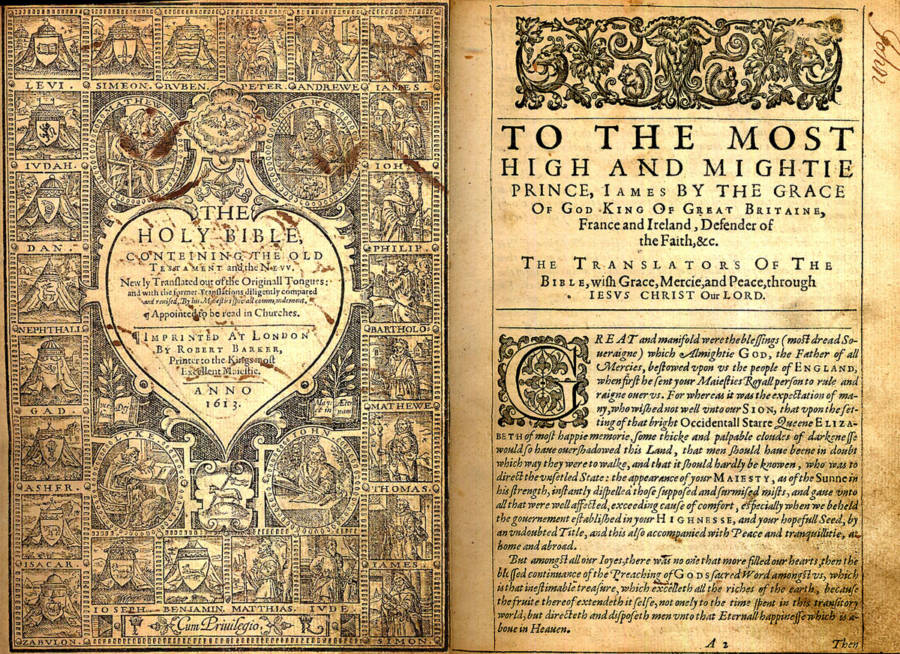 |
The original 1611 King James (Iames?) Bible, with "I" instead of "J". Left page, top right, renders James as "Iames".
|
Hebrew Roots hallucinations of the name
It's worth addressing two other claims I've heard in relation to the name of Jesus inside Hebrew Roots Christianity: Zeus and "Yahshua."
Zeus: A fringe theory in the Hebrew Roots world claims the name "Jesus" is supposedly a form of the Greek "Zeus". This is simply not supported by evidence. The Greek term for Zeus doesn't sound like the later English Jesus, and there is no historical or textual evidence supporting the name "Jesus" deriving from the Greek word for Zeus. It's just paganoia run amok, untouched by reality. 😄
Yahshua: The name "Yahshua" and its variants are not supported by the evidence. To my knowledge, there is no written record of that name anywhere in antiquity. It's an attempt by Hebrew Roots Christians to insert the divine name of God into the Messiah's name, but without understanding of Hebrew language rules. As discussed above, Yeshua ישוע already means "YHWH is salvation." There is no need to inject the divine name into it, it's already there.
Conclusion
Did we answer the question in the post? How sure are we that Jesus' real name is Yeshua?
The evidence favors Jesus' original name to be either Yeshua or its longer form Yehoshua. Language evolution and polemics are probably responsible for "Yeshu". If I had to put a percentage on it, I'd say I'm 85% certain that Jesus' original name was Yeshua, not Yeshu.
Yeshua/Yehoshua fits best with a name given to mean "saving people from their sins."
It seems to fit better with the transliteration into Greek. (Any New Testament Greek students reading? I'd love to hear your opinion.)
Yeshu was likely a shortened version of Yeshua/Yehoshua, driven by dialects of Hebrew/Aramaic that lost pronunciation of the ending ע ayin, shortening the diphthong "ooh-ah" to "ooh". It may have been especially driven by Christian communities containing both Aramaic and Greek speakers, where Greek didn't support the precise vocal sounds that Hebrew and Aramaic have.
Yeshu may have been driven by Jewish anti-Christian polemical works. A derogatory acronym was ascribed to ישו (YSU), which may have been a common Aramaic pronunciation of the original name by the 4th century. It gets written in the Babylonian Talmud during its finalization stage during the 400-500s AD. This in turn influences modern Judaism and Israelis today to use "Yeshu" to refer to Jesus.
It's possible we're wrong, and that Yeshu was the original. (It's even possible, as certain Church fathers asserted, that the Greek name Iesous was the original!) But this seems unlikely given the textual, linguistic, historical, and archeological evidence.
Does it matter?
With regards to faith, it doesn't really matter! I'm quite certain that God knows whom we speak of when we call his son by Jesus, Jesu, Yeshua, Yeshu, Yehoshua. (Or even the made-up, not-actually-Hebrew name "Yahshua".)
With regards to truth and accuracy, I suppose it matters to some extent. It is interesting and perhaps useful to know the real name of the most influential Jew who ever lived, whom we revere as the Messiah and Son of God. Yes, that's worth knowing, even if it doesn't ultimately matter in daily faith practice.


