Import jQuery

Showing posts with label jesus. Show all posts

Controversial 1st century passage about Jesus’s resurrection might be original after all


Wonderful news of illuminating new scholarship by religious studies professor T.C. Schmidt on Josephus and Jesus.

The Jewish historian Josephus (AD 37-100) is one of the most important historical sources of Jewish life, war, and religion in the 1st century. A member of the Jewish priestly class and military general in the failed war against Rome, he wrote over a half million words about Jewish life, including a controversial paragraph about Jesus.

Scholars have long thought that Josephus' writing about Jesus, called Testimonium Flavianum, was a later addition or editorial by Christian scribes. It seems too Christian for a non-Christian Jew like Josephus to write.

But new scholarship gives evidence that Josephus' famous Testimonium Flavianum is original and not a later addition as once thought. 

What's the new scholarship? 4 new pieces of evidence.

1. Manuscript evidence: Early Syriac and Latin translations of the original Greek attest to an original reading in which Josephus says Jesus was thought to be the Messiah.

2. Literary evidence: Computer literary analysis confirms the style, grammar, and word choices of the passage as authentic; a literary fingerprint unique to Josephus.

3. Greek evidence: When Josephus says Jesus appeared to his followers on the third day, he used the Greek word phaino, which connotes "something seeming to appear". This fits the style of Josephus and renders a non-committal take on the resurrection of Jesus; not out of place for a non-Christian Jew.

4. Insider Evidence: Where did Josephus get his information from? New scholarship shows it's from first-hand sources. Josephus' wartime commander was Ananus II, who Josephus records as having executed Jesus' half-brother James. He was the son of Ananus I, the same high priest who presided over Jesus' interrogation, and who's son-in-law was Caiaphas. Both appear in the Gospels (Luke 3 and John 18).

I'll give more details on each of these below. But first, for context, here's today's translation of Testimoniam Flavianum:

Now there was about this time Jesus, a wise man, if it be lawful to call him a man; for he was a doer of wonderful works, a teacher of such men as receive the truth with pleasure. He drew over to him both many of the Jews and many of the Gentiles. He was the Christ. And when Pilate, at the suggestion of the principal men amongst us, had condemned him to the cross, those that loved him at the first did not forsake him; for he appeared to them alive again the third day; as the divine prophets had foretold these and ten thousand other wonderful things concerning him. And the tribe of Christians, so named from him, are not extinct at this day.

It sounds very Christian. This has led scholars to suggest it's inauthentic; a later Christian addition or edit.

But T.C. Schmidt proposes that given this new evidence, Testimonium Flavianum should read as an authentic writing from Josephus:

And in this time, there was a certain Jesus, a wise man, if indeed one ought to call him a man, for he was a doer of incredible deeds, a teacher of men who receive truisms with pleasure. And he brought over many from amongst the Jews and many from amongst the Greeks. He was thought to be the Christ. And, when Pilate had condemned him to the cross at the accusation of the first men amongst us, those who at first were devoted to him did not cease to be so, for on the third day it seemed to them that he was alive again given that the divine prophets had spoken such things and thousands of other wonderful things about him. And up till now the tribe of the Christians, who were named from him, has not disappeared.

1. Manuscript Evidence

In the traditional Testimonium Flavianum, the statement “He was the Christ” is the giveaway, so it was thought, that this couldn’t have been written by a non-Christian Jew like Josephus. The expression “a (mere) wise man” earlier in the paragraph fits Josephus’s likely view, but a declaration of messianic identity is out of place.

But Schmidt gathered all Latin and Syriac translations of Josephus' Antiquities. In these, he notes that Latin and Syriac manuscripts of this passage don’t have the clear affirmation “He was the Christ” but instead the more doubtful “He was believed to be [Latin] / thought to be [Syriac] the Christ.”

Given the early date of these renditions—AD 300s—and the unlikelihood that any Latin or Syriac Christian copyist would demote Jesus, it seems reasonable to conclude this was what Josephus wrote. In the Greek copying tradition, a single verb (legomenos, “called,” perhaps) appears to have dropped out, either by accident or intent.

2. Literary Evidence

A mathematical, computer-assisted literary analysis of the author's vocabulary and syntax suggest Testimonium is original.

Schmidt found that Josephus used a unique term every ~87 words throughout his corpus. Having a unique word, and a couple of rare words, in a 90-word paragraph is exactly what we’d expect. Schmidt even examined Josephus’s rate of using common words such as "and", "or", and "the"—and the Testimonium shows the same frequencies as the rest of his nearly half-million-word output. Josephus’s fingerprints are all over this contested paragraph.

3. Greek Evidence

Schmidt offers a Greek-language insight into the most obvious Christian interpolation: the statement typically translated “he appeared to them alive again on the third day.” The key verb is phainō—"to appear." Many scholars have reasonably noted that a non-Christian Jew like Josephus would never have said Jesus actually "appeared alive." -- too Christian!

But Schmidt argues that phainō in this context carries one of its other connotations, well attested in Greek writings from Plato (fourth century BC) to Origen (third century AD)—namely, to indicate "something seeming or appearing to be so (but which may not actually be so)."

That would mean Josephus isn’t claiming Jesus really was alive, any more than earlier in the paragraph he was claiming Jesus was actually the Christ. Rather, he’s reporting, in a noncommittal or even skeptical way, that “it seemed” to Jesus’s followers he was alive, just as they "believed" or "thought" Jesus to be the Christ. Schmidt gives examples of this usage in Josephus.

4. Insider Evidence

But even if Testimonium is original to Josephus, it doesn't mean Josephus got it right. After all, Josephus could just be reporting rumors he heard, or official stances from one or more groups.

But Schmidt argues convincingly that Josephus got his information about Jesus and the resurrection from first-hand sources.

Josephus moved within the priestly dynasty directly connected to both deaths. His wartime commander was Ananus II (Ananus the Younger), the high priest who ordered James’s execution. Ananus II was the son of Ananus I, Ananus the Elder, the former high priest who presided over Jesus’s interrogation (known as Annas in John 18:13). Ananus the Elder’s daughter married Caiaphas, the high priest named in the Gospels. Ananus II was therefore Caiaphas’s brother-in-law. Luke 3:2 and John 18:13 place Ananus and Caiaphas together at the apex of the priestly establishment.

Josephus twice calls Ananus II "the oldest of the chief priests" and notes his death in AD 68–69. Ananus II was likely in his 70s or 80s when he died, making him in his 30s or 40s around AD 30, fully adult and influential at the time of Jesus’s trial.

Therefore, Schmidt plausibly speculates that Ananus II (the Younger) might even have been a member of the Sanhedrin that handed Jesus over to Pilate. Whatever we make of that suggestion, Schmidt is right to note that Jewish law required families to keep the Passover meal in the patriarch’s house. This means Ananus II would have been at his father’s house on the night Jesus was brought there for questioning (John 18:13). Therefore, Schmidt writes, "Ananus II surely would have observed the portion of the proceedings held in his family’s patriarchal residence."

Conclusion

Absolutely fascinating new evidence that Josephus' words about Jesus are essentially authentic. It renders Josephus non-committal about Jesus; only saying he was called the Messiah and that it appeared to his followers that he was raised from the dead.

However, even this is remarkable, early attestation of Jesus and claims of his resurrection. Today, many atheists want to claim that Jesus was either entirely fabricated, or that his claims of messiahship or resurrection were later innovations or exaggerations.

The authenticity of Testimonium works against those claims. Remarkable!

Very grateful to T.S. Schmidt's work and its review by John Dickson in The Gospel Coalition.

How sure are we that Jesus' real name is Yeshua? (And not Yeshu?)

I had an interesting conversation this week with some Jewish folks over Twitter. It started with an open-ended question: Almost immediately I thought of Jesus. No Jewish families name their kids "Jesus!" 😊 I knew that reply would come up. And sure enough:

But that's a bit oversimplified, isn't it? "Jesus" isn't Jesus' real name. His parents and contemporaries would have called him by his real name. And there were no hard "J" sounds in 1st century Hebrew or Aramaic. His real name couldn't have been "Jesus" - the language didn't support it!

I replied,

This has been my long held understanding. Someone pushed back:


Here, Chanan asserts with great snark that Jesus' real name was Yeshu ישו. Is he right?

For sure, Jews today call him Yeshu. And Israelis in general do as well. Most Israelis call him Yeshu ("YEH-shu), though Messianic Jews everywhere call him Yeshua (yeh-SHU-ah). Not long ago, Israeli Prime Minister Benjamin Netanyahu was giving a speech in Hebrew about Jewish and Christian friendship in Israel. During the speech, he referred to Jesus as Yeshu.

Does it matter? Not in significant ways. But it's worth finding out the truth.

Revisiting how the name was given, look at Matthew 1, the very first chapter of the Gospels:

Now the birth of Jesus Christ took place in this way. When his mother Mary had been betrothed to Joseph, before they came together she was found to be with child from the Holy Spirit. And her husband Joseph, being a just man and unwilling to put her to shame, resolved to divorce her quietly. But as he considered these things, behold, an angel of the Lord appeared to him in a dream, saying, “Joseph, son of David, do not fear to take Mary as your wife, for that which is conceived in her is from the Holy Spirit. She will bear a son, and you shall call his name Jesus, for he will save his people from their sins.”

It's that last line we should pay attention to. It's a sentence that doesn't make much sense in English. Call his name "Jesus" because he will save his people from their sins? In English, that doesn't follow; what does this name have to do with saving people?

But in Hebrew this makes a bit more sense. 

Summarizing Ernest Kline's A Comprehensive Etymological Dictionary of the Hebrew Language:

The name [Jesus] is related to the Biblical Hebrew form Yehoshua`(יְהוֹשֻׁעַ‎), which is a theophoric name first mentioned in the Bible in Exodus 17:9 referring to one of Moses' companions and his successor as leader of the Israelites. This name is usually considered to be a compound of two parts: יהו‎ Yeho, a theophoric reference to YHWH, the distinctive personal name of the God of Israel, plus a form derived from the Hebrew triconsonantal root y-š-ʕ or י-ש-ע "to liberate, save". There have been various proposals as to how the literal etymological meaning of the name should be translated, including:

  • YHWH saves
  • YHWH is salvation
  • ...etc
So the Scripture becomes, "You should call his name [YHVH saves] because he will save his people from their sins."

That makes good sense. Salvation and saving people are closely related. In the Hebrew Bible, when the psalmist cries out for salvation from his enemies, he's asking God to literally save him from death. 

In the New Testament, the meaning of salvation is expanded to include participation in the Messianic era, the Kingdom of Heaven. The people who follow Jesus as God's messiah will be raised from the dead. They're saved from death. Salvation, saving people, the name "Yeshua." It all clicks together.

What about "Yeshu"?


So where does this "Yeshu" come from? From two possible sources: the Talmud and language evolution.

The Babylonian Talmud, finalized a few hundred years after Yeshua's life, contains a disturbing reference to a figure named "Yeshu". It's believed by many to be referring to Jesus. In the story, a man uses necromancy to summon the spirit of a dead man, Yeshu, who is being punished for his crimes in hell. Many scholars think this "Yeshu" figure is intended to be Jesus of Nazareth. The passage may have been written as an anti-Christian polemic response to the Church of the 400s, which was fully engulfed in anti-Jewish polemics. The Church's anti-Semitism may have spurred the final editors of the Babylonian Talmud to include such a story to warn religious Jews against following Jesus of Nazareth as the Jewish messiah.

Others have noted "Yeshu" may be a derogatory acronym in the Talmud. Y S U corresponding to the Hebrew letters י-ש-ו (yud, shin, vav) as an acronym for ימח שמו וזכרו(נו): Yimakh shemo v'zichrono / may his name and his memory be erased. And there is some evidence to support this. In one passage in the Babylonian Talmud, Yeshu is written with special punctuation marks to indicate it's an acronym. But there are other places in the Talmud where Yeshu is written without the punctuation marks, so it's uncertain.

Another possible source for "Yeshu" is language evolution. The name "Yeshua" ends in a double vowel sound: "ooh-ah". This diphthong may have been shortened to a single vowel sound as Hebrew and Aramaic evolved, shortening Yeshua to Yeshu.  Some language scholars have suggested certain dialects of Hebrew and Aramaic dropped the sound of the final letter ע‎ (ayin), which had no counterpart in Koine Greek. For example, Biblical scholar Hugh Schonfield argues in The History of Jewish Christianity that northern dialects of Hebrew and Aramaic dropped the final ayin sound in their pronunciation of Yeshua, resulting in Yeshu. 

And it's not uncommon for language to evolve like this. Even in the Hebrew-speaking world today, there are multiple strains of Hebrew. For example, one strain pronounces the word "sabbath" as the Hebrew word "shabbat" שבת, but another pronounces it as "shabbas". And that's because the two strains diverged in pronunciation of an ending Hebrew letter ת: one strain uses pronounces it with a "t" sound, another with an "s" sound.

My unimportant layperson opinion: It's reasonable to imagine an early Christian community comprised of Greek and Hebrew/Aramaic speakers simplifying terms that cross languages. And by the time the Babylonian Talmud was finalized, Jewish anti-Christian works assigned a derogatory acronym to this already-establish pronunciation of "Yeshu."

James Ossuary


One artifact from the historical record, the James Ossuary, suggests Jesus' name was originally Yeshua ישוע, not Yeshu ישו.

Experts agree this bone box is from 20-70 AD. However, experts are conflicted about the authenticity of the inscription on the box. The Aramaic inscription reads: 

יעקוב בר יוסף אחוי דישוע

Transliterated: 
Ya'akov bar Yoseph achui d'Yeshua

Translated:
Jacob (James) son of Joseph, brother of Yeshua

A picture of the James Ossuary with the inscription on the side.

A better view of the inscription, courtesy this paper on the authenticity of the James Ossuary inscription. The paper argues that both the ossuary and its inscription are authentic to the 1st century.


A magnified closeup of the inscription on the James Ossuary. The final ע ayin in ישוע (Yeshua) is clearly visible on the left.


If authentic, this inscription would suggest the person whose bones were in the box was remarkable because his brother was a man named Yeshua. We know that James, the half-brother of Yeshua, was actually called Ya'akov or Jacob. This means this ossuary may have held the bones of James the Just, brother of Jesus.

More relevant to our investigation here, it strengthens the case of Jesus' original name being Yeshua rather than Yeshu.

How did we get the name "Jesus"?


This question is less controversial. It's widely agreed by language scholars, Bible scholars, and historians that his original name went through several language transliterations and evolution to get to "Jesus".

In short:

  1. Hebrew/Aramaic: ישוע. This was likely the name given to Jesus of Nazareth at his birth. It makes the passage in the Gospels, "You shall call his name Yeshua because he will save his people from his sins", actually make sense, as the name in Hebrew means "YHWH saves".
  2. Koine Greek Ἰησοῦς (Iēsous). As Christianity spreads outside of Judea, Greek is the vehicle for widespread understanding of the Gospel. In translating the Hebrew ישוע to Greek, translators translate the name letter-by-letter, filling in close approximations where necessary. Greek had no ש (Hebrew letter shin) "sh" sound, so they translated it with the Greek letter σ sigma. They add an final sigma ς as well for a masculine, singular ending.
  3. Middle English: Iesu. From 1000-1400 AD, English speakers took the Greek Iesous and the Latin IESVS into the English Iesu, a rather straightforward hop. By the 15th and 16th century, English began to distinguish the "J" sound from "I". (Remnants of this old name still exist, e.g. the hymn Jesu, Joy of Man's Desiring.)
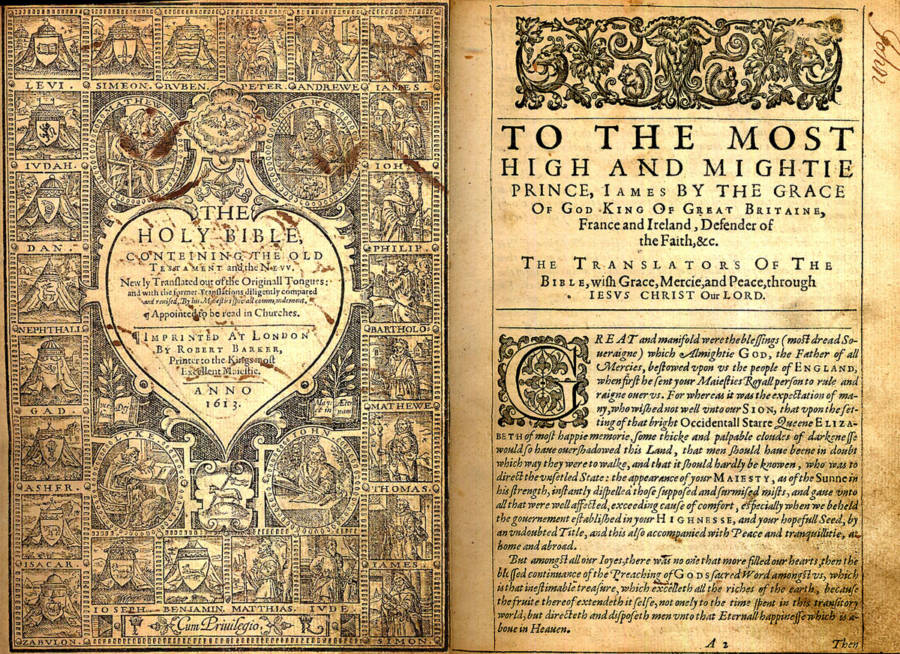
  4. Modern English: Jesus. The first King James Bible, published in 1611, still had "Iesus". But by the end of that century, the English "J" entered common use. Iesus becomes Jesus.
The original 1611 King James (Iames?) Bible, with "I" instead of "J". Left page, top right, renders James as "Iames".

Hebrew Roots hallucinations of the name


It's worth addressing two other claims I've heard in relation to the name of Jesus inside Hebrew Roots Christianity: Zeus and "Yahshua."

Zeus: A fringe theory in the Hebrew Roots world claims the name "Jesus" is supposedly a form of the Greek "Zeus". This is simply not supported by evidence. The Greek term for Zeus doesn't sound like the later English Jesus, and there is no historical or textual evidence supporting the name "Jesus" deriving from the Greek word for Zeus. It's just paganoia run amok, untouched by reality. 😄 

Yahshua: The name "Yahshua" and its variants are not supported by the evidence. To my knowledge, there is no written record of that name anywhere in antiquity. It's an attempt by Hebrew Roots Christians to insert the divine name of God into the Messiah's name, but without understanding of Hebrew language rules. As discussed above, Yeshua ישוע already means "YHWH is salvation." There is no need to inject the divine name into it, it's already there.

Conclusion


Did we answer the question in the post? How sure are we that Jesus' real name is Yeshua?

The evidence favors Jesus' original name to be either Yeshua or its longer form Yehoshua. Language evolution and polemics are probably responsible for "Yeshu". If I had to put a percentage on it, I'd say I'm 85% certain that Jesus' original name was Yeshua, not Yeshu.

Yeshua/Yehoshua fits best with a name given to mean "saving people from their sins." 

It seems to fit better with the transliteration into Greek. (Any New Testament Greek students reading? I'd love to hear your opinion.)

Yeshu was likely a shortened version of Yeshua/Yehoshua, driven by dialects of Hebrew/Aramaic that lost pronunciation of the ending ע ayin, shortening the diphthong "ooh-ah" to "ooh". It may have been especially driven by Christian communities containing both Aramaic and Greek speakers, where Greek didn't support the precise vocal sounds that Hebrew and Aramaic have.

Yeshu may have been driven by Jewish anti-Christian polemical works. A derogatory acronym was ascribed to ישו (YSU), which may have been a common Aramaic pronunciation of the original name by the 4th century. It gets written in the Babylonian Talmud during its finalization stage during the 400-500s AD. This in turn influences modern Judaism and Israelis today to use "Yeshu" to refer to Jesus.

It's possible we're wrong, and that Yeshu was the original. (It's even possible, as certain Church fathers asserted, that the Greek name Iesous was the original!) But this seems unlikely given the textual, linguistic, historical, and archeological evidence.

Does it matter?

With regards to faith, it doesn't really matter! I'm quite certain that God knows whom we speak of when we call his son by Jesus, Jesu, Yeshua, Yeshu, Yehoshua. (Or even the made-up, not-actually-Hebrew name "Yahshua".)

With regards to truth and accuracy, I suppose it matters to some extent. It is interesting and perhaps useful to know the real name of the most influential Jew who ever lived, whom we revere as the Messiah and Son of God. Yes, that's worth knowing, even if it doesn't ultimately matter in daily faith practice.

The death of the Jewish scholar who sought the historical Jesus

geza-vermesSadly, or perhaps fittingly, one of the greatest Jewish Jesus scholars of all time, Géza Vermes, has passed away today on Yom Yerushalayim, as Israel celebrates the reclaiming of Jerusalem in 1967.

Messianic believers had a kind of scholarly ally in Vermes: he argued, as many Torah-observant Messianics do, that the historical Jesus is so radically different from modern Christianity that Christians may want to rethink the fundamentals of their faith. In particular, Christians should rethink how we approach the Torah (the Law of Moses); today's Christianity largely considers it irrelevant and obsolete, though the historical Jesus upheld it.

I was introduced to Vermes several years ago through an enlightening article he wrote on Josephus, the 1st-century Jewish historian and early witness to the Jesus movement. Vermes’ radical conclusions on Josephus's writings is that virtually all of Josephus' statements on Jesus are authentic, and not the product of later Christian editors as some claim.

(If Vermes was right, and Josephus’ writings on Jesus are indeed authentic, it has profound implications for Judaism and Jesus faith.)

Through his books on Jesus, such as The Gospel of Jesus the Jew, Vermes described Jesus as a 1st-century Jewish holy man who directed his message to the Jewish people alone. And I think this isn't too far from the truth: the New Testament itself records Jesus ministry as directed almost entirely to Israel; we don't see any "go to the gentiles" sort of command until immediately before Messiah's ascension to heaven.

As a Jewish Catholic priest who converted to Liberal Judaism, Vermes believed not in Christianity, but in an authentic, historical Jesus whose gospel could be discovered through studying the New Testament.

811730In Searching For The Real Jesus, Vermes said,

"Archaeological finds [such as the Dead Sea Scrolls] have all taught us something new, but the best source for reconstructing the portrait of the historical Jesus has been available all the time. It lies in the New Testament – provided it is interpreted with a view to discovering what the original writes meant to convey to the original readers. [...] Today, theologians and secular historians of religion, working hand in hand using the latest linguistic, archaeological and cultural tools, should be able to retrieve the authentic Gospel of Jesus, his first-hand message to his original followers."

Vermes suggested that, properly understood, the historical Jesus is a figure that Jews should find familiar and attractive. This understanding of Jesus in the Jewish world is one that will ultimately triumph, I believe, with Vermes being an a kind of trailblazer in a growing | choir | of Jewish voices – scholarly, secular, and religious – that find Jesus and his message to be absolutely and utterly Jewish.

Yom Yerushalayim celebrationToday, on Yom Yerushalayim, Israel celebrates a great Scriptural & historical reclaiming: Jerusalem, after nearly 2000 years, was reclaimed by the Jewish people on this day in 1967.

But Vermes was a trailblazing voice for another great Scriptural reclaiming: the Jewish reclaiming of Jesus, an event that we hold will one day culminate in the physical and spiritual salvation of all Israel and the return of King Messiah to Zion, a time that I believe has drawn nearer because of Vermes’ earnest work towards the historical, Jewish Jesus.

Vermes will be remembered & missed.

What we know about the deity of Messiah

The deity of Yeshua – the idea that Jesus is God – is a stumbling block for some, particularly religious Jews who believe the messiah will be human only.

Here’s an example from the other week, where well-known Jewish blogger DovBear objected to the idea that Yeshua has turned gentiles to the God of Israel. Why? Because he believes gentiles don’t worship the God of Israel, they just worship Jesus:

image

(I didn’t continue the conversation; Twitter is not a great place for theological digging.)

Many religious Jews see Christians this way: not worshiping the God of Israel, Judaism’s God; instead they worship Jesus!

If the divinity of Messiah is such a stumbling block to Jews, is there budging room in Messianic faith to allow for a non-divine Jesus? Are we misinterpreting the New Testament, retroactively reading into it the deity of Messiah?

The Messiah's relationship to God is, I think, largely mystery, with the gospels giving us only hints of understanding.

But there are some things we can say for sure:

  • Messiah is called 'God' in the gospels. The apostle Thomas, upon seeing Messiah raised from the dead, says to Yeshua, “My Lord, and my God!” If Messiah was not divine, but only a human prophet, this was the time for Messiah to rebuke Thomas for erroneously calling him “God”, yet Messiah instead said, “Blessed are those who believe without seeing.”
  • Messiah is worshiped in the gospels by his disciples. If Yeshua was not God, he would have objected to being worshiped.
  • Messiah is worshiped in heaven by all creation, according to Revelation. Again, Messiah/God doesn’t object to being worshiped. Contrast this with Revelation 22, where John bows and worships an angel, who rebukes him saying, “Do not! I’m only a servant like you. Worship God alone!”
  • John’s mystical introduction in his gospel calls Messiah “God”: “In the beginning was the Word, and the Word was with God, and the Word was God. He [Messiah] was with God in the beginning, and through Him  all things were made.”
  • Paul’s epistles are more silent on the matter, much to the chagrin of Jewish anti-missionaries who often claim Christianity was invented by Paul. But we do have evidence of the deity of Yeshua in Paul’s letters: he records that every knee will bow to honor Messiah, and every tongue confess that Messiah is Lord, and again that “In Messiah is the fullness of the Godhead in human form.
  • In Revelation, the Messianic throne of the Lamb and the throne of God are one and the same. Worship is directed to “Him”, singular.

Bottom line: the New Testament supports the idea of Messiah's deity; including worship directed to Messiah.

Either that's idolatry, or Messiah is God. 

We cannot be faulted for worshiping Messiah; it’s intrinsic to the New Testament. We cannot be faulted for putting an unnecessary stumbling block in front of Jewish people; it’s actually a necessary part of our faith!

In fact, the issues of the deity of Messiah is a crux of Messianic faith: if Yeshua is not God, and we worship him, then it’s idolatry. But if Yeshua is God, and we refuse to worship him, then it’s blasphemy. Getting this understanding right is crucial, then: veering off to the left being a form of blasphemy, off to the right being a form of idolatry. The gospels show a proper path, one that includes worship of Messiah.

Simply put, according to the New Testament, Messiah is God.

Is Messiah part of God? All of God? Fully God in human form? One of 3 persons of God? One God but many forms? I think that's where it gets fuzzy/mystical, and the New Testament is largely silent; the term “trinity” doesn’t appear in the New Testament. I don't believe we should take hard positions on issues where the Scriptures leave wiggle room.

What we can say for certain is, Messiah is Lord, God, and worthy to receive worship.

Thanks, God, that I'm not like them!

Derek Leman relates his first experience in an Orthodox Jewish synagogue. As he entered the place where Jews were praying, repenting, and beating their chests, Derek relates,


I expected to go into the synagogue, see how confused and sadly lost these Jewish people were, and exit more resolved than ever to convert all Jewish people to Jesus.

I had brought in the attitude of the Pharisee. In a paradoxical reversal, I was now the Pharisee and these modern day Pharisees were the tax collectors. I was thinking to myself,
“God, I thank you that I am not like these Orthodox Jews but that I know my sins are already forgiven.”


I thought, how sad that people would beat their chest. What a pathetic and wasted display of ritual and emotion when simple faith in Jesus would do!

Yet as I watched, my mind was changed. I started praying for them to be saved, but the spirit of repentance was contagious. Didn’t I have enough failures that I should also beat my chest before the Living God? Or should I expect that grace makes all such displays of contrition irrelevant?

There is a Grace Myth to the effect that we are automatically alright with God because of the cross and that we are in need of very little repentance.


My experiences with Christians leads me to concur: There's an abuse of grace in the Christian Church today. Some have gone as far as to say repentance of sin isn't even required; you're automatically forgiven in Jesus. That is, if I sin, say I committed adultery, I would have no need to go to the Lord and repent; I would be forgiven without repentance because of the cross of Jesus Christ.

I'm going to stop there; this isn't a let's-bash-Christians post. I only want to say, each person who loves the Lord needs repentance and forgiveness.

Why?

Because everyone fails, even the best-intentioned, upstanding Christian -- even me. Even you. Each knows what evil is in him. So let's have a heart of repentance as we near the final 3 Feasts of the Lord this year.

These final 3 Feasts are a shadow of Messiah's return in Yom Teruah, his judgment and atonement in Yom Kippur, and finally his coming to live with us in Tabernacles.

Given this light, as His feasts draw near this year, keep in mind his quick forgiveness. Remember how His mercy has no end, just like the psalmist said. Come humbly before the Master of all Creation, the one who formed you. Repent -- turn your back on those ways of darkness you keep to yourself -- and come clean to the One who loves you.

I'm Offended That You're Offended!

I've been offending a lot of people lately.

  1. Wezlo, a Baptist pastor of Christdot.org fame, was offended at my statement on Barack Obama's pastor, "Shame on the fools who equate the murdering of children with the acts of a nation against the murderers." I further suggested Israel is morally right in its war against the murderers of these kids, and that there are times when God uses righteous anger, even righteous violence.

    So offended was the Protestant pastor that he ended up deleting several posts, closing the comments on one blog post, and finally hinted it as a reason to close his blog. "That was out of line", he tells me. "You're coming here trying to pick a fight", he asserts. "You should have said, 'I think it's foolish...' rather than 'Shame on the fools...'", so as not to offend anyone, he tells me in a now-deleted post.

  2. A pluralistic man of the secular world was offended after I mentioned that the names of the months of our western calendar are named after "false gods". "False gods?", he asks, "How is my god any more false than yours?!"

    I suspect his was a rhetorical question; there are not too many people nowadays worshipping Aphrilis, namesake of the month of April.

  3. Pakistani Muslim and long time acquaintance Adnan Siddiqi and his Muslim friends were offended by the implication that the Jewish people have survived 4000 years thanks to God's preservation, despite at least 8 different civilizations attempting to destroy them. I then suggested that Hamas et al will go the way of the dodo, as did the groups prior that tried to destroy the Jewish people. Needless to say, that didn't soothe his wounds.

  4. Even some Jewish friends took offense after I pointed out the modern Jewish calendar differs from God's calendar in Scripture. All-around nice guy, dad of 8 kids, and friendly Messianic Jewish rabbi Derek Leman, found it wise to publicly distance himself from me for my remarks on the Jewish calendar.

    [Update: in the comments to the same post, another Jewish reader, Gene Shlomovich, is engaged in a debate with me over the merits of Messianic Israel theology, the theology that states both Jews and gentiles are part of Israel, either by descent or by Messiah's grafting-in.]


Combine those with the respectful theological disagreements with a Christian friend, Brian, regarding the dissolution of the Levitical priesthood, a debate with comments long enough to write a short novel, a debate which continued on privately for a few more back-and-forths.

In addition, I've recently discovered another Christian friend privately took deep offense at the recent assaults on Easter, finally admitting he "didn't want to hear anymore about it". Ignorance is bliss!

In the last few weeks, I've offended at least 4 Christians, 2 Jews, 2 Muslims, and a man who in all likelihood is an atheist. And those are just the people who've spoken up. :-)

All that said, here's some more red meat for the easily-offendable. :-) I suspect it will offend Jews, Muslims and atheists more than Christians, for it contains something most Christians believe, something I consider the Christians to be absolutely and entirely correct in. (Shocking, ain't it? Not too often I can agree with Christianity!)

It's a quote from an intellectual Jewish man, a former atheist, who turned to Messiah in his mid-life, Art Katz. He had this to say regarding the easily-offendable nature of the pluralistic western world. In some ways, it gives me reassurance through all these debates and arguments and offend-ings and disagreements,

Have you heard of pluralism? The whole modern western world is pluralistic. That is to say, "many paths to God." There's no single truth.

Jesus made a remarkable statement: "If you see me, you see the Father, I and the Father are one. No man comes to the Father but by me. If any man comes any other way, that man is a thief and a robber." You guys realize what a scandal the gospel is? You realize how abrasive the gospel is? Do you realize that God has chose the foolish things? That there's nothing about the gospel that's intellectually credible? God has given us something calculatingly foolish, compared to the wisdom of the world. The world that is pluralistic and likes to consider many paths to truth has got to contend with a gospel that insists upon itself, and the Jesus of that gospel, as the only truth. It is uncompromising in its insistence. It is absolute in its expression. And the very question of absoluteness and singularity itself runs right across the whole tenet and grain of the modern world. You understand that? Do you understand how pluralistic the whole mindset of the world is, how many options -- I don't know's, the maybe's, the grey's, who's to say's -- and into that whole mucky world of vagaries, and choices, and nuances, comes one statement out of the heart of God: "I am the way, the truth, and the life, and no man comes to the Father but by me."

If I hear anything from my Jewish kinsmen in conversations I have been involved with my people, invariably they bring up, "What about the other people of the world? What about Buddhists, what about Muslims, what about Hindus? Don't they have a religion, isn't it a world faith? Aren't there redemptive elements in these religions? And you feel a blush coming up to the roots of your being, when you have to insist and say, "No, these are satanic deceptions and false alternatives that lead unto death." To insist on the singularity of the gospel, to insist on the absoluteness of it: this is not just an issue of religion, it's hitting the world head-on in a confrontation of wisdoms, of moral systems, of mentalities.

I've found this to be true, that one bold statement goes against the grain and tenet of the world and induces all kinds of anger and offense: No man comes to God but through Yeshua the Messiah. Speak that truth, and you're a bigot by the world's standards. The world will slander you and attack you and mock you to no end should that tiny statement be uttered in public. It is the ultimate offender in this easily-offendable, politically correct world.

For the record, I'd like to say that none of the disagreements have created a cold between myself and any of you who know me personally. I always prefer clarity to agreement, and I think honest debates help bring about that clarity.

So if you're offended or disagree with me, I want to hear from you, I want to discuss it, I want to find the truth of the matter. Even if we can't attain agreement, at least we can find clarity in exactly where each side stands.

The Torah is obsolete and passing away?

Or at least, so goes the teaching I've heard from many Christian preachers and thinkers. Is it true?

"What is the old covenant?" Great question. After all, Hebrews 8 in the Christian New Testament says,

By calling this covenant "new," he has made the first one obsolete; and what is obsolete and aging will soon disappear.
Many Christians understand this to mean the Torah, the Law of Moses, which Jews follow to this day in the form of the religion of Judaism, is old and obsolete, aging and will soon disappear. The notion of Torah disappearing reinforces the religion Christianity and tears down the religion of Judaism, so it's a tempting thought for many Christians.

And so the thinking goes that Christians and even Jews need not follow God's commandments in the Torah.

I replied to Trent in an email, but the answer lies so deep in Scripture, I thought it worthy of posting to the blog where you folks can read it as well. Here we go...

You asked what is the old covenant from a Hebrew perspective. Good question.

There were a couple of "old" covenants.
  • God made a covenant with Adam that man must work to live.
  • God made a covenant with Noach that the earth will never again be destroyed by a flood.
  • God made a covenant with Avraham that his descendants will be as numerous as the stars in the sky, uncountable, and that he would be the father of many nations.
  • God made a covenant with Jacob that his name would be Israel and that his offspring would be God's people forever.
  • God made a covenant with all Israel that if they keep His commandments in Torah, they will be blessed and will prosper in the land God gave them.
  • God made a covenant with David that promised him one of his descendants would have a throne established forever.
When Christians talk about the "old" covenant, they're usually referring to the covenant God made with Israel on Mt. Sinai, telling them to keep His commandments. These weren't actually new commandments He gave to Israel, but were deeper, elaborate revelations of God's own commandments which were kept from the beginning of time -- look how Abel sacrificed innocent blood as an offering, or how Cain's act of murder was evil, or how Noah knew which animals were clean and unclean...all long before God's covenant with Israel at Sinai. What I'm saying is this: God's commandments are timeless and not limited to the Sinai covenant.

The covenant on Mt. Sinai became "old" once the covenant was renewed on Mt. Moab (If I recall right!) with blessings given for keeping the commandments, whereas the Sinai had many curses for breaking the commandments.

Mind you, none of these have been replaced by Messiah's new covenant with us.

In Jeremiah 31, a new covenant is prophesied to occur between God and the southern house of Judah (Jews today) and the northern nation of Israel (lost, absorbed into the gentile nations to this day):

The time is coming," declares the LORD,
"when I will make a new covenant
with the house of Israel
and with the house of Judah.

It will not be like the covenant
I made with their forefathers
when I took them by the hand
to lead them out of Egypt,
because they broke my covenant,
though I was a husband to them, "
declares the LORD.

"This is the covenant I will make with the house of Israel
after that time," declares the LORD.
"I will put my law in their minds
and write it on their hearts.
I will be their God,
and they will be my people.


Now, I believe he's prophesying about the Messianic covenant here, because if you look at Messiah's actions, he was always about writing the Torah on our hearts. For example, Messiah told us [paraphrasing], "You've heard it said, 'Do not commit adultery.' But I say, if you even look at a woman with lust in your heart, you're committing adultery."

That's taking a Torah commandment, the Law, and applying it to the heart.

He made similar statements about hating your brother, about loving your neighbor, taking oaths, loving God, even the less popular ones related to Temple service.

In fact, almost all of Matthew 5 is dedicating to getting to the point of the Torah, and applying it to our hearts, rather than just outwardly as the Pharisees were doing.

Now, what does all this have to do with the old covenant stuff?

The book of Hebrews says that these things -- in particular, the Cohenim (Levitical priesthood) is passing away. While that's true, it won't be gone until the New Covenant is complete, otherwise Messiah wouldn't have bothered applying what is "old" to our hearts. You might think the New Covenant is complete with Jesus, but I propose it's not complete until He finishes the job: new heaven, new earth, new Jerusalem descending from heaven, everyone knowing the Lord. That's when the New Covenant is complete, after which we will enter another covenant that makes the "new covenant" become old. :-)

What evidence is there that the New Covenant isn't complete yet, you ask? Look at the rest of Jeremiah 31 that we just quoted earlier, here's the rest of the prophecy:

No longer will a man teach his neighbor,
or a man his brother, saying, 'Know the LORD,'
because they will all know me,
from the least of them to the greatest,"
declares the LORD.
"For I will forgive their wickedness
and will remember their sins no more."

This is what the LORD says,
he who appoints the sun
to shine by day,
who decrees the moon and stars
to shine by night,
who stirs up the sea
so that its waves roar—
the LORD Almighty is his name:

"Only if these decrees vanish from my sight,"
declares the LORD,
"will the descendants of Israel ever cease
to be a nation before me."

This is what the LORD says:
"Only if the heavens above can be measured
and the foundations of the earth below be searched out
will I reject all the descendants of Israel
because of all they have done,"
declares the LORD.

"The days are coming," declares the LORD, "when this city will be rebuilt for me from the Tower of Hananel to the Corner Gate.


There are 3 things about this "new covenant" of Jeremiah's that haven't happened yet:
  1. Everyone will know the Lord
  2. Israel will no longer be rejected
  3. Jerusalem will be rebuilt completely
Don't be ignorant of these things -- Jews today will retort Christian missionaries saying, "If your Jesus brought Jeremiah's new covenant, how come these things haven't happened?" If you look at anti-missionary websites like Jews for Judaism, they explicitly list every "new covenant" prophecy Jesus did not fulfill, then go on to say, "to our knowledge, no one has ever fulfilled these messianic requirements."

If you study the Scriptures, however, you'll find that it's prophesied that a new Jerusalem will descend from heaven, Israel will return to the Lord, and every knee will bow [jeez, that's cliche, I know!] - all will know the Lord. When those things happen, only then is the "old covenant" complete, because the Old Covenant -- with it's earthly pictures of heavenly things like blood shedding for atonement of sins, the Holy Temple, the priests -- will be replaced by the actual things they were pictures of. I think that's what the author of Hebrews meant when he says "by calling this covenant new, he makes the first old, and what's old and obsolete is passing away.

Is the old covenant obsolete? Is the Torah, which includes the 10 commandments, obsolete? The end of Hebrews 8 seems to indicate that the old covenant, or at least, the priesthood, is old and obsolete, and is passing away.

We must reconcile Hebrews 8 with Messiah's words that not a single mark of the pen, not a single commandment, will pass away until heaven and earth pass away. That includes even the Levitical priesthood. This means -- and excuse me for this very unpopular, politically incorrect statement -- there will be a 3rd Temple in Jerusalem, complete with a Levitical priesthood. That's my belief.

So, the New Covenant doesn't replace the Sinai covenant as much as it builds on it. For example, without the Old covenants telling us about shedding of innocent blood for atonement of sin, Y'shua's sacrifice would seem totally bizarre and foreign.

Heck, Paul says that without the Torah, we wouldn't know what sin is; the idea that Messiah would free us from sin would seem pointless, because we wouldn't know what sin is.

And without the commandments in Torah, Messiah wouldn't have anything to write on our hearts.

Without the old Davidic covenant, the very concept of a Messiah itself would be foreign to us.

The new covenant builds upon the old covenants.

Upon This Disciple I'll Create My New Religion?

I've recently been debating with a Catholic man, Ariel, in the comments to Catholic Relevance.

Ariel is rather peculiar religious person, in that he went from a child under Catholicism, to agnosticism, to Evangelical Christianity, to Messianic Judaism, then back to Catholicism. (Wow!) He is now a chief contributor to IsraelCatholics.com.

In the little debate, Ariel points to us to his testimony and lays out the span of events that led him to believe that "Messianic Judaism is not biblical enough and [that] Catholicism really is truly Jewish and truly the faith of the Bible."

He further states,
"Messianic Judaism usually uncritically accepts the two pillars of Protestantism: sola scriptura (the Bible as sole source of authority) and sola fide (salvation by faith alone). Yet both of these doctrines are neither Jewish, neither biblical, nor genuinely Christian!"


Ariel and I debate these points and many others in the comments to Kineti Le'Tzion - Catholic Relevance. The points made are so important, however, I feel this debate deserves more visibility than dueling comments in a buried blog post!

To keep things reasonable short and concise, since so many of you [ahem, Gary] refuse to read long posts, I'm going to address only a single issue today:

Should we have a Pope?

Ariel states the Catholic position this way:

The fact that Jesus appointed Peter to be "the rock on which I will build my Church" is quite clear from the NT. See the wealth of other scriptures and quotes from the early church (way before Constantine!) in this presentation.


Ariel is referring to the following Scripture, Matthew's record of the gospel, ch. 16,

Jesus replied, "Blessed are you, Simon son of Jonah, for this was not revealed to you by man, but by my Father in heaven. And I tell you that you are Peter, and on this rock I will build my church, and the gates of Hades will not overcome it. I will give you the keys of the kingdom of heaven; whatever you bind on earth will be bound in heaven, and whatever you loose on earth will be loosed in heaven."


It is from this Scripture that Catholics claim the Roman Catholic Church is the only true church of Jesus Christ. Indeed, Catholics claim Peter was the first Pope in a succession of popes leading up to the current Roman Catholic Church head:


While Catholics claim the Apostle Peter was the first Pope, the current Pope is Joseph Ratzinger, now called Pope Benedict XVI, a former Hitler Youth (though it's claimed he had no choice in the matter), is seen above wearing the Mitre (religious headgear), which some folks speculate is the pagan Dagon fish hat, although that is contested.

So, are the Catholics correct? Was Peter the first Pope? Did Jesus give authority to Peter to be the first Pope? Did Jesus authorize the creation of a church built on Peter in Rome?

Let's examine the evidence and come to a conclusion.

The first matter is the very Scripture itself. A few things strike me about this quotation:

  • "You are Peter, and upon this rock..." - This is Greek word play. The Greek "Petras" means rock or stone, so it appears Jesus is playing a word game by saying "You are Petros, and upon this petras..."

  • "I will build my church" - This translation and understanding is based on the faulty assumption that Jesus is starting a new religion. After all, we think of "church" as a big building with a steeple symbolizing organized religion, or perhaps a large religious organization itself like the Catholic Church. However, Jesus did not come to start a new religion, and this is evident in the fact that word "church" here is the very same Greek word "ekklesia", which means an assembly of people. Ekklesia is found elsewhere in the Bible -- even the Old Testament! -- but only in the New Testament is it translated in this way, perhaps intentionally as a way for the Church to validate its existence, sadly.

  • "The gates of Hades will not overcome it" - I always get a kick out of this. Why would Jesus, a Torah-observant Jewish rabbi, talk about the pagan Greek god of the dead, Hades? Given that speaking the name of false gods is a sin according to Torah, if Jesus really did say this, he would not have been sinless - very consequential to Christian doctrine. Interesting! More on this in a moment.
So, what's the deal with all this? Is Jesus starting a new religion founded on Peter? Did Jesus break a Torah mitzvot by speaking the name of Greek god of the dead, thus sinning? The answer lies in the original text.

The book of Matthew was originally written in Hebrew, a document attested to by the early Church fathers Clement of Alexandria, Origen, Jerome, Papias, and Irenaeous. (Despite this evidence, some modern scholars debate Hebrew Matthew's existence.)

In any case, we no longer have the original Hebrew Matthew, it has since been lost. We do, however, have a Hebrew manuscript of what is believed to be the original Hebrew, in the form of a medieval document written by a Spanish Jewish physician, Shem Tov ben Isaac ben Shaprut. This Hebrew version of Matthew is dubbed Shem Tov's Hebrew Matthew.

(It should be noted there is debate among scholars and Christians as to whether Shem Tov's Matthew is a manuscript from Hebrew or a translation from Latin or Greek. In the very least, there exists in Shem Tov's Hebrew Matthew some rabbinic Judaic bias, such as writing Messiah's name blasphemously1.)

I wanted to get my hands on this and see what the Hebrew Matthew had to say about Jesus building a church on Peter. 2 weeks ago, I did just that, and began studying Shem Tov's Hebrew Matthew. Unsurprisingly, using the Hebrew names1, it reads much differently than the Greek:

[Y'shua] said to him, "Blessed are you, Shimon ben Yochanan, because flesh and blood has not revealed this to you, but my Father who is in heaven. I say to you: you are a stone and I will build upon you my house of prayer. The gates of Gehenna will not prevail against you because I have given you the keys to the kingdom of heaven. Whatever you bind on earth will be bound in heaven; whatever you loose on earth will be loosed in heaven.


Now this is interesting. In the Shem Tov's Hebrew Matthew, we see that no longer is Messiah saying he'll build a church, which implies Jesus is creating a new religion. He instead says he will build a house of prayer, which does not imply a new religion or anything foreign to the Jewish faith.

What did Messiah mean when he said he'd build a house of prayer, you ask? Is He talking about building the Catholic Church? No, it seems obvious what he meant: since Messiah later revealed to Peter that the gentiles are to be included in the faith of the God of Israel, Peter was the foundation of what became a massive gentile following of Jesus that we have today. That gentile following of Messiah is the house of prayer. It does not speak to one particular denomination, Catholic or otherwise. Thus, whether Peter visited Rome or founded a church there -- a debatable point Catholics and Protestants have argued over for centuries -- is irrelevant.

Another interesting bit about this Scripture is how the difficult problem of "Hades" goes away in the Hebrew. While Hades was a Greek god of the underworld, Gehenna was a real place outside Jerusalem that became essentially a garbage dump where fires were burned continuously to consume the refuse of the city. Canaanite pagans had previously sacrificed their children to their false god, Santa Clause Molech, in the valley of Gehenna, so there was also a dark evil associated with the place.

Another interesting bit is how the Hebrew says, "the gates of Gehenna will not prevail against you", as opposed to the Greek reading, "the gates of Hades will not prevail against it [the Church]". The Hebrew is saying Gehenna will not prevail against Peter, the Greek is saying the gates of Hades will not prevail against the Church.

Given this understanding, I see no Scriptural evidence supporting the idea of a Pope, who presumes himself to be Jesus Christ on earth, infallible. On the contrary, I see Scriptures that indicate such presumption to be haughty, if not blasphemous.

The final idea we need to address -- because this confronts both Catholic and Protestant Christianity head on -- is the idea that Jesus came to start a new religion.

Some Christians deny this, saying it is the Jews who created the new religion, or that true Christianity is not different than the original faith in the God of Israel.

But these same Christians betray themselves by saying the Torah is passed away, that Jesus' grace replaces God's Law, or that we safely ignore God's Law because Jesus "nailed it to the cross". Indeed, my father-in-law once said to me, paraphrasing here, "Judah, Israel doesn't matter anymore -- everything changed with Jesus."

Do you Christian folks who profess such things understand what you're saying?

  • If Jesus did away with the Law, then he is a false prophet who would receive capital punishment for leading people away from God.

  • If Jesus did away with the Law, he started a new religion in which the Law is relegated to the back seat, and the Jews would be correct in rejecting Him.

  • If Jesus did away with the Law, or even diminished it in any way, he contradicted his own words and his own actions.

  • If Jesus made less meaningful even the slightest commandment in Torah, he failed to fulfill the messianic prophecies in the Tenakh (Old Testament), thereby rendering his Messianic status a lie.

  • If Jesus replaced Israel with the Church, then Jesus made God out to be a liar; for Jesus would be revoking something God promised to be irrevocable: the Torah will be an everlasting covenant between Himself and Israel.

  • If Jesus "changed everything" such that Torah is diminished, then He did indeed create a new (false) religion, and a Protestant is merely a lesser, misled form of a Catholic, the highest form of follower in this new religion.

Let me spell it out in plain words for you: by claiming Jesus somehow diminished the Law, you are unwittingly stating that Jesus is both a false messiah and a false prophet.

Stop with your foolish claims that Jesus somehow diminished the Torah, you're leading people astray.

Greek Jesus vs Hebrew Yeshua

Let's be frank. If the Greek peacenik adonis Iesous Kristo started a new religion, where we're supposed to have big Churches with steeples, celebrate these new holidays called Easter, Christmas, Lent, and Ash Wednesday, Sunday mass, and all the paraphernalia associated with a new religion, then the Catholic Church is right, and we should all convert to Catholicism.

On the other hand, if the Torah-observant, Jewish rabbi Yeshua HaMoshiach didn't start a new religion, then we need to clean up the mess that was created not 100 years after his death, which culminated in the creation of an official state religion in 325 CE, when the Roman Emperor Constantine declared himself the 'Holy' Roman Emperor and Sol Invictus (invincible sun god) and formalized what is today the Roman Catholic Church, complete with its Sun-day based worship.

So, who do you believe in? The Greek Iesous Kristo? Or the Hebrew Yeshua HaMoshiach? They are not one and the same; one is a perversion of the other. Which is it?

Our English Jesus Christ descends from the Greek understanding of Him, not the Hebrew understanding. We have a Greek mindset in these things -- it's no wonder Jews find Jesus so foreign and repugnant! He's tainted with Greek, pagan undertones in all we say about Him, everything from the western 'Christian' holidays, to his supposed diminishing of Torah, to the very halo we paint around His head.

We need to return to the teachings of this Jewish Messiah -- Sabbath, the Feasts of the Lord, Torah -- and get away from the man-made, Hellenized bastardization of these things that we have now in the Roman Catholic Church and its Protestant offspring.

Do we need a Pope to govern The Church? When one realizes the church in its current form is a religious invention of men, the answer becomes clear. What we do need is a return to our being Israel -- a holy, set apart people for God, different from the world -- grafted in not by race, but by belief in the God of Israel who gave Messiah so that both Jews and gentiles can be clean.


1. Shem Tov, himself a devout Jew being persecuted by the church, unfortunately substituted Yeshua's name in the Hebrew Matthew text with the shorter acronym YSH'W, which is a Hebrew acronym that meant to slam Jesus. The acronym's full form is Yemach Shemo Vezichro (literally meaning 'May his name and memory be obliterated'). It is an ancient rabbinic word play on Jesus' Hebrew name Yeshua, and Shem Tov used this shameful name in his manuscript of Hebrew Matthew.

----------------
Now playing: Steve McConnell - Ki T'Hilati Attah
via FoxyTunes

It's OK, I meant well

How much does one's real motive -- his heartfelt belief on the matter -- influence whether an act is moral or immoral?

If a man murders another, but his heart believed it was done for good, is it still evil? If the man truly believed his action was done out of righteousness or human ethical behavior, does it make the otherwise unethical act more ethical?

I encounter this argument from many gentile Christians who, after being confronted about the very un-Christian backgrounds of supposedly Christian holidays like Easter or Christmas, respond with the quip, "All that may be true, but I'm honoring God in my heart."

It's the religious version of "it's the thought that counts".

It's a good point. I know there are many folks, filled with God's spirit, doing their best to walk a righteous life before God and relying on God for their righteousness, who are trying to honor God in celebrating Christmas, Easter, Lent and other so-called Christian holidays, as well as now non-Christian holidays such as All Hallow's Eve (Halloween). Gentile Christians have told me many times, "I'm not worshipping my Christmas tree, and these other pagan symbols mean nothing to me, they're harmless decorations!"

Where does that leave us? What's the truth here? Well, let's summarize what we know:

  1. The Christian holidays of Easter, Christmas, and Lent were formed from pagan rituals. These were chosen over God's holidays largely because of the hatred of Jews and all things Jewish in the early gentile Church. (See Church: Behold Your Founder) For example, man's Easter was chosen over God's Passover because Roman Emperor and founder of the Roman Catholic Church, Constantine, decreed in the 325 CE,
    "We ought not therefore to have anything in common with the Jew. It would be your duty not to tarnish your soul by communication with such wicked people (the Jews). It was declared to be particularly unworthy for this, the holiest of festivals, to follow the customs (the calculation) of the Jews who had soiled their hands with the most fearful of crimes, and whose minds were blinded. In rejecting their custom we may transmit to our descendants the legitimate mode of celebrating Easter. You should consider not only that the number of churches in these provinces make a majority, but also that it is right to demand what our reason approves, and that we should have nothing in common with the Jews."

  2. These holidays have largely been scrubbed of their former pagan symbolism and racist past, although some forms still exist. Easter eggs, Easter rabbits, yule tide, mistletoe, Christmas trees, silver testicles of the Egyptian god Ra (excuse me, silver balls on Christmas trees), candles on Christmas trees, and the mythical St. Nick who knows when you're sleeping or when you're awake and whether you've been bad or good, are a few examples.

  3. Most Christians are unaware of the pagan and anti-Jewish, anti-Torah backgrounds of these holidays.

  4. The few Christians who have knowledge of this and continue to celebrate have justified their doing so by saying they are honoring God in their heart.

  5. It is true that most Christians who are truly desiring to walk with God are, in fact, trying to honor God through these holidays, despite their pagan and racist backgrounds.


So, are Christians right in saying, "These holidays are what I make them to be, the pagan & anti-Jewish backgrounds don't mean anything to me"?

I'd like to look at Scripture and see. Is there anything in Scripture that would indicate either way? Let's look.

From the Torah

One thing that immediately comes to mind is something found back in the Torah. When Moses ascended the mountain to receive the commandments, the people of Israel became weary and, in their impatience, melted down their gold and from it, formed an undoubtedly beautiful golden statue of a calf, and worshiped it. To us, this sounds like pretty straightforward idolatry, doesn't it?

But a crux most Christians miss in this story is something that Jewish tradition holds: the golden calf they molded wasn't a new god; after all, the Lord was doing all kinds of miracles right before their eyes -- the splitting of the Red Sea, the leading pillar of cloud by day, the leading pillar of fire by night, the closing of the sea on the Egyptians, the giving of manna and water in the middle of the Negev desert -- the Israelites weren't in the market for a new god.

This golden calf was not a new god, no, Jewish tradition holds the calf was molded for the "unseen God", the Lord, who rode invisibly on the back of this calf. The Egyptian tradition of creating idols of their gods riding triumphantly on the backs of cattle was borrowed by the Israelites, and now the Israelites were making an idol for the Lord, the invisible god, riding on the back of a golden calf.

Still with me?

If this tradition holds water, the Israelites meant well. In fact, they were worshipping the Lord.

But this was something God didn't approve of, despite Israel's good intentions. Why? They were mixing holy and profane: a tradition of the world mixed with an otherwise holy people and holy God.

From the B'rit Chadasha (New Testament)

When Messiah went to the Temple in Jerusalem, he encountered folks who were selling the necessities for offerings in the Temple -- grain offerings, sin offerings, praise offerings -- as commanded by the Torah.

These folks meant well, they were even helping those who were giving to God. But when Messiah saw them, he did something rather unexpected and violent,

Jesus entered the temple area and drove out all who were buying and selling there. He overturned the tables of the money changers and the benches of those selling doves. "It is written," he said to them, " 'My house will be called a house of prayer,' but you are making it a 'den of robbers.'"
Despite the good intentions of those selling offerings for the Temple, Messiah rebuked them and sent them away. Why? Mixing holy and profane, mixing God's house with man's market.

What about when Messiah related to his followers all the things that must happen to him and how the Messiah must suffer and die? Kefa (Peter) responded, "Never!"

Certainly Peter had good intentions and meant well; he was stating he'd never let harm come to Yeshua. But did Peter's good intentions spare him?

From that time on Jesus began to explain to his disciples that he must go to Jerusalem and suffer many things at the hands of the elders, chief priests and teachers of the Torah, and that he must be killed and on the third day be raised to life.

Peter took him aside and began to rebuke him. "Never, Master!" he said. "This shall never happen to you!"

Jesus turned and said to Peter, "Get behind me, Satan! You are a stumbling block to me; you do not have in mind the things of God, but the things of men."

Wow. Why did Messiah himself come against Peter so harshly, especially when his intentions were good? Because he was mixing holy and profane; God's plan mixed with man's ideas. Peter meant well, even meant to glorify God, but that didn't make it right.

From logic and reason

If heart-felt motive is the only thing that determines whether an act is moral, anarchy exists and morality is relative.

Taken to an extreme end, the thinking of "It's OK because I mean well" results in any act being defensible. I could steal from you justly because I was fully convinced in my own mind that stealing from people wealthier than myself is morally good; a modern Robin Hood, if you will.

A more reasonable position, some might say, is that because you are fully convinced that a mother has a right to choose whether to let her developing child live or die, and because the mother's intention isn't evil -- she just doesn't want to have kids -- it is morally acceptable and agreeable that she kill her child abort the fetus if she so chooses.

When led to it's ultimate end, any crime is a non-crime, every sin is a non-sin, if we define morality or righteousness as "whatever I want it to be" or "whatever the purpose of my heart is", we're left with a humanist's utopia: relative moralism, no real rights or wrongs, nothing truly righteous, nothing truly evil.

Conclusion

Indeed, such thinking will lead one to a kind of washy unitarianism: for if the intent of one's heart is what matters, who's to say Hindus, Buddhists, Muslims, and other world religions have it wrong? They all believe in their heart they're following God, in some form or another, so why bother them?

If believers in Messiah can justify observing the world's holidays in good conscience, with all the pagan and anti-Jewish paraphernalia associated with Easter, Christmas, and Lent, we cancel out a gospel that insists on itself as the only way to God, we cancel out absolute morality, we remove the very idea of righteousness. We relegate absolute morality to the backseat, placing a greater importance on the intent of one's heart, allowing for wiggle room.

We've discovered in Scripture that one can try to please God and still do something unpleasing to God. We've seen that intent of the heart isn't the only thing that matters. While God does look on the heart, it can't be the only scale of right and wrong.

Your celebrating Easter is no better than putting a cross on a Buddha; we're mixing holy and profane. One must ask Christians, would you feel comfortable with celebrating such things if Messiah was visiting your home tonight? Would you talk to him how beautiful your adorned tree looks? How much fun the kids had at the Easter egg hunt? And then tell Him how you're doing these things in His name and for His sake? I can only imagine his response!

No matter how much we convince ourselves otherwise, seemingly harmless things like this do not honor God. God is not honored by your Christmas tree, God is not honored by your Easter eggs. Let's stop pretending otherwise.

Follow up on John Hagee

I recently blogged about televangelist John Hagee and his apparent going off the deep end in his saying that "Jesus was not the Christ/Messiah" of the Jews. This statement comes from Hagee's latest book promotion, which found its way onto YouTube:


The ending of that blog post, I wrote,

If any of you fine blog readers believe I've misrepresented John Hagee in any way, please let me know in the comments; I don't mean to spread lies about anyone, but only to bring things to light, resulting in clarity.


Well, it turns out Hagee is not so far off after all: one commenter, Lou Vasquez, noted,

He [Hagee] is stating the issue poorly, probably for the shock value of it.

He is trying to say that Yeshua (Jesus) did not come as the perceived Messiah by most Jews but came as the suffering servant. Most Rabbinical Jews that I know only know of the Messiah as the coming King (Meshiach ben David).

What Hagee is trying to say here, but it is offensive, is that He did not come as King but as the servant, “Meshiach ben Yoseph”.


To clarify, the idea of 2 Messiahs is a very old, very common idea in Judaism:
  • Moshiach Ben David: The Messiah son of David who, like David, becomes physical, political king over Israel, conquers all the nations, and finally brings lasting peace. This is the Messiah prophesied of in Scriptures like Isaiah 2.

  • Moshiach Ben Yosef: The Messiah son of Joseph who, like Joseph, suffered through many hardships, only to bring about the salvation of the whole world. This is the Messiah prophesied of in Scriptures like Isaiah 53.


According to Lou's comment, John Hagee may be merely saying Jesus was not Moshaich Ben David the Jews were expecting. Indeed, Jesus did not conquer the nations, judge the world, or bring lasting peace, as is prophesied of the Messiah son of David.

On the contrary, Jesus fits the Moshiach Ben Yosef perfectly and fulfilled the prophecies concerning him to a tee.

Therefore, it is believed Jesus was Moshaich Ben Yosef. New Testament prophecy in Revelation has it that Messiah will return as Moshaich Ben David, and will conquer the nations and bring lasting peace to the world.

Getting back to Hagee, I realized I need more information about what Hagee is really saying in order to have correct discernment on this matter. Is Hagee really saying Jesus wasn't the Messiah, at all? Or was he saying Jesus merely wasn't the Messiah the Jews were looking for, Messiah Ben David?

Well, I decided the best way would be to buy the book and give it a read. (I'm such a tool, I know!)

Turns out, Hagee is saying Jesus wasn't the Messiah son of David. He doesn't quite put it in those words, but rather, he says Jews were looking for the Messiah who would throw off the Roman Empire and make Israel independent and great once again, and who would bring peace finally. Jesus wasn't that person.

Hagee makes his case by saying, even the disciples thought Jesus was Messiah son of David, even up to the last moment Jesus was here on earth. From Acts 1 in the New Testament,

So when they met together, they asked him, "Master, are you at this time going to restore the kingdom to Israel?"

He said to them: "It is not for you to know the times or dates the Father has set by his own authority. But you will receive power when the Holy Spirit comes on you; and you will be my witnesses in Jerusalem, and in all Judea and Samaria, and to the ends of the earth."

After he said this, he was taken up before their very eyes, and a cloud hid him from their sight.

They were looking intently up into the sky as he was going, when suddenly two men dressed in white stood beside them. "Men of Galilee," they said, "why do you stand here looking into the sky? This same Jesus, who has been taken from you into heaven, will come back in the same way you have seen him go into heaven."


From this, we see even the disciples didn't understand; they still thought Jesus was going to become physical king of Israel, throw off the Roman bondage, restore Israel to its once-great status, righteously judge all nations, and finally bring lasting peace to humanity. But Messiah responded by saying it isn't for us to know when that time is. We don't get to know.

John Hagee is correct in saying Jesus was not the Messiah the Jews were looking for. Jesus was not Moshaich Ben David. Instead, Jesus was the Moshaich Ben Yosef -- the suffering servant who would bring salvation to the whole world.

In an ironic twist, most modern Christians today are ignorant of the different roles of Messiah, and believe that when Jesus returns, he'll still be the same pacifist, hippy, peacenik, Greek-looking adonis we've been led to believe he was.

On the opposing side, Jews are *still* waiting for Moshiach Ben David.

And this time, Jews will get what they're expecting, while the gentile world will get something totally radical and foreign: a Jewish revolutionary who becomes ruler of Israel and who righteously judges all nations.

Interesting times!

----------------
Now playing: Steve McConnell - Lord Knows and Remembers
via FoxyTunes

Interesting facts about Christianity

This morning as I was praying, with tomorrow being one of the 7 Feasts of the Lord commanded in Scripture, I began to think back to Scripture and where we are as a group of followers of Messiah. I imagined the pieces we're doing now that are un-Scriptural -- pure man-made religion and tradition -- and reconsidered the purpose and validity of those things. I began to compile a list, which I've posted below.

If there is a mistake in the list below, please correct me in the comments. If you have additional un-Scriptural Christian traditions you'd like to add to this list, please let me know in the comments.

Finally, I suspect some may be offended by this, because most of us actually practice some of these. The purpose isn't to offend, but is only to shed light on what is man-made versus what God has commanded. It's up to you to figure what to do from there. Please understand I'm not saying all these things are evil; I'm simply stating what has Scripture support and what does not. I hope this helps you all align your theology accordingly!

  • Jesus never stated he came to start a new religion.

  • Nowhere in Scripture did Jesus convert anyone to a new religion.

  • Nowhere in Scripture is a man told to say a prayer to ask Jesus into his heart to make him saved.

  • Messiah's first followers were all Jewish.

  • Messiah's first followers met in houses, synagogues, and the Temple, not in churches.

  • All 12 disciples of Messiah were Jewish.

  • Jesus was Jewish.

  • Jesus' name wasn't actually Jesus.

  • Followers of Jesus were not originally called "Christians", but rather, they were a sect of Judaism known as "The Way" community.

  • Whenver "Scripture" is referenced in the New Testament, it is referring to Torah, the Prophets, and the Writings (the Tenakh/Old Testament) of the Jewish Bible; for there was no compiled, canonical New Testament at that time.

  • The term "Trinity" is not mentioned anywhere in Scripture.

  • The term "Rapture" is not mentioned anywhere in Scripture.

  • The Christian holiday of Lent is not mentioned anywhere in Scripture. However, a pagan origin of the holiday is mentioned negatively.

  • The Christian holiday of Easter is not mentioned anywhere in Scripture. However, the false goddess the holiday is named after is mentioned negatively in Scripture as Ashtar/Ashtoreth.

  • The Christian holiday of Saint Patrick's Day is not mentioned anywhere in Scripture.

  • The Christian holiday of Saint Valentine's Day is not mentioned anywhere in Scripture.

  • The Christian holiday of Good Friday is not mentioned anywhere in Scripture.

  • The Christian holiday of Passiontide is not mentioned anywhere in Scripture.

  • The Christian holiday of Palm Sunday is not mentioned anywhere in Scripture.

  • The Christian holiday of Christmas is not mentioned anywhere in Scripture. However, a pagan origin of the holiday is mentioned negatively.

  • Yuletide is not mentioned in Scripture.

  • Nowhere in Scripture is it said we are to give gifts to each other on Jesus' birthday.

  • Christmas trees are not mentioned anywhere in Scripture. However, a pagan origin of that tradition is mentioned negatively.

  • Nowhere in Scripture are we commanded to put up a nativity scene on Jesus' birthday.

  • Nowhere in Scripture are we commanded to eat a pig on Jesus' birthday.

  • Nowhere in Scripture is Jesus' birth said to be the 25th of December.

  • Nowhere in Scripture is Jesus' birth celebrated.

  • Nowhere in Scripture does it say you must attend church.

  • Nowhere in Scripture are we commanded to meet on Sunday.

  • Nowhere in Scripture are we commanded to wear our finest clothes or hats when meeting together.

  • Nowhere in Scripture is the Christian practice of Mass or Liturgy.

  • Nowhere in Scripture is the Christian practice of Rosary.

  • Nowhere in Scripture is the Christian practice of Adoration.

  • Nowhere in Scripture is the Christian practice of Confession.

  • Nowhere in Scripture is the Christian practice of Communion.

  • Sunrise services are not mentioned anywhere in Scripture. However, a pagan origin of the tradition is mentioned negatively. They were passed onto the Church through the the Roman Catholic Church's founder, Constantine, who himself was a sun worshiper, a fact admitted by the modern Church.

  • Nowhere in Scripture does it mention Jesus rising from the dead on Easter.

  • Nowhere in Scripture is it commanded of us to eat a pig on Jesus' resurrection day.

  • Nowhere in Scripture does it say Jesus will take us away to Heaven before the world's judgment and tribulation occur.

  • The Pope is not mentioned anywhere in Scripture.

  • Catholic priests are not mentioned anywhere in Scripture.

  • Archdiocese are not mentioned anywhere in Scripture.

  • Scripture does not mandate the position of Pope.

  • The Pope's position of "Jesus Christ on Earth" is not supported anywhere in Scripture.

  • Confession to Catholic priests is not mentioned anywhere in Scripture.

  • Catholic Holy Water is not mentioned anywhere in Scripture.

  • Catholic Holy Salt is not mentioned anywhere in Scripture.

  • Sprinkling the dead with Holy Water is not mentioned anywhere in Scripture.

  • Giving last rites is not mentioned anywhere in Scripture.

  • Confession before death is not mentioned anywhere in Scripture.

  • Baptism right before death is not mentioned anywhere in Scripture.

  • Baptism of those unwilling or unable to be baptized is not mentioned anywhere in Scripture.

  • Post-mortem baptisms are not mentioned anywhere in Scripture.

  • Infant baptism is not mentioned anywhere in Scripture.

  • Praying to Christian saints is not mentioned anywhere in Scripture.

  • Praying to Mary, mother of Jesus, is not mentioned anywhere in Scripture.

  • The deification or semi-deification of Mary is not mentioned anywhere in Scripture.

  • Wearing crosses or execution stakes around your neck is not mentioned anywhere in Scripture.

  • Kissing crosses is not mentioned anywhere in Scripture.

  • Kissing the feet of statues of Christian saints is not mentioned anywhere in Scripture.

  • Kissing prayer-counting beads is not mentioned anywhere in Scripture.

  • Nowhere in Scripture was the Sabbath changed to Sunday. The Roman Catholic Church modernly acknowledges they changed the Sabbath by their own authority.

  • Nowhere in Scripture does it say the Torah, or Law, is abolished. In fact, Jesus said the opposite.

  • After Jesus' death, gentile followers of Messiah were told by the apostles to keep at least a subset of the Torah, the Noahide laws from the Torah. Modern Christians do not keep these, let alone the whole Torah.

  • Modern Christians do not keep all 10 Commandments from the Torah.

  • Nowhere in Scripture does it say God's covenant with Israel is broken.

  • Nowhere in Scripture does it say God has replaced Israel with the Church.


Despite all these things, folks that actually keep the Scriptural Feasts and commandments are said to be misled, "under the Law", not under grace, and putting others under condemnation.

How far we have come! I wonder if much of modern Christianity would be recognizable to the Jewish Messiah Yeshua, who has for so long been exiled in Rome? Or a better question may be, will the fully Westernized, Hellenized religion of Christianity recognize the Jewish revolutionary who restores Israel and judges all the nations from Jerusalem, and finally inviting the whole world to celebrate the Feasts of the Lord with Him? Or will He be written off as too Jewish: "under the Law", too-much-judgement-not-enough-grace?

The thought of judgment, condemnation, and discipline are concepts so foreign to us westerners, it sounds almost like a different religion. Too many are put to sleep by the all-grace, all-forgiving, happy peacenik Jesus preached in the pulpits. Such a Jesus would never judge, never condemn, never correct. In other words, such a Jesus is a pushover. Such is being taught in western pulpits.

Custom comments