Import jQuery

Showing posts with label divinity of Yeshua. Show all posts

Messiah's Divinity in the Opening Verses of Mark's Gospel

One of the oldest manuscript fragments of the Gospel of Mark, known as P.Oxy LXXXIII 5345, estimated to be some 1800 years old.

Last week I was reading the gospel of Mark, widely believed to be the oldest of the gospels, and  stumbled on something I'd never seen before. 

In the opening verses of Mark's gospel, he shows Yeshua is God. Here's the verse in question, see if you spot it:

The beginning of the Good News of Yeshua ha-Mashiach, Ben-Elohim. As Isaiah the prophet has written,
"Behold, I send My messenger before You, who will prepare Your way. The voice of one crying in the wilderness, 'Prepare the way of ADONAI, and make His paths straight.'"
John appeared, immersing in the wilderness, proclaiming an immersion involving repentance for the removal of sins. All the Judean countryside was going out to him, and all those in Jerusalem. As they confessed their sins, they were being immersed by him in the Jordan River.

Those are the opening verses of Mark. Do you see the reference to Yeshua's divinity?

Folks tend to focus on the "Yeshua the Messiah, son of God" statement.

But notice Mark's quote from Isaiah. In fact, it's a quote from Malachi (Mal. 3:1) and Isaiah (Is. 40:3). Let's break it down:

"Behold, I will send My messenger before You, who will prepare Your way."

This is a quote is from Malachi 3:

הִנְנִ֤י שֹׁלֵ֙חַ֙ מַלְאָכִ֔י וּפִנָּה־דֶ֖רֶךְ לְפָנָ֑י וּפִתְאֹם֩ יָב֨וֹא אֶל־הֵיכָל֜וֹ הָאָד֣וֹן ׀ אֲשֶׁר־אַתֶּ֣ם מְבַקְשִׁ֗ים וּמַלְאַ֨ךְ הַבְּרִ֜ית אֲשֶׁר־אַתֶּ֤ם חֲפֵצִים֙ הִנֵּה־בָ֔א אָמַ֖ר יְהֹוָ֥ה צְבָאֽוֹת׃ 

Behold, I am sending My messenger to clear the way before Me, and the Sovereign you seek shall come to the temple suddenly. As for the angel of the covenant that you desire, he is already coming.

Notice in Malachi, God is sending a messenger before "Me" -- before God himself. Mark is saying, "God has sent a messenger to prepare the way for Himself."

Mark then quotes Isaiah 40:3:

קוֹל קוֹרֵא--בַּמִּדְבָּר, פַּנּוּ דֶּרֶךְ יְהוָה; יַשְּׁרוּ, בָּעֲרָבָה, מְסִלָּה, לֵאלֹהֵינוּ

A voice rings out:
“Clear in the desert
A road for the LORD!
Level in the wilderness
A highway for our God!
Who is the road being cleared for? The LORD. The text is unmistakable on this point: it uses the divine name יהוה here and calls him "our God" אלֹהינו.

Mark says John the Baptist appeared as this messenger who would prepare the way for the LORD our God.

In Mark, John the Baptist is the messenger, and Yeshua is the LORD our God.

All in the opening verses of our oldest gospel. 

I have read the Gospels many times but never noticed this. 

Keep reading the Bible, dear Kineti readers, there is new insight and wisdom to be found even if you've read it a hundred times before!

Torah Tuesdays: Harsh Idolatry Commandments, and How Some Jews Weaponize Them Against Christians

It may surprise some readers to know that in Israel, "missionary" is a dirty word.

Already in Israel, it is illegal to encourage a minor to change his religion. In 2023, a bill was introduced by fundamentalist religious leaders to criminalize all solicitation for religious conversion. (The bill didn't pass, though it gets re-upped every few years by far-right religious parties who see it as their religious duty.) Even tourists can be denied entry into Israel if they're suspected of missionary activity.

What does this have to do with the Torah? 

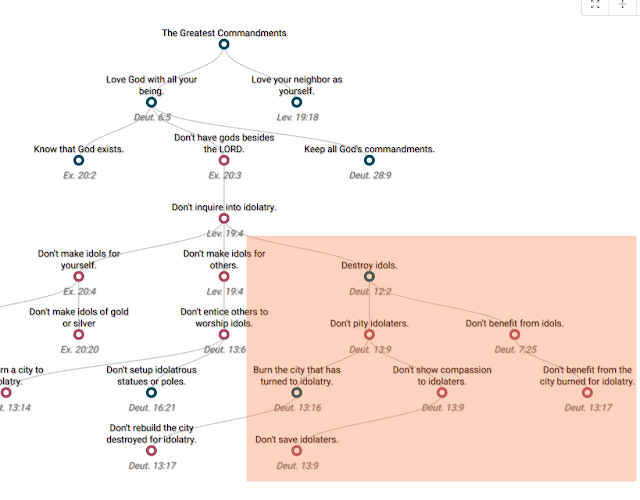
As part of EtzMitzvot, every Tuesday I add more commandments to the visual tree. This week I added the highlighted commandments concerning idolatry:

Specifically these commandments:
  • Don't pity idolaters.
  • Don't show compassion to idolators.
  • Don't save idolators.
Whew - "don't pity", "don't show compassion", and "don't save them" - harsh! Certainly not politically correct. Maybe even counterintuitive to what many Christians understand to be God's character. 

But it nonetheless is God's character to hate idolatry. Historically, idolatry nearly destroyed Israel on multiple occasions. The Torah's harsh prohibitions on idols reflects God's character: it shows God's deep love and care for His people. God doesn't want His people to turn to delusions, sexual immorality, or self-harm, and the Canaanite cults involved all three.

These 3 commandments are one of several idolatry commandments that Maimonides derives from the Torah, and all three are based on Deuteronomy 13:7-10:

“Suppose your brother—your mother’s son—or your son or daughter, or the wife of your bosom, or your best friend of your own soul misleads you secretly, saying, ‘Let’s go and serve other gods’—that you and your fathers have not known, from among the gods of the peoples around you, near you or far off from you, from one end of the earth to the other. You are not to give in or listen to him, your eye is not to pity him, and you are not to spare or conceal him. Instead, you will surely put him to death. Your hand should be the first against him to put him to death, and afterwards the hand of all the people. You are to stone him with stones to death because he tried to entice you away from Adonai your God, who brought you out from the land of Egypt, from the house of slavery. Then all Israel will hear and be afraid, and never again will they do such an evil thing as this in your midst.

In essence, anyone who tells Israel to turn to other gods receives the death penalty. No citizen of Israel can hide an idolater, pity him, save him from penal judgment. Instead, he is to be stoned to death.

This commandment was given at a time and context where the nations were worshiping figurines of gold and silver, sacrificing humans to gods. The Canaanites were self-mutilating to worship Baal and engaging in temple cult prostitution, homosexuality and bestiality as forms of Asherah worship.

A Canaanite tablet from 1300 BC depicting Asherah, a Canaanite goddess whose worship appears repeatedly in the Tenakh. It is this sort of idolatry ancient Israel was surrounded with. God's commandments in the Torah were mean to prevent such idolatry.

To the original Israelite audience of the Torah, these prohibitions on idolatry would have been clear: worshiping Baal and Asherah is forbidden under threat of death.

What do commandments about idols have to do with modern Judaism and Christianity? Much, it turns out.

Some forms of Orthodox Judaism misapply these commandments to forbid Christianity and persecute Christians.

Chabad, for example, reinterprets these commandments as prohibitions on "missionaries" and "missionizing":


Suddenly, the commandments about not worshiping idols like Asherah now apply to Christians following the God of the Bible through the Jewish Messiah from Nazareth.

It is no wonder that some Jewish religious extremists have harassed Jewish followers of Jesus: barging into Christian events with bullhorns, denying or revoking citizenship of Jewish Christians in Israel, planting bombs at the homes of Messianic leaders. In the eyes of some religious extremists, people who call the Tenakh their Bible, call on the God of Israel, and follow the Jewish man from Nazareth are idolaters and missionizers.

I understand why some hardline Jewish religionists believe that. I understand how they misapply it to Christians. To them, Christians aren't following God, they're following a false god named Jesus. (Some religious Jews are more nuanced and will say that Christians are following God plus another entity besides God.)

The reality is hard to understand but nonetheless true. Christians are following only one God, the God of the Bible. 

God sent Jesus to bring humanity to Himself. He provided atonement and forgiveness of sins just before the Temple and Levitical system was destroyed. God revealed that Jesus is not merely a man, but an appearance of Himself, not unlike how God appeared to Abraham. This is not two or three gods, as Islam and Judaism misunderstand. God, Messiah, and the Spirit of God are not 3 gods. It is one God.

This is why Christians have no problem with Jesus saying that the Shema -- "Hear O Israel, the LORD our God is one" -- is the most important commandment. God is one, and the most important commandment is to worship him alone. 

If Jesus is a different god, as some parts of Judaism and Islam believe, then indeed it's right to apply these anti-idolatry commandments to Christians.

But if Jesus is an appearance of God, and there's only one God, then worshiping that one God is right, and applying these Torah commandments against Christians is a grave misinterpretation and perversion of the Torah.

Nuance and mystery in the divine messiah perspective

As followers of the Jewish messiah and students of the Bible, we have come to an understanding of the messiah’s identity that is more exalted than modern Jewish views of the messiah.

Modern Judaism says messiah will be a great man and king, but not God.

Yet it is our conviction that Messiah was an appearance of Hashem, not unlike how God appeared to Avraham:

Then Hashem appeared to him [Avraham] at Mamre’s large trees while he was sitting in the entrance of his tent during the heat of the day. When Avraham lifted up his eyes to see, suddenly, three men were standing right by him.

In this passage from the Torah, the Hebrew text literally reads that Hashem appeared to Avraham:

image

imageHow did God – who is infinite and incomprehensible to the human mind, without form or flesh – show himself? Given that no man has ever seen the face of God and lived, given that mountains melt like wax before the presence of God, given that if God raises his voice the earth disappears, given the whole vast expanse of the universe can’t contain him, how could God possibly appear to Avraham?

He did it by sending a comprehensible appearance and representation of himself.

Were they merely angels? 

They were angelic beings, yes. And yet, again the Hebrew text tells us there is more here: one of the 3 figures is identified as Hashem himself, and it is Hashem speaking to Avraham:

And Hashem said unto Abraham: 'Wherefore did Sarah laugh, saying: Shall I of a surety bear a child, who am old?

(Again, the Hebrew text literally uses the sacred name, Yud-Hey-Vav-Hey; it’s Yahweh speaking to Avraham.)

And when Avraham responds, he does so knowing it is Hashem he is speaking to.

Let’s stop in the story for a moment and ask – if Avraham bowed down and worshiped this human-comprehensible representation of God, would it be idolatry? After all, we are to worship God alone.

But in the text we read that Avraham pleads – as one would in prayer – with the human-comprehensible representation of Hashem, and even begs him to forgive sin:

And the men turned from thence, and went toward Sodom; but Abraham stood yet before the LORD. And Abraham drew near, and said: 'Wilt Thou indeed sweep away the righteous with the wicked? If there are fifty righteous within the city; wilt Thou indeed sweep away and not forgive the place for the fifty righteous that are therein?

He pleads with this human-comprehensible representation of Hashem. The Hebrew text doesn’t even phrase it so awkwardly; it simply says, Avraham pleaded with Yud-Hey-Vav-Hey standing before him.

The Orthodox Jewish world today tries to avoid saying this figure is an appearance of God. This isn’t actually Hashem, they’ll say, it’s an angelic representative, or even perhaps the Angel of of the Lord, a mysterious figure who acts on behalf of the one God.

But it doesn’t actually matter for our purposes here. Look at what the text says of the one who appeared to Avraham:

  • He was a servant of Hashem.
  • He spoke on behalf of God with God’s authority.
  • He accomplishes God’s purpose.
  • He pardons sin.
  • He was addressed as God himself.
  • He was a human-comprehensible appearance of Hashem.
  • Yet, there is distinction between this appearance and Hashem himself.

This is not unlike how we Messianics and Christians see Messiah.

In the gospels and the New Testament,

  • Messiah is a servant of Hashem.
    “This is My servant, in whom I am well pleased.”
     
     
  • Messiah spoke on behalf of God with God’s authority.
    “You have heard that it was said, ‘You shall not commit adultery.’ But I tell you that everyone who looks upon a woman to lust after her has already committed adultery with her in his heart... Now when Yeshua had finished these words, the crowds were astounded at His teaching, for He was teaching them as one having authority and not merely as a Torah scholar.
     
  • Messiah accomplishes God’s purpose.
    “I have placed you as a light to the nations, so that you may bring salvation to the ends of the earth.”
     
  • Messiah pardons sin.
    ”The Messiah is to suffer and to rise from the dead on the third day, and that repentance for the removal of sins is to be proclaimed in His authority to all nations, beginning from Jerusalem.”
     
  • Messiah is addressed as God himself.
    “Thomas said to Messiah: ‘My Lord and my God!’”
     
  • Messiah is a human-comprehensible appearance of Hashem.
    “For in Messiah dwells the fullness of God.”
     
  • Yet distinction exists between Messiah and Hashem.
    “For this reason God highly exalted Messiah and gave Him the name that is above every name, that at the name of Yeshua every knee should bow, in heaven and on the earth and under the earth, and every tongue profess that Yeshua the Messiah is Lord to the glory of God.”

While there are differences between “Hashem appearing to Avraham” and “Hashem appearing as Messiah”, there are shared implications: God can appear in whichever form he chooses – he is not limited by Orthodox theology - and secondly, that form has the authorization and power of God.

One additional item we can extract here is the distinction between Hashem and his human-comprehensible representation.

Notice in that last bit, God and Messiah are distinct: God is making Messiah highly exalted; it’s not God making God highly exalted.

If we simply say that there is no distinction between God and Messiah, this Scripture would be nonsensical; “For this reason, God highly exalted God and gave God the name above every name.” Non sequitur.

Acknowledging there is a distinction between God and Messiah, we see that Messiah is a servant of Hashem: God exalts Messiah. And for what purpose? So that Hashem receives glory from all nations: “to the glory of God our Father.”

All nations submitting to Messiah, Messiah submits to God, and in this way, all nations will be in submission to the God of Israel.

There is distinction here between God and Messiah, and yet Messiah is one with God.

This nuance and mystery causes Christian people to be uncomfortable. Can we really say Messiah is God if there is a Scriptural distinction?

Yes.

In the same way that Avraham addressed his heavenly visitor as Yahweh himself, so also we can say that Messiah is God.

While there was distinction between Avraham’s divine guest and Hashem – after all, the figure was flesh and bones and Hashem is not a man – Avraham still addressed the figure as Hashem himself. So we too address Messiah as Lord to the glory of the God of Israel.

7 things we know about Yeshua from non-Biblical sources

Intellectually dishonest atheists and anti-missionaries will claim there is no evidence outside of the New Testament for the historical Jesus.

The reality is, multiple witnesses attest to the person of Jesus in Israel in the 1st century, with followers from Israel and eventually the nations worshiping him as both Messiah and God.

The Great Cloud of Witnesses blog has assembled a nice list of early evidence of Messiah and his followers outside the New Testament, supplemented here with quotations.

  1. Yeshua was executed in Judea during the period when Tiberius was emperor (A.D. 14-37) and Pontius Pilate was governor (A.D. 26-36).  Tacitus [Annals 15.44.2-5]
    Nero fastened the guilt and inflicted the most exquisite tortures on a class hated for their abominations, called Christians by the populace. Christus, from whom the name had its origin, suffered the extreme penalty during the reign of Tiberius at the hands of one of our procurators, Pontius Pilatus, and a most mischievous superstition, thus checked for the moment, again broke out not only in Judaea, the first source of the evil, but even in Rome, where all things hideous and shameful from every part of the world find their centre and become popular. Accordingly, an arrest was first made of all who pleaded guilty; then, upon their information, an immense multitude was convicted, not so much of the crime of firing the city, as of hatred against mankind. Mockery of every sort was added to their deaths. Covered with the skins of beasts, they were torn by dogs and perished, or were nailed to crosses, or were doomed to the flames and burnt, to serve as a nightly illumination, when daylight had expired. Nero offered his gardens for the spectacle, and was exhibiting a show in the circus, while he mingled with the people in the dress of a charioteer or stood aloft on a car. Hence, even for criminals who deserved extreme and exemplary punishment, there arose a feeling of compassion; for it was not, as it seemed, for the public good, but to glut one man's cruelty, that they were being destroyed.
  2. The movement spread from Israel to the nations. Tacitus [Ibid.]
  3. His followers worshipped him and sang hymns to him “as to a god.” Pliny [Letters from Bithynia, c. A.D. 110]
    They asserted, however, that the sum and substance of their fault or error had been that they were accustomed to meet on a fixed day before dawn and sing responsively a hymn to Christ as to a god, and to bind themselves by oath, not to some crime, but not to commit fraud, theft, or adultery, not falsify their trust, nor to refuse to return a trust when called upon to do so. When this was over, it was their custom to depart and to assemble again to partake of food--but ordinary and innocent food.
  4. He was called “the Messiah.” Josephus [Antiquities 20.197-203—an undisputed passage]
    Festus was now dead, and Albinus was but upon the road; so he assembled the sanhedrin of judges, and brought before them the brother of Jesus, who was called Christ, whose name was James, and some others, [or, some of his companions]; and when he had formed an accusation against them as breakers of the law, he delivered them to be stoned.
  5. In Roman lingua franca, Yeshua’s followers were called “Christians.” Tacitus, Pliny [see above]
  6. They were numerous in Bithynia and Rome. Tacitus, Pliny [see above]
  7. His brother was James. Josephus [see above]

Problematic for the atheist and anti-missionary, these historical, often secular accounts of Jesus align with the New Testament’s record.

What we know about the deity of Messiah

The deity of Yeshua – the idea that Jesus is God – is a stumbling block for some, particularly religious Jews who believe the messiah will be human only.

Here’s an example from the other week, where well-known Jewish blogger DovBear objected to the idea that Yeshua has turned gentiles to the God of Israel. Why? Because he believes gentiles don’t worship the God of Israel, they just worship Jesus:

image

(I didn’t continue the conversation; Twitter is not a great place for theological digging.)

Many religious Jews see Christians this way: not worshiping the God of Israel, Judaism’s God; instead they worship Jesus!

If the divinity of Messiah is such a stumbling block to Jews, is there budging room in Messianic faith to allow for a non-divine Jesus? Are we misinterpreting the New Testament, retroactively reading into it the deity of Messiah?

The Messiah's relationship to God is, I think, largely mystery, with the gospels giving us only hints of understanding.

But there are some things we can say for sure:

  • Messiah is called 'God' in the gospels. The apostle Thomas, upon seeing Messiah raised from the dead, says to Yeshua, “My Lord, and my God!” If Messiah was not divine, but only a human prophet, this was the time for Messiah to rebuke Thomas for erroneously calling him “God”, yet Messiah instead said, “Blessed are those who believe without seeing.”
  • Messiah is worshiped in the gospels by his disciples. If Yeshua was not God, he would have objected to being worshiped.
  • Messiah is worshiped in heaven by all creation, according to Revelation. Again, Messiah/God doesn’t object to being worshiped. Contrast this with Revelation 22, where John bows and worships an angel, who rebukes him saying, “Do not! I’m only a servant like you. Worship God alone!”
  • John’s mystical introduction in his gospel calls Messiah “God”: “In the beginning was the Word, and the Word was with God, and the Word was God. He [Messiah] was with God in the beginning, and through Him  all things were made.”
  • Paul’s epistles are more silent on the matter, much to the chagrin of Jewish anti-missionaries who often claim Christianity was invented by Paul. But we do have evidence of the deity of Yeshua in Paul’s letters: he records that every knee will bow to honor Messiah, and every tongue confess that Messiah is Lord, and again that “In Messiah is the fullness of the Godhead in human form.”
  • In Revelation, the Messianic throne of the Lamb and the throne of God are one and the same. Worship is directed to “Him”, singular.

Bottom line: the New Testament supports the idea of Messiah's deity; including worship directed to Messiah.

Either that's idolatry, or Messiah is God. 

We cannot be faulted for worshiping Messiah; it’s intrinsic to the New Testament. We cannot be faulted for putting an unnecessary stumbling block in front of Jewish people; it’s actually a necessary part of our faith!

In fact, the issues of the deity of Messiah is a crux of Messianic faith: if Yeshua is not God, and we worship him, then it’s idolatry. But if Yeshua is God, and we refuse to worship him, then it’s blasphemy. Getting this understanding right is crucial, then: veering off to the left being a form of blasphemy, off to the right being a form of idolatry. The gospels show a proper path, one that includes worship of Messiah.

Simply put, according to the New Testament, Messiah is God.

Is Messiah part of God? All of God? Fully God in human form? One of 3 persons of God? One God but many forms? I think that's where it gets fuzzy/mystical, and the New Testament is largely silent; the term “trinity” doesn’t appear in the New Testament. I don't believe we should take hard positions on issues where the Scriptures leave wiggle room.

What we can say for certain is, Messiah is Lord, God, and worthy to receive worship.

Jesus as Messiah-but-not-God doesn’t work, leads to apostasy

Is it kosher to believe Jesus is the Messiah, but not God?

Messianic Jewish trouble-maker blogger Gene Shlomovich asks the question over at Daily Minyan, relaying a story of a woman who’s troubled by her husband’s belief that Yeshua is Messiah but not God:

You see, my Jewish husband (who is from Israel) believes that Jesus is the Messiah of Israel through whom God redeems and saves, but he refuses to believe that Jesus is God too. My husband is adamant that he will not accept this belief. I don’t know what to do – I don’t want him to be lost.

My response:


My younger brother went down this exact path. He has now denied Yeshua and converted to Orthodox Judaism and lives in an Orthodox community in Israel. He now sends me Jews For Judaism material which attempts to persuade listeners to abandon their silly beliefs in Jesus.

Look. The gospels and the epistles and Revelation set Yeshua’s place as divine son of God, glorified, sitting on the throne in Heaven, one with the Father, all power given to Him, all creation bows and worships Him. Any student of Torah will know either that’s idolatry, or Yeshua is God.

Throw away that crux, and there’s very little to keep you following Yeshua. Throw away that central truth of the gospels, and there’s little that can’t be thrown out. From this position, it’s not too far a leap to say Yeshua is optional. And once optional, the option to discard Messiah is on the table. It becomes very attractive to say, “Let’s just be quiet about that Yeshua stuff and join with the greater Jewish world.”

As one Messianic Jewish blogger wrote last year in his final post, “Judaism is more important to me than Yeshua”, announcing he no longer believed Yeshua was God or Messiah, and that he was leaving the faith.

This woman’s husband has abandoned a central crux of the New Testament – the divinity of Yeshua – and may well be on the path to denying Yeshua altogether. It would not surprise me to see this man leave the faith within two years.


Yeshua’s divine status has long been the stumbling block, especially for Jewish people. (Heck, Isaiah prophesied as much, so it shouldn’t be a surprise.)

I wrote back in 2009 that as long as Yeshua is Lord, the Jewish world won’t accept Messianics. The divinity of Yeshua is the ultimate point of tension between Jewish and Christian worlds, and 2012 has seen at least | 3 | books on the topic from both sides. I predict we’ll see an increase in this tension in the next few years, as this modern mending of Jewish-Christian relations continues to grow fruit.

(By the way, I think it’s God at work, it’s a marvelous thing, and I can’t wait to see where this ends up.)

But even today, with the great move God is doing in Jewish-Christian relations, with Christians alone supporting Israel and loving Zion when Zionism has become a dirty word, and on the other side with Jews beginning to ease suspicions of Christians, the stumbling block of Yeshua’s divinity remains.

You see it in R. Shmuley Boteach’s book, Kosher Jesus. In that book, Boteach argues Jesus was a great Jew, and a righteous teacher, a Jewish revolutionary, and all these wonderful things, everything…except divine. Boteach can’t say Jesus was divine, because it would mean that Shmuley would have to, with the rest of creation, bow to Yeshua and worship him. Someday, maybe, but not in Kosher Jesus.

Likewise for the recent books by Jewish scholars like Daniel Boyarin and others – great statements about Yeshua, or even closer, the authentic Jewishness of the idea of a divine Messiah. But today, if a Jewish person says Yeshua is divine, well, they have crossed the line into Christianity. If Jesus is God, you’re a Christian. That’s something both Jews and Christians agree on.

Naturally, some Messianics will try to smooth over that stumbling block. Some of us will find nice ways to say Jesus was something less than what the gospels make him out to be. We’ll “explore” his divinity, we’ll come up with elaborate and mystical ways to muck up the clear statements in the New Testament regarding Yeshua’s identity. We’ll cite respected sages and extra-biblical writings and give lip service to Yeshua as an agent of God, but not God himself. We’ll say he’s Savior, King, Messiah, First, Last…but not God. We’ll intellectualize away the Word Made Flesh, and we’ll study ourselves out of belief in Yeshua as divine Messiah and Son of God. That will happen, but it’s going to be done by people who seek acceptance by men rather than God. A lot of them will realize that you can’t really have 2 Kings, 2 saviors, 2 firsts and lasts, 2 creators, 2 gods. A lot of them will lose faith and take others with them.

Don’t be disturbed by it. God is going to roll over all that junk, and something big and grand will result.

And I think that’s where we Messianics – Messianic Judaism folks, Jewish Christians, and even Hebrew Roots folks – that’s where God is going to use us. I’m excited for what God’s going to do! I’m excited to see how this is all going to play out. It’s already getting interesting, even now, in 2012. And it might be a long ways away, but sooner or later, it’s going to end with Yeshua reigning in Jerusalem, the new city descended from heaven, and its King, Yeshua, shining like the sun.

That’s what I’m looking forward to, friends.

To the Kingdom and its eternal King.

Until then, folks, let’s hold on tight to Yeshua and the commandments, and I think we’ll be alright.

God In Human Form

As I stated in my 2008 Oxford debate on the incarnation with Rabbi Shmuley Boteach, “Can Jews believe Jesus is God?

If by the question you mean could God, who is complex in His unity, sit enthroned in heaven, filling the universe with His presence, infinite and uncontainable in His majesty, and yet at and one and same time manifest His glory among us in the tent of a human body for thirty-three years, then the answer is categorically yes, and there is nothing idolatrous about this belief at all.

In fact, it is harmony with the Hebrew Scriptures, even explaining some of the mysteries of our own Bible, and on some level it has parallels with rabbinic concepts. In fact, in the midrash to Psalm 91 it is written, “At [the moment that Moses finished building the Tabernacle], a great question arose: How could a Tabernacle with walls and curtains contain the Presence of the Almighty? The Master of the Universe Himself explained, ‘The entire world cannot contain My glory, yet when I wish, I can concentrate My entire essence into one small spot. Indeed, I am Most High, yet I sit in a [limited, constricted] refuge – in the shadow of the Tabernacle.’

-Dr. Michael Brown at the Borough Park Symposium

Affirming Kinzer

The other day, I drew attention to the beliefs of one of our Messianic leaders, Mark Kinzer. In particular, the belief that we ought to welcome Yeshua-denying Jews in our midst.

Meanwhile, you mean, lazy, stupid fine blog readers assumed I was taking a dump on one of our scholars.

  • Derek Leman implied I was a kindergartener who can’t write about Yeshua’s divinity myself.
  • Gene Shlomovich said I was trying to cast doubt on Kinzer’s devotion to Yeshua.
  • Michael Schiffman said I was bordering on Lashon Hara and going on a witch hunt.

Since you all read me totally wrong, and in the worst possible way, and assuming the worst of me, let me make it plain as dirt:

Mark Kinzer is a disciple of Yeshua who upholds 2 principles that define us in the Messianic movement:

  • The deity of Yeshua
  • The legitimacy of the Torah

Or in layman’s terms, Yeshua is God, and God’s commandments are in effect, and these two things are the core of Messianic Judaism.

I affirm both of those.

Praise God for faithful disciples like Mark Kinzer.

Clear?

Kinzer holds a number of beliefs -- Bilateral Ecclesiology and the Documentary Hypothesis, for example -- that I categorically reject. (I’m not alone.)

But he’s a disciple of the Lord, and I don’t lose sight of that.

#WhatOurLeadersBelieve, Kinzer edition

KinzerAs part of the bilateral ekklesia, we refuse to accept the Jewish community's negative doctrinal boundary marker, just as we refuse to accept the Christian community's negative boundary marker dealing with our covenantal practice of the Torah. (Once again, we realize the significance of our hermeneutic of dialectical ecclesial continuity.)

But should we exclude from our midst those Messianic Jews who adhere to these negative boundary markers, i.e., who deny the deity of Yeshua, or who deny the covenantal obligation of Torah? I am not convinced that we should.

Affirmation of the deity of Yeshua and affirmation of the covenantal obligation of Torah observance for Jews are the two central principles of our communal existence, and we can rightly require that our leaders uphold them. They are our center, but they need not constitute our outer boundary.

-Mark Kinzer, leader of the Messianic Jewish Theological Institute (MJTI), from a paper given at the Hashivenu forum

What Kinzer is arguing for is that Messianics who deny Yeshua is God should be accepted in Messianic congregations.

While that is being debated, it’s important to note that this same group, MJTI, loudly argues that other Messianic communities, such as One Law and Two House Messianics, should be excluded from the Messianic movement. 

To put it succinctly, MJTI argues Messianics who deny Yeshua’s divinity are OK, but Yeshua-faithful Messianics who broaden the application of Torah, or who broaden the composition of Israel, are Not-OK.

It it times like these that I am thankful to God that intellectuals do not run the Messianic movement. I am thankful that regular folks of the Messianic movement, God’s sheep, are shepherded not by the intellectuals, but by Yeshua himself.

Custom comments