Import jQuery

Showing posts with label historical Yeshua. Show all posts

How sure are we that Jesus' real name is Yeshua? (And not Yeshu?)

I had an interesting conversation this week with some Jewish folks over Twitter. It started with an open-ended question: Almost immediately I thought of Jesus. No Jewish families name their kids "Jesus!" 😊 I knew that reply would come up. And sure enough:

But that's a bit oversimplified, isn't it? "Jesus" isn't Jesus' real name. His parents and contemporaries would have called him by his real name. And there were no hard "J" sounds in 1st century Hebrew or Aramaic. His real name couldn't have been "Jesus" - the language didn't support it!

I replied,

This has been my long held understanding. Someone pushed back:


Here, Chanan asserts with great snark that Jesus' real name was Yeshu ישו. Is he right?

For sure, Jews today call him Yeshu. And Israelis in general do as well. Most Israelis call him Yeshu ("YEH-shu), though Messianic Jews everywhere call him Yeshua (yeh-SHU-ah). Not long ago, Israeli Prime Minister Benjamin Netanyahu was giving a speech in Hebrew about Jewish and Christian friendship in Israel. During the speech, he referred to Jesus as Yeshu.

Does it matter? Not in significant ways. But it's worth finding out the truth.

Revisiting how the name was given, look at Matthew 1, the very first chapter of the Gospels:

Now the birth of Jesus Christ took place in this way. When his mother Mary had been betrothed to Joseph, before they came together she was found to be with child from the Holy Spirit. And her husband Joseph, being a just man and unwilling to put her to shame, resolved to divorce her quietly. But as he considered these things, behold, an angel of the Lord appeared to him in a dream, saying, “Joseph, son of David, do not fear to take Mary as your wife, for that which is conceived in her is from the Holy Spirit. She will bear a son, and you shall call his name Jesus, for he will save his people from their sins.”

It's that last line we should pay attention to. It's a sentence that doesn't make much sense in English. Call his name "Jesus" because he will save his people from their sins? In English, that doesn't follow; what does this name have to do with saving people?

But in Hebrew this makes a bit more sense. 

Summarizing Ernest Kline's A Comprehensive Etymological Dictionary of the Hebrew Language:

The name [Jesus] is related to the Biblical Hebrew form Yehoshua`(יְהוֹשֻׁעַ‎), which is a theophoric name first mentioned in the Bible in Exodus 17:9 referring to one of Moses' companions and his successor as leader of the Israelites. This name is usually considered to be a compound of two parts: יהו‎ Yeho, a theophoric reference to YHWH, the distinctive personal name of the God of Israel, plus a form derived from the Hebrew triconsonantal root y-š-ʕ or י-ש-ע "to liberate, save". There have been various proposals as to how the literal etymological meaning of the name should be translated, including:

  • YHWH saves
  • YHWH is salvation
  • ...etc
So the Scripture becomes, "You should call his name [YHVH saves] because he will save his people from their sins."

That makes good sense. Salvation and saving people are closely related. In the Hebrew Bible, when the psalmist cries out for salvation from his enemies, he's asking God to literally save him from death. 

In the New Testament, the meaning of salvation is expanded to include participation in the Messianic era, the Kingdom of Heaven. The people who follow Jesus as God's messiah will be raised from the dead. They're saved from death. Salvation, saving people, the name "Yeshua." It all clicks together.

What about "Yeshu"?


So where does this "Yeshu" come from? From two possible sources: the Talmud and language evolution.

The Babylonian Talmud, finalized a few hundred years after Yeshua's life, contains a disturbing reference to a figure named "Yeshu". It's believed by many to be referring to Jesus. In the story, a man uses necromancy to summon the spirit of a dead man, Yeshu, who is being punished for his crimes in hell. Many scholars think this "Yeshu" figure is intended to be Jesus of Nazareth. The passage may have been written as an anti-Christian polemic response to the Church of the 400s, which was fully engulfed in anti-Jewish polemics. The Church's anti-Semitism may have spurred the final editors of the Babylonian Talmud to include such a story to warn religious Jews against following Jesus of Nazareth as the Jewish messiah.

Others have noted "Yeshu" may be a derogatory acronym in the Talmud. Y S U corresponding to the Hebrew letters י-ש-ו (yud, shin, vav) as an acronym for ימח שמו וזכרו(נו): Yimakh shemo v'zichrono / may his name and his memory be erased. And there is some evidence to support this. In one passage in the Babylonian Talmud, Yeshu is written with special punctuation marks to indicate it's an acronym. But there are other places in the Talmud where Yeshu is written without the punctuation marks, so it's uncertain.

Another possible source for "Yeshu" is language evolution. The name "Yeshua" ends in a double vowel sound: "ooh-ah". This diphthong may have been shortened to a single vowel sound as Hebrew and Aramaic evolved, shortening Yeshua to Yeshu.  Some language scholars have suggested certain dialects of Hebrew and Aramaic dropped the sound of the final letter ע‎ (ayin), which had no counterpart in Koine Greek. For example, Biblical scholar Hugh Schonfield argues in The History of Jewish Christianity that northern dialects of Hebrew and Aramaic dropped the final ayin sound in their pronunciation of Yeshua, resulting in Yeshu. 

And it's not uncommon for language to evolve like this. Even in the Hebrew-speaking world today, there are multiple strains of Hebrew. For example, one strain pronounces the word "sabbath" as the Hebrew word "shabbat" שבת, but another pronounces it as "shabbas". And that's because the two strains diverged in pronunciation of an ending Hebrew letter ת: one strain uses pronounces it with a "t" sound, another with an "s" sound.

My unimportant layperson opinion: It's reasonable to imagine an early Christian community comprised of Greek and Hebrew/Aramaic speakers simplifying terms that cross languages. And by the time the Babylonian Talmud was finalized, Jewish anti-Christian works assigned a derogatory acronym to this already-establish pronunciation of "Yeshu."

James Ossuary


One artifact from the historical record, the James Ossuary, suggests Jesus' name was originally Yeshua ישוע, not Yeshu ישו.

Experts agree this bone box is from 20-70 AD. However, experts are conflicted about the authenticity of the inscription on the box. The Aramaic inscription reads: 

יעקוב בר יוסף אחוי דישוע

Transliterated: 
Ya'akov bar Yoseph achui d'Yeshua

Translated:
Jacob (James) son of Joseph, brother of Yeshua

A picture of the James Ossuary with the inscription on the side.

A better view of the inscription, courtesy this paper on the authenticity of the James Ossuary inscription. The paper argues that both the ossuary and its inscription are authentic to the 1st century.


A magnified closeup of the inscription on the James Ossuary. The final ע ayin in ישוע (Yeshua) is clearly visible on the left.


If authentic, this inscription would suggest the person whose bones were in the box was remarkable because his brother was a man named Yeshua. We know that James, the half-brother of Yeshua, was actually called Ya'akov or Jacob. This means this ossuary may have held the bones of James the Just, brother of Jesus.

More relevant to our investigation here, it strengthens the case of Jesus' original name being Yeshua rather than Yeshu.

How did we get the name "Jesus"?


This question is less controversial. It's widely agreed by language scholars, Bible scholars, and historians that his original name went through several language transliterations and evolution to get to "Jesus".

In short:

  1. Hebrew/Aramaic: ישוע. This was likely the name given to Jesus of Nazareth at his birth. It makes the passage in the Gospels, "You shall call his name Yeshua because he will save his people from his sins", actually make sense, as the name in Hebrew means "YHWH saves".
  2. Koine Greek Ἰησοῦς (Iēsous). As Christianity spreads outside of Judea, Greek is the vehicle for widespread understanding of the Gospel. In translating the Hebrew ישוע to Greek, translators translate the name letter-by-letter, filling in close approximations where necessary. Greek had no ש (Hebrew letter shin) "sh" sound, so they translated it with the Greek letter σ sigma. They add an final sigma ς as well for a masculine, singular ending.
  3. Middle English: Iesu. From 1000-1400 AD, English speakers took the Greek Iesous and the Latin IESVS into the English Iesu, a rather straightforward hop. By the 15th and 16th century, English began to distinguish the "J" sound from "I". (Remnants of this old name still exist, e.g. the hymn Jesu, Joy of Man's Desiring.)
  4. Modern English: Jesus. The first King James Bible, published in 1611, still had "Iesus". But by the end of that century, the English "J" entered common use. Iesus becomes Jesus.
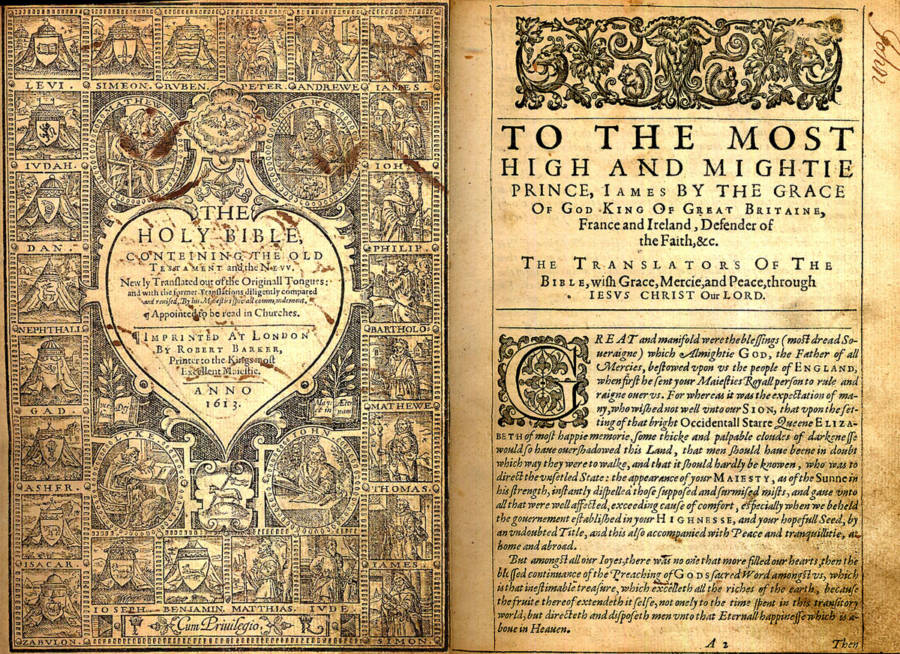
The original 1611 King James (Iames?) Bible, with "I" instead of "J". Left page, top right, renders James as "Iames".

Hebrew Roots hallucinations of the name


It's worth addressing two other claims I've heard in relation to the name of Jesus inside Hebrew Roots Christianity: Zeus and "Yahshua."

Zeus: A fringe theory in the Hebrew Roots world claims the name "Jesus" is supposedly a form of the Greek "Zeus". This is simply not supported by evidence. The Greek term for Zeus doesn't sound like the later English Jesus, and there is no historical or textual evidence supporting the name "Jesus" deriving from the Greek word for Zeus. It's just paganoia run amok, untouched by reality. 😄 

Yahshua: The name "Yahshua" and its variants are not supported by the evidence. To my knowledge, there is no written record of that name anywhere in antiquity. It's an attempt by Hebrew Roots Christians to insert the divine name of God into the Messiah's name, but without understanding of Hebrew language rules. As discussed above, Yeshua ישוע already means "YHWH is salvation." There is no need to inject the divine name into it, it's already there.

Conclusion


Did we answer the question in the post? How sure are we that Jesus' real name is Yeshua?

The evidence favors Jesus' original name to be either Yeshua or its longer form Yehoshua. Language evolution and polemics are probably responsible for "Yeshu". If I had to put a percentage on it, I'd say I'm 85% certain that Jesus' original name was Yeshua, not Yeshu.

Yeshua/Yehoshua fits best with a name given to mean "saving people from their sins." 

It seems to fit better with the transliteration into Greek. (Any New Testament Greek students reading? I'd love to hear your opinion.)

Yeshu was likely a shortened version of Yeshua/Yehoshua, driven by dialects of Hebrew/Aramaic that lost pronunciation of the ending ע ayin, shortening the diphthong "ooh-ah" to "ooh". It may have been especially driven by Christian communities containing both Aramaic and Greek speakers, where Greek didn't support the precise vocal sounds that Hebrew and Aramaic have.

Yeshu may have been driven by Jewish anti-Christian polemical works. A derogatory acronym was ascribed to ישו (YSU), which may have been a common Aramaic pronunciation of the original name by the 4th century. It gets written in the Babylonian Talmud during its finalization stage during the 400-500s AD. This in turn influences modern Judaism and Israelis today to use "Yeshu" to refer to Jesus.

It's possible we're wrong, and that Yeshu was the original. (It's even possible, as certain Church fathers asserted, that the Greek name Iesous was the original!) But this seems unlikely given the textual, linguistic, historical, and archeological evidence.

Does it matter?

With regards to faith, it doesn't really matter! I'm quite certain that God knows whom we speak of when we call his son by Jesus, Jesu, Yeshua, Yeshu, Yehoshua. (Or even the made-up, not-actually-Hebrew name "Yahshua".)

With regards to truth and accuracy, I suppose it matters to some extent. It is interesting and perhaps useful to know the real name of the most influential Jew who ever lived, whom we revere as the Messiah and Son of God. Yes, that's worth knowing, even if it doesn't ultimately matter in daily faith practice.

AltJT: Test your Jesus Theories in the book of Acts, and what we can learn about Paul’s Torah observance

Author and blogger Lois Tverberg has a great idea: test your “Jesus theories” in the Book of Acts. Let’s call it the Acts Litmus Test for Jesus Theories. AltJT.

AltJT goes like this: your ideas about Jesus are probably colored by your very existence in a foreign culture 2000 years removed from Jesus.

Therefore, to test whether your ideas about Jesus have any merit, you should find evidence of it in the actions of Jesus’ disciples and the early Christian community.

Where can we find evidence of the actions of the early Christian community?

Well, it just so happens we have a book for that: Acts, i.e. The Book of Recorded Actions of the Disciples of Yeshua.

(I love literal names like that. Like Snakes on a Plane, there’s no mistaking its contents.)

Bottom line: your ideas about Jesus should be supported in the Book of Acts. This is the Acts Litmus Test for Jesus Theories, AltJT.

Tverberg elaborates,

bible&candleThere’s no end, it seems, to how people can interpret the words of Jesus. It’s not hard to pluck out a line here and there and read it in some strange new way. How can we know how they actually sounded to his original audience?

I’ve discovered that a great place to look for answers is in the book of Acts. The people there were first-century believers who heard Jesus firsthand. No time had elapsed for his words to be reinterpreted, and his first followers were passionate for living them out. It’s not unreasonable to conclude that what the early believers did (or at least tried to do) was what Jesus taught.

She crystalizes this with an example where popular Christian preacher John MacArthur has a Jesus Theory. Let’s call it the Jesus Killed Judaism Theory. It goes like this:

“He [Jesus] obliterated the sacrificial system because He brought an end to Judaism with all its ceremonies, all its rituals, all its sacrifices, all of its external trappings, the Temple, the Holy of Holies, all of it.”

-John MacArthur

But if we apply the AltJT, we see disciples of Yeshua still partaking in the sacrificial system, meeting in the Temple courtyard, still practicing the feasts, and so on.

If MacArthur’s theory about Jesus obliterating Judaism is true, it was lost on the early Christian community.

MacArthur’s theory fails the AltJT test.

44682314Everyone and their grandma has ideas about Jesus. Your liberal college grad will say Jesus was a peacenik. HuffPo will claim Jesus was ambivalent about homosexuality. The President of the United States’ pastor says Jesus was a social liberator. Thomas Jefferson claimed Jesus was merely a reformer. Some Jews will claim Jesus was a good rabbi.

People are gonna have their opinions about the most influential Jew who ever lived. So remember AltJT to see if those opinions have merit.

AltJT and what it can tell us about Paul, Judaism, and Torah observance

I’d like to extend this AltJT idea to theories about Paul. It’s the same idea: Paul was a very influential figure in the early believing community. Most scholars put some of his letters as the earliest books of the New Testament, within 20 some years of the events of the gospels.

Therefore, if your Paul Theory has any merit (i.e. is not just a bunch of new age-y shis conjured up by pampered 21st century minds), you should see evidence for it in the Book of Acts.

A great example of this is a popular, often-repeated idea is the Paul-As-Jesus-Corrupter Theory. It goes like this:

“Jesus might have been a nice Jewish teacher or whatever, but Paul clearly taught Jews to leave Torah. Therefore, he’s responsible for creating this new religion, Christianity, turning Jesus into a god and making it palatable to gentiles.

The other day, this theory reared its ugly head over at the Rosh Pina blog, where a Jewish person who happened to follow the anti-missionary shysters a little too closely regurgitated this theory to me:

“We are explicitly warned from accepting any prophet or dreamer who would take us away from the Torah (Deuteronomy 13v2-6). That obviously includes Paul and, if some of the words put into his mouth by the gospel writers are what he actually said, eg John 14v6, also jc…”

-gila8, a random guy on the internet claiming Paul invented Christianity and teaches Jews to leave Torah

Paul takes Jews away from Torah is the clear implication.

Rabbi Shmuley Boteach’s recent popular book, Kosher Jesus, also makes this argument: Jesus was a fine Jew, but Paul corrupted it all and turned him into a god, inventing Christianity.

Does this theory pass the AltJT test; do we see in the actions of the early Christian community a belief that Paul was drawing Jews away from Torah?

Yes! We actually do see Jewish followers of Jesus who think Paul is doing that, right in Acts 21. (By the way, just reading the story again in Acts 21-23 is absolutely riveting. I’ve read the story many times, but it’s somehow more powerful as I read it today.)

Back in Acts 21, Jews who objected to this Yeshua-as-Messiah message claimed Paul was teaching Jews to abandon the Torah:

Paul, see how many tens of thousands of Jewish believers, and they are all zealous for the Torah. Now what they have been told about you is that you are teaching all the Jews living among the Goyim to apostatize from Moshe, telling them not to have a b’rit-milah for their sons and not to follow the traditions.

The believing Jews ask Paul to prove he is, in fact, doing the opposite: teaching Torah and practicing it himself:

“What, then, is to be done? They will certainly hear that you have come. So do what we tell you. We have four men who are under a vow. Take them with you, be purified with them, and pay the expenses connected with having their heads shaved. Then everyone will know that there is nothing to these rumors which they have heard about you; but that, on the contrary, you yourself stay in line and keep the Torah.

“However, in regard to the Goyim who have come to trust in Yeshua, we all joined in writing them a letter with our decision that they should abstain from what had been sacrificed to idols, from blood, from what is strangled and from fornication.”

The next day Sha’ul took the men, purified himself along with them and entered the Temple to give notice of when the period of purification would be finished and the offering would have to be made for each of them.

Observe what’s going on here: unbelieving Jews are claiming Paul teaches Jews to leave Torah.

(This is very much the same situation today, as noted previously.)

The believing Jews assume Paul is not teaching this, and even ask him to prove the rumors false. Paul carries out their request.

Paul is not teaching Jews to abandon the Torah.

The Paul-as-Corruptor-of-Jesus’-Teachings Theory fails the AltJT test: the acts of the early believers don’t align.

Thus, such theories will have to (and they do!) resort to conspiracy theories, where the New Testament is heavily redacted (but not enough to see the “real” Jesus and Paul under the veneer on which they base their theories – oiy!)

Conclusions and 2 anti-Torah theories that fail the AltJT test

If you have a belief about Jesus, a sticky idea in your head about who Jesus of Nazareth is, see if it aligns with the early Christian community, see if it aligns with the actions of the disciples. It’s our best measuring rod.

Notice 2 examples of Jesus or Paul theories fail the AltJT test:

  • The Christian-created Jesus-Obliterated-Torah theory
  • The Jewish-created Paul-Corrupted-Jesus theory, claiming Paul was anti-Torah and contrary to Jesus’ pro-Torah teachings

Both of these fail the test, and both have one thing in common: the supposed obliteration of Torah and Judaism.

I think the reason for that is, Christians and unbelieving Jews have a desire to believe Jesus-faith necessarily results in Torah obliteration.

The Church wants to believe it because it is now fully divorced from Judaism and is, in fact, a religion apart from Israel-faith.

The Synagogue wants to believe that because it can’t allow the Jewish Jesus out of the box, lest the human-erected barrier between Judaism and Christianity diminish.

But in the end, our ideas and theories must be measured against the Scriptures. The book of Acts – detailing the actions of the early disciples and Yeshua community – is perhaps our best testbed.

And the book of Acts shows the early community had not jettisoned Judaism and the practice in the Temple, nor do we see Paul teaching Jews to abandon Torah.

And best yet, there appears to be a growing chorus of scholarship, Jewish and Christian, acknowledging the reality of Jesus and Paul as Torah-upholders, rather than new religion inventors.

Perhaps this is a step in undoing the divorce of Messiah faith from Israel’s religion. Perhaps this is a step towards the restoration of all things.

Dismantling myths about Jesus and his Judaism

If there ever was a series of posts every Messianic believer should read, it’s Yeshua Reconstructed.

In it, Messianic Jewish pioneer Stuart Dauermann dismantles, with articulate precision, popular myths and beliefs about Yeshua. Popular views like,

  • “Jesus was good Jewish rabbi, not a gentile god”
  • “Jesus threw away Judaism and started a new religion”
  • “Jesus never existed, he was a myth invented by politically-charged gentiles”

Dauermann acknowledges the wide, varying popular opinions about who Jesus of Nazareth is, and piques us to reexamine and reconsider these.

Why? What’s the basis for reexamining your idea of who Jesus is?

Modern scholarship and its growing consensus about who, exactly, Jesus was. Dauermann, always the eloquent writer, puts it like this:

You could say that our agenda on this matter is three-fold: reexamining  what we think of when we think “Yeshua of Nazareth,” reconsidering whether those are really valid or only established opinions, and reconstructing Yeshua in our hearts, minds, and lives so that the Yeshua “in here” corresponds more closely to the Yeshua “out there.”

We are saying that old assumptions about Yeshua/Jesus are falling like just so many pins in a 300 game. And the bowling ball that is knocking them over is the consensus of recent scholarship.

Modern scholarship’s growing consensus on Jesus undermines some of the popular-but-wrong opinions about him. Such myths include:

  • That Jesus never claimed to be the Messiah
  • That the New Testament was written hundreds of years later by people who didn’t even know the Yeshua of history.
  • That the idea of a Divine Messiah, as God in human flesh, was a marketing ploy to sell Jesus to the pagan world.
  • That the idea of the Messiah as a Suffering Servant was a Christian assault on the Jewish consensus that the passage speaks of the sufferings of Israel, not the Messiah.
  • That Jesus and the apostles jettisoned the Torah, Shabbat and Kashrut, disassembling Judaism as we know it.

Dauermann shows, via a growing consensus among Bible scholars, that these widely-believed statements are shown to be false, “despite their long gray beards.”

We now know:

  • Jesus claimed to be the Messiah, the Son of David, King of Israel;
  • The New Testament with the possible exception of two or three books, was written within the lifetime of eye witnesses of the events it describes, with some of Paul’s letters written as early as AD 49 into the 50s, within 25 years of the events described, and the first of the gospels, Mark, written shortly after the destruction of the Temple in Jerusalem, 70 CE.
  • The idea of a Divine Messiah, as God in human flesh, was a bonafide Jewish opinion of the day, supported by fully respectable midrashic uses of Scripture;
  • The idea of the suffering Messiah was old and well attested in Jewish life, and even after the time of Jesus, the rabbis of the Talmud still spoke of the Messiah in these terms, as did many rabbis later in history.
  • Jesus was a defender of Torah against what he viewed to be revisionist abuses by the Scribes and Pharisees. None of his practice or his teachings may rightly be viewed as overturning Shabbat, and Kashrut, both of which he upheld in word and practice.

Reconstructing Yeshua sums up all these points beautifully, the post itself a culmination of a several weeks of posts building the evidence:

  1. Game-Changing Ideas from a Jewish Scholar
  2. ‘Son of God’ Doesn’t Mean What You Think It Means!
  3. ‘Son of Man’ and the Deity of Yeshua
  4. Boundaries: Can They Change and Be Renegotiated?
  5. Did Jesus Come So Jews Could Eat a Cheeseburger? (How the 1st century Pharisees and Scribes were Torah innovators, how this got them into trouble with Yeshua, and how Yeshua’s objections to their innovations have become conflated with objections to the Torah itself.)
  6. Is Jesus a Goyishe Fraud? (Answering the common myth that Jesus was just a Jewish rabbi, and the New Testament was written hundreds of years later by overzealous gentile followers, who turned him into a god.)
  7. Reconstructing Yeshua 

Hats off to Rabbi Dauermann for highlighting the large quantity of convincing scholarship on the historical Jesus! It’s a step towards jettisoning the atheist-driven pseudo-scholarship on the mythical Jesus. And it’s a step towards renegotiating those old, human-erected boundaries between Judaism and Christianity. Yes!

Soaking in over the last few weeks Rabbi Dauermann’s articulation of Messianic hope in light of modern scholarship has strengthened my own faith – yes! – and I hope the same for you, fine Kineti readers.

7 things we know about Yeshua from non-Biblical sources

Intellectually dishonest atheists and anti-missionaries will claim there is no evidence outside of the New Testament for the historical Jesus.

The reality is, multiple witnesses attest to the person of Jesus in Israel in the 1st century, with followers from Israel and eventually the nations worshiping him as both Messiah and God.

The Great Cloud of Witnesses blog has assembled a nice list of early evidence of Messiah and his followers outside the New Testament, supplemented here with quotations.

  1. Yeshua was executed in Judea during the period when Tiberius was emperor (A.D. 14-37) and Pontius Pilate was governor (A.D. 26-36).  Tacitus [Annals 15.44.2-5]
    Nero fastened the guilt and inflicted the most exquisite tortures on a class hated for their abominations, called Christians by the populace. Christus, from whom the name had its origin, suffered the extreme penalty during the reign of Tiberius at the hands of one of our procurators, Pontius Pilatus, and a most mischievous superstition, thus checked for the moment, again broke out not only in Judaea, the first source of the evil, but even in Rome, where all things hideous and shameful from every part of the world find their centre and become popular. Accordingly, an arrest was first made of all who pleaded guilty; then, upon their information, an immense multitude was convicted, not so much of the crime of firing the city, as of hatred against mankind. Mockery of every sort was added to their deaths. Covered with the skins of beasts, they were torn by dogs and perished, or were nailed to crosses, or were doomed to the flames and burnt, to serve as a nightly illumination, when daylight had expired. Nero offered his gardens for the spectacle, and was exhibiting a show in the circus, while he mingled with the people in the dress of a charioteer or stood aloft on a car. Hence, even for criminals who deserved extreme and exemplary punishment, there arose a feeling of compassion; for it was not, as it seemed, for the public good, but to glut one man's cruelty, that they were being destroyed.
  2. The movement spread from Israel to the nations. Tacitus [Ibid.]
  3. His followers worshipped him and sang hymns to him “as to a god.” Pliny [Letters from Bithynia, c. A.D. 110]
    They asserted, however, that the sum and substance of their fault or error had been that they were accustomed to meet on a fixed day before dawn and sing responsively a hymn to Christ as to a god, and to bind themselves by oath, not to some crime, but not to commit fraud, theft, or adultery, not falsify their trust, nor to refuse to return a trust when called upon to do so. When this was over, it was their custom to depart and to assemble again to partake of food--but ordinary and innocent food.
  4. He was called “the Messiah.” Josephus [Antiquities 20.197-203—an undisputed passage]
    Festus was now dead, and Albinus was but upon the road; so he assembled the sanhedrin of judges, and brought before them the brother of Jesus, who was called Christ, whose name was James, and some others, [or, some of his companions]; and when he had formed an accusation against them as breakers of the law, he delivered them to be stoned.
  5. In Roman lingua franca, Yeshua’s followers were called “Christians.” Tacitus, Pliny [see above]
  6. They were numerous in Bithynia and Rome. Tacitus, Pliny [see above]
  7. His brother was James. Josephus [see above]

Problematic for the atheist and anti-missionary, these historical, often secular accounts of Jesus align with the New Testament’s record.

Custom comments