Import jQuery

Showing posts with label idolatry. Show all posts

Torah Tuesdays: Harsh Idolatry Commandments, and How Some Jews Weaponize Them Against Christians

It may surprise some readers to know that in Israel, "missionary" is a dirty word.
Already in Israel, it is illegal to encourage a minor to change his religion. In 2023, a bill was introduced by fundamentalist religious leaders to criminalize all solicitation for religious conversion. (The bill didn't pass, though it gets re-upped every few years by far-right religious parties who see it as their religious duty.) Even tourists can be denied entry into Israel if they're suspected of missionary activity.

What does this have to do with the Torah? 

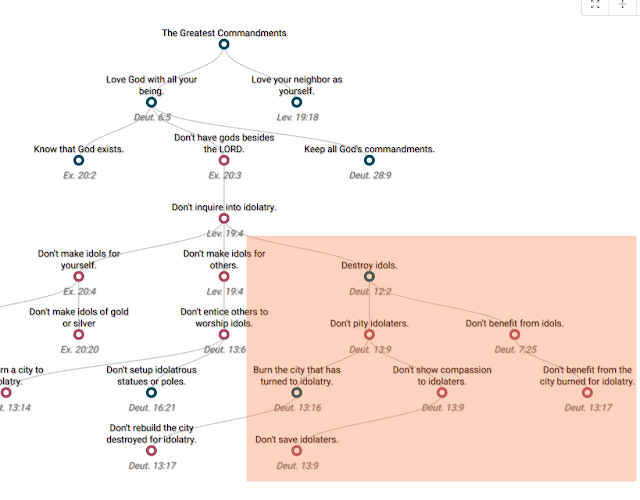
As part of EtzMitzvot, every Tuesday I add more commandments to the visual tree. This week I added the highlighted commandments concerning idolatry:

Specifically these commandments:
  • Don't pity idolaters.
  • Don't show compassion to idolators.
  • Don't save idolators.
Whew - "don't pity", "don't show compassion", and "don't save them" - harsh! Certainly not politically correct. Maybe even counterintuitive to what many Christians understand to be God's character. 

But it nonetheless is God's character to hate idolatry. Historically, idolatry nearly destroyed Israel on multiple occasions. The Torah's harsh prohibitions on idols reflects God's character: it shows God's deep love and care for His people. God doesn't want His people to turn to delusions, sexual immorality, or self-harm, and the Canaanite cults involved all three.

These 3 commandments are one of several idolatry commandments that Maimonides derives from the Torah, and all three are based on Deuteronomy 13:7-10:

“Suppose your brother—your mother’s son—or your son or daughter, or the wife of your bosom, or your best friend of your own soul misleads you secretly, saying, ‘Let’s go and serve other gods’—that you and your fathers have not known, from among the gods of the peoples around you, near you or far off from you, from one end of the earth to the other. You are not to give in or listen to him, your eye is not to pity him, and you are not to spare or conceal him. Instead, you will surely put him to death. Your hand should be the first against him to put him to death, and afterwards the hand of all the people. You are to stone him with stones to death because he tried to entice you away from Adonai your God, who brought you out from the land of Egypt, from the house of slavery. Then all Israel will hear and be afraid, and never again will they do such an evil thing as this in your midst.

In essence, anyone who tells Israel to turn to other gods receives the death penalty. No citizen of Israel can hide an idolater, pity him, save him from penal judgment. Instead, he is to be stoned to death.

This commandment was given at a time and context where the nations were worshiping figurines of gold and silver, sacrificing humans to gods. The Canaanites were self-mutilating to worship Baal and engaging in temple cult prostitution, homosexuality and bestiality as forms of Asherah worship.

A Canaanite tablet from 1300 BC depicting Asherah, a Canaanite goddess whose worship appears repeatedly in the Tenakh. It is this sort of idolatry ancient Israel was surrounded with. God's commandments in the Torah were mean to prevent such idolatry.

To the original Israelite audience of the Torah, these prohibitions on idolatry would have been clear: worshiping Baal and Asherah is forbidden under threat of death.

What do commandments about idols have to do with modern Judaism and Christianity? Much, it turns out.

Some forms of Orthodox Judaism misapply these commandments to forbid Christianity and persecute Christians.

Chabad, for example, reinterprets these commandments as prohibitions on "missionaries" and "missionizing":


Suddenly, the commandments about not worshiping idols like Asherah now apply to Christians following the God of the Bible through the Jewish Messiah from Nazareth.

It is no wonder that some Jewish religious extremists have harassed Jewish followers of Jesus: barging into Christian events with bullhorns, denying or revoking citizenship of Jewish Christians in Israel, planting bombs at the homes of Messianic leaders. In the eyes of some religious extremists, people who call the Tenakh their Bible, call on the God of Israel, and follow the Jewish man from Nazareth are idolaters and missionizers.

I understand why some hardline Jewish religionists believe that. I understand how they misapply it to Christians. To them, Christians aren't following God, they're following a false god named Jesus. (Some religious Jews are more nuanced and will say that Christians are following God plus another entity besides God.)

The reality is hard to understand but nonetheless true. Christians are following only one God, the God of the Bible. 

God sent Jesus to bring humanity to Himself. He provided atonement and forgiveness of sins just before the Temple and Levitical system was destroyed. God revealed that Jesus is not merely a man, but an appearance of Himself, not unlike how God appeared to Abraham. This is not two or three gods, as Islam and Judaism misunderstand. God, Messiah, and the Spirit of God are not 3 gods. It is one God.

This is why Christians have no problem with Jesus saying that the Shema -- "Hear O Israel, the LORD our God is one" -- is the most important commandment. God is one, and the most important commandment is to worship him alone. 

If Jesus is a different god, as some parts of Judaism and Islam believe, then indeed it's right to apply these anti-idolatry commandments to Christians.

But if Jesus is an appearance of God, and there's only one God, then worshiping that one God is right, and applying these Torah commandments against Christians is a grave misinterpretation and perversion of the Torah.

Money, Sex, and Self: Idols of Western Civilization

Summary: The Torah’s prohibition on making idols for others. Idolatry in the West: money, sex, politics, and worship of self. Apostle Paul’s Torah exegesis, where he sees idolatry in sexual immorality and greed.

I thought I’d get back to studying Torah and mapping them into our giant commandments tree:

image

As a refresher, we’ve been going through the famous 613 commandment list created by the influential medieval Torah scholar, Maimonides.

We’ve mapped only a measly 67 commandments so far, lots to go! SmileBut I like digesting commandments one by one; it helps me learn, and maybe it helps you too. Bonus: adding each commandment to the giant commandments tree leaves a truly awesome visual artifact.

Don’t make an idol for others

“Do not turn to idols, or make molten gods for yourselves. I am Adonai your God.”

-Leviticus 19:4

Maimonides previously derived a commandment from this same text:

image

But here, Maimonides derives a second commandment: not to make idols for others.

A plain reading of the Biblical text doesn’t speak about making idols for other people, unless one interprets hidden meaning in the text. And that’s precisely what Maimonides does:

In the words of the Sifra, "’And do not make gods,' means that you may not even make them for others." Our Sages said, "One who makes an idol for himself transgresses two prohibitions," i.e. the prohibition of making an idol with his own hand, even for others, as explained in this Third prohibition; and also the prohibition of acquiring an idol and having it made with his permission — even if someone else made it for him — as we explained previously in the Second prohibition. Therefore he is punished with two sets of lashes.

-Maimonides, Sefer Hamitzvot

In other words, there are two commandments here, according to Maimonides and the Sages:

  1. Don’t inquire into idolatry, derived from the Biblical text, “Do not turn to idols.”
  2. Don’t make an idol for others, derived from the Biblical text “And do not make gods for yourselves.”

I’m not entirely comfortable making two commandments from a single verse here – I’m not sure I buy Maimonides’ explanation – but sometimes we must recognize our humble status. I’m no Maimonides! Not nearly as studied and engaged with the Biblical text nor the sages of Judaism who have studied the text for their whole lives. So I bow to their interpretation here; two commandments it is.

I’ve decided to map the commandment underneath the “Don’t inquire into idolatry”, which is the other commandment from this same verse:

image

Idolatry today in the West

When I read about idolatry in the Torah, it’s easy to skim over it because we don’t really deal with idols today. It was a significant source of apostasy in ancient Israel – nearly all nations worshiped multiple gods in the form of figurines and statues – and a threat to faith in the one God, the God of Israel.

But today, idol figurines are almost nonexistent; we see remnants of it in Hinduism in the east, but here in the Western world, it’s a thing of the past. Humanity has grown to understand that idols made with human hands are powerless figurines – hooray! That’s a huge accomplishment and evolution from the old world.

Their idols are silver and gold,
The work of human hands.
They have mouths, but cannot speak;
Eyes, but cannot see.
Ears, but cannot hear;
Noses, but cannot smell.
Hands, but cannot feel;
Feet, but cannot walk,
Nor utter a sound with their throat.
Those making them will become like them.

-The psalmist of Psalm 115 correctly predicting the downfall of idols. #savage

That isn’t to say we have abandoned idolatry. On the contrary, in the West, we worship other things besides idols. We worship celebrities. Via extreme environmentalism and overzealous animal rights activism, we worship nature. We worship money; capitalism is great, yet it’s easy to become addicted to money and money-making.

But above all, we worship ourselves. The selfie generation isn’t merely photogenic; the West is primarily concerned with the cares and wants and desires and pleasure of self.

Take it on the personal level: a man who fails to control his alcohol consumption becomes an alcoholic; a slave to alcohol. A man who cannot keep his gambling habit under his command becomes an addict; a slave to dice. Ditto for drugs, sexuality, and money. If you don’t exercise control over self, self rules you, and you become a slave.

And that’s precisely where we are in Western civilization. Self rules you.

Abortion is an outgrowth of selfishness: it puts the wants and desires of self over that of an unborn and blameless child. “I don’t want this child, so I will kill it before it’s born.”

Socialism is an outgrowth of selfishness: those without envy and covet those with, demonizing those with and seeking to take their possessions and wealth and give it to self. And it does it under the guise of justice.

The generation of the triggered snowflake is an outgrowth of selfishness. This produces universities concerned more about the feelings of students than fostering a healthy forum of ideas. In the selfish generation, being offended is a virtue, being perceived as persecuted doubly so.

An unselfish generation would welcome life, even if it were inconvenient.

An unselfish generation would seek to create and multiply wealth, raising all boats, rather than taking from the few who have created it.

An unselfish generation would serve other people for God’s glory.

But here in the 21st century, people worship themselves and their feelings and their desires. And that’s still idolatry.

Idolatry beyond gods

Paul the apostle says that idolatry goes beyond worship of gods.


If you have been raised up with Messiah, keep seeking the things above—where Messiah is, sitting at the right hand of God…Therefore, put to death what is earthly in you—sexual immorality, impurity, lust, evil desire, and greed—for that is idolatry.

-Paul to the Colossians, chapter 3

Image result for saint paul writing his epistlesThis really strikes me that Paul, the Jewish scholar and writer of much of the New Testament, sees idolatry in these things. Sexual immorality, impurity, and lust: how are these idolatry? Because, I think, it’s again worship of self.

If a man is driven and commanded by his sexuality; he is a slave to it. Porn is huge today in the West, and I think a great deal of people, especially men, are enslaved to it. We see it also in sexual abuse perpetrated by men who are living a secret life. This is idolatry because it makes you serve your desires; you become a slave to desire rather than God.

(Women are affected too, but I suspect not to the degree men are due to our biological differences.)

Evil desire and greed are also idolatry, Paul says. How so? Like sexual immorality, a person becomes a slave to these things. How many people are driven by money? People steal for money, people deceive for money, some murder for money. Our modern forays into socialism likewise are driven by greed. Instead of worshiping God, people worship money. And that is idolatry.

Leviticus and Colossians: Idolatry kills

Tying this back to our Torah commandment, God commands us not to turn to idols. The reason is that you’ve gotta serve somebody. And you can only serve one thing; it’s impossible to serve two masters.

Everybody serves something. In this the modern West, most people serve money, sex, power, or themselves.

But God speaks to the ancients, and to us: service to God alone produces upright living and a moral, stable civilization. 3500 years have passed since this divine command was given, and history attests to this truth: idols, in whatever form they take, destroy a man, destroy a family, destroy a civilization.

Torah Tuesdays: Holy stones!

Shalom, folks. Continuing in my multi-year long process of mapping all the Biblical commandments into an interactive, visual tree – EtzMitzvot.com – I’ve added several commandments to the tree tonight, most of which deal with idolatry. Commentary below. Enjoy!

#50 Don’t setup statues for worship

image

Do not set up any wooden Asherah pole beside the altar you build to the LORD your God, and do not erect a sacred stone, for these the LORD your God hates.
Deuteronomy 16:21-22

Maimonides interprets this as 'Not to erect a pillar in a public place of worship.'

I find this interpretation both too narrow in one area and too broad in another. Smile 

Location, location, location

It’s too narrow when he says, “in a public place” – reading the text and looking at several commentaries, it seems apparent God isn’t so much concerned about pillars in public places, but rather, to not erect poles or statues with the intent of worshiping them. While the text does say Asherah poles “next to the altar of the LORD”, the following verse on sacred stones, or statues, seems more open-ended.

Tripolye_statue1The explicit reference to Asherah in the text is likely due to the previous inhabitants of the land of Israel, the Canaanites, who erected poles to worship a fertility goddess by that name. Worship of Asherah, along with her well-known cohort Ba’al, spread from the Canaanites to the people of Israel; 9 different books of the Bible, including 2 books of the Torah, explicitly reference worship of this idol.

The Torah explicitly forbids Asherah poles near the altar of the LORD. This suggests God knew the Israelites would mix idol worship and worship of God. Recent archaeological finds suggest the same: artifacts from 800 BC contain inscriptions linking Yahweh and Asherah as husband and wife.

This has prompted atheists, and a recent BBC television series, to claim the Bible has a conspiracy/cover up of this God-to-Asherah connection. I find this charge easily dismissible; the Torah is quite open – hardly a cover up! – when explicitly forbidding this syncretism.

Pillars, statues, and holy stones

Maimonides’ interpretation is too broad when he says “not to erect a pillar.” The context here is clearly on idolatrous objects of worship, not simply pillars or statues of any kind. It seems to me secular statues – for example, war memorials – are not likely what the Torah is attempting to forbid here.

iwo_statue_lg
An example of a secular statue.
Not likely what is being forbidden by the
commandment against statues.

Maimonides’ broad interpretation, in which virtually all kinds of pillars and statues and likenesses are forbidden, has had a lasting effect on the Jewish people today. When I was in Israel last summer, I saw evidence of this. In the city of Herzliya, named after Zionist pioneer Theodore Herzl, the city’s water tower, as I recall, has a faux statue of Herzl. Instead of a statue, they have some halacha-safe image that looks like a statue but isn’t:

Herzl
Faux statue of Theodore Herzl in Herzliya, Israel.

All because of the ban on statues and likenesses, per Maimonides’ broad interpretation of this passage and a few others like it.

That said, as I recall, there are some real statues in Israel that apparently don’t fall under the stringent halacha against statues. Just outside of the Old City of Jerusalem, near David’s tomb, there’s a Holocaust memorial with a statue of a girl, along with a halachic justification for the statue. I found it amusing enough I needed to snap a few photos of it:

10368908_10152486455388003_4430044600722447239_o

Here’s a close-up of the tablet, along with blurb about “Yes, this is in keeping with Jewish law [against statues] and is endorsed by the Rabbis.”

endorsedRabbis

So it would seem there must be some halachic exception to Maimonides’ ruling that statues and standing stones are forbidden. (An exception that the fine people of Herzliya haven’t discovered? Smile)

That said, there are some ugly standing pillars in Israel. The United Nations, in all its vast wisdom, erected a giant pillar just outside Jerusalem as a symbol of tolerance. (Did not a single person at the UN think to check Jewish halacha before building this monstrosity, or are they just trolling us with a giant phallic symbol?)

Phallic

Phallic2

Phallic3

Somehow, I think the UN Tolerance Monument might just fall under the Scriptural ban on sacred statues! Smile

Thanks for reading, see you next Tuesday.

Custom comments