Import jQuery

Showing posts with label prayer. Show all posts

Some Thoughts for Back to School Week by Aaron Hecht

This week, my two sons joined 2.6 million other Israeli children, and tens of millions more all over the world, in that most beloved (and hated) of childhood traditions, the first day of the new school year.

I know how blessed we are that both of my sons are in an educational framework that is WAY above the average for Israel. I won't say much more about that, but I've seen the evidence that the principal's at both my eldest son's high school and my youngest son's primary school cited to back up their claims to being among the best schools in the country and I was convinced by it.

However, I am also under no illusions that this is sufficient.

The test scores of Israeli high school graduates have been at the bottom of the barrel for OECD countries every year for a very long time, and it's no mystery why. A recent study was published showing that Israeli teachers have some of the lowest levels of professional skills in the OECD. If the teachers are barely able to read, write, and explain complex situations, we can't expect the students to have these skills.

The problems go beyond poor test scores and have also begun to show up on factory floors and board rooms, as older workers (many of whom were immigrants from the former Soviet Union, which for all its faults had an excellent education system) retire and companies struggle to find younger people who have the skills and knowledge necessary to replace them.

But Israel is not alone in having problems along these lines.

In the last few years, I have seen one news report after another about university freshman in America, Canada, Western Europe and Australia showing up on campus unable to read even basic passages out of their textbooks or take notes in class. Professors also report students being unable to hold serious discussions about many topics because they simply don't have the vocabulary and also have a hard time focusing on anything for any great length of time.

I am therefore "that dad" who takes away his kids' screens for at least two hours every evening after they come home from school and makes them read books, play educational games (often playing with them, because that makes it more fun for everyone) or going outside and burning off energy at the park by playing with our wonderful little dog.

I'm even "that dad" who downloads worksheets with math and science problems for my sons to work on if their teacher didn't give them enough homework. I'm "that dad" who pays for them to take karate lessons and signs them up for whatever summer school programs are available from the municipality, sends them to the camps provided by our church, or anything else I can think of to get them off the couch and off their screens.

I am also "that dad" who reads the daily portion from the One-Year Bible to my children at bedtime, and you better believe I'm "that dad" who prays for them every night as they're going to sleep, and also every morning as they're on their way to school.


Brothers and sisters, I'm not saying all this to brag on myself, but rather to give you some ideas about how you can invest in your own children.

The schools do their best to give our children what they need and their teachers and coaches are, for the most part, dedicated and sincere professionals who care about the children and want what's best for them. The same is true of the pastors and youth leaders at our churches.

But they simply can't do it all themselves. 

If we want our children to grow up to be happy, successful, high-functioning human beings who will make positive contributions to society and stay with the faith after they grow old enough to make their own decisions then we have to intentionally invest our time, effort, money and other resources into making sure that happens.

It's not enough to drop them off at school in the morning and pick them up in the afternoon and then let them do whatever they want in the evening. It's not even enough to take them to church once a week and make sure they go into the Sunday school.

That's important, but it's not sufficient.

We must do more than that, not only for the obvious reason that we want our children to have the skills and knowledge they will need to get a decent job when they're done with school. It's not just about them getting a good job; it's also about them NOT falling away from the Faith and/or turning into a zombie/barbarian.

Beyond your local congregation (which you can and MUST sow into with your time, effort and above all your prayers) I can recommend two parachurch organizations which have been a huge blessing to my own life, especially my parenting journey.

The first is Family Life Today and the second is Moms in Prayer.

Last but certainly not least, I can't end this blog without saying once again that getting a dog for my family was one of the best decisions I ever made, and I recommend it for everyone.


"Thoughts and Prayers": On School Shootings and the Good Samaritan

Superhero Flash praying

Last week in the US, a teenager took a rifle into an elementary school and murdered 19 people, mostly children.

Senseless.

And this is just one of a long string of school shootings that have plagued this nation since the 1990s.

After the tragedy, social media was flooded with citizens and politicians offering sympathy,

“My thoughts and prayers are with the families.”

Maybe you wrote something similar on your Facebook page?

This generated a great backlash of secular cynics, many politically motivated, who responded:

"We don’t need your useless thoughts and prayers! How many kids have to die before you shut up and actually do something to prevent the next shooting?

On Reddit, one atheist wrote in a wildly upvoted post,

“Thoughts and prayers” is the equivalent of thinking you are doing something to contribute, without having to do anything at all at the same time.

There’s some truth to what they’re saying.

At shabbat dinner this week, I talked to my kids about this and asked if they had heard people mocking “thoughts and prayers”. Indeed, they had heard.

What’s our answer; are “thoughts and prayers” as useless as “sending good vibes”?

To answer, I read to my kids the parable of the Good Samaritan.

You already know the story. In the parable, a man is robbed, beaten, stripped naked, and left for dead along the road.

A kohen sees the beaten man along the road. But he doesn’t help, and instead walks to the other side of the road.

A Levite walks by. He sees the man, but likewise doesn’t help.

Finally, a Samaritan sees the man. He applies medical treatment, transports him to the nearest inn, and pays for his stay and expenses.

What does this have to do with school shootings?

This parable in its original context was to show who is our “neighbor” in the context of the Torah mitzvah, “Love your neighbor as yourself". Yeshua explains the parable: the true neighbor is the one who showed compassion.

But this parable also means that we as God’s people must be people of action. “Thoughts and prayers” are not enough. In the parable, it was the person who took action that was deemed righteous. Even more righteous than the ultra-religious, fervently praying Kohen and Levite.

Likewise, we must be people of action. If we don’t take action, we’re not really serious in our thoughts and prayers. And if our thoughts and prayers aren’t genuine or backed by action, secular cynics are right to critique it as meaningless babble.

I told my kids that God wants us to be people of action, not merely airy religious fluff sending people good vibes through social media. Prayer and action. Faith and works.

Yeshua’s half-brother Ya’akov/James says the same thing:

If a brother or sister is naked and lacks daily food, and one of you says to them, “Go in shalom, keep warm and well fed,” but you do not give them what the body needs, what good is that?

It’s not enough to well-wish, even in prayer. We need action, otherwise prayer is dead.

A rational mind will ask, “If action is what matters, why pray at all?”

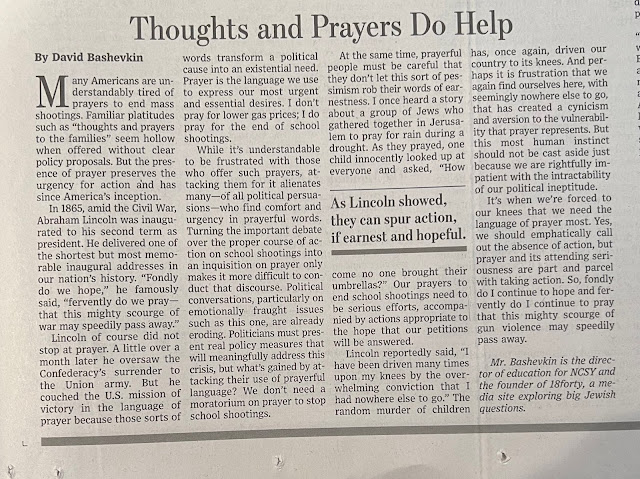
David Bashevkin proposes a beautiful answer in today’s Wall Street Journal:

Screenshot of David Bashevkin's article on the Wall Street Journal

He notes that when Abraham Lincoln addressed the nation during the US Civil War, he asked the nation to pray that war would cease:

Fondly do we hope, fervently do we pray – that this mighty scourge of war may speedily pass away.

Lincoln prayed to end the war, and he waged war against the Confederates. He was a man of both prayer and action. But why pray at all if action is what matters? Bashevkin writes,

[Lincoln] couched the U.S. mission of victory in the language of prayer because those sorts of words transform a political cause into an existential need. Prayer is the language we use to express our most urgent and essential desires. I don’t pray for lower gas prices; I do pray for the end of school shootings.

Catch that? He is saying that earnest prayer drives a whole people, even a whole nation, to action. 

Good vibes don't do that. Prayer does. 

Prayer is fuel in the engine of action.

I’d add to Bashevkin’s statements: We sincerely believe that a people united in earnest prayer, willing and ready to act, can move the heart of God.

(And sometimes, we the faithful and prayerful are the very means of God’s intervention in the world.)

James, the same one who wrote that prayer without action is meaningless, also writes, “The effective prayer of a righteous man is powerful.”

To be effective, prayer must be earnest and fervent. To be righteous, a man must take action.

Earnest, hopeful, fervent prayer combined with ready action. In King James lingo, this availeth much.

Making it real: what can we do in tragedies like this?

If I’ve convinced you that we need to be people of action, you might ask what’s the next step. How do we help people affected in the recent school shooting?

One way is charity, which is considered a mitzvah – a commandment and good work – in both the Hebrew Bible and the New Testament.

Unlike any other time in history, it’s easy to give to charity around the world thanks to the internet.

Some other ways to help: if you run a small business, you could donate a portion of profits, or ask customers to donate on checkout. If you work for a large company, you can donate and ask your employer to match your donation.

Change can also be on the individual level. A change of mind, a change of heart. Let me ask a hard question, dear reader: is it time to reconsider your views about guns? I’m not asking you to go woke here. I’m asking you to consider Scriptural ethics above political concerns. Our allegiance is to God, not any political party.

Are your views on guns informed mainly by the ethic of Scripture, or by the talking points on political talk shows and podcasts? Given the Bible’s overarching theme of pikuach nefesh - preservation of life above almost all else - might we consider a more balanced approach to guns and gun access?

If your answer is, “Any gun reform is veiled leftism!”, you probably have a blind spot here.

Change can also be on the political level. Write to politicians to take action to prevent school shootings. Maybe you feel posting armed guards at schools would help. Maybe better security measures at schools. Maybe stricter gun access laws. Maybe better background checks. Maybe laws to restrict access to high powered guns. Maybe it’s better mental healthcare for disturbed individuals. Tell your elected leaders how you feel. Tell them what you believe must be done. Petitioning political power is also a form of action, and Biblical figures from Esther to Nehemiah to Paul used it to accomplish good.

Dear Kineti reader, can you earnestly pray and take action to end school shootings? Let’s make progress on this, little by little. I’m going to agree with Mr. Bashevkin in fervent prayer and action that this mighty scourge of violence in schools would come to an end. Will you do the same, dear reader?

Getting through difficult times in life with psalms and prayer

psalms

I help run a Messianic congregation, and one of our congregants told me she was going through tough times in the last year.

“2016 was a hard year. I spent most of it in a challenging situation. I hope and pray for the best this year… I need healing because of a spiritual issue I'm dealing with.

Please let me know anything else I can or should try”

I told this woman we’d be glad to pray for her as leaders and pray for her together in our community. I asked if there was anything tangible we could do to help. And I told her what I personally do when I’m going through tough times.

It’s not some magic formula. I’m not selling religious cure-alls. But it’s something that helps me, personally. And if it helps me, maybe it will help you too.

Here’s what I said:


For help with spiritual issues, I personally find two things helpful:

First, when I pray, I just dump everything that's weighing on me onto the Lord in prayer. And I speak to God like I would a close friend: being completely honest, telling Him my frustrations, struggles, all of it. Everything weighing on me, and in plain language. Heart-dumping everything like this has a way of not only bringing my burdens before God, but also helping me evaluate where I'm at in the situation.

Often times when I'm praying like that, God will show me what I need to do.

The second thing that helps me is, I read the psalms aloud over my own life. I go somewhere private and read the psalms out loud and speak them over my own life. Psalms like

are some I often turn to. If there's a sin issue, Psalm 51, Clean Heart. Maybe you have some psalms that speak to you.

The reading aloud part is important for me. Reading silently it’s too easy to separate myself from the text; the text is an old text written by somebody else, to somebody else. But reading aloud and declaring these words of God over my life changes my outlook, changes me.

Doing this helps me see things from a better perspective. Psalm 27 says, for example,

The Lord is my light and the savior of my life; whom shall I fear?
The Lord is the strength of my life; of whom shall I be afraid? …
When my enemies advance against me to devour,
And when my foes attack me, they will fall
And though I am besieged
And a war breaks out against me
Whom shall I fear?

If the God of the universe is the savior of my life – if the God of Everything is the one who saved my life, the life of Judah Himango – truly there is nothing for me to fear. These words from God encourage me to keep pressing on.

God doesn’t heal all people all the time

This morning, Ruth, a friend of my family’s for several decades, a Messianic Jewish woman who I’ve known since childhood, passed away after a grueling battle with cancer.

This post is to help me gather my thoughts about her passing.

We’d been praying for Ruth for months. Her husband was praying without ceasing – nearly every waking moment – believing God for a miracle to heal her of stage 4 cancer. In my morning prayers I asked God for a miraculous healing. Just days ago, my older brother and his family and my parents and myself joined together and prayed for Ruth’s healing.

But this morning, Ruth passed away.

God doesn’t heal all people all the time.

This should be obvious – hospitals are full and people are dying all the time – but religious people often suggest that if humans just trusted God, God will heal them every time, all the time.

I think God has made no such promise.

Last shabbat, my entire congregation prayed together for Ruth’s healing. I remember asking, “God – will the dust give praise to you? But if you heal Ruth, I know she will declare your power and glorify you before this generation, to everyone she encounters.

But this morning, Ruth passed away.

God doesn’t heal all people all the time.

I think some religious people don’t want to hear this report. We want to believe that God heals anyone and everyone anytime and all the time.

But this morning, Ruth passed away.

Some people believe that if God doesn’t heal a person, it means the person praying lacks faith.

One such person recently told me, “I was praying for a woman I had just met. I laid hands on her, prayed for healing, then asked if she was healed. When she said no, I replied, ‘Sorry, I just need to have more faith’, and then tried praying some more…”

Let me tell you, Ruth’s husband had perfect, longstanding faith. He believed God for healing even when the doctors recommended end-of-life hospice care. He believed for healing even when medical professionals told him to prepare for the worst. Even the lack of a miracle didn’t sway his faith; he continued believing for a miracle up to and even after Ruth’s passing.

And Ruth’s faith, and her husband’s faith, was not some newfound zealous-but-shallow yearling faith. Rather, it was the faith of people who’ve walked with God and trusted God for healing over several decades.

Weeks ago, Ruth’s husband had told me, “I have not wavered in my faith. I will not bend nor budge on this issue. Please speak the scriptures over Ruth. ‘He himself bore our sickness and carried our diseases and by his wounds we were healed!’”

But this morning, Ruth passed away.

God doesn’t heal all people all the time.

It wasn’t because Ruth lacked faith. It wasn’t because Ruth’s husband lacked faith.

It wasn’t because the wrong type of prayer was said.

It wasn’t because hands weren’t laid, or the prayer formula was wrong, or that anointing oil wasn’t used properly, or that the wrong name pronunciation was used, or any other pseudo-biblical healing formula forgotten. None of that mattered.

No, it was because God doesn’t heal all people all the time.

If this wasn’t true, the hospitals would be empty.

If this wasn’t true, no righteous person would ever die; the prophets and the disciples and the righteous heroes of our faith would still be here with us. But they’re all dead and buried.

Religious people often say that God sees the beginning and end of each person’s life. But we contradict ourselves when we say God heals all people all the time; it would mean some people would never die, some people would have no end, thus elevating them to a status reserved only for the divine.

Ruth and her husband did no wrong. As I see it, they believed God for healing, as the Scriptures show us to do. They did everything they physically could do, too, receiving treatment from modern medicine. They spoke the Scriptures over her. They believed with perfect faith that God would heal Ruth of disease. Even so, God did not send healing. Nor could modern medicine save her.

God is not at fault, nor are the humans involved. It was her time to go.

It’s not a failure of God. It’s the plan God has for humanity at this time: every human has a beginning of life, and an end of life.

This morning was the end of Ruth’s life. May her memory be a blessing.

God has not promised to heal all people all the time. But the good news is, God’s righteous people have an assurance written in the Hebrew Bible; a promise reiterated by Messiah himself: there will come a day when God miraculously raises the righteous from the dead, with renewed physiology that will never again succumb to disease or death.

And this is Ruth’s hope, too. She was a blessing to me in my life, she will be missed, and she will be remembered. And, when God gives the command, every person will raise to life and stand before Him. He’ll breathe new life and weave renewed flesh onto Ruth here on earth. Her body in that day will be cancer-free, and she will declare the glory of God.

What do religious Jews think of the Lord’s Prayer?

Over at Jewish Life & Learning, a new Jewish Q&A site, the question came up, “Is a Jew permitted to say the Lord’s Prayer?

"Our Father who art in heaven, hallowed be thy name. Thy kingdom come. Thy will be done on earth as it is in heaven. Give us this day our daily bread, and forgive us our trespasses, as we forgive those who trespass against us, and lead us not into temptation, but deliver us from evil."

This is the Catholic English version of the "Lord's Prayer." Its direct antecedent can be found in the New Testament and according to their tradition, was basically said by Jesus as a prayer to God.

Would a Jew be permitted to say this as a prayer?

The answers were fascinating.

One commented that the prayer is familiar:

I don't know Greek so I don't know what the original says or what "Thy kingdom come" means but it looks to my untrained eye like some of the things we do pray for every morning before p'suke d'zimra.

The same commenter did think the line “forgive us as we forgive others” was fishy, saying it was foreign to ask God to emulate us.

I responded that Yeshua may not have been suggesting God emulate humanity, but rather, God reward human forgiveness with divine forgiveness. I cited Gamaliel II:

Whoever has mercy on other people, Heaven will have mercy upon him; whoever does not have mercy on other people, Heaven will not have mercy upon him.

Another commenter, giving the accepted answer, found nothing wrong in Messiah’s Prayer itself, instead suggesting that Jews should not pray the prayer simply because it’s from another religion:

We find that there are in fact practices in prayer (kneeling, raising our hands) that are attested in Tanach but were later abandoned as Jewish practices, precisely because non-Jewish religions made these parts of their own rituals. How much more so, then, that we shouldn't adopt prayers that they originated!

Another commenter, also unable to find fault in the actual prayer, appealed to the sufficiency of the Torah:

Why does anyone need such a prayer, anyway? The Torah has everything that's needed. Saying this 'prayer' would seem to be conferring tacitly some legitimacy on the entire concept of a so-called 'new testament'.

Another commenter rejected it because it gave legitimacy to Christianity, a religion that actively converts Jews:

I am certainly not paskening here, but it is essentially a sectarian prayer, and gives credence to that religion. What is the motivation in saying it? Breaking down boundaries in this area is surely a slippery slope, when dealing with a religion that actively wishes to convert Jews. So it is, at the least, a very bad idea.

Another commenter also used the “Christianity is idolatry!” argument:

Even if you hold that Christians worship HaShem in some ludicrous way and aren't worshiping an idol, it still is not the JEWISH way of worshiping. As such, Jews may not participate, join, copy, or in any way emulate this practice.

It's at best Hukath HaGoyim [decree of gentiles], at worst 'Avodah Zarah [idolatry].

What I found particularly interesting here is, no one really found fault with Messiah’s prayer by itself.

One commenter at first protested,

The ‘arting in heaven’ for one thing seems a step away from anthropomorphism to me.

However, another commenter quickly replied that “Our Father who art in Heaven” is actually a Hebrew phrase, Avinu Shebashamayim, common in many of Judaism’s own prayers.

Another commenter, perhaps grasping at straws to find fault with Messiah’s prayer, could only find problems if the prayer was applied in all circumstances:

One could pick apart various parts of this prayer. For example, "forgive us our trespasses, as we forgive those who trespass against us". This seems akin to Jesus saying "judge not, lest ye be judged." But there are places this applies and where it does not. The gemara in Bava Kamma 50a states “Kol HaOmer HKB”H Vatran Hu, Yevatru Chaiyav”, “Anyone who says Hashem is a pushover, Hashem will push over his life”.

Ultimately, the answers given by these knowledgeable religious Jews were enlightening: Jews don’t have a problem with Messiah’s Prayer so much as they have a problem with Christianity.

And try as some did, ultimately the arguments against Messiah’s Prayer were really arguments against Christianity.

This reminds me of how, even among militant atheists, the best arguments against Yeshua are not really against Yeshua himself, but against Christianity:

Note that the Salvation Army gets defended even by atheists. Why? Because they do what Yeshua taught.

This says something, something great, about Messiah’s life, I think. Even those who oppose him can find little of his life or ethics to oppose.

Pray for Messiah’s followers in Israel

I received a note from Israeli Messianic Jewish music artists Avner & Rachel Boskey earlier this week:

The last months have been very full.  As you may remember, on June 10, Avner testified in a legal trial in Beersheva, regarding the riot against the Beersheva Messianic congregation in 2005 (which we've written about in our recent personal updates). 

As mentioned before, Messianic Pastor Howard Bass filed a suit against the chief rabbi of Beersheva and against Yad L'Achim, an anti-Messianic organization which actively harasses Messianic believers in Israel [emphasis mine], for their instigation of and involvement in a riot which took place in December 2005.

During the trial on June 21 the remaining three witnesses for the prosecution (all believers) gave their testimonies of what they saw and heard during the riot, and one witness from the defense (a leading Chabad rabbi) was also questioned.  The chief rabbi of Beersheva, Yehuda Deri, and the head of the anti-Messianic organization Yad L'Achim were not yet questioned due to lack of time.  The next trial session is scheduled for this fall – November 23.

Please continue to pray for righteousness, truth and justice to prevail in Israel.  A number of Messianic believers who were present in the courtroom spoke of the hostility and hatred for believers they sensed in the eyes and hearts of some who do not yet know the Lord.  Please pray for grace, love, blessing and the revelation of Yeshua for these precious people.  Several fair articles appeared in the Jerusalem Post recently regarding this case.

This same morning I got a blog comment from a poster going by the name Yad L’achim in the comments to Are We Christian, posting yet more of the same rehashed arguments attempting to sway us from the path God has called us, attempting to sling mud on Messiah.

This blog sure attracts the anti-missionaries! Praise God, I must be doing something right!

Yad L’achim is an anti-Messianic organization that harasses Yeshua’s followers in Israel through verbal abuse and violence. They are currently on trial in Israeli courts for their vigilante violence against those followers of Messiah.

This isn’t the first incident of persecution against Yeshua’s devout: we’ve documented Ultra Orthodox persecution of Messianics at least three times before on this blog, covering everything from book burnings, harassment on the streets while shouting epithets, physical attacks, burning of homes, exploding packages that almost killed a Messianic boy, fire-bombings, and finally revocation of citizenship and exportation. There’s a spirit of hatred towards Yeshua in Israel unlike any place on the planet, and it’s growing.

Please pray daily for these precious people that, in their blindness and hard-heartedness, commit acts of violence and hatred against Messiah’s own. Though they think they are doing right according to their religion, they are actively subverting God’s Kingdom. Pray for them that God would give dreams, visions, first-hand encounters with Messiah, softened hearts, even an inkling of warmth toward Messiah. God can do anything, folks. I’m convinced of it. Pray for it with patience and endurance, God will bring it to pass. Pray for the folks undergoing this persecution, too, that God would give them the perseverance and longsuffering that will stand as a righteous example of Messiah.

Prayer on Mt. Chermon

My younger brother sent me these photos of him and a family friend going up to Mt. Chermon for prayer. Mt Chermon is rich in Biblical history, both Judaic and Messianic, and is modernly a hotly contested piece of land.

Beautiful photos, but what a place to pray!

img0216x

img0217l

img0221c

On Prayer and Miracles

praying_hands

Back before I got into this Torah and Messiah faith, I was a big Christian and a church-goin’ kid. My family, both parents having come out of Catholicism, were very much involved in Protestant and Evangelical Christianity. (Back then, my dad didn’t know of his biological parents nor his Jewish grandparents. More importantly, we were largely ignorant of God’s commandments back then!)

We’d attend multiple services on Sunday: early service, lazy man’s 11:00am service, and the night service. Wednesday service. Conferences with all the big Christian leaders. Bible study in church. Vacation Bible School. I did all that. And almost all my relatives were big on the church thing, too, so it ran in the family.

During that time, I was exposed to some stuff that had some long ranging affects on faith life. One thing in particular is prayer.

Let me tell you a fun little story. I was about 12 or 13, playing in a basketball league at the local YMCA. During pre-game practice, I got one of those splitting headaches, the kind that FRIGGIN’ HURTS. Borderline migraine. My grandma, God bless her, pulled me aside in front of the whole team, laid hands on me and prayed for me, saying, “Judah, I’ll pray and you tell me when it’s gone.” Embarrassed and perturbed, I didn’t know what to do or make of this.

She prayed for like half an hour.

The headache didn’t go away.

“It’s gone.” I said, lying to her. As a kid, you don’t know what else to do when standing there for 30 minutes while your kid friends stare at you like a crazy person. I played the whole game enduring a splitting headache, not saying a word in order that grandma be none-the-wiser.

In another instance, during the pre-teen years, my family was visiting some big Protestant Church. I was in Sunday school. The teachers had each kid come up and ask for prayer for something personal. Mine was some illness at the time; a cold or something trivial. It doesn’t matter what it was. They prayed “until it went away”. It didn’t go away.

These and other instances of prayer left a bad impression on me. I think they’d leave a bad impression on anybody who believed in God! Maybe God didn’t do miracles anymore, I thought. “How come it can’t be like in the Bible?” I thought to myself. You know, back in the good old days of religion, when God regularly intervened and everyone saw His power. (I was an early-blooming Grandpa Tevye!)

Then as you grow older and dumber, you start to wonder, “Maybe those things in the Bible never happened at all; maybe they’re just exaggerated stories! Who knows? It doesn’t work now, that’s for sure.”

To top it off, I soon discovered a lot of things we do in prayer are just rituals. Despite the Protestants being all hardcore Sola Absurdum, despite their looking down upon all forms of ritual, there’s actually no real Scriptural mandate for most of what we do in prayer. Folding hands, joining hands, bowing heads, saying “amen”, saying, “In Jesus’ name”, closing eyes, praying that God would bless the food, and so on. That’s all ritual, zero Scriptural support for them. Some of that became meaningless and mundane to me, and I promptly dropped some of those things when I moved out of my parent’s house. (Shh! To this day, I still don’t pray a blessing over the meal!)

There was only 1 redeeming thing about prayer in my life. My dad would pray over us kids every night before bed, praying with full meaning and earnestness. That affected me positively. I really believe that his prayers kept me under God’s directing. Without it – being purely honest here – I’d probably be an agnostic today.

Fast forward a few years.

About a month ago, one Messianic leader and friend told me how prayer had “transformed his life”.

Oiy!

When religious people start talking about transformations, they might as well be speaking religious Esperanto; I totally tune out. I’ve seen too many “transformations” that weren’t real. Call me jaded, but I just don’t believe you. Maybe you think you had a transformation, but you’re still the same person.

Well, this religious friend sent me, on his dime, some teachings on prayer. Since he’s a friend, I listened to them. I tried it out. I started praying. Regularly. I started praying without demanding anything. I came to God in prayer, mostly just giving thanks. Praying started out with giving-of-thanks. Praise. Like worship music, but with just the lyrics. No demands. I prayed for other people, too. Yes, some asking, but mostly just praise.

What happened?

Well, I didn’t get healed of physical illness. I didn’t miraculously receive gold fillings.

fills2 

No healing miracles happened. Nothing I could point you to and say, “See! Goes does exist after all!”

Things did, however, start to change. Some good things. Some transformative things have happened in my life and in the lives of the people I was praying for

Gosh, I hate to sound like that. If you’re anything like me, you read that last part and mentally skipped over it. But in honesty, my life with God is changing, transforming, because I started praying like this regularly. I pray in the morning. In the afternoon, I stop work and pray in private. I sometimes pray at night.

But what can I say? Prayer is changing my life with God. I actually talk to God, regularly, rather than just talk about him on this blog or just on shabbat during Bible study. It’s changing my life – less sin, believe it or not. That’s a good thing.

Why less sin? I don’t know. I think communicating directly with God does something to you. Puts your mind in the right place. Maybe it puts your flesh down. I don’t know. But it works. God’s plowing through my problems like a bulldozer on an ant hill.

And I’ve seen 2 people affected by my prayers. Not in some airy spiritual way either; but in a real way that showed up in the real world.

I’ve been praying regularly for 1 month and I’ve seen these real, actual good things happen. 1 month! Man. What is going to happen in 1 year? In 5 years? Think of the stuff you can change by praying earnestly for a lifetime? I think this stuff works, just not always in the way we expect it to.

I haven’t been healed of physical sickness; there was no undeniable God-manifestation, no bare arm of the Lord coming out of heaven. Maybe that won’t happen. Maybe it will. I have no idea now, actually. Before I was almost certain such things weren’t possible, seeing them fail so many times when I was younger. Now I’m not so sure. Maybe God still does heal people. I know for sure he doesn’t heal everybody. I know for sure that he doesn’t even heal all the people that love Him, as unfair as that seems.

But prayer affects things. I’m convinced of it.

One thing I want to start doing is praying for people that have totally and utterly abandoned God. I mean, the gone-gone people. Guys like Sam Harris and Richard Dawkins, guys that are so far removed from God, they’re convinced in their own minds God doesn’t exist and actively combat people deluded by the God spell. And for the people that despise us because we believe in God. To them, we’re just simpletons and fools who fell for the 3000 year old myths of Semitic tribesmen. I’m going to pray for these long-lost folks. Who knows what God will do? It’d sure as heck take a miracle for some of these people to turn to the Lord!

And I want to start praying for God’s Kingdom to show up. I mean, Messiah coming here and reigning as king. Restoring Israel. Settings things straight. Vindicating God’s people. Making his hidden kingdom be very visible in front of everybody. All those doubters shown wrong, all those haters put in their place. I want that to happen.

Most of all, I want to stand in a station of prayer in giving thanks and praising God. I think it’s one of the reasons we exist as humans, to give thanks to the God that formed us.

I want to start praying for the big stuff. Maybe they’ll happen. Maybe they’re not part of God’s plan, maybe they won’t happen. But prayer affects things. If you’d just STOP your busy life for one darn minute and just talk to God, things will change. So won’t you join me?

Saying Grace

I remember as a kid, when the family would gather before a meal, one of the adults would say, "Can someone please say grace?" 

"Grace!" would be my quick reply. :-)

The Judeo-Christian tradition of saying grace is an old tradition, to be sure. But is it Scriptural? First Fruits of Zion discusses this:

Blessing God at Meals

Thought for the Week

"We thank You, our holy Father, for Your holy name that You have caused to dwell in our hearts, and for the knowledge, faithfulness and eternal life that You have made known to us through Your servant Yeshua. Yours is the glory forever."

-First doxology of the grace after meals from the Didache as translated for First Fruit's of Zion's We Thank You.)

Commentary

When you have eaten and are satisfied, you shall bless the LORD your God for the good land which He has given you. (Deuteronomy 8:10)

In Christian homes, it is traditional to offer a prayer of thanksgiving before meals. This is a Christian tradition inherited from Judaism. In Judaism, it is traditional to bless God for the food He has provided prior to partaking of it. We read of Yeshua keeping this tradition several times in the Gospels. Sometimes Christians refer to this as "blessing the food," but in Judaism, the food is not blessed, God is blessed for providing the food. In any case, blessing God before meals is a precious tradition of the Master and one we would all do well to imitate.

However, the Torah commands us to also bless God after we have eaten. The Torah says, "When you have eaten and are satisfied, you shall bless the LORD your God for the good land which He has given you" (Deuteronomy 8:10).

The Torah gave this commandment to the children of Israel so that they would not forget God. The materialism of wealth and success are dangerous to our souls. When we are fat and happy, we are apt to ignore God, forget about His commandments and turn away from Him. Moses warned the children of Israel that their success and prosperity in the land of Israel would give them proud hearts and make them forget the LORD. He warned the Israelites not to tell themselves, "My power and the strength of my hand made me this wealth" (Deuteronomy 8:17).

This can be compared to a young student who received an allowance from his father while he studied. The monthly allowance covered all of his living expenses. His father also paid tuition for his son. So long as the student depended on the monthly allowance money from his father, he was careful to meet all of his father's expectations in school, write home frequently and live in keeping with his father's directives. After taking a campus job, though, the student found he no longer needed his father's monthly allowance for living expenses. He no longer worried about meeting his father's expectations. However, he forgot that his father was paying the tuition as well.

Judaism preserves an ancient after-meals prayer of thanksgiving that is still recited today. The four blessings of the traditional Grace After Meals can be found in any Jewish prayer book. The oldest version of Grace After Meals is preserved in the Didache. This early, apostolic-age Grace After Meals was composed by early believers. They recited it together after meals to fulfill the commandment of Deuteronomy 8:10. Like the traditional Jewish version of Grace After Meals, it consists of four blessings thanking God for provision and looking forward to the Messianic era.

You can find the text from the Didache blessings in Hebrew and English in First Fruits of Zion's new prayerbook We Thank You. Click here to learn more about the commandment of blessing God at meals.

Derek Leman digs deeper into the tradition and reviews FFOZ's book on the tradition of saying grace after meals: We Thank You, a new book offering "a simple and innovative liturgy for disciples of Yeshua by weaving the ancient meal blessings of Judaism together with recently discovered prayers of the early believers."

I have a confession to make. Growing up, the tradition of saying grace had become meaningless to me, and now as an adult I do not say grace before or after the meal. It does seem to be a commandment to thank the Lord after a meal; perhaps I am compelled to reinstitute it! :-) 

Do you fine blog readers say grace at all, before or after your meal?

The Lord's Prayer in Aramaic song

My younger brother showed me this song called Abwoon, Aramaic for Father. The song is a Aramaic musical rendition the famous Lord's Prayer.

What's interesting to note is that Jesus most likely spoke both Hebrew and Aramaic. Syrian-Aramaic was a common language in Israel during Jesus' time, so it's quite likely he spoke this language in addition to His native Hebrew. It’s conceivable the original Lord's Prayer was in Hebrew or Aramaic, just as this song has it:


One day Jesus was praying in a certain place. When he finished, one of his disciples said to him, "Lord, teach us to pray, just as John taught his disciples."

He said to them, "When you pray, say:

Abun d'bashmayo
Neth kadash ishmoch
Tithe malkuthog
Nehwe sebjonog
Aykano d'bashmayo
Of bar'o
Hab lan laghmo d'sunkonan yawmono
Washboek lan ghauwbayn
Waghtohain
Aykano dof ghnan
Shbakan lghayobain
Oelo ta'el lan lnesjoeno
Elo fason lan men biesho
Metul diloch ie malkoetho
Oe ghaylo teshbughto
Hoel 'olam 'olmien
Amien


In English,

Our Father in heaven,
Hallowed be your name,
Your kingdom come,
Your will be done,
On earth as in heaven.
Give us today our daily bread.
Forgive us our sins as we forgive those who sin against us.
Save us from the time of trial,
And deliver us from evil.
[For the kingdom, the power, and the glory are yours,
Now and forever. Amen.]

A number of Messianic artists have also done custom renditions of the Lord’s Prayer, often mixing Hebrew and English:

Custom comments