Import jQuery

Showing posts with label Christianity. Show all posts

Charlie Kirk's Death and Radical Forgiveness

Charlie Kirk was a devout Christian and dear friend of Israel. He called on his fellow Christians to honor the Bible's command to love Israel and the Jewish people. Israeli Prime Minister Netanyahu grieved the loss of Kirk, calling him a "lion-hearted friend of Israel who stood tall for Judeo-Christian civilization." Kirk's final book set to be released in two months, Stop in the Name of God, is how Christians can find blessing in honoring the Sabbath.

The assassination of Christian conservative Charlie Kirk has impacted me deeply.

I don't know why it's impacted me so. I don't care much for celebrities, and I try to keep my head out of politics wherever possible. But Kirk's death has had me crying twice now in private, praying to God for answers and grieving over the people celebrating and laughing about his death. I've been angry at the cowards who have justified his assassination in the name of politics.

The morning before Charlie Kirk died, I was talking to God about the stabbing of the young girl on the train in what appeared to be a racially-motivated attack. The train security footage was gruesome and showed her bleeding out and no one helping. I was asking God about it and how this nation can heal in the face of such terrible brokenness. How do you fix a nation like that?

I felt God show me that it will take radical forgiveness. I felt God showing me that it would take a victim forgiving the perpetrator of an attempted murder. Going public about the forgiveness and telling others to do the same. That would change many hearts and minds and begin to heal the nation. That's what I felt God showing me.

Hours later, I heard that Charlie Kirk was shot. My first thought was, "Oh no, he's dead - God was warning me about it this morning." My next thought was, "Wait, was God trying to show me that Kirk will survive and forgive his attempted murderer?" Kirk would certainly be a great candidate to do that. He has a huge platform, and he always made his Christian faith the center of all he did.

Hours later, news broke that Kirk had succumbed to his injuries and died. I was so grieved when I first heard it. I cried.

Today, Charlie Kirk's murderer is in custody. A young man from Utah confessed his crime to his father,  a former police officer, who eventually got him to turn himself in.

Whenever a tragedy occurs in the US, it's immediately politicized. Guns are the problem. No, access to weapons isn't the problem, evil people are the problem. But guns make it easier to murder people. But if guns are the only problem, what about the man who just stabbed a young woman on a train? Do we ban knives too?

Oh, and then it gets really political. Was the shooter trans? Black or white? His ammunition was inscribed with leftist antifa slogans and a reference to a possible LGBT community. But wait, his parents were Republican? And there's a photo of this young man sitting on a Trump blowup for Halloween? Maybe the shooter was MAGA? And the alt-right will tell you that Israel (of course!) had Kirk killed. New information comes out that the shooter was a member of antifa Discord channels, and his X profile shows pro-Palestinian slogans and anti-Israel propaganda. Maybe that's why he murdered Kirk? 

So many theories and everyone's arguing.

It gets worse. Certain fools began saying Kirk deserved to die for his anti-LGBTQ stance. Others said he got what he deserved since he was in favor of gun ownership. Numerous teachers, nurses, political commentators, high school admins, professionals and more were fired in the last 24 hours for saying evil things about Charlie Kirk. Businesses didn't want to be associated with the backlash against one of their employees.

It goes on forever, friends, and it makes it all worse.

It happens every time there's a tragedy.

I keep circling back to what I felt God showed me about healing this nation. How can this nation be healed of its deep brokenness? Radical forgiveness.

I suspect Charlie Kirk, if he had survived, would be the first to forgive the perpetrator. He would ask us to do the same and to pray for the man who tried to kill him. It's what we signed up for when we became Christians: to love your enemy; to desire to see his highest good.

But Charlie Kirk is dead. 

Maybe the task, then, falls to us, the Christian public, to forgive this man. We lost a godly man, a bold ambassador of the Gospel, and a gentle soul who sought to turn the US back to God. We lost him because of hatred. It won't be healed by more politics and fighting about guns. But we can start the healing process now, by forgiving this man who killed Charlie Kirk, seeking this man's highest good, asking God to turn his heart back to himself that he might be saved.

Friends, will you join me in praying for this man who murdered Charlie Kirk? I think it matters. Pray that God would change his heart. Pray that he'd turn to the Lord. Pray for his highest good: that he'd repent to Kirk's widow and children. Justice will be served, but we can forgive as a step towards healing this nation. I think Charlie Kirk would be overjoyed if we did.

Why I'm Still Torah-Observant


"Judah, why are you still following all that Jewish stuff?"

I attend a Sunday church. While my calling is in the Messianic Jewish movement, I'm currently more involved with the Christian world. My wife is neither Messianic nor Torah observant. One of the contributors to this blog, Aaron Hecht, isn't Torah-observant (yet 😉). 

My kids have sometimes complained that I forbid them eating certain foods. Why can't they have a bacon cheeseburger when they go out with their friends?

And while we as a family make time for erev Shabbat with a special meal, Bible discussion and blessings on each person at the table, Saturdays often fill up with activities, including my own. I'm not leading my family in keeping Shabbat well.

Last week I was talking theology with my father-in-law, and he asked whether my eating kosher is just tradition. He mentioned the vision God gave to Peter, with unclean animals coming down from heaven with a voice saying, "Rise, kill, and eat!" Doesn't that mean all food is clean in the age of Jesus? 

And didn't Jesus say he came to fulfill the Law? If the Law is fulfilled, do we really have to keep it anymore? Isn't the Law written on our hearts, and thus we don't have to work it out in our actions?

I've also witnessed lots of problems among Torah-observant believers: Torah terrorism, demonizing our Christian brothers, conspiracy theories, and lots of nonsense unrelated to Torah-keeping. I used to do those things myself. And because of all that ugly behavior from Torah keepers, some friends have come out as no longer Torah observant

One Christian friend keeps asking me why I'm following those old rules anyways when I'm already saved in Jesus. What's the point of following those all those Jewish things when you're already going to heaven?

It'd sure be easier to fit in with my Christian friends if I just gave up pursuit of the Torah. I could join them for Friday nights out on the town. Why am I still following those old rules, anyways? 

I also struggle with sin in my own life. Sometimes, Torah keeping feels like it's putting lipstick on a pig. I am the pig. How can I worry about kosher when I engage in lustful thoughts or lose my temper with my kids or fight with my wife?

And what is Torah observance, anyways? Is it the Orthodox Jewish Torah observance, with separate kitchens for meat and milk, eating only at rabbinically-certified kosher restaurants and growing out your sidelocks? Or is it the Hebrew Roots Torah observance, wearing multicolored tzitzit tied to belt loops and sounding shofars on every upbeat chorus? Or is it Christian Torah observance, feeding the hungry, giving to charity and standing for the unborn?

I've been thinking a lot about these things. 

Why am I still pursuing Torah in my own life and family?

And my answer is this: the Bible.

What I mean is, I'm convinced -- still! -- that the Bible repeatedly demonstrates that God wants his people to keep the Torah as much as we're able.

  • The New Testament records Jesus keeping the Torah.
  • We have no record of Jesus, the disciples, or the apostles actually breaking the Torah.
  • Jesus tells his disciples that anyone who does the Torah will be considered great in the coming age. (And, those who tell others not to keep the Torah will be considered least.)
  • The New Testament records Jesus telling his followers to keep the Torah.
  • Many of Jesus' commands are above and beyond the Torah. The Torah forbids adultery, but Jesus says even looking at a woman in lust is a kind of adultery. How can we say the Torah is done away with when Jesus' tells us to observe a stronger, more stringent version of it?
  • The New Testament records the disciples keeping the Torah.
  • After Jesus heals a man with leprosy, he tells the man to observe the Torah's commandment about healed lepers. Why would Jesus do that if the Torah was done away with?
  • The New Testament records Paul keeping the Torah in order to publicly put to rest rumors to the contrary. "That way, all will realize there is nothing to the things they have been told about you, but that you yourself walk in an orderly manner, keeping the Torah." (Acts 21:24) How is it that modern Christianity now claims the Paul did not keep the Torah? It's the opposite of the plain meaning of this verse.
  • The New Testament explicitly affirms the Torah is good, holy, and righteous.
  • God punished Israel for not keeping the Torah. If the Torah is no longer applicable, logically God would need to repent to Jewish people for punishing them for something He no longer requires of them.
  • The Torah issues a warning against any prophet or leader who claims the Torah need not be observed.
  • Many of the commandments of the Torah have an explicit clause about its eternal nature. "This commandment is for you and your descendants forever, no matter where you live." If the Torah is done away with, parts of the Bible become false.
  • By claiming Jesus broke the Torah or teaches his followers to break it, Christians are inadvertently making Jesus into the false prophet of Deuteronomy 13.
  • When the Israelites returned from Babylonian captivity, Nehemiah had to correct people breaking the Torah, telling them that their disobedience is the reason God sent them into captivity in the first place. I remain unconvinced God is OK with his people doing things he previously punished us for.
  • Jesus tells people that God created the Sabbath for humanity. Why have his followers discarded something God created for our benefit?
  • When Jesus is falsely accused of breaking the Torah (e.g. healing on the sabbath), He responds not by saying the Torah is done away with. He responds by saying what God intended for the Law (e.g. it's lawful to do good on the sabbath).
  • By claiming Jesus broke the Torah or did away with it, Christians are inadvertently confirming his religious critics.
  • When Jesus returns, He will (still) be Jewish; the Lion of Judah. Shouldn't the followers of the Jewish Jesus emulate His way of life?
  • A Jewish Jesus will live in a way consistent with his first appearing: an observant Jew who shows us how to properly keep the Torah.
  • Jesus is returning to Jerusalem, not to any other city. That implies that Israel, Jews, and Torah still matter to God.
  • The Bible says when Messiah returns, He'll require all nations to go up to Jerusalem to keep the Biblical holidays. Anyone who refuses will have no rain. This implies Messiah wants all people to be Torah observant.
  • The New Testament commands the Gospel "to the Jew first, then the Gentile". This implies Israel and Jewish people still exist. Jewish people remain because of the Torah.
  • I'm unconvinced of the claim that Peter's vision means the food laws have been abolished. I find Peter's own interpretation of the vision more persuasive and powerful: God has made Gentiles clean through Messiah.
  • The remaining anti-Torah statements in the New Testament, like Paul in Galatians, appear not to be wholesale rejection of the Torah, but relying on the Torah to be saved. Christianity today claims Paul is rejecting the Torah altogether, but this runs counter to Paul's own actions in Acts 21.
  • Christians often appeal to Jesus' statement, "I have come to fulfill the Law", but they don't consider the full quote: "I have not come to abolish the Law, but to fulfill the Law." Christianity has not made a practical distinction between abolishing and fulfilling.
  • Modern Christianity has thrown out all food laws, even though the apostles ruled that Gentile converts to Christianity must follow certain food prohibitions from the Torah.
  • I remain unconvinced of the superficial divisions of the Law into moral, civil, and ceremonial; the division doesn't appear in the Bible itself. How can we say, then, that God abolished two of those three divisions?
  • Keeping the 10 commandments but not the other parts of the Law strikes me as inconsistent. On what basis should we keep the 10 but discard the 600+ summarized by the 10?
Another reason I keep the Torah is, I don't trust myself to make better moral judgments than God.

God gave us commandments governing how we live. I can throw those out at my discretion. But, "trust in the LORD wholeheartedly and lean not on your own understanding." 

Part of trusting God is believing He's right even if I don't understand Him. I don't understand some commandments God gave us. But I won't lean on my own understanding. I trust that God is wiser than I am. 

If I throw out the Torah, I'm already taking steps towards a progressive and humanistic religion. Throw out the Torah? Why not throw out the New Testament too? Progressive churches have done exactly this. Pastors of such churches are even free to criticize Jesus's own teachings - and why shouldn't they? If God can do away with the Torah, why can't we do away with things from any part of the Bible we don't like? Don't like the laws prohibiting lesbian and gay relationships? Just discard them. Don't like the laws about preserving life? Just discard them. Don't like the laws prohibiting men pretending to be women? Just discard them. Much of the culture war is a natural outcome of discarding the Torah.

I don't want to go down that path. I think the better option is following God to the best of my ability.

A big part of that is just doing the things God told us to do, including the Torah. And doing those things in light of how Jesus kept the Torah.

There are other reasons to keep the Torah. Jews who follow the Jewish Messiah should not cease being Jewish. God doesn't want Jewish people to disappear, and Jews who do not keep the Torah tend to assimilate and disappear within a generation or two. God has used the Torah to preserve the Jewish people. The Torah is the Constitution of the people of Israel. 

Another reason to keep the Torah is because the early Christian communities did. The Didache, an early Christian writing dated to the late 1st century, tells the believers to fast twice a week, weigh the cost of faith, observe basic Torah morality, forbid abortion. It spends most of its time advocating for the way of life, repeating many of the basic commandments from the Torah.

Those are valid reasons to keep the Torah.

But for me, I come back to the Bible. I cannot in good conscious stop doing what God commanded. I cannot un-convince myself that the Torah is righteous, good, holy, part of the living Word of God. Powerful and sharper than a sword, piercing the soul, judging the thoughts and intentions of the human heart. The Torah is part of the whole counsel of God.

I don 't know how to keep all the Torah. I know I'm not keeping all of it. I'm undoubtedly mistaken in how I'm keeping some of it. I'm not doing the Torah life very well in some areas of my life. 

I don't know which is better: the Hebrew Roots version of Torah observance or the Orthodox Jewish version of Torah observance. I'm failing at many parts of Torah observance in my own life and in my family and home life. And I know lots of people in the Torah-and-Yeshua world are doing things poorly and generally showing that they're just sinful humans.

Despite all this, I'm going to keep pursuing God's Torah. This means keep learning. Keep reading the Scriptures. Keep knocking on the door in prayer for more wisdom. Keep asking the Lord to turn me to Himself. "Enlighten my eyes with Your Torah." Keep asking God to sanctify my life, make it align more with His image.

The New Christian Antisemitism


There's a growing fringe segment of Christianity that hates Jews.

I've long known this, but I saw it first-hand again yesterday. Owen Strachan, a Christian leader who runs the James Dobson Culture Center, wrote a short note on antisemitism within the fringes of Christianity. He wrote,

I replied, thanking him for speaking out. I said,

Thanks for posting this. 

Too many believers are falling into the delusion of antisemitism: a hatred of Jesus' own family, a hatred of the race of the apostles and all 12 disciples, a hatred of the heritage of nearly all the writers of the New Testament.

Read again Romans 11.

I am reminding fellow Christians that the New Testament says that even if unbelieving Jews oppose the Gospel, they are still loved by God (Romans 11:28-29). And, that they will one day return to their own Messiah (Romans 11:25-26).

But the 200+ replies to all this reveal the poisoned state of many Christian hearts towards Jews. Let me show you a few.

As if to prove Owen's point on Christian antisemitism. Notice how the phrase 'Christ is King' is being misused: not a declaration of Jesus as Messiah, but as a political and racial taunt.

Yet another great example of how "Christ is King" phrase is being misused as racist political chant.

Only Jews hate Jesus, says great internet philosopher Dog Tongue.

"We're not hating Jesus' family, we're just hating the Jews! What's that? The New Testament begins with Jesus' Jewish genealogy? I don't care, I hate the Jews more than I care about the Bible!"

Now here's something different. A claim that Jesus (sorry, Yahusha 😱) isn't white. My psychic powers are revealing to me what he's trying to say: "Jews are white, Jesus isn't white, therefore Jesus isn't Jewish." This is likely a Black Hebrew Israelite cult follower who claim Jews aren't Israelites.

This seemingly innocuous statement is yet another antisemitic threat: The time of the Jews is almost up, and we're coming for you. Tik tock, tick tock.

Jesus' people aren't Jews. Only those who believe in Jesus are his people. Nevermind that the New Testament calls Jews "God's people whom he foreknew" (Rom 11).

"Jews aren't allies of Christians unless you convert! Also, stop murdering people, you evil Jews!"


This is the old antisemitic conspiracy theory that European Jews (Ashkenazi) have no blood relation to ancient Israelites. This theory has been widely disproven, but racists keep repeating it anyways.

If certain Christians in history hated Jews, we should too, right? No way they'd ever make mistakes!

Also, we have green skin. Don't forget that part.

Certainly not enough to read this hot garbage!

You know who "says they are Jews but are not"? Jew-hating Gentiles who believe they are the true Israel.

He did the meme. Shlomo, shut it down! The goyim know!

There is a great deal of brokenness in Christian hearts about Jewish people. 

I could dismiss these replies as random internet weirdos. But something like 95% of the 200+ replies were racist garbage like these. 

Truth is, antisemitism is being mainstreamed in both the progressive left where it is disguised as anti-Zionism, and the conservative right where it is championed an America-first banner alongside all the groypers, Nazis, and Nutzis. With antisemitism increasing on both political sides, many Christians are now falling into the demonic delusion. God help us. 

The Bible warns that all nations will turn against Jerusalem. It is falling into place now, even in the church.

I have newfound respect for those bold Christians who continue to stand up for Israel and the Jewish people. I suspect it will become more difficult to do so in the future.

Torah Tuesdays: Harsh Idolatry Commandments, and How Some Jews Weaponize Them Against Christians

It may surprise some readers to know that in Israel, "missionary" is a dirty word.

Already in Israel, it is illegal to encourage a minor to change his religion. In 2023, a bill was introduced by fundamentalist religious leaders to criminalize all solicitation for religious conversion. (The bill didn't pass, though it gets re-upped every few years by far-right religious parties who see it as their religious duty.) Even tourists can be denied entry into Israel if they're suspected of missionary activity.

What does this have to do with the Torah? 

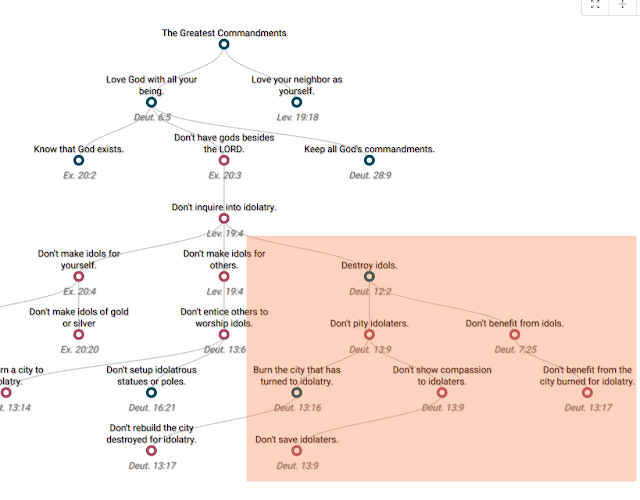
As part of EtzMitzvot, every Tuesday I add more commandments to the visual tree. This week I added the highlighted commandments concerning idolatry:

Specifically these commandments:
  • Don't pity idolaters.
  • Don't show compassion to idolators.
  • Don't save idolators.
Whew - "don't pity", "don't show compassion", and "don't save them" - harsh! Certainly not politically correct. Maybe even counterintuitive to what many Christians understand to be God's character. 

But it nonetheless is God's character to hate idolatry. Historically, idolatry nearly destroyed Israel on multiple occasions. The Torah's harsh prohibitions on idols reflects God's character: it shows God's deep love and care for His people. God doesn't want His people to turn to delusions, sexual immorality, or self-harm, and the Canaanite cults involved all three.

These 3 commandments are one of several idolatry commandments that Maimonides derives from the Torah, and all three are based on Deuteronomy 13:7-10:

“Suppose your brother—your mother’s son—or your son or daughter, or the wife of your bosom, or your best friend of your own soul misleads you secretly, saying, ‘Let’s go and serve other gods’—that you and your fathers have not known, from among the gods of the peoples around you, near you or far off from you, from one end of the earth to the other. You are not to give in or listen to him, your eye is not to pity him, and you are not to spare or conceal him. Instead, you will surely put him to death. Your hand should be the first against him to put him to death, and afterwards the hand of all the people. You are to stone him with stones to death because he tried to entice you away from Adonai your God, who brought you out from the land of Egypt, from the house of slavery. Then all Israel will hear and be afraid, and never again will they do such an evil thing as this in your midst.

In essence, anyone who tells Israel to turn to other gods receives the death penalty. No citizen of Israel can hide an idolater, pity him, save him from penal judgment. Instead, he is to be stoned to death.

This commandment was given at a time and context where the nations were worshiping figurines of gold and silver, sacrificing humans to gods. The Canaanites were self-mutilating to worship Baal and engaging in temple cult prostitution, homosexuality and bestiality as forms of Asherah worship.

A Canaanite tablet from 1300 BC depicting Asherah, a Canaanite goddess whose worship appears repeatedly in the Tenakh. It is this sort of idolatry ancient Israel was surrounded with. God's commandments in the Torah were mean to prevent such idolatry.

To the original Israelite audience of the Torah, these prohibitions on idolatry would have been clear: worshiping Baal and Asherah is forbidden under threat of death.

What do commandments about idols have to do with modern Judaism and Christianity? Much, it turns out.

Some forms of Orthodox Judaism misapply these commandments to forbid Christianity and persecute Christians.

Chabad, for example, reinterprets these commandments as prohibitions on "missionaries" and "missionizing":


Suddenly, the commandments about not worshiping idols like Asherah now apply to Christians following the God of the Bible through the Jewish Messiah from Nazareth.

It is no wonder that some Jewish religious extremists have harassed Jewish followers of Jesus: barging into Christian events with bullhorns, denying or revoking citizenship of Jewish Christians in Israel, planting bombs at the homes of Messianic leaders. In the eyes of some religious extremists, people who call the Tenakh their Bible, call on the God of Israel, and follow the Jewish man from Nazareth are idolaters and missionizers.

I understand why some hardline Jewish religionists believe that. I understand how they misapply it to Christians. To them, Christians aren't following God, they're following a false god named Jesus. (Some religious Jews are more nuanced and will say that Christians are following God plus another entity besides God.)

The reality is hard to understand but nonetheless true. Christians are following only one God, the God of the Bible. 

God sent Jesus to bring humanity to Himself. He provided atonement and forgiveness of sins just before the Temple and Levitical system was destroyed. God revealed that Jesus is not merely a man, but an appearance of Himself, not unlike how God appeared to Abraham. This is not two or three gods, as Islam and Judaism misunderstand. God, Messiah, and the Spirit of God are not 3 gods. It is one God.

This is why Christians have no problem with Jesus saying that the Shema -- "Hear O Israel, the LORD our God is one" -- is the most important commandment. God is one, and the most important commandment is to worship him alone. 

If Jesus is a different god, as some parts of Judaism and Islam believe, then indeed it's right to apply these anti-idolatry commandments to Christians.

But if Jesus is an appearance of God, and there's only one God, then worshiping that one God is right, and applying these Torah commandments against Christians is a grave misinterpretation and perversion of the Torah.

Jesus and the Sabbath Show Up on Joe Rogan Experience


This week, the world's most popular podcast, the Joe Rogan Experience (JRE), hosted Christian apologist Wesley Huff. 

Wes is a historian, author, researcher, expert in Biblical manuscripts and early Christian writings, PhD candidate, and defender of the authenticity of the Gospel accounts. I've followed Wes' writings and videos for years, so I'm happy to see him get some major exposure on JRE.

Here's the full episode:

Why is this significant? Protestia explains that this episode is likely to be the furthest reaching gospel broadcast in history.

Huff’s message went out to Joe Rogan’s 14 million regular listeners. Even moderately popular episodes enjoy over 11 million downloads, and some far more. In a month’s time, Rogan’s downloads exceed 190 million in the course of a month (which is more than the number of Americans who watched the moon landing). It’s more than those who watched the Beatles on Ed Sullivan. It’s more than those who watched Nixon’s resignation speech. It’s more than those who watched the Chiefs beat the Eagles at ‘23 Super Bowl. It’s more than those watched the O.J. Simpson verdict. It’s more than those who watched JFK’s funeral, or the wedding of Prince William and Kate Middleton.

As an example of the podcast's influence, just before days before the 2024 election, President Trump appeared on JRE, and it resulted in a last minute bump towards Trump, leading to an election victory. 

These unscripted, long form conversations are powerful. The podcast has some 14 million listeners and avid followers from a variety of backgrounds and persuasions.

Wesley Huff appears on the podcast to talk about God and the truth of the Bible. He did a fantastic job of defending common objections to the historicity of Jesus, specifically his death and resurrection. Questions like, "How do we know Jesus really died when he was crucified?", "How do we know Jesus appeared to people alive after his crucifixion?", Wes handles it well and gives the evidence.

I want to zero in on a question where the Torah comes up and dive a bit deeper on it. (After all, friends, this is the Kineti blog!)

Wes argues in this clip that Jesus was against moralism:

Here's the interesting bits:

Huff: I actually think that Jesus condemns moralism. And ultimately what I see [Jordan] Peterson doing is looking at Jesus as a moral example. And if Jesus is nothing but a moral example, then you can save yourself and you don't need a Savior. I think Jesus would critique that, because Jesus is very against moralism.

Rogan: How do you define Jesus being against moralism? What do you mean by that?

Huff: Jesus looks at the religiosity of his day, with particular groups like... the Pharisees who are like lay scholars, and Sadducees who are professional priest scholars, and he's constantly critiquing the fact they have this hypocritical religiosity to them. They're constantly doing things like, uh, tithing their mint leaves to make sure they get all...this is where we get letter of the law vs. intention of the law. Jesus critiques them for that because he says, 'You're trying to do everything right, and you're missing the point.' One of the things he says is, if one of your donkeys falls in a ravine on the sabbath, do you pull it out? Or is that work? What's the point of the sabbath? 

Rogan: Hmmm.

Huff: Is it to not do any work? Like, is it to make sure you're not working too hard, because you might be breaking the sabbath? Or like, what is the point? And he says, the sabbath was made for man, not man for the sabbath. And there's this intention -- and this is the whole Sermon on the Mount, Matthew chapter 5 -- is he keeps saying, "You have heard it said, but I say..." and he's referring to the Mosaic Law. And it looks like he's critiquing the Mosaic Law, but he's not actually. He's getting back to the intention of the Law. So when he says, "You've heard it said, 'Do not commit murder', but I say to you anybody who harbors hate for their brother in their heart has committed murder." - what he's getting at is, what is the intention, what's the meaning of the Law that God gives to you?

This is really great and I applaud Wesley for telling millions of listeners God is real, the Bible is true, and giving evidence for Jesus' resurrection. I love that Wes explained that Jesus isn't critiquing the Law, he's getting to the purpose of the Law. This is a profound truth and many lay people in Christianity miss it.

Wes' comments on Jesus and the Law goes well with my recent teaching, The Law of Christ is the Law of Moses Kept in a Christlike Way. Jesus isn't critiquing "You shall not murder", he's saying that the true goal of that law was to prevent hatred in your heart, and that having hatred in your heart is actually breaking the Torah. Likewise for the law against committing adultery: its true aim was to prevent sexual immorality even in the mind and the heart; merely lusting after someone other than your spouse is actually breaking the Torah.

OK! But there's a wriggle here. I don't blame Huff for not addressing it, because the Rogan podcast audience is not ready for deep theology. But maybe you are, dear reader.

The wriggle is the sabbath and its true meaning.

Huff says, 

"One of the things [Jesus] says is, if your donkey falls in a ravine on the sabbath, do you pull it out? Or is that work? What's the point of the sabbath? Is it to not do any work? Like, is it to make sure you're not working too hard, because you might break the sabbath?"

Let's put these in a table to illuminate the issue:

Torah commandmentTrue meaningTrue meaning aligns
with plain meaning
Do not commit murderDo not have hatred in your heart.
Do not commit adultery.Do not lust in your heart.
Do not work on the sabbath; keep it holy.

See the issue? Huff states there's a true meaning behind the commandments in the Law. But note that the commandments' plain meaning cannot be cancelled by their true intention:

  • No hatred in the heart doesn't mean we're now free to commit murder, of course.
  • Likewise, no lust in the heart doesn't mean we're free to commit adultery.
  • No work on the sabbath doesn't mean we're free to work on the sabbath or treat it like any other day.

That's the wriggle: Christianity largely does work on the sabbath and treats it like any other day.

If I'm being charitable, Christianity keeps the 1st day of the week, Sunday, as the new sabbath. That also contradicts the plain meaning of the commandment in Exodus 20:9-11. But even if we grant Sunday is the new sabbath and is considered holy by meeting with other Christians on the sabbath, work is still permitted on Sunday. There are notable exceptions, like Chik-Fil-A restaurants. But it's the exception that proves the rule. The Christian world, whether Catholic, Protestant, or Orthodox, works on the sabbath even if we move the sabbath to Sunday. This again cancels the plain meaning of the text.

And there's another mystery here. What is the true meaning, the real intention, of the law about resting on the sabbath and keeping it holy? Is there a true meaning, one deeper than the plain meaning?

Jesus doesn't explicitly give us one like he does for murder and adultery. 

He gives an example that saving the life of an animal on the sabbath is permissible. (Judaism's concept of pikuach nefesh.) He heals a man on the sabbath and tells us that it's permissible to do good on the sabbath. Jesus says the sabbath is made for man. Here are the prominent sayings of Jesus on the sabbath. Make good note of what is, and isn't, there:

Jesus' statement Implied true meaning
"Which of you, with a son, or even an ox, falling into a well on the sabbath, will not immediately pull him out?" Healing a person or saving their life is permissible on the sabbath.
"Haven’t you read in the Torah that on the sabbath the priests in the Temple break the sabbath and yet are innocent? I tell you that something greater than the Temple is here." A divine priority: Messiah is greater than the Temple, and the Temple is greater than sabbath. "Violating" lesser priorities in service to a higher priority is no violation at all.
"Therefore it is permitted to do good on the sabbath." The sabbath is meant for good.
"The Son of Man is Lord of the sabbath." Messiah created the sabbath. The creator of the sabbath has authority to say what is permissible on it.
"The sabbath was made for man, and not man for the sabbath." The sabbath is intended for the benefit of humanity. The sabbath should be a joy and a delight, not a burden.

Is there deeper meaning to the sabbath commandments? Certainly. But I think these are a good start.

Notably missing from Jesus' sabbath statements are any claims that all work is permissible on the sabbath, or that the sabbath is done away with.

My conviction remains and is strengthened: Jesus did not wish his followers to do away with the sabbath. He wished to tell us that preserving life trumps not working on the sabbath. He wished to tell us that sabbath was created for us. He wished to tell us that doing good on the sabbath is permissible. But I'm convinced Jesus did not intend for a non-existent sabbath where anything is permissible.

Jesus' disciples should have a day of rest. It should be on the 7th day. You can do good works on it, and you can save someone's life on it. It should be a joy and not a burden; it was created for us. But it's a day of rest, not a day to work or catch up on your shopping. Christianity needs reform in this area.

C.S. Lewis on Arguing Theology Over the Internet


I've started reading Mere Christianity, C.S. Lewis' monumental apologetic work.

In the opening pages, he says something that applies to internet arguments. Of course, Lewis lived long before the internet existed. But the warning he issues to believers are especially relevant for our internet age:

"Ever since I became a Christian I have thought that the best, perhaps the only, service I could do for my unbelieving neighbours was to explain and defend the belief that has been common to nearly all Christians at all times. I had more than one reason for thinking this. In the first place, the questions which divide Christians from one another often involves points of ecclesiastical history, which ought never be treated except by real experts. I should have been out of my depth in such waters: more in need of help myself than able to help others. And secondly, I think we must admit that the discussion of these disputed points has no tendency at all to bring an outsider into the Christian fold. So long as we write and talk about them we are much more likely to deter him from entering any Christian communion than to draw him into our own. Our divisions should never be discussed except in the presence of those who have already come to believe that there is one God and that Jesus Christ is His only Son." 

Years ago in the early days of the internet, there was a Christian site called ChristDot that I participated in. On that site, we argued theology with one another almost daily. Over many months, a Christian leader of the site decide he was no longer a Christian. (And, of course, not a single non-believer became a Christian because of our arguments.) I remember a post asking him, "Did all our arguing on Christdot contribute to your unbelief?" And as I recall, the answer was, to a degree, yes.

On this blog of 20 years, I've seen several people vehemently argue about everything from the relevance of the Torah, the age of the earth, the deity of Yeshua, the meaning and context of Old Testament commandments, and a million other things. I've argued with a Messianic rabbi who later committed repeated sins and left his congregation. I've argued with family members who left the faith. For a few years I argued with a Jewish believer who later denied Yeshua.  I've argued with other Messianics about the role of Gentiles in the Messianic movement. I've argued with Karaites, Christians, Jews, conspiracy theorists, anti-vaxxers, flat earthers, Muslims, atheists, gay-affirming Christians. 

To what end? 

Maybe it's good to discuss theology with other believers. For me at least, it helps clarify and shape my thinking. It's been a real purpose of this blog.

Lewis argues that theology disputes have no tendency to bring in people to the faith. He even says it deters people from entering the faith. In my experience, it can even lead people away from their faith, especially as people tend to be less gracious vicious when hidden behind a screen and keyboard.

This speaks to me: arguments about high theology in the public sphere are dangerous: if non-believers see us arguing about them, it is likely to push them away from God.

Torah Keeping is a Gradient, Not a Binary

image

Break the binaryChristians, Jews, and we Messianics in between speak about Torah observance like an on/off switch: you’re either Torah observant, or not. Torah observance as a binary.

Orthodox Jews say they have Torah in the “on” position.

Christians will say they are not under the Law: Torah in the “off” position.

But the truth is, nearly every person on earth is Torah observant.

Torah observance is not on/off binary. It’s a gradient scale:
image

This isn’t universalist every-path-leads-to-God kumbaya nonsense.

Nope. It’s describing reality:

  • Loving God wholeheartedly? That’s Torah.
  • Loving your neighbor as yourself? That’s Torah.
  • Abstaining from sexual immorality? That’s Torah.
  • You're not swindling, cheating, or hating? That’s Torah.
  • Caring for the widow and orphan? That’s Torah.
  • Visiting the sick and caring for the oppressed? That’s Torah.
  • Honoring your mother and father? That’s Torah.
  • Not stealing or murdering? That’s Torah.

And these aren’t just some minor details. Most of these are weightier matters of the Torah, involving justice, mercy, faithfulness. These are the big ‘uns. Smile

This truth – that nearly all humanity keeps Torah on some level – leads us to some surprising realizations.

  1. No one keeps 100% of the Torah. Not even the most stringent of the Haredim.
  2. Christians are Torah observant. Less so than Messianics and Orthodox Jews, yes, but more than the secular world.
  3. All humanity is Torah observant to a degree, probably because God has written on the human conscience the basics of morality.

Nobody keeps 100% of the Torah

I’ve often heard this used as an excuse for why Christians aren’t (supposedly!) Torah observant (even through they are).

But it’s a bad excuse, in the same way that “I’m unable to follow 100% of the laws of the United States government, so why try?” is also a bad excuse.

While it’s not an excuse to avoid the Torah, it is nonetheless true: no one keeps 100% of the Torah.

This is two ways: first, not all commandments apply to everyone. (Commandments specific to farmers, or to priests.)

But it’s also true no one keeps all the commandments that do apply to them! There are cultural and external factors that stop people from keeping commandments that apply to them. The Temple is destroyed, so you don’t bring offerings to God in it. You don’t live in Israel, so you don’t make aliyah to Israel 3 times a year. The culture has changed, so even the most stringent Ultra-Orthdox Jew doesn’t observe the laws regarding levirate marriage.

Christians are Torah observant

Christians are some of the most charitable, faithful, generous giving people in the world.

A few years ago when I was working with youth homeless shelters as part of my software job, I saw the organizations who were providing hot meals, shelter, and medical care to homeless youth. Organizations like Lutheran Social Services. Catholic Charities. Salvation Army. Loaves and Fishes. Park Community Church.

Not all the organizations were Christian. Some were secular. There was even a few Islamic organizations. But by and large? Christian churches and outreaches were feeding the hungry, clothing the naked, caring for the sick.

That’s Torah.

I no longer believe that Christians aren’t Torah observant. When Christians protest, “We’re not under the Law!”, I think they are doing themselves a disservice. Because they’re going above and beyond the Law, keeping the Torah as Yeshua did: by being a servant.

It’s true Christians don’t keep kosher. They mostly don’t keep the Biblical Chagim/Feasts. They don’t keep the Sabbath. (Unless you count things like Chik-Fil-A closing on Sundays. Wrong day, but points for trying.) But as great as kosher, Feasts, and Shabbat are, those are not the weighty matters of the Torah.

I call on my readers to keep these in mind when speaking with or about Christians.

All humanity keeps basic Torah principles

In Paul’s letter to Rome, chapter 1, he says God will judge every person, because no person is without excuse; God is visible in nature. In Paul’s words, “What can be known about God is plain to everyone—for God has shown it to them. His invisible attributes—His eternal power and His divine nature—have been clearly seen ever since the creation of the world, being understood through the things that have been made.”

I’ve pondered these words for months. I believe Paul is saying that all people intrinsically know basic morality. People know murdering an innocent is wrong. People know cruelty is wrong. Rape is wrong. And so on.

Why does virtually every human being know this? Evolutionary anthropologists would argue these are evolved traits rising from societal gains. I argue its source is out of this world. SmileGod has put in every human conscience what we might call “Torah basics.” This is why nearly every culture and language has some basic morality, where murder, theft, rape, and more is outlawed or otherwise suppressed.

Takeaways for Messianic people

God cares about how much Torah we keep. The “gradient scale” spoken of here is describing reality on the ground, not the ideal from above.

Torah observance as a gradient doesn’t mean God is fine with you ignoring the Bible. No, God calls humanity to perfection – that’s the ideal. Perfection would be keeping every commandment that applies to you in the way that God wants you to apply them, and according to a divine priority and weightiness, where certain commandments overrule others.

“Gradient” speaks of the reality on the ground: humanity isn’t perfect. Every person hasn’t kept the Torah perfectly, though nearly every person on earth keeps some of it, by instinct or secular law or faith conviction.

Given that reality, and given that Christians are keeping a great deal of Torah already should have some implications for how we talk about Christianity and Judaism.

We often get into debates about the role of Torah for today. We often chide Christians for their lack of Torah keeping, or their negative attitude towards it. Christians often return the favor, calling Torah keepers as heretics, legalists, and worse.

(This problem is present in the Jewish world, too, with Orthodox sects keeping Torah in a more stringent way, where Reform sects keep in less according to the letter and even re-interpreting it in each generation.)

These issues will keep coming up, and we are right to wrestle with them: how to keep the Torah, what we can keep in the 21st century, what parts of the Torah to major on, and so on. But when we wrestle with them, let’s avoid the temptation to demonize our “opponents.”

Our “opponents” are trying to apply the Bible to their lives in a meaningful way. And moreover, both Jews and Christians are our brothers. Family disputes will happen, but let’s remain family and not cut people out of God’s Kingdom. I suspect when Messiah arrives and brings his long-awaited nation, we will see many people who believed – and applied the Torah – differently than we.

Keep these broad mercies of God in mind the next time we speak of believers on the other side of the fence.

Human Ageing in View of the Divine

Summary: Science-based medicine is inching closer to extending the human lifespan. If, in the distant future, people can live forever, does that change our faith and religion, given its promise of eternal life? Warning: This post speculates about a future that may never happen. Even so, it’s worth exploring.

image

I've been reading a fascinating book by Dr. Michael Fossel, professor of clinical medicine, Michigan State University. Fossel is an optimistic proponent of the telomere theory of ageing. This theory states:

  1. Humans age because our cells age.
  2. Cells age because they stop dividing after a certain number of divisions (called the Hayflick limit).
  3. Cells stop dividing because the caps of the chromosomes, called telomeres, shorten with each division.
  4. When telomere caps are too short, the cell ceases dividing and eventually breaks down, slows the production of energy, and releases excess garbage in the form of free radicals.
  5. When your cells are unable to repair themselves and remove cellular garbage, your skin, tissue and organs begin to break down.
  6. As your body stops repairing itself and your tissue breaks down, you eventually succumb to a disease of old age, such as cancer, heart disease, or Alzheimer’s.

This is the telomere theory of ageing in a nutshell. (I’m a layperson, not a medical professional, so take my simplified summary with a grain of salt.)

It should be noted there are other theories of ageing currently in scientific circles, such as the theory of damage accumulation, the theory of life force, the theory of free radicals, among others.

“Big if true…”

Suppose for a moment Fossel’s theory is correct. Fossel theorizes that extending your cells’ telomeres will actually reverse cellular ageing processes and help prevent the diseases of old age. He theorizes:

  1. Your cells will resume dividing like they did when you were young.
  2. Young dividing cells will better repair you skin, tissue, organs and immune system.
  3. With your body now repairing itself and recycling cellular damage, you’ll be less prone to diseases of old age, like cancer, heart disease, and Alzheimer's.
  4. A human body that is always fighting off diseases of old age will live longer if not indefinitely: you’re not limited to 70 or 80 years. Your lifespan would be limited only by external factors (e.g. getting hit by a bus).

Dr. Fossel cites experiments which he believes proves the telomere theory of ageing. He says if we take skin cells from an elderly person and grow them in the lab, it will predictably produce old skin: weak, thin, easily tearable. Likewise, taking skin cells from a young person and growing them produces young skin: thick, strong, rugged skin. The moment of truth came when Dr. Fossel took the elderly skin cells and extended their telomeres. The result? The elderly cells acted as though they were young, and produced young skin.

This has significant implications beyond removing skin wrinkles from the elderly. Diseases of ageing, like heart disease and cancer (currently the number top 2 leading causes of death in the West) can be combatted by this same technique.

Fossel recently founded a new medical company, Telocyte, to apply these techniques in modern medicine. Their first target? Alzheimer’s disease. This disease of old age is the result of a breakdown in cellular function that clears plaques from the brain. As this recycling breaks down in old age, plagues build up on the brain, killing brain tissue and reducing cognitive function, eventually resulting in death.

Fossel believes by lengthening the telomeres of cells responsible for the cleanup of plaques on the brain, we can not only prevent Alzheimer’s, but even reverse it in existing patients.

A healthy skepticismbrain-salt-l

Before I go any further, a word about critical thinking.

Disciples of Yeshua in the 21st century desperately need a healthy skepticism. The internet, for all its blessings, is also a curse: an overload of information. Many people believe what they want to believe, and the internet quickly supplies it.

In the Hebrew Roots movement in particular, I’ve seen many people believe all kinds of nonsense. Conspiracy theories, flat earth, all-natural elixir cure-alls and other quackery.

This skepticism should apply to medical science as well. I am skeptical of the claims of Dr. Fossel, and you should be too. While he may not be a quack selling brain salt elixir, his theory could be wrong, or too simple, or any number of variables could invalidate it. It’s too early to tell, and the proof will be in the pudding. If we see Fossel’s company curing Alzheimer’s disease by 2025, then we can start to get excited. But until then, it’s just another claim in a sea of (mis)information.

Humans are going to live longer regardless

Whether the telomere theory of ageing holds or not, one thing is certain: humans are living healthier, longer lives. In the last 250 years science-based medicine has more than doubled human life expectancy:

The advent of surgery, vaccines, and antibiotics has greatly increased human lifespan worldwide.

200 years ago, it would be rare to see a person live to 70. Today, it’s the norm and we think nothing of it.

If this trend continues – and it likely will barring an apocalyptic event such as World War III – future generations will likely enjoy a longer lifespan. Fewer instances of cancer, heart disease, and other diseases of old age.

Consider the present: humanity has already eradicated small pox, nearly eradicated polio, and we have a cure for Hepatitis C.

New medical innovations like CRISPR enable us to cure genetic diseases; last month (November 2018), the FDA approved an investigational new drug application that aims to cure Leber Congenital Amaurosis, the leading cause of childhood blindness.

Eventually, humanity may reach a point where human disease is all but eradicated. At that time, humans may live indefinitely.

Eternal life in Christianity and Judaism

If medical and scientific progress continue, it’s likely humans will eventually live very long, if not indefinitely.

This got me thinking:  What does it mean for people of faith if science-based medicine allows us to live forever?

Judaism and Christianity are united in hope of eternal life via resurrection. It’s so central to our faith that the Apostle Paul said our faith is in vain if there’s no eternal life:

“How can some of you say there’s no resurrection of the dead? If it’s true there’s no resurrection, then Messiah wasn’t raised. And if Messiah wasn’t raised, our faith is in vain.”

-Apostle Paul, Letter to Corinth

It’s central to mainstream Judaism as well. The fundamental 13 principles of Jewish faith include a confirmation of the resurrection:

“I believe with perfect faith that the dead will be brought back to life when G-d wills it to happen.”

-Maimonides, 13th principle of Jewish faith

This is the eternal life that Judaism and Christianity speak about: that one day, at the time God sees fit, God will raise the dead back to life and we will live with Him on earth. This is the “Kingdom of God” spoken of in the gospels; the Olam Haba (Age to Come) that Judaism is waiting for.

For us, this message of the resurrection is based on an actual historical event: Messiah was raised from the dead by God some 2000 years ago. It’s not merely a matter of faith, but also one of evidence. The early disciples of Jesus knew whether he was dead or not – if anyone hid the body or made a false claim about his resurrection, it would have been them – and yet, all of them went to their brutal deaths proclaiming it to be true, refusing to recant: this man Jesus literally rose from the dead and appeared to them in the flesh after his death.

The idea of eternal life has impacted to billions of believers through the ages.

For example, at Hanukkah we remember the Maccabees who firmly believed that “after our death Abraham, Isaac, and Jacob will receive us and all our forefathers will praise us” (4 Maccabees 13). It was this conviction of eternal life that empowered them to stand up to a wicked and brutal empire. “You may kill us today, but one day we will be living again.”

For Christians, it was this same message of eternal life – now tangible and nearer with Jesus’ resurrection – prodding on the early believers to preach the risen Jesus, even with the threat of torture and death through Rome’s sadistic brutalities.

And on the darker side of things, it’s the same hope of eternal life that animates Islamic extremists to commit suicidal terrorism, believing they will enter Paradise with Allah for murdering unbelievers.

The hope of eternal life is still powerful today.

The recently deceased President George H.W. Bush hoped for eternal life, anticipating seeing his wife and his 3 year old son “on the other side.”

Messianic Jewish pioneer and Rabbi Stuart Dauermann spoke of his conversation with a dying woman, a skeptic of eternal life:

The medical technician said, “Lady: that’s the biggest tumor I ever saw.” And it was on her liver.

Lillian didn’t have long to live, and we had a conversation.

She said to me, “Ah, what the hell. When you’re dead you’re dead.”

I responded, “Lillian, you don’t know that. You’ve never died before!”

That brought her up short.

I then went on to say, ”Look, Lillian. Yeshua said this,  ‘I am the resurrection and the life. Whoever believes in me, though he die, yet shall he live, and everyone who lives and believes in me shall never die.’ Now, if some guy standing on a streetcorner says this, or some other clown, you could dismiss it as the rantings of a fool. But when a person who lived the most remarkable life ever lived, and whose life and teachings have had compelling force for thousands of years says this, then it’s something else entirely.”

She was listening now. I went on.

“Lillian, it’s like playing a game of poker. You can take all your chips and put them on your proposition, ‘When you’re dead you’re dead.’  Or you can take those chips and place them on Yeshua who said that by believing in him and in what he said, you will continue living even on the other side of death. Which choice will you make?”

She gave a smart answer. No surprise. “Well, I don’t have much choice do I?”

I agreed.

Eternal life is a powerful hope indeed!

But what if Lillian had a choice? What if her choice was, “Keep being a skeptic of faith if you please; medicine will cure your cancer.”

If humans can one day attain eternal life without faith and religion, what does that do to faith?

Addressing religious objections to medical life extension

Some may think this is a non-issue. Some of you fine readers will say,

“The Lord will return before then.”

Maybe so, but maybe not. It’s been 2000 years. What’s another few hundred? No one knows.

“It’s not our place. Extending human lifespan is playing God.”

Maybe. But many religious people used to think that surgery was also playing God, but I bet none of you will turn down life-saving surgery today.

Additionally, God commanded humans to subdue the earth. Doesn’t that include subduing disease?

“This is crazy talk. We’ll never solve death.”

That’s entirely possible, even likely. But the trajectory of history shows an increasing lifespan thanks to medicine and science. If the trajectory continues, we’re looking at very long lifespans, possibly indefinite lifespans. You may think I’m crazy, and you might be right. But it’s my blog, and I get to think out loud even the wild-eyed thoughts! Smile

“It’ll never happen, because God decreed death as a curse in Genesis.”

God did curse humanity with death in Genesis. But that curse included men working by the sweat of our brows and women having great pain in childbirth, and both of those have been alleviated.

Let me tell you, friends, I work hard, but I don’t sweat and I don’t work the fields. I consider that a blessing. My God-given technological skills have allowed me to provide for my family without back-breaking field tilling. And even if I was a farmer, I’d utilize technology – GPS-guided tractors, engines, crop rotation, irrigation, and more – so that farming isn’t so terrible an existence.

As for the curse on women, my wife gave birth just last year. She didn’t have much pain in childbirth thanks to the wonders of modern medicine. Ditto for our other 2 children, both of whom are happy and healthy.

In short, the “curse on humanity” is still here – people are still dying, men are still working, and women still have pain in childbirth – but all those things have been alleviated by technology and medicine. Perhaps the curse of death can be alleviated as well.

Religious outcomes of medical eternal life

Maybe some of my readers will reject one or both, but suppose both are true:

  • Eternal life provided by God is real
  • Science-based medicine will provide eternal life, or something close to it.

Supposing both are true for a moment, what would religion look like?

The powerful message of eternal life that has animated so many Jews, Christians, and Muslims would probably be less impactful.

“Will you live forever?” will be answered with, “If I want to.”

That removes a reliance on God in some way.

Impactful statements from God will be less impactful. John 3:16’s famous, “All who believe in Me will not perish, but have everlasting life” would be rendered passé.

There will still be the desire to live with God – enter the Kingdom of Heaven, the Olam Haba – but that won’t be as powerful if death isn’t looming over every head.

So, I suspect religion and faith would be in decline because of one its central fruits would be duplicated by science and medicine.

On the other hand, it could make death even scarier for some. Like the man in a horror film running away from his tormentor, closing door after door on his pursuer, so too the person running from death through all kinds of medical interventions, trying everything to keep death at bay.

Maybe humans are designed to die, whether biologically or spiritually speaking. I spoke with my grandmother a few months before she died, talking to her about medical innovations that could extend human life. She told me, “I’d pass. I’m ready to die when the time comes, and I don’t want to live here forever.”

It took me by surprise. What I wish I would have asked her is, “Are you saying that because of all the pain and health trouble of old age? Would you still say that if you were healthy?”

As a healthy 35 year old, I want to live forever. I don’t want to die. But maybe time will change me.

Another interesting potential outcome of very long or indefinite lifespans is a good one: the accumulation of wisdom.

Young people are idiots who think they know everything. (I submit this blog post as evidence! Winking smile) Older generations have learned lessons that youth have yet to learn. The elderly have lived, experienced, and learned lessons difficult to pass on merely through words. And even if they could be transmitted by words, the young aren’t listening; they already know everything.

Having long-living people would likely increase humanity’s wisdom. Our leaders would likely be the more elderly people with more wisdom. Wisdom would dictate avoidance of war, because people who have experienced the hell of war would go to great lengths to avoid it. Culture would begin to see the elderly as wise, rather than as the nearly-irrelevant dementia-riddled burdens today’s culture views them as.

Long or indefinite lifespans would have repercussions worldwide; overpopulation would likely pressure us to move to other planets. Resource scarcity might produce war and famines. I won’t discuss these here, as I want to focus only on its impact on faith.

If science-based medicine can cure diseases, reduce suffering, and even give us eternal life, where does that leave faith? It will be a disruptive time.

Conclusion

The lame walk, the deaf hear, the blind see, all because of modern medicine. Some see this in an atheistic light – “Look what we did…without God!”

But maybe God is the platform here, and we are built atop it. God told us to take dominion over the earth and subdue it. Subduing disease surely falls in line, then, with God’s own commandment to humanity, one that predates even the curse of death.

The appearance of Messiah 2000 years ago changed the world forever; even our reckoning of time (BC/AD). It also ushered in an era where the Christian ethic reigns: compassion, healing, feeding the poor, caring for the needy, hospitals, medicine, food and more are in abundance. Perhaps modern medicine is an outgrowth of Christianity. Indeed, many western hospitals were founded by pious Christians; many hospitals still bear names like “Saint Joseph’s” or “Methodist Central.”

Viewed in that light, modern medicine and its ultimate goal of wiping out disease is of godly origins. I welcome it. But how will your faith be affected, fine Kineti reader, if you can achieve eternal life in the here and now through medicine alone?

The 11 Elements of Liberal Christianity: A Conservative’s Friendly Critique

Summary: With liberal Christianity in sharp decline, a new book seeks to define its tenets and rehabilitate its negative image. But the 11 principles of liberal orthodoxy are easily affirmed by many religious conservatives, including myself. What gives? It’s a theological motte-and-bailey argument.

imageInfluential Christian author Scot McKnight writes about the Eleven Elements of Liberal Orthodoxy, citing a new book by Michael Langford, The Tradition of Liberal Theology, which defines tenets of liberal Christianity.

Langford enumerates 11 core principles of liberal orthodoxy:

  1. A use of the Bible that is not always literal.
  2. Reason and revelation are in harmony.
  3. A non-legalist account of redemption.
  4. The possibility of salvation outside a narrow path.
  5. Toleration.
  6. Original sin, but not original guilt.
  7. Belief in free will.
  8. A view of providence that respects the integrity of the natural order.
  9. The joint need of faith and works.
  10. A minimal number of basic teachings.
  11. A range of acceptable lifestyles.

As a conservative religious person, I was surprised to discover that I affirm nearly all of these. Some examples:

Literal Bible: The Bible is not always literal. Books of poetry, for example, are especially non-literal. Psalm 19 speaks of God pitching a tent for the sun, and like a championship runner, the sun runs its race through the sky, speaking its words to all living things. This is clearly not literal; it’s poetic. And I know of no conservative religious person who believes every word of the Bible is literal.

Undoubtedly conservatives and liberals disagree how much of the Bible is literal, but the difference is not binary.

Reason: We conservatives don’t believe human reason is fundamentally in opposition to divine revelation. We only caution complete reliance on human reason; “lean not on your own understanding.” Human reason is mutable and ever-changing, and the human propensity for evil can produce a kind of reason leading away from God.

Salvation outside a narrow path: OK, admittedly most conservative religious are narrow in their view of who God saves. (“Everyone is going to hell, except me [and my denomination]”). I’ve argued the opposite for years: God saves whom He will save. Evangelicals are not the arbiters of eternal life (God is), and final judgment hasn’t yet been pronounced (it won’t be until the end of the age.)

So, will God save the boy in the remote island who never heard of God? Will he save the unborn child killed in the womb? Will he save the secular Holocaust survivor? My answer is that the Judge of the Earth will do what’s right. God’s path is narrow, but His mercy is exceedingly broad.

While many conservatives differ with liberal theologians on this issue, I find some common ground.

Faith and works: I have been an avid influencer towards this in conservative religious circles: the all-grace, do-nothing gospel produces ineffective disciples of Jesus and runs counter to the gospels. It’s not limited to me; the Messianic congregations and Churches near me are likewise doing tangible works in Messiah’s name: volunteering at Loaves & Fishes, raising money for charity, taking shifts at women’s shelters, running soup kitchens, volunteering at Feed My Starving Children. I see it. My congregation has done it. Conservatives are practicing faith and works.

I think it is a dying minority of conservatives who are grace-only. It is dying because its disciples are not effective.

A minimal number of basic teachings: We conservatives are not overly loaded with basic doctrines, are we? I find Evangelicals to often have utterly barebones core teachings; usually a variation of, “Believe in Jesus so that you will be saved and live forever with God.” Conservatives have more teachings we consider important – but fundamentals? It’s minimal.

As I read these 11 principles, I found myself agreeing with almost all of them.

Why are religious liberals and conservatives so far apart, then, if we basically agree on a bunch of important things?

A real divide

A few years ago, a liberal Presbyterian minister visited my congregation. I happened to be teaching that day. The minister came up to me after the service and she said, “You know, I often have to remind my congregation, ‘God loves all people – even Republicans.’” I laughed, and replied that I have tell my conservative congregation the same thing – only with regards to Democrats!

And I think that little story sums up liberal/conservative differences: we so oppose the other side, imagining the other side so heretical they must be on the outs with God.

Longford’s own definitions of liberalism asserts that the liberal orthodox are “born again” – a defense stated almost certainly because of conservative assertions to the contrary. (In Evangelical circles, if you are not born again, you are headed for hell.)

Turning the tables, Langford says conservatives are irrational (rejecting rational thought and intellectualism) and tend to be fanatical. (As a religious conservative, I had to both laugh and acknowledge some truth in that!)

Meanwhile, we conservatives wonder how it is that liberal congregations can even exist.

What good is a religion if you don’t follow its rules? Why call yourself a follower of God if you don’t adhere to what God says (about sin, lifestyles, sexuality, abortion, ...). We conservatives see in liberal churches such an extreme focus on tolerance, God’s people there are no longer ruled by God, but by the whims of godless culture. Are there theological “lines in the sand” in liberal Christianity? From our view over here, it seems everything is negotiable.

To conservatives, liberal churches are nearly indistinguishable from secular culture.

Fueling our speculation, liberal Christianity appears to be shrinking and dying:

Mainline Protestants (those in the United Methodist Church, Evangelical Lutheran Church in America [ELCA], Episcopal Church, Presbyterian Church [U.S.A.], American Baptist Churches, United Church of Christ [UCC], and The Christian Church [Disciples of Christ]) have fared poorly in recent decades. While Christianity overall is not dying in America, Mainline Protestantism is getting closer. According to the GSS, 28% of Americans identified with a mainline church in 1972. By 2014, that number had dropped to 12.2%.

A recent report from the Presbyterian Church (U.S.A.) corroborates this trend. The report looked at church statistics from 2002 to 2013. The denomination reported net membership losses each year. In 2002, the denomination shrank by 41,812 members. This number peaked in 2012 when they reported a net loss of 102,791.

Meanwhile, conservative religious groups are growing:

Evangelicals have remained steady for the most part, according to the polls. The GSS found that evangelical affiliation and reported church attendance peaked in the 1980s and 1990s, then declined, then rebounded. In 1972, 17.1% of Americans self-identified as evangelical. In 2014, this percentage increased to 22.7. Similarly, the number of Americans regularly attending church increased from 7.9% to 12.5%.

Theologically weak, soft or non-existent rules, shrinking membership – we see religious liberals as a dying breed that at best are highly deceived, and at worst leading people away from God.

The Liberal Motte and Bailey

So why is it that we conservatives can affirm most of these 11 principles of liberal orthodoxy?

It’s because these 11 principles are the motte of a motte-and-bailey argument.

imageNamed after medieval castles which contained a weak outer bailey but an defensible inner motte, motte-and-bailey arguments are ones in which a person makes a controversial statement (“The God of the Bible permits homosexuality” – the bailey), and then when critiqued, he retreats to a stronger position (“God loves all humanity” – the strong motte).

These 11 elements of liberal Christianity sound like the motte. They are general and obviously true. How could a religious person fail to affirm both faith and works as important?

The real problem is the liberal bailey.

Examples are in order:

Literal Bible

While it’s true that the Bible is not always literal, there are times when it is literal. The strong motte is that the Bible is not always literal. But the weak bailey says that much, if not all of the Bible, is ahistorical and fiction. The Exodus didn’t really happen. Jesus didn’t perform miracles. God didn’t literally create human beings. God didn’t actually speak to Abraham. The resurrection isn’t real. Moses probably hallucinated the burning bush. (One liberal theologian actually claims, for example, that the best explanation for the post-crucifixion disciples going from defeated band to bold proclaimers is that they shared a group hallucination of the risen Messiah. Oiy.)

We can abide that some of the Bible isn’t literal.

But if we say that core principles of faith are not real or literal – that the resurrection is airy spiritual idea rather than flesh and bones coming to life – well, that makes our faith out to be no more valuable than a children’s fairy tale.

Reason and revelation are in harmony

They can be. But who can claim an unchanging human reason? Not a few hundred years ago it was reasonable to put criminals to death by ripping their flesh off with red hot pincers.

Human reason is mutable and unreliable.

We conservatives can abide the motte that reason need not be contrary to divine revelation, but we cannot accept the exaltation of human reason to the divine unchanging standards. It can lead to increased human pride that challenges God. (Indeed, much of modern science has been fueled by the atheistic thought that with human ingenuity, all things are possible.)

This liberal principle has been abused too often. It results in people throwing out all religion and become atheists; human reason is exalted against or above divine revelation.

This produces anemic communities of faith.

The possibility of salvation outside a narrow path

Yes, perhaps there will be more people in God’s kingdom than what any person might imagine. That again is the strong liberal motte.

But the weak bailey is that liberal Christianity – and even liberal Judaism for that matter – tends to say all paths are valid. Everyone is welcomed, and any condemnation of sin, most any standard for living is frowned upon as legalistic.

God’s mercy is indeed great, but God is a God of both mercy and justice. Compassion and standards. It seems that liberal Christianity has forgotten the latter.

Toleration

The strong motte is that we should be tolerant of those who are not living in the ideal standard God set. On this we conservatives agree.

The bailey is that tolerance means acceptance. Tolerance has been redefined from, “Tolerating a bad behavior” to “Accepting the bad behavior as good.”

The Bible does speak of tolerance, but it’s in the context of God’s tolerance for sinful people so that they repent of the thing He’s tolerating:

But you, O man—judging those practicing such things yet doing the same—do you suppose that you will escape the judgment of God?  Or do you belittle the riches of His kindness and tolerance and patience—not realizing that God’s kindness leads you to repentance?

-Romans 2

Tolerate and welcome people where they are, yes.

But leave them unchanged and remaining in sin? No.

A view of providence that respects the integrity of the natural order

This means things like the parting of the Red Sea happened because of an earthquake or other natural event.

They might be right; maybe miracles are done within the framework of the natural rules of the universe.

But…why limit God? Imagine there is this software engineer, a computer programmer, who designed a complex system. When he makes changes to that system, when he intervenes, he only does so within the rules of the complex system he designs. He doesn’t write new code – he just changes the values of the the variables to make the desired event occur."

I mean, why?

I think the liberal answer is, “Because our message about miracles are more credible to the unbelieving world.”

We conservatives do not believe that a sufficient reason to limit God’s intervention in human affairs. Will unbelievers flock to our churches, or be swayed more towards faith, if we tell them miracles are actually natural events? I’m very skeptical of that claim, and I think most conservatives are too.

The joint need of faith and works

 We agree on this motte – and I’d be glad to work with liberals to do good works in unison! But the bailey here, I suspect, has less to do with good works and more to do with politics.

How many liberal Christians were cheering on the student walk-outs to protest the 2nd Amendment? How many liberal Jews take the tikkun olam motto to mean opposition to the Republican party?

On my side of the fence, it feels like the liberal “good works” too often means, “Doing what leftist politicians say we should do.” (And, if your values align virtually in perfection with one political party, I suggest you are driven not by your faith but by partisan politics.)

If liberals want to feed the poor, I’m there. If you want to visit the sick, I’m with you. If you want to visit people who are suffering, let’s do it together.

A minimal number of basic teachings

Yes, let’s not overcomplicate matters. The gospel is quite simple, after all. And the Torah itself is concerned primarily with loving God and loving neighbor.

But so often, this devolves from “a minimal number of teachings” to “zero fundamental teachings.”

If we throw out the reality of the resurrection, what faith do Christians and Jews really have? It’s no wonder Paul said it was a fundamental matter – if there is no real resurrection, then Messiah didn’t raise either, and our faith is in vain. Likewise Maimonides encoded in his 13 principles of Jewish faith that the dead will raise; it’s a fundamental.

If we throw out these fundamental principles and say they are not basic, plain teachings, there is little religious ground left to stand on. It becomes purely emotional and feelings-based, and that does not produce strong, vibrant religious communities.

A range of acceptable lifestyles

This is the biggest whopper of all the motte-and-bailey arguments.

The strong motte here is that God accepts people where they are, and so should we. “While we were yet sinners, Christ died for us.”

But the reality is the bailey: to liberal Christianity, virtually all lifestyles are acceptable. Gay Christians. Transgender Christians. Christians having sex outside of marriage.

Is adultery permitted? It wouldn’t surprise me.

“Acceptable lifestyles” to God? Those are already defined in the Bible. But liberal Christianity and liberal Judaism discards those rules about lifestyles. So ultimately, most anything goes.

If the Law doesn’t matter, the Lawgiver doesn’t matter. This again produces lawless lifestyles that are not governed by personal discipline over one’s desires, but by freedom to be slaves to our own vices. This kind of religion doesn’t change people. This kind of religion has little impact on the daily lives of people – there are virtually no rules to govern them, after all.

Such a religion cannot survive. And if statistics are to be believed, liberal Christianity is not surviving, and liberal Judaism is not thriving in the place it matters most: Israel.

The 11 Elements of Liberal Christianity are nice values. As a religious conservative, I can affirm many of them. But there’s a chasm between what these elementary principles and the state of how people are living in and leaving liberal Christianity.

Custom comments