Import jQuery

Showing posts with label messianic movement. Show all posts

Why I'm Still Torah-Observant


"Judah, why are you still following all that Jewish stuff?"

I attend a Sunday church. While my calling is in the Messianic Jewish movement, I'm currently more involved with the Christian world. My wife is neither Messianic nor Torah observant. One of the contributors to this blog, Aaron Hecht, isn't Torah-observant (yet 😉). 

My kids have sometimes complained that I forbid them eating certain foods. Why can't they have a bacon cheeseburger when they go out with their friends?

And while we as a family make time for erev Shabbat with a special meal, Bible discussion and blessings on each person at the table, Saturdays often fill up with activities, including my own. I'm not leading my family in keeping Shabbat well.

Last week I was talking theology with my father-in-law, and he asked whether my eating kosher is just tradition. He mentioned the vision God gave to Peter, with unclean animals coming down from heaven with a voice saying, "Rise, kill, and eat!" Doesn't that mean all food is clean in the age of Jesus? 

And didn't Jesus say he came to fulfill the Law? If the Law is fulfilled, do we really have to keep it anymore? Isn't the Law written on our hearts, and thus we don't have to work it out in our actions?

I've also witnessed lots of problems among Torah-observant believers: Torah terrorism, demonizing our Christian brothers, conspiracy theories, and lots of nonsense unrelated to Torah-keeping. I used to do those things myself. And because of all that ugly behavior from Torah keepers, some friends have come out as no longer Torah observant. 

One Christian friend keeps asking me why I'm following those old rules anyways when I'm already saved in Jesus. What's the point of following those all those Jewish things when you're already going to heaven?

It'd sure be easier to fit in with my Christian friends if I just gave up pursuit of the Torah. I could join them for Friday nights out on the town. Why am I still following those old rules, anyways? 

I also struggle with sin in my own life. Sometimes, Torah keeping feels like it's putting lipstick on a pig. I am the pig. How can I worry about kosher when I engage in lustful thoughts or lose my temper with my kids or fight with my wife?

And what is Torah observance, anyways? Is it the Orthodox Jewish Torah observance, with separate kitchens for meat and milk, eating only at rabbinically-certified kosher restaurants and growing out your sidelocks? Or is it the Hebrew Roots Torah observance, wearing multicolored tzitzit tied to belt loops and sounding shofars on every upbeat chorus? Or is it Christian Torah observance, feeding the hungry, giving to charity and standing for the unborn?

I've been thinking a lot about these things. 

Why am I still pursuing Torah in my own life and family?

And my answer is this: the Bible.

What I mean is, I'm convinced -- still! -- that the Bible repeatedly demonstrates that God wants his people to keep the Torah as much as we're able.

  • The New Testament records Jesus keeping the Torah.
  • We have no record of Jesus, the disciples, or the apostles actually breaking the Torah.
  • Jesus tells his disciples that anyone who does the Torah will be considered great in the coming age. (And, those who tell others not to keep the Torah will be considered least.)
  • The New Testament records Jesus telling his followers to keep the Torah.
  • Many of Jesus' commands are above and beyond the Torah. The Torah forbids adultery, but Jesus says even looking at a woman in lust is a kind of adultery. How can we say the Torah is done away with when Jesus' tells us to observe a stronger, more stringent version of it?
  • The New Testament records the disciples keeping the Torah.
  • After Jesus heals a man with leprosy, he tells the man to observe the Torah's commandment about healed lepers. Why would Jesus do that if the Torah was done away with?
  • The New Testament records Paul keeping the Torah in order to publicly put to rest rumors to the contrary. "That way, all will realize there is nothing to the things they have been told about you, but that you yourself walk in an orderly manner, keeping the Torah." (Acts 21:24) How is it that modern Christianity now claims the Paul did not keep the Torah? It's the opposite of the plain meaning of this verse.
  • The New Testament explicitly affirms the Torah is good, holy, and righteous.
  • God punished Israel for not keeping the Torah. If the Torah is no longer applicable, logically God would need to repent to Jewish people for punishing them for something He no longer requires of them.
  • The Torah issues a warning against any prophet or leader who claims the Torah need not be observed.
  • Many of the commandments of the Torah have an explicit clause about its eternal nature. "This commandment is for you and your descendants forever, no matter where you live." If the Torah is done away with, parts of the Bible become false.
  • By claiming Jesus broke the Torah or teaches his followers to break it, Christians are inadvertently making Jesus into the false prophet of Deuteronomy 13.
  • When the Israelites returned from Babylonian captivity, Nehemiah had to correct people breaking the Torah, telling them that their disobedience is the reason God sent them into captivity in the first place. I remain unconvinced God is OK with his people doing things he previously punished us for.
  • Jesus tells people that God created the Sabbath for humanity. Why have his followers discarded something God created for our benefit?
  • When Jesus is falsely accused of breaking the Torah (e.g. healing on the sabbath), He responds not by saying the Torah is done away with. He responds by saying what God intended for the Law (e.g. it's lawful to do good on the sabbath).
  • By claiming Jesus broke the Torah or did away with it, Christians are inadvertently confirming his religious critics.
  • When Jesus returns, He will (still) be Jewish; the Lion of Judah. Shouldn't the followers of the Jewish Jesus emulate His way of life?
  • A Jewish Jesus will live in a way consistent with his first appearing: an observant Jew who shows us how to properly keep the Torah.
  • Jesus is returning to Jerusalem, not to any other city. That implies that Israel, Jews, and Torah still matter to God.
  • The Bible says when Messiah returns, He'll require all nations to go up to Jerusalem to keep the Biblical holidays. Anyone who refuses will have no rain. This implies Messiah wants all people to be Torah observant.
  • The New Testament commands the Gospel "to the Jew first, then the Gentile". This implies Israel and Jewish people still exist. Jewish people remain because of the Torah.
  • I'm unconvinced of the claim that Peter's vision means the food laws have been abolished. I find Peter's own interpretation of the vision more persuasive and powerful: God has made Gentiles clean through Messiah.
  • The remaining anti-Torah statements in the New Testament, like Paul in Galatians, appear not to be wholesale rejection of the Torah, but relying on the Torah to be saved. Christianity today claims Paul is rejecting the Torah altogether, but this runs counter to Paul's own actions in Acts 21.
  • Christians often appeal to Jesus' statement, "I have come to fulfill the Law", but they don't consider the full quote: "I have not come to abolish the Law, but to fulfill the Law." Christianity has not made a practical distinction between abolishing and fulfilling.
  • Modern Christianity has thrown out all food laws, even though the apostles ruled that Gentile converts to Christianity must follow certain food prohibitions from the Torah.
  • I remain unconvinced of the superficial divisions of the Law into moral, civil, and ceremonial; the division doesn't appear in the Bible itself. How can we say, then, that God abolished two of those three divisions?
  • Keeping the 10 commandments but not the other parts of the Law strikes me as inconsistent. On what basis should we keep the 10 but discard the 600+ summarized by the 10?
Another reason I keep the Torah is, I don't trust myself to make better moral judgments than God.

God gave us commandments governing how we live. I can throw those out at my discretion. But, "trust in the LORD wholeheartedly and lean not on your own understanding." 

Part of trusting God is believing He's right even if I don't understand Him. I don't understand some commandments God gave us. But I won't lean on my own understanding. I trust that God is wiser than I am. 

If I throw out the Torah, I'm already taking steps towards a progressive and humanistic religion. Throw out the Torah? Why not throw out the New Testament too? Progressive churches have done exactly this. Pastors of such churches are even free to criticize Jesus's own teachings - and why shouldn't they? If God can do away with the Torah, why can't we do away with things from any part of the Bible we don't like? Don't like the laws prohibiting lesbian and gay relationships? Just discard them. Don't like the laws about preserving life? Just discard them. Don't like the laws prohibiting men pretending to be women? Just discard them. Much of the culture war is a natural outcome of discarding the Torah.

I don't want to go down that path. I think the better option is following God to the best of my ability.

A big part of that is just doing the things God told us to do, including the Torah. And doing those things in light of how Jesus kept the Torah.

There are other reasons to keep the Torah. Jews who follow the Jewish Messiah should not cease being Jewish. God doesn't want Jewish people to disappear, and Jews who do not keep the Torah tend to assimilate and disappear within a generation or two. God has used the Torah to preserve the Jewish people. The Torah is the Constitution of the people of Israel. 

Another reason to keep the Torah is because the early Christian communities did. The Didache, an early Christian writing dated to the late 1st century, tells the believers to fast twice a week, weigh the cost of faith, observe basic Torah morality, forbid abortion. It spends most of its time advocating for the way of life, repeating many of the basic commandments from the Torah.

Those are valid reasons to keep the Torah.

But for me, I come back to the Bible. I cannot in good conscious stop doing what God commanded. I cannot un-convince myself that the Torah is righteous, good, holy, part of the living Word of God. Powerful and sharper than a sword, piercing the soul, judging the thoughts and intentions of the human heart. The Torah is part of the whole counsel of God.

I don 't know how to keep all the Torah. I know I'm not keeping all of it. I'm undoubtedly mistaken in how I'm keeping some of it. I'm not doing the Torah life very well in some areas of my life. 

I don't know which is better: the Hebrew Roots version of Torah observance or the Orthodox Jewish version of Torah observance. I'm failing at many parts of Torah observance in my own life and in my family and home life. And I know lots of people in the Torah-and-Yeshua world are doing things poorly and generally showing that they're just sinful humans.

Despite all this, I'm going to keep pursuing God's Torah. This means keep learning. Keep reading the Scriptures. Keep knocking on the door in prayer for more wisdom. Keep asking the Lord to turn me to Himself. "Enlighten my eyes with Your Torah." Keep asking God to sanctify my life, make it align more with His image.

Is the COVID Vaccine Biblically Kosher?

Israel's former Prime Minister Benjamin Netanyahu receiving his COVID-19 immunization
Israel's former Prime Minister Benjamin Netanyahu being immunized against COVID-19. He tweeted this photo and recited the Shehekianu blessing.

I recently was asked by a reader,

My husband and I are not convinced that the current endorsed pokes are biblically clean. What has the Counselor shared with you?

“Biblically clean” is Hebrew Rootish for “kosher according to the plain text meaning in the Bible, excluding any later rabbinic stringencies.” 😊

Here’s my answer:

There are three parts to this question:

  1. Do the various COVID vaccines contain Biblically non-kosher ingredients?
  2. If yes, do kosher laws apply to non-food substances? (e.g. do kosher laws forbid receiving a heart valve transplant from non-kosher animals?)
  3. If kosher laws do apply to non-food substances, can one still receive a non-kosher substance to save one’s life?

Do the COVID vaccines contain non-kosher ingredients?

For the first question, I don’t see any Biblically-forbidden ingredients in the COVID vaccines. Here are the ingredients for the three major COVID vaccines. There are no Biblically-forbidden ingredients in the COVID vaccines.

One might argue that some of the vaccines are morally tainted in other ways unrelated to kosher. For example, some of the vaccines were tested on cells derived from an embryo believed to be aborted in the 1970s. This is a legitimate objection; a few pro-life organizations have publicly stated, “Still get the vaccine because lives will be saved, but we are petitioning the government to ban the use of embryonic cells during testing.” I agree with that sentiment and hope they succeed.

But to answer the question directly, no, the COVID vaccines do not contain non-kosher ingredients. Israel's head Rabbinic authorities, whose kosher stringencies extend far beyond most Messianic and Hebrew Roots kosher practices, affirm the vaccine is kosher. More on that in a minute.

Do kosher food laws apply to non-food substances?

Suppose for a moment the COVID vaccines contained a non-kosher ingredient. Would it be permissible to get the vaccine?

It’s a trickier question than you might imagine. For example, burn victims often require skin graft meshes made from skin of non-kosher animals. Is that permissible? Or, can one receive a pig’s heart valve transplant?

Choice quote:

“There is no halakhic problem with pigskin and pig heart valves. Beyond that, there’s a very important tenet of Judaism called pikuah nefesh, or, preservation of life. According to Jewish law, any of the mitzvot in the Torah (except idolatry, murder, and forbidden sexual relationships) can and in fact should be violated in order to save a person’s life; the pikuah nefesh principle is that strong. This means that even if the use of pig parts wasn’t generally allowed by halakhah, when people’s lives are at stake, we are commanded to do whatever is necessary to save them.”

This principle addresses part 2 and 3 of the question: even if the kosher laws pertain to non-food items, kashrut laws themselves can be broken for the sake of preserving a life.

This principle – saving a life is more important than other commandments – is reflected in Yeshua’s teaching in the Gospels, too. When asked whether it was Torah-permitted to heal on Shabbat, Yeshua said yes, just as it is permissible to break shabbat to save the life of an animal, likewise it is permitted to heal a person on shabbat. Preservation of life takes precedence over other commandments.

One can extend this to immunizations. 

Even if the vaccines contained non-kosher substances – and they do not – preservation of life takes precedence over kashrut laws. Just as one can break Shabbat to save an animal’s life, one can break kashrut to save a human life. Indeed, many Jews survived the Holocaust by eating whatever food was available – even if not kosher – and they did not sin in doing so.

Israel’s example

As a general philosophy, we believers in Yeshua should, where possible, avoid diverging from the people and practices of Israel. 

For too long, our faith in the Jewish Messiah has been foreign to the Jewish people because we’ve abdicated our place among the people of Israel and rejected the norms, people, practices, and land of Israel. It is due time we repair that.

And what is Israel doing today?

In Israel, the chief religious leaders have stated that Pfizer’s COVID vaccine is kosher and should be taken to preserve life. This includes Israel's Chief Ashkenazi Rabbi David Lau, Israel’s Chief Sephardic Rabbi Yitzhak Yosef, as well as leading Ultra-Orthodox rabbis Chaim Kanievsky and Gershon Edelstein, all of whom have backed the Pfizer COVID vaccine and encouraged Israelis to get immunized and end the pandemic.

Likewise, Israel’s former Prime Minister Benjamin Netanyahu got immunized and encouraged all of Israel to do the same. The new Prime Minister Naftali Bennet also chose vaccination and even stated that refusal to immunize puts other citizens of Israel at risk of serious disease and death.

Disciples of Yeshua should do the same. We should prioritize preservation of life -- emulating the Master Yeshua -- over our smaller quibbles about the vaccine. We ought to join the rest of Israel in embracing the medicine that will end this global pandemic. It is Biblically kosher and preserves human life.

Against Being The Vaccine Guy

An man obsessed with...something
Crazed and obsessed? This has been me for the last few months. 

God has a higher calling for the Anti-Vaxx Guy, the Alternative Medicine Guy, the Conspiracy Guy, the Flat Earth Guy, the Angry At The World Guy, the Election Was Stolen Guy, the Biden is Literally Hitler Guy.

And God has a higher calling for me, The Vaccine Guy.

I want to be the guy known for loving and serving God and His people. Vaccines are great and all, but I’ve been unbalanced in this over the last few months.

I’m in danger of becoming The Vaccine Guy.

In this post, I’m going to show you how I got here, how it’s become an imbalanced issue in my life, and what I aim to do to fix that.

What I’ve been wasting my time on during the pandemic

A year ago as we entered this global pandemic, I knew there would major disputes among believers about COVID and vaccines, especially in the Hebrew Roots submovement.

Last July, in the midst of the COVID pandemic, I saw my Facebook friends starting to say Really Dumb Things™. One friend said, “The COVID vaccine is POISON!! DO NOT GET THIS SHOT!”

It was dumb because at the time, there was no COVID vaccine; they didn’t show up until 6 months later in December.

I asked my friend, “What COVID vaccine? There is no vaccine available for COVID right now. And there are multiple in development. Which one are you referring to?”

“All of them!” she replied.

I posted an ingredients list and asked which ingredient was poison.

“All of it! All of it is poison!”

I had posted the ingredients of an apple.

I knew, right then, that we were in for a rough ride.

People had opinions – strong opinions! – on things that didn’t even exist yet. They had already made up their minds in irrational exuberance. Their confidence made up for their lack of expertise.

Sidebar: In the age of the internet, it’s easy to be confident and wrong. Watch a YouTube video from Ovadiah Ben Clem about how the COVID vaxx will transmorgrify your DNA, and suddenly you have strong opinions about something that you have no expertise in. Your thinking isn’t shaped by expertise or data. It’s shaped by opinions from non-experts.

I knew there would be a tsunami of misinformation soon thrashing the shores of our social media pages and our oneg tables, especially among the Messianic movement and Hebrew Roots submovement, which tend to be anti-vaxx and steeped in scientific skepticism.

And I figured this time around would be worse than past anti-vaxx fears, because we were in the midst of a global, once-in-a-century worldwide plague. It would really divide people.

Anti-vaxx activists making sensational claims about the Polio vaccine, circa 1954
Historic anti-vaxx propaganda: An anti-vaxx flyer from 1955 demonizes the Polio vaccine as an experimental, murderous drug, a work of the Devil, a tool of the anti-Christ, with horrific side-effects. The vaccine was so effective, it ended the pandemic within two years. And by 1979, the vaccine had completely eradicated Polio from the US.

By December, against all odds and thanks to President Trump’s government fast-track program, the first COVID vaccines became publicly available in record time.

But how would we know if they worked?

This is where a lot of people turn to Ovadiah Ben Clem on YouTube, Outraged Political Guy on Big News Network, All-Natural-Bro dot com, and other non-expert sources.

Forget opinions, what does the data say?

But I focused on the data.

Specifically, if the COVID vaccine works, we should see a decrease in new cases, hospitalizations, and deaths. And we should see this in multiple nations, wherever the vaccine is rolled out.

If the vaccine doesn’t achieve those results, well, we need to acknowledge that and find a different treatment.

So I did an experiment: I said, “If the vaccines work, we should see X and Y results 30 days from now.” Here’s what I predicted back in January, right as the vaccines were rolling out:
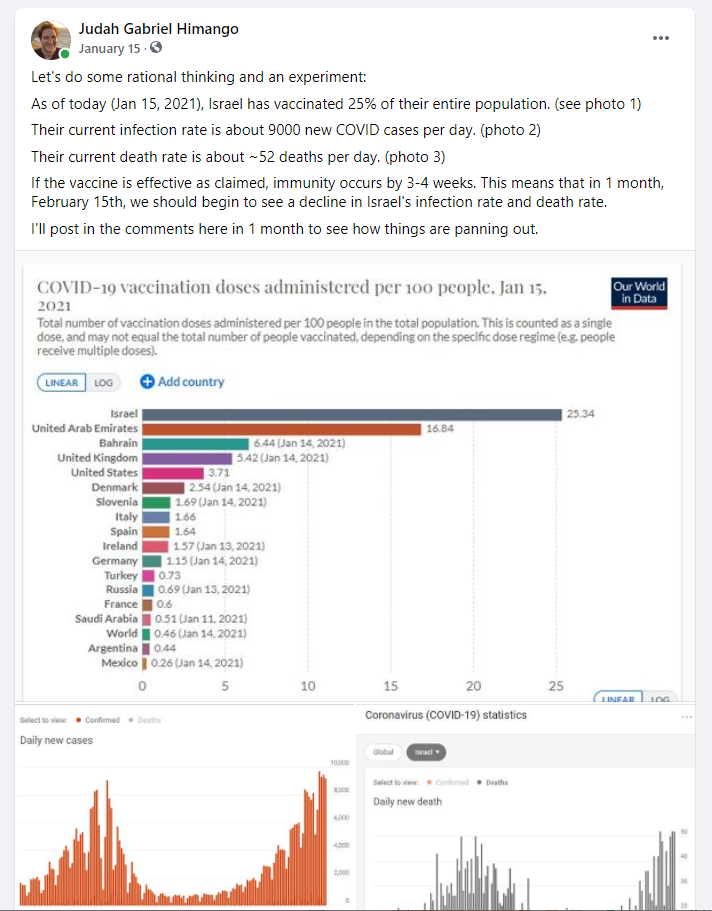
Me making predictions about vaccine efficacy back in January

In the comments, I added my prediction:

My prediction that the vaccine will cause a drop 15-20% drop in COVID infections

I figured, if the COVID vaccine works, we should see a significant drop in COVID infections and deaths within 30 days. I predicted a 15% to 20% drop.

A month later, my prediction was not only accurate, it wasn’t optimistic enough. COVID infections and deaths declined even more than I predicted:

Results of my prediction

The results were better than I predicted: Israel saw a 33% decrease in COVID infections, and a 40% decrease in COVID deaths.

I did this same experiment each month for the next 4 months: predicting what Israel’s COVID infection rate would be a month later given their current vaccination rate. All predictions came true, and all of them were not optimistic enough; the vaccine was more effective at stopping COVID than we had even hoped.

By April, Israel reported zero COVID deaths for the first time since the pandemic began. Shortly after, Israel lifted its mask restrictions, rolled back its vaccine passport, and removed most of its COVID restrictions.

For all intents and purposes in Israel, things are returning to normal; the pandemic is ending.
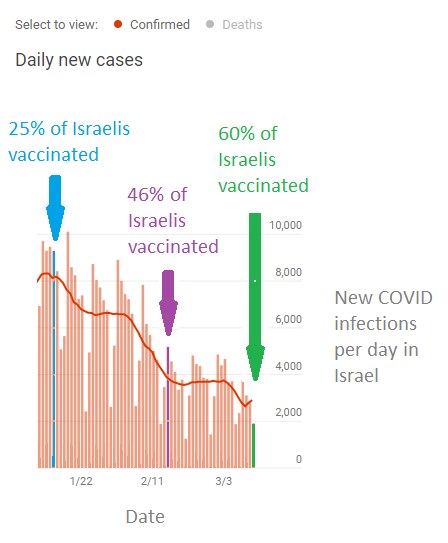
Graph showing the correlation between COVID vaccination rate and decreasing number of new COVID infections

Correlation isn’t causation, though, so maybe all this data is a fluke, explained in other ways. Maybe Israel was fudging the numbers? Or maybe COVID naturally declined? Maybe COVID ran through the population and natural immunity kicked in?

But wherever a COVID vaccine was widely deployed, new infections, hospitalizations, and deaths dropped sharply and significantly. While Israel was a great test case, as they were the first and fastest nation to rollout a COVID vaccine to a majority of its citizens, it was not the only example.

This same pattern – vaccine introduced, infections disappear – was repeated in other nations with high vaccination rates, including the UK and US. As more people received the vaccine, cases and deaths declined.

Meanwhile, nations like India and Brazil suffered new waves of terrible COVID outbreaks, killing thousands per day.

Why?

Their vaccination rates were among the lowest in the world:

Graph showing COVID vaccination rates across nations

If this weren’t enough, more data rolled in from large studies showing the COVID vaccine to be highly effective at preventing COVID infections and deaths. Israel did numerous studies, but my favorite is this one by Maccabi Healthcare. They studied 523,000 vaccinated Israelis and and 628,000 unvaccinated Israelis. Same demographics, same ages, same ethnic backgrounds. Apples-to-apples comparison.

The result?

In the vaccinated group, 544 got sick with COVID.

In the unvaccinated group, 18,425 got sick with COVID.

These results were so stunning it prompted the head of Maccabi’s health division to say,

“The data unequivocally prove that the vaccine is very effective and we have no doubt that it has saved the lives of many Israelis.”

Dr. Miri Mizrahi Reuveni

In light of all this evidence, I’ve adopted the same view: the data shows beyond a doubt Pfizer’s COVID vaccine is highly effective at stopping COVID infections and deaths.

Social Media Warrior

I raised these data points on social media, showing that the vaccine appears to be very effective and will likely end the pandemic.

Anti-vaxx folks would flock in and try to explain away that data.

And soon, my Facebook page became a battleground.

I’d go back and forth with these folks; I have written over 1000 replies in the last 6 months to their comments, posts, and DMs.

In these replies, I’ve refuted vaccine conspiracy theories about Bill Gates, 5G chips, overpopulation and horrific vaccine side-effects. I’ve rebutted accusations that the vaccine makes you sterile, turns you gay, changes your DNA, or is gene therapy. I’ve responded to people who told me I will die because I chose to vaccinate myself. I’ve responded to people who told me, “You are no longer following Hashem. You have turned to Molech.” I’ve responded to people saying that I’m no longer trusting God by getting immunized. I’ve responded to people who told me I should find a burial plot so I don’t burden my wife and kids with my inevitable demise from the vaccine. I’ve responded to people saying I will get deathly sick in the next 6 months. I’ve responded to people who told me that I will be controlled by 5G radio waves. I’ve responded to people who told me that I will make others sick by shedding my vaccine-induced spike proteins.

I've engaged with people who point to fringe doctors who are against the COVID vaccine. Almost invariably, such people are ousted from medical profession or hold wild views of their own. For example, anti-vaxx hero Dr. Tenpenny: an osteopath who has never treated COVID patients...also rejects germ theory. Or consider anti-vaxx crusader Dr. Avni: he is no longer a medical doctor -- his license was revoked -- not only for his opposition to vaccination but also because he has advised cancer patients to avoid seeking modern medical treatment for cancer. To be clear, the overwhelming majority -- I would estimate over 99% -- of medical doctors support the COVID vaccine. Among those doctors who actually treat COVID patients, the number is even higher. Yes, there are a tiny minority who do not: they are often defrocked quacks who hold wild, fringe views in addition to their opposition to vaccines.

I've engaged folks who point to vaccine injuries in the VAERS database, calling attention to the number of reported serious side-effects. I've responded: VAERS shows about 48,000 adverse, serious events. That sounds horrible, until you consider that 160 million Americans have been immunized. That means, according to VAERS, you have a better chance of getting struck by lightning than you do getting a serious side-effect from the vaccine. And the numbers get better from there: an estimated 75% of VAERS reports turn out unrelated to the vaccine (e.g. an immunized man gets into an car accident 2 weeks later - this report goes into VAERS.) All in all, the COVID vaccine has, thus far, proven to be a safe medicine.

In short, I've engaged with nearly every argument against the COVID vaccine.

Some folks from my old congregation, too, would engage me and push their anti-vaxx views – some via snail mail, others by Facebook, others in person – usually coupled with conspiracy theories about Bill Gates, microchips, and other technology they didn’t understand.

My family also got sucked into anti-vaxx stuff. I had a few disputes with family members, sometimes public, over vaccines and related news about vaccine side-effects. I didn’t like doing that. At the same time, I felt compelled to speak up for my convictions.

People I admired and respected, Messianic musicians and congregational leaders and leaders in the Messianic Jewish movement, posted anti-vaxx conspiracy theories that often tied in our faith:

  • “The vaccine is the Mark of the Beast!”
  • “The vaccine is a new Holocaust!”
  • “Bill Gates is trying to depopulate the world through vaccines!”

I’ve engaged those folks, too, trying to offer a different perspective with grace, sometimes calling attention to their sensationalism and how it hurts our witness about God and Messiah.

One Messianic Jewish ministry, a husband and wife that tour the United States, had come on my Facebook page and told me, “The COVID vaccine is much like Nazi Dr. Mengele’s experiments on Holocaust prisoners.”

I responded by saying, “This is what I mean when I say that Hebrew Roots has a misinformation problem. Sensationalism like this hurts our credibility as Yeshua’s disciples.”

This woman then responded by posting on her social media a big “OH MY GOD I’M BEING PERSECUTED BY JUDAH GABRIEL HIMANGO” thread:


This woman claimed I was shaming her. That I slammed her. That I said she was a bad believer. That she was ungodly.

None of those things were true. I shame bad ideas, not people. It’s why I didn’t even use her name in my post. I even blurred out her name on the original post when highlighting the sensational claim.

Even so, after seeing this woman take offense to my calling out her idea as sensational, I offered to delete my post for peace in Yeshua’s name.

She and her husband never responded to that offer.

I deleted my post anyways.

But there it was, and still stands today, a post that demonized me as bully figure, attacking people directly with shaming tactics. 214 likes, 124 comments, 17 shares.

And not just fringe people here - mainstream Messianic ministries and individuals, including Messianic Jewish ones accepted in the mainstream Messianic movement, were there in the comments, agreeing that I’m just a horrible person who shames people. 

Her post certainly brought a lot of sympathy for suffering this supposed persecution. Many commenters misread her post and assumed she was being attacked because she was Jewish. To this day, I still don’t understand why she opened her post with her Jewish heritage; my post didn’t mention her, her name, or her background. I have Jewish heritage too – my post called out ideas, not heritage.

Seeing a few hundred people piling on you, saying how terrible you are for attacking and shaming a person is a delightful experience. 😅 Internet mobs are vicious, especially when motivated with political or religious zeal. And witnessing hundreds of people agree with the sensational idea, “The vaxx is really a new Holocaust!” was a jarring moment.

I began to think, “Is everybody crazy? Am I crazy? Do I even belong in this movement?”

I responded to her post in grace. I told her and the hundreds of commenters,

“If you really believe the COVID vaccine is a new Holocaust and an experiment like the kind Dr. Mengele ran, let’s revisit this thread in one year. If millions of Israelis have died, I will acknowledge I was in grave error and apologize. But if millions of Israelis have not died from the vaccine, I ask you do the same.”

(How many of those hundreds of commenters will repent when it turns out the millions of Israelis haven’t died from the COVID vaccine, but rather, millions of lives have been saved? How many will have the humility to acknowledge their error?)

Becoming known for a minor issue

But all this came at a cost, in my estimation.

Last month I attended a wedding for a young man from my old congregation. At the wedding, I was seated at a table with some folks from my old congregation – all of them anti-vaxx. After polite niceties and small talk, much of the discussion that night was about vaccines. I didn’t want it to be. Weddings aren’t the place for that.

One of the folks at the table asked why I am so obsessed with vaccines. In my mind, I’m not obsessed; just trying to stand up for my convictions. But then again, that’s what all crazy people say. 😉

The week of the wedding I also visited with my parents and the discussion turned to vaccines. “I heard someone say the vaccine makes you magnetic; a magnet will stick to your arm where you got the shot.” (Spoiler: I tried it. I'm not magnetic.)

And then, last month at Proclaim Hebraic Music Fest, I met some amazing people…who were stunned to discover that I was pro-vaccine.

In all these cases, I didn’t even want to discuss vaccines. But the discussion came anyways, probably because I’ve made it too high a priority in my life, given it too much free rental space in my head.

About a month before all this, I had felt the pressing of the Lord to back off from my course of action. Fighting with believers over that in public resulted in a unhealthy imbalance in my own life, regardless of whether I was right.

I had long advised friends and congregants to back off from unhealthy obsessions – conspiracy theories, pet doctrines, flat earth – and instead be known for doing good works for the Lord.

Now I felt the Lord telling me the same.

And soon, friends started cautioning me against my current course of action. A pro-vaccine family member asked me privately, “Why are you doing this? What’s the point? Is anyone really going to change their mind?”

My parents had called me to tell me that I was being too harsh and rigid, unwilling to just have a discussion about anti-vaxx concerns.

Another friend told me, “I admire what you’re doing trying to change hearts and minds. But you’re putting yourself into the fire. Maybe taking a break would be good for your mental health?”

It’s OK to go against the grain and stand up for your beliefs. More than OK. It takes courage to do that when everyone else is going in the opposite direction.

“You have enemies? Good. That means you stood up for something, sometime in your life.”

Winston Churchill

But I recognize that God doesn’t want me to be The Vaccine Guy. It’s good to be pro-vaccine, because lives are saved. But I have prioritized it too highly. There are more important things, and a higher divine calling, than advocating for vaccines.

This is true for anti-vaxx folks, too. God has a higher calling for the Anti-Vaxx Guy, the Alternative Medicine guy, the Conspiracy Guy, The Flat Earth Guy, the Angry At The World Guy, The Election Was Stolen Guy.

Does this mean we can’t talk about our convictions? That I must hold my tongue while the anti-vaxxers plaster their hot garbage all over the walls of the internet?

No.

But it does mean that if I become known for those things, something’s out of balance. God’s people should be known for caring for the sick, for the poor, visiting the imprisoned, feeding the hungry. To serve God’s people in tangible ways. Caring for my family. Serving my local community.

I want to be that Guy because that’s how God wants us to live, as described in the Bible.

Changes

I haven’t quite figured out the right balance here. The data has convinced me more than ever that vaccines are a great blessing from God and are saving millions of lives right now. Since lives are at stake, it’s an important issue.

But I can’t let vaccines become the Big Issue in my life. That’s too small a thing for a disciple of Yeshua. It’s an imbalance. It can’t be the primary cause in my life, even in the midst of this pandemic.

How can I bring some balance to my pro-vaccine views as a disciple of Yeshua?

For starters, I’ve spent the last month not posting about vaccines on my Facebook page. Really, an exercise in self-control. Am I able to do that? Or has it gotten so bad I’m unable to keep my mouth shut for a moment?

(Anti-vaxx folks have still been posting on my wall and sending me DMs, and I have sometimes responded to those, for better or worse. 🤷‍♀️)

I’m also avoiding jumping in on vaccine threads started by other folks. There have been numerous times where I started typing a reply, only to delete it all and let it be.

There will be times when I post about vaccines. Silencing dissent isn’t the answer. But deprioritizing the vaccine issue in my life is a good start. I can have those convictions without being known as The Vaccine Guy. I can avoid majoring on a minor issue.

I aim in the future to keep these posts balanced with regards to my life’s calling as a disciple of Yeshua, that I don’t become known for such a small thing as my stance on vaccines. If I want to be used by God for bigger things, I can't make my life about a single issue.

Maybe that's true for you, too, fine Kineti reader.

The Baby Boomers' Messianic Movement

enter image description here

The modern Messianic movement is a first-generation movement: birthed in the 1960s and '70s. But that first generation of pioneers are ageing, however, and a new generation – our generation of Millennials – must rise up to take up the mantle.

As the Millennial generation takes the torch, we recognize challenges in Messianic movement the Boomers have left to us: fundamentalism, rigidity, majoring on minors, a lack of critical thinking, failing to deal with issues relevant to today’s generation, an inability to plan for the future.

In a new episode of the Messianic Walk, Messianic apologist J.K. McKee and I discuss these challenges and propose reasonable paths forward to help modern Messianics navigate these difficulties:

10 Rules for Light: An Antidote to Misinformation


Friends, have you heard things like this on social media?

Hebrew Roots friends on Facebook sharing misinformation

  • “Israel is going on COVID lockdown because the Rabbis are meeting with the Messiah”
  • “God or NASA? Who’s lying about the shape of the earth?”
  • “100% proof coronavirus outbreak is staged and faked to round up believers”
  • “Joe Biden’s name in Hebrew means ‘Alas, judgment’”
  • “The coronavirus vaccine is the Mark of the Beast”
  • “CERN, the physics experimental lab for particle collision, is
    opening demonic portals to hell”
  • “NASA scientist admits to Biblical model of flat, non-rotating earth”
  • “WARNING!! Kamala Harris may be the biblical Whore of Babylon”
  • “Thus saith the LORD: Biden is not President, never will be, and Trump will be sworn into office in June”
  • “February 11th, 2021 will witness a sign in the heavens: the sign of the coming of the son of man”
  • “The 32 teams of the NFL + SuperBaal champion correlate to the 33rd degree of freemasons”
  • “During Biden’s inauguration, a scroll named Justice was opened in Heaven. It spoke to me, ‘Massive voter fraud will soon be exposed!’”

All of the above are real quotes from the Facebook pages of my Messianic friends.

And all of it is hot garbage.

Messianics spreading misinformation on their Facebook pages is a real problem. It’s led to people leaving the movement. It’s caused young people to feel alienated. It’s chased away rational and thinking people. It’s hurt our credibility about God and Messiah.

With apologies to Jordan Peterson, here are 10 Rules for Light: An Antidote to Messianic Misinformation. 

Ways to become a better disciple of Yeshua by valuing truth over misinformation in your digital life.

  1. 🔗 Be slow to speak. The Bible tells us that disciples of Yeshua should be slow to speak and slow to anger. Does the thing you’re posting align with this biblical trait? Or does it demonstrate that you’re quick to speak and quick to anger?
  2. 🔗 No information is better than bad information. Don’t post things if you’re not certain if they’re true. Proverbs 17 says, “Even a fool is thought wise if he keeps silent, and discerning if he holds his tongue.” A popular quote attributed to Mark Twain says the same thing: “It’s better to keep one’s mouth shut and be thought a fool than to open it and remove all doubt.”
  3. 🔗 Ask how it’ll impact your witness. If the thing you’re about to post turns out false, will your unbelieving friends, family or peers think less of your credibility?
  4. 🔗 Look for credible sources. Are the authors of the video or article experts in the subject matter? Are they respected in their field? Or is this just some rando from YouTube?
  5. 🔗 Ask the experts. Is your video about a hidden Hebrew meaning? Ask a native Hebrew speaker first. Is your article about medicine? Ask someone in the medical field before posting. Is your video about technology? Ask a technologist. (Don’t know any experts in the subject matter? Privately ask for feedback from your congregation leaders before posting. When in doubt, leave it out.)
  6. 🔗 Avoid sensationalism. Is the thing you’re about to share sensational? Does it make outrageous or extraordinary claims? “The COVID vaccine isn’t a vaccine - it’s biotechnology meant to sterilize us!” Extraordinary claims require extraordinary evidence. In my experience, more than 99% of such posts are pure hot garbage. Avoid sensationalistic posts and your truthfulness batting average will improve.
  7. 🔗 Watch out for confirmation bias. Are you posting this because it’s true, or because it confirms an opinion you already have? Too often Yeshua’s disciples have zero skepticism for viewpoints we already agree with. Exercise your God-given intellect and rationality and be skeptical.
  8. 🔗 Be wary of politics. Politics blinds otherwise reasonable people to obvious truths. Politics unnecessarily divides communities. There are times when politics aligns with Biblical values – opposition to slavery in the past, and opposition to abortion today are two examples. But outside of these extremes, politics tends to hurt our witness. The Apostle Paul didn’t spend his countless hours talking about how evil Caesar was, or who he’d be supporting as the next Governor of Judea. He spent that time on Messiah and him crucified.
  9. 🔗 Avoid ‘all spirit, no brain’ If the post you’re about to share is based on private revelation only, shy away from posting it. Example: “During Biden’s inauguration, a scroll named Justice was opened in Heaven. It spoke to me, ‘Massive voter fraud will soon be exposed!” Friends, there is no shortage of hucksters, charlatans, false prophets and televangelists who make such claims. But there is a dire shortage of the real deal. Shy away from posting private revelations because 99% of the time, they’re false.
  10. 🔗 Refocus on Yeshua. If I go to your Facebook page, will I see you’re a disciple of Yeshua? Or will I see conspiracy theories about THE TRUTH of the moon landing? If you want the truth, Yeshua said, “I am the truth.” Spend your energy on Yeshua and his kingdom, doing the things he told you to do.

Friends, follow these rules in your digital life. Before you post on Facebook, before you send that email, before you tweet, before you send that DM. We want to create a more truthful Messianic world. If you pitch in and do your part by valuing truth in your digital life, we’ll repair the brokenness that exists today and be a better light for the King.


The Messianic Movement: The End-Time Move of God

enter image description here

I don’t know about you, fine Kineti readers, but I often tune out discussions about the last days, the end-times, the return of Messiah.

Why?

All of the hype, sensationalism, failed predictions, idle speculation, and crazy-uncle nonsense that gets peddled. It’s not my cup of tea!

However, the Lord wants us to have a joyful anticipation, even excitement, about His return. I don’t want to avoid studying the return of the Lord merely because so many abuse it. And I want to have that anticipation of the Lord’s return; that sort of thing fills you with joy and hope. I want that.

This week I sat down with Messianic apologist and author J.K. McKee to discuss the end-times and the Messianic movement’s role in it:

In it, J.K. and I tackle 5 questions pertaining to the last days and the Messianic movement:

  1. How do Messianics today handle the subject of the last days; what’s been our personal experience in the Messianic movement?
  2. Given how disruptive and uniquely difficult 2020 has been, the Lord’s return has been top of mind. How should Messianics think about the last days?
  3. With regard to the end-times, what does the Messianic perspective bring to the wider body of believers?
  4. What role will the Messianic and Hebrew Roots movement play in the the last days leading up to the return of Yeshua?
  5. What further studies and investigations need to take place in the Messianic movement regarding the last days?

Here you’ll find a candid conversation about the last days and the Messianic movement.

I expressed how I’ve personally been turned off to conversations about the end-times due to sensationalism, failed predictions, date-setting, and more. John shared his reservations as well.

At the same time, we can’t simply punt and avoid the topic. The Lord wants us to have a joyful anticipation, an excitement even, knowing his return is imminent.

John and I discuss all this and more in episode 5 of the The Messianic Walk. Enjoy, friends!

My interview with Messianic apologist J.K. McKee


I had the genuine delight to be interviewed by J.K. McKee of MessianicApologetics.net. We talk about Messianic Judaism, Hebrew Roots Christianity, good and bad fruit in our movement, and we even snuck in some Star Trek nerd chatter! 


Here are some highlights from the interview:

  • 4:00 My Messianic calling
  • 6:24 Star Trek fun!
  • 8:56 The good and bad of running Messianic blog
  • 12:05 Heresy hunters in our faith community
  • 14:18 A little knowledge can be a dangerous thing
  • 15:53 The need for grace among Messianic believers
  • 18:45 Messianic Judaism: the positives
  • 27:04 Sidebar on subduing the earth: believers ought to embrace science, technology, medicine
  • 30:15 Creationism and discussing science issues in our faith community
  • 33:31 Messianic Judaism: the negatives
  • 34:58 Messianic Judaism's disregard for non-Jews called to the movement
  • 47:26 Advice for newcomers into the Messianic movement
  • 50:23 Good fruit in the Hebrew Roots movement
  • 57:34 ...and the bad fruit of Hebrew Roots
  • 1:03:20 How conspiracy theories often devolve into anti-Semitism
  • 1:07:30 What are the big things to communicate to Messianic believers?
J.K. McKee has been a huge influence on my life. He's the author of many must-have books for Messianic believers that helped shape my faith into a stable, committed walk with the Lord. I've used his books and his materials as the basis for many of my own teachings at my congregation. 

To say this interview, then, was an honor and joy would be to understate the matter by several orders of magnitude. 

In the interview, we tackle some difficult subjects ranging from Jew / Gentile equality in the body of Messiah, major issues facing our movement -- including Messianic Judaism and Hebrew Roots -- as well as what I see as good fruit. We close the interview with what I think every Messianic believer ought to apply to their own lives.

I hope you enjoy this interview, friends, and more importantly, that it helps your walk with the Lord.

My teachers: Who I’ve learned from in faith and politics

Image result for teachers torah instruction

I was recently at a beautiful multi-congregation Sukkot event and was surprised by the number of people are celebrating Sukkot for the very first time. There are many people – often, Christians who left the church – who are finding renewal in Torah and the Messianic movement.

Some of these Messianic newbies Smileasked me about ministries I’d recommend. Michael Rood? First Fruits of Zion? 119 Ministries?
Having been in the Messianic movement for effectively my entire 33 years of existence, I’ve come to witness good fruit from certain ministries and individuals, while others produce little or no fruit. Through it all, I’ve come to trust several Messianic ministries and teachers as people who are faithful to the Scriptures, engage with Jewish and Christian scholarship, temper the sensationlism that too often characterizes Hebrew Roots Christianity, excise the cruft of Messianic Judaism religion-emulation, and major on the important matters of faith.

These are the individuals and ministries that have had the most impact on my faith over the years, people I’ve come to trust. You’d do well to learn from them.

Faith

  • imageMessianic Apologetics
    Scripturally-sound, balanced teaching engaged with Christian and Jewish scholarship. Messianic apologist J.K. McKee and his ministry defends and advances a pro-Messiah, pro-Torah faith in the God of Israel from a position of conservative Biblical scholarship. Sees believers joined with the Jewish people as part of an enlarged commonwealth of Israel. Has an excellent Frequently Asked Question section answering a wide variety of Messianic-minded questions.
  • imageTorah Resource
    Tim Hegg, Rob Van Hoff, and a host of mature, theologically-trained teachers expound on the Bible through articles, books, videos and podcasts. Avoids the sensationalism of Hebrew Roots and the religion-emulation of Messianic Judaism. Advocates for a Torah-observant faith through Messiah. I enjoy their podcast, The Rob & Caleb Show, where they tackle relevant issues in the Messianic and Hebrew Roots worlds.
  • imageMessianic Publications
    Laying a firm foundation in Messiah and Torah. Apologetics, study, articles and more from a host of guests from the independent Messianic movement, both Jewish and gentiles believers. Recent articles include opinion pieces like Christianity vs. Judaism: A False Dichotomy, apologetics resources like It is often said: 2000 years of Christianity cannot be wrong, and 64 reasons to keep the 7th day sabbath.
  • imageInterFaithfulness
    The Messianic Jewish agenda stated concisely and articulately by the inimitable Messianic Jewish pioneer, Rabbi Stuart Dauermann. While his calling and focus is specifically towards Jewish people, I find his talking points broadly applicable and intellectually provocative. Argues for the “More Jewish Jesus” – a Messiah who is halachically Torah-observant and calls Jews to become better Jews.
  • imageDavid's Tent
    Wisdom on world events from Israeli believers Avner & Rachel Boskey. Prophetic look at Israel, the Church and the nations. Avoids the wild-eyed end times nuttiness of many other eschatology-focused ministries.
  • imageDr. Michael Schiffman
    Real wisdom. Lessons gleaned through life. Messianic Jewish Rabbi and Chevra Humanitarian founder Dr. Michael Schiffman writes frankly on struggles, life stories, wisdom, charity, and more.

I’ve learned a great deal from the above ministries and teachers.

That isn’t to say I’ve learned nothing from others – including my parents, my Messianic real-life friends, and local Messianic congregation. Nor does this list imply I endorse 100% of the above. Rather, the ministries and people listed above have demonstrated over several years to have a remarkably high wisdom-to-junk ratio,Smile, high enough to say, “These are ministries Messianic believers would do well to learn from.”

Politics

As a political conservative who desires to see Judeo-Christian values remain foundational to Western civilization, I’ve been positively influenced by conservative Jewish voices Dennis Prager and Ben Shapiro:

  • imageDennis Prager and Prager University
    Dennis Prager is a reasoned, articulate voice for goodness, faith, and Judeo-Christian civilization. He is a political talk show host for over 3 decades. His recent work, Prager University, produces short 5 minute videos on culture, politics, faith, and more from a Jewish conservative viewpoint. Changing minds one video at a time. Check out the Prager University YouTube Channel. His nationally syndicated radio show is a rare gem of wisdom on life, faith, male and female differences, marriage, human sexuality, God, Israel, the United States.
  • imageBen Shapiro
    Sharp and reasoned, this young Jewish conservative firebrand combats the errs of leftism, holds principle over party, and is a powerful voice for Judeo-Christian values. Editor of The Daily Wire news. His Ben Shapiro Show daily podcast is a goldmine of political rationality, a razor’s edge of hard reality in a feelings-based, politically-correct climate: “Facts don’t care about your feelings.”

News

Folks also ask me about trustworthy news sources on Israel. There are a few that I cautiously learn from:

  • imageTimes of Israel
    Moderate news source on the land and people of Israel. Avoides the self-destructive, leftist politics of Haaretz. More balanced than YNet or Jerusalem Post; fewer ads too.
  • imageKehila News 
    Stories, teachings, news, musings from Messianic believers in Israel.

Do you have teachers or news organizations that you've learned from and have come to trust?  Let us know in the comments.

What the Messianic movement is (and isn’t)

Mt. of Olives. Courtesy Godot13 - Own work, CC BY-SA 3.0, https://commons.wikimedia.org/w/index.php?curid=28600288

What’s the purpose of the Messianic movement?

I came across a Facebook thread this week that showed to me again the confusion about the purpose of the Messianic movement.

image

As someone who has been in the Messianic movement since childhood, I find a lot of his reasons for leaving the Messianic movement come down to misunderstanding what our purpose is.

The Messianic movement doesn’t exist to confirm modern Judaism

“I got into the Messianic movement, due to my desire to confirm to the Jewish faith (as it exists today).”

In my experience, this sentiment often leads to apostasy.

Setting out to confirm an existing religious sect is as wise and fruitful as a Southern Baptist searching the Scriptures trying to confirm Southern Baptist doctrine. Or a Sadducee setting out to confirm their now-obsolete brand of Judaism. The whole premise is wrong.

Our goal must be seeking God and Messiah above everything else. If we place other ideas, philosophies, and even religions above that, we are creating a kind of idol.

Yes, Messiah closely aligned with Hillel Pharasaic Judaism. And in the Scriptures, Paul identifies himself, post-Damascus, as a Pharisee. But does that mean the Pharisees were correct in everything or that Pharisaic Judaism is God’s Approved Brand of Religion? Of course not.

If your desire is simply to confirm a particular Judaism, you’re not seeking God or Messiah first. You’re seeking religion first, and probably an identity within that religion; apostasy.

And for folks looking to confirm modern Judaism by practicing Messianic Judaism, you’re in for a world of hurt. Messianic Judaism is rejected by the Jewish world as anathema: worshiping Messiah as God is considered idolatry, and therefore Messianics and Christians are seen as idolaters.

This leads a person to say, “Well, I know Judaism isn’t the problem – since I’m trying to confirm it – so the problem must be with the Messianic ideas. Ideas like Messiah being the gateway to God, Messiah giving eternal life, granting forgiveness of sins, Messiah’s sacrifice on the cross, and Messiah’s divine and eternal nature.

A person pursuing that is quickly led away into apostasy.

As one Messianic blogger wrote in his final post announcing his apostasy, “Judaism is more important to me than Yeshua.”

The Messianic movement is not a movement to confirm modern Judaism. The Messianic movement exists to confirm the identity of Messiah, not to confirm a particular kind of Judaism.

The Messianic movement doesn’t support low views of Messiah

“I was leaning strongly towards the Messiah being a created being instead of the eternal word of God. It wasn't until I read that the early Jewish believers had 'rites' like the Orthodox Churches that I truly repented of all that.”

In this gentleman’s case, he got into the Messianic movement because he had a low christology – that is, a view of Messiah that sees him as something less than the gospels make him out to be – and he believed the Messianic movement would be a good home for that belief.

Some folks have hangups about the exact nature of God. Others fear gentile influence with regards to the trinity or other formulations of God’s oneness. For these reasons, some move into a position that is easy to hold intellectually, but difficult to hold scripturally: that Messiah is a prophet and human messiah, but not God.

It’s easy to hold that view intellectually: God reveals to us in the sh’ma that God is one. Yeshua, then, becomes a king, prophet, and messiah, but any worship of him or prayer to him becomes idolatry.

Simple.

But the problem with this view is the Scriptures themselves:

God reveals to us in the gospels that Messiah is more than a man; he’s divine and one with God. He’s worthy of worship, praise, honor, power, glory – the kind befitting only God himself. Revelation speaks of the throne of God-and-the-Lamb, as if God and Messiah are singular. Even the old Messianic prophecies of the Tenakh – like Zechariah 14 – say that it is Yud-Hey-Vav-Hey – the personal name of God, Yahweh – who sets his feet on the Mt. of Olives, vanquishes Israel’s enemies, and brings world peace. In Isaiah, God has become my salvation, every knee bows to God and confesses him. In the New Testament, God becomes salvation (in Hebrew, Yeshua), and every knee will bow to him and tongue confess him as Lord. (Philippians 2:11)

To hold a view that the Messiah isn’t divine, isn’t one with God, isn’t an emanation or image of God, well, we must eventually throw out the New Testament.

The Messianic movement exists to confirm the identity of Messiah as both Lord and God. Anything less is a departure from what we’re about.

Conclusion

So far we’ve discussed what the Messianic movement isn’t: it’s not a welcoming home for low christology, nor a home to simply confirm modern Judaism.

In the next post, I’ll address this man’s comments about Messianics and liturgy: are we Messianics opposed to liturgy? To rote prayer? More when I return…after shabbat. Smile Shabbat shalom.

Purim: 5 unusual lessons for Yeshua's disciples

Classic repost: I wrote this article just prior to Purim 2014 while examining the book of Esther. Enjoy!

Mordechai in the streets of Persia

Purim is here this weekend, and it's good to remember and celebrate God's deliverance of Israel. Some obvious ones: It’s intriguing to see anti-Semitism's deep roots in humanity, going back to 450 years before Messiah. It's interesting to note how God is not mentioned by name – yet is entirely present – in Esther.

But these things we’ve heard before.

What I want to you show you today is 5 unusual things that stood out to me as I read Esther this morning. Deeper things worthy of amplifying to Yeshua’s disciples.

The Jewish people are still central in God's plans

The book of Esther at first saw resistance from joining the Christian Bible as canon. Some saw it as "too Judaizing." Martin Luther, too, found he could never reconcile with this book. Esther amplifies the Jewish people to a point that made the Church fathers uncomfortable.

The amplification of the Jewish people is unmistakably present in Esther. Even Mordechai's famous plea to Esther drips in saturation with this theme, his statements thoroughly certain of divine protection for the Jewish people:

"If you remain silent at this time, relief and deliverance for the Jews will arise from another place, but you and your father’s family will perish. And who knows but that you have come to royal position for such a time as this?"

As a follower of Israel's Messiah, I believe that Jews and non-Jews have equal access to God and are joined together in the family of Israel.

Even so, it does not and cannot erase the special calling God has for the Jewish people, the natural branches of Israel. This should be evident in Paul's declaration that if Israel has experienced a temporary hardening of heart towards Messiah, with the result of the salvation of the nations, the Jewish people's return to the Jewish Messiah will be like life from the dead.

Let me repeat that so that you don’t skim over it as religious jargon: The Jewish people returning to the Jewish Messiah will be like life from the dead, and no amount of gentiles coming to faith in Israel’s God will change that.

Even Messiah's own words count Jerusalem and the Jewish people as the gatekeepers of Messiah, his arrival hinging on Israel's acceptance of "Baruch haba b'shem Adonai!”

For those of us in the Hebrew Roots world, we must be cognizant of this reality. Gentiles grafting into the commonwealth of Israel does not negate the special promises God has for the Jewish people. It doesn’t mean gentiles are worse than Jews, but rather, God has a distinct plan for the salvation of the Jewish people.

Those who joined Israel became Jews

This is a particularly controversial thing to say in light of the state of the modern Messianic movement. One group believes they join to Israel through loving Israel's God, Messiah, and Torah. Another group says one must undergo ritual circumcision, at which point, one is a Jew. Yet another group believes it is part of the lost tribes of Israel.

In Esther, towards the end of the book, we read something often omitted from modern Esther retellings. In those days, when the Jewish people were granted this divine reversal of fortunes, "many people from all nationalities joined them and became Jews."

We are not told what "becoming a Jew" in the 4th century BC entailed. But we do know that these people who joined the Jews became Jews themselves. The Biblical command mandating the celebration of Purim mentions this people:

The Jews resolved and took upon themselves, their descendants and all who might join them that without fail they would observe these two days [Purim] in accordance with what was written in [this book] and at the appointed time, every year; and that these days would be remembered and observed throughout every generation...

It reminds me of the Exodus, in which a multitude of non-Israelites joined Israel and identified with her. Hebrew Roots and Messianic gentiles are in this same boat: joining to the Jewish people and standing with Israel.

Does this mean Messiah-following gentiles should convert to Judaism and become Jews? I don’t think so. God's intention isn't for everyone to be a Jew. God has plans for gentiles, too, plans that in their fruition have seen billions of non-Jews turn to Israel’s God through Israel’s Messiah. (Hallelu!)

But it does suggest that joining Israel is a deeper thing than many in the Messiah-following world make it out to be. It is more than Torah observance. It is more than love for Israel's God through Israel's Messiah. It is more than love for Jewish people. At the very least, it is helping and supporting the natural branches of Israel in physical and tangible ways. Aligning oneself with Israel in thought and deed.

Are we really joined to Israel? I don’t think so, not in tangible ways that Jews recognize. That needs to be fixed.

God can use people with pagan names

It feels silly to have to say something that should be so obviously true. And yet, I have to say it because of silliness in our religion.

Artist's rendition of EstherThe name Esther likely comes from the name of a pagan goddess. (The same one that Easter comes from.)

Mordechai likely comes from the phrase, "follower of Marduk", also a pagan god.

While these names were likely given to these Jews by their captors, you don't see Esther and Mordechai waxing indignant over it. There were bigger fish to fry.

So many in the Messianic and Hebrew Roots world concern themselves -- perhaps too much --  with perceived pagan influences. Still others are caught up in names, especially names for God. Some people refuse to worship God unless a particular name is (or isn’t) used. (Can Hebrew Roots folks worship when we adore ‘HaShem’? Can Messianic Judaism folks agree when ‘Yahweh’ is praised and thanked? I can already sense your panties getting bunched up.)

And some religious friends change their given name in order to appear more religious, or to reflect their identity.

I understand why, and yet, here we have Esther and Mordechai, two names of likely pagan origin, and yet names are of little concern in Esther. There were bigger issues to tackle then, and so it is now.

It should be obvious to us that God uses people even if they don't have religious names.

And yes, God can use people even if their names are pagan in origin.

God can use people who do not fit the religious mold

Many of the pioneers and founders of the modern state of Israel were secular, agnostic, or even atheist.

Photo of Theodore HerzlTheodore Herzl, the 19th century founder of Zionism, was agnostic. His opposition? The religious.

Herzl visited many nations and diplomats in hopes to garner support for a Jewish state in Palestine. When he approached the Pope and the Catholic Church, the Pope refused, saying that unless Jews converted to Christianity, the Church would not support a Jewish state.

Herzl saw opposition even among his own people. Certain European Orthodox Jewish communities opposed Herzl and his plan for a Jewish state in Palestine. They erroneously believed that only messiah could restore the Jewish people to Israel.

Religious people stood in the way of God's plans for the creation of the modern State of Israel.

Photo of Eliezer Ben YehudaAnd in that same generation, Eliezer Ben Yehuda moved to Israel nearly a century before its founding and pushed for the resurrection of the Hebrew language. His major opponent? Jerusalem's ultra-Orthdox community. They opposed Ben Yehuda's Hebrew-only newspaper, HaZvi, eventually shutting it down after a year of fierce opposition. Restoring the holy language to a common tongue was a grave sin, you see.

Again, it was religious people who stood in the way of divine mandate.

Photo of David Ben GurionIsrael's first Prime Minister, David Ben Gurion, was by most accounts an agnostic or Jewish atheist. It was through his leadership Israel survived its first decade, a perilous decade characterized by repeated invasions from the Islamic world, motivated by the same anti-Semitic spirit that motivated Haman.

Ben Gurion received little help from the ultra-religious. While the nascent Jewish state was fighting for its very existence, the ultra-religious sought exemption from military service in order to continue religious school. (A decision that is being overturned as I write this post.)

I tell you all these things to drive a point back to Esther and Mordechai.

In the book of Esther, like the founding of the State of Israel, God is hidden, and yet thoroughly present. And his work is accomplished through means religious people do not expect. Sometimes, it is religious people who are opposing God. Perhaps God used secular people because their ears were not so clogged by theology and dogma.

We view Esther and Mordechai as righteous individuals today, even though we know little about their faith life. And what we do know of them isn't exactly a perfect picture of religious life. Both were engaged with a pagan nation, working in the government of an idolatrous imperial power, eating at treif banquets held by a pagan king.

Heck, Esther was wed to a pagan gentile! And if that weren't enough, she was a WOMAN! You know, those people that Judaism restricts from singing, wearing tallits, or carrying Torah scrolls at the Western Wall.

(And – be honest – how many of us religious people would balk at the idea of our daughter marrying a pagan leader? Perhaps it was for this reason Esther was an orphan!)

Religious people balk at such things, and yet God accomplished his purposes despite the circumstances. Sometimes, religion can get in the way of us seeing clearly the divine plan.

As Messiah’s disciples, let us be opened to the possibility that God is at work outside our niche, and can work through people who don’t fit the religious mold.

Revelation of truth in its due time

When Esther was to marry the king, she did not reveal her true identity as a daughter of Abraham. Had Esther strolled into the King's court announcing she was a Jewess, perhaps she may never have wed the king, and in return, never had the opportunity to save Israel.

Messiah's disciples can learn something from this. First, many of Yeshua's disciples wear their faith on their sleeve. I understand why, but sometimes it is a turn-off for people. If we instead showed kindness and service -- did good works without expectation of return -- and without worrying about pushing our belief in Messiah, it can yield good fruit.

Esther did reveal herself to the King -- but only when the time was right. This is an example for us as Yeshua's disciples. "Preach Messiah always, and if necessary, use words."

Lessons learned from Esther

  1. The Jewish people are still central to God’s plans. We can say with Mordechai’s boldness and confidence, “relief and deliverance for the Jews will arise”, regardless of the theological forecasts of the religious.
  2. Like in the days of Esther, many will attach themselves to Israel, and yet, God’s promises to the Jewish people are not cancelled.
  3. God works through unlikely people. Esther and Mordechai both took on names from the pagan world, worked and lived in a pagan culture, and yet God used them for good.
  4. God works in ways that often confounds the religious. Esther was not a model religious figure, and yet God used this unlikely soul to accomplish salvation for Israel.
  5. God’s timing is not our own. Religious people can often be blustering, impatient, angry, indignant…but Esther’s example is one of patience, fasting, quiet trusting. In this end, this is what swayed the pagan king.

Take in these lessons from Esther, fine Kineti reader, as you remember God’s faithfulness this Purim.

Custom comments