Import jQuery

Showing posts with label atheists. Show all posts

Aristotle's Unmoved Mover, Explained

imageLast year I came across 5 Proofs of the Existence of God by Edward Feser. It’s a modern take on classic logical proofs of God.

Though it reads a bit academic, it’s nonetheless enjoyable and a powerful tool for defending the reality of God’s existence.

Yesterday, the author appeared on Ben Shapiro’s Sunday Special. His explanations and discussions of the classical proofs are fascinating and clarifying.

There’s a saying, “If you can’t teach it, you don’t understand it.” So I’d like to write my thoughts one of these classical proofs – teach them to you, fine Kineti reader – so that I better understand them myself. Along the way, maybe you’ll learn them better as well.

In the interview Feser says his favorite of the five classical proofs of God is the Aristotilian proof, also called the Unmoved Mover argument. This is the one we’re tackling today in this post.

Here’s Feser explaining in his own words the Aristotelian argument for God’s existence:

This proof of God goes back at least 2300 years, to the time of Aristotle, though it may be even older as Plato presents an earlier version of it.

The Aristotelian argument is based on the observation that change occurs: my fingers changing from idle to active as I type this, your eyes changing from still to moving as you scan and interpret this sentence.

Aristotle calls this the actualization of a potential. My fingers had potential to move, and when they moved, the change was actualized. Your eyes had the potential to scan this text, now they are actually scanning it. This is change: something going from potential to actual.

And this affects all matter, including inorganic matter. Water changes from cold to warm. Molten lava to solid rock. Potential to actual.

If change involves going from potential to actual, how does it ever happen? What causes the change from potential to actual? Aristotle observes that only actualized objects cause something to go from potential to actual.

For example, my fingers are sitting ready at the keyboard: just look at all that potential. Potential to move downward and strike the keyboard. How are they actualized, what causes them to start typing? An already-actualized thing, my nervous system in action, flexed my muscles and caused them to go from potential movement to actual movement.

In a nutshell, actualized objects are the only thing able to move something from the potential state into actual state. Something can go from potential to actual only if there’s something actual that makes it happen.

This goes all the way down the line: my nervous system has potential to send signals to my fingers. What causes it to send signals, moving it from potential to actual? Well, another actual: my brain.

One thing caused by another, caused by another, caused by another. All the way down the line.

Intuitively, my thought while watching the video was, “Ah, and those series of changers go all the way back in time until we get to God.”

Wrong.

Feser says Aristotle’s fundamental position isn’t that the changes go merely backward in time, but that they are downward in the here-and-now. The fingers are typing here and now because my nervous system is firing here and now. The nervous system is firing here and now because my brain is sending signals to it here and now.

This chain of changers – my fingers, by my nervous system, by my brain, by molecules holding together my body, and so on – where does the chain end? It must have an end – a first domino - Aristotle argues, otherwise we’d have a “vicious regress.” (More on this theoretical vicious regress later.) There must be a root changer – a cause of change that itself was uncaused – responsible for all successive changes.

The first domino

There must be an uncaused cause, an unchanging changer, an unmoving mover; the first domino. Aristotle argues such an unmoved mover is purely actual. While it’s changing other things, itself is unmoved and unchanged.

How do we know the unmoved mover is God?

Consider the properties of the first cause, that first domino. We observe that it must be both unchanging and powerful. Furthermore, it must not be governed by time nor by the material universe.

Unchanging:

We’ve established that change involves going from potential to actual. But this first domino wasn’t any potential, it was purely actual, it wasn’t caused and isn’t susceptible to change. It’s unchanging.

Why is that important? Because everything in the known universe is susceptible to change. Time changes all material things, both organic and inorganic. Thus, the first mover must be not be a material thing; it doesn’t change with time. And since time has no effect on the unchanging changer, we say it isn’t governed by time like everything else in the universe is.

(Sidebar: is this a god-of-the-gaps argument? I’d say this is an observation of the universe; out best evidence shows that all things are governed by time; they change with time. There’s nothing in the universe known to be unchangeable over time. So, the evidence suggests that either there is no first mover – what Aristotle called vicious regress; an impossible, infinite recursion of movers – or there exists something outside of the material universe and outside of time.)

The first mover is unchanging. Because time changes all material things, the first mover is outside of time and outside of the material world.

Powerful:

Power is the stuff required to change anything from potential to actual.

As I type this and as you read it, both of us are expending energy – we’re utilizing power. We consume food to produce energy, which we utilize to actualize something, to turn it from potential to actual.

Feser gives the example that an earthquake has the power to knock a boulder down a hill: the actualization of potential. The rock had the potential to roll down the hill, and the earthquake’s power actualized it.

Working our way back to the first mover, the first domino, because nothing caused it, it’s ultimately the source of all power activity.

It’s power – at the beginning of time and throughout all-time – drives all other power. It’s the first of all the dominos and not caused by any other power.

Every power exerted since then – the formation of the universe, the creation of planets and stars, the beginning of life – everything until the point of you reading this very sentence – all of it started because of the enormous power exerted by the first mover.

Thus we say that the first mover is both exceedingly powerful and the source of all existing power in the universe. The first mover is all-powerful.

(The Hebrew Bible phrases it as אֵל שַׁדַּי, El Shaddai, usually translated as God Almighty; in plain modern English we would say God the All-Powerful.)

These attributes of the first mover – immaterial, unchanging, outside of time, all-powerful, the source of all power – describes divine attributes, something beyond of nature. We call that all-powerful, immaterial mover God.

Are we sure there’s a first mover? Why not a vicious regress?

How do we know there’s a first mover? Why can’t we have an infinite string of movers moved by another mover?

Feser says the problem with having an infinite chain of movers – what Aristotle calls a ‘vicious regress’ – is that it keeps deferring the explanation.

Sidebar: in The Universe Had a Beginning, I noted a similar problem of scientists just kicking the can down the road; deferring the answer. For example, modern cosmology posits the universe had a definite beginning about 13.7 billion years ago. But physicists uncomfortable with the reality of a universe that suddenly came into existence – the instant of creation – have tried to say there are multiple universes (multiverse theory) or the universe expands and contracts infinitely from nothing to something (oscillating universe theory). Both fail to answer the question of what created the universe, and instead merely kick the can down the road. In the case of the multiverse theory, the can is kicked down the road, and the question becomes “what created the thing that creates the universes?”

Feser says the vicious regress fails to answer the question we started out asking: “What caused the first actualization?”

That mover that made the universe appear in an instant, what made it move? Since the universe didn’t exist before then – and since modern cosmology affirms the universe is not eternal – we’re now back to square one: something outside of the universe (since it didn’t exist yet) exerted power on material to cause the universe to come into existence.

Why not just say, “We don’t know what started the universe?”

For some, because science doesn’t currently know what could cause the universe to come into existence, some say, “Who knows? Why posit any explanation at all?”

Feser answers with an analogy. Suppose a school student in chemistry class mixes the wrong chemicals together and causes an explosion. “There’s no explanation, it just happened”, say the investigators.

Would anyone be satisfied with such an answer? Of course not.

We don’t accept such answers in science or in everyday life; this “throw up your hands” answer is only acceptable, it seems, when the answer points to divine origins. And this, says Feser, is cognitive dissonance, a mental blind spot, on the part of proponents of atheism.

“When you push forward consistently this basic idea that things must have explanations, you’re going to be led unavoidably to the existence of an unmoved Mover, an uncaused Cause.”

How can we persuade the secular world about God and faith?

image

Q. “How can I speak with atheists about God and faith?”

A. “Just show them this YouTube clip of [discredited sensationalistic religious guy with zero scientific or academic credentials.] IT’S UNDENIABLE!!11”

This is actual, bona fide advice religious people give when confronted with the question of how to engage the secular world. And it’s terribly ineffective.

How can we impact people outside our religious niche? How should we live so as to reflect Messiah well to the increasingly secular world?

I discuss this on the Conversations with the Bible podcast below:

Host Ryan White and I chat about:

  • Relaxing our religious stringency that everything in the Bible must be literal and historical. (e.g. parables are not historical; nor many of the Psalms literal.)
  • How the Bible uses narratives, both historical and fictional, to change minds.
  • How to speak to people on their level, in their terminology, about God and faith. Exemplified by Billy Graham.
  • How loving your neighbor has a lifelong impact on the recipients of that love.
  • Human evil, why the Bible’s book of Revelation encourages believers to stand up to evil, and why many of the worst atrocities in human history are committed by atheists with absolute power. (Corollary: why a disproportionally high number of dissidents in totalitarian societies have been believers in God.)

There’s so much I wanted to get to in this podcast that we didn’t have time for. I wanted to talk about general apologetics. How there’s a wealth of evidence in favor of divine origins: the Big Bang, the Cambrian explosion, the origins of life, the fine-tuning of the universe. Why the story of the resurrection of Jesus is real and historical and explains why disciples went from disbanded and depressed group of people fearing for their lives, to boldly announcing the reality of Messiah to the ends of known world, even under pain of torture and death.

Perhaps we’ll get to these next time. They’re most certainly worthy of a post or two as well.

Fearing God produces moral courage, undermines atheist dictatorships

“The midwives of the Hebrews, fearing God, refused to do as Pharaoh had commanded; they let the Hebrew boys live.”

-Exodus 1

Image result for dennis prager rational bibleFear of God is necessary to make a society of moral individuals. Of course there are moral atheists, just as there are moral pagans, and moral individuals in even the worst cultures. But you cannot build a good world with a handful of individuals who happen to be good people. You need a universal moral code from a universal God Who is the source of that moral code, and this God must judge all people accordingly. Consequently, “fear of God” is as inevitable as it is necessary. If God judges how moral we are, of course there will be a fear of Him – just as there is of a human judge. Conversely, if God does not judge people, there is no reason to fear Him.

In our time, many people invoke the commandment to love God but ignore or even disparage the commandment to fear God. While many God-believers will engage in heroic self-sacrifice out of love of God, most God-believers are moral on a day-to-day basis because they believe they will be judged by God. That’s why, for example, in traditional Western societies, the finest people were routinely described as “God-fearing,” not “God-loving”

This fear is what gave the midwives [of the Hebrews in Egypt] the strength to carry out what is, as far as we know, the first recorded act of civil disobedience in history. Indeed, fear of God explains why a disproportionately high number of dissidents in totalitarian societies have been believers in God. When I visited the Soviet Union in 1969, I smuggled out a Soviet Jewish dissident song whose lyrics included the words: “I fear no one except God, the only one” (“Nye byusa nikovo krome boga odnavo”).

Those words were all the more remarkable in that the vast majority of Soviet Jewish dissidents were not religious. But they understood the simple moral and logical fact that if one “fears no one except God,” one can muster the courage not to fear a totalitarian state.  And these simple words also explain why totalitarian states like the Soviet Union so feared and fought against belief in God. Because belief in God posits there is something higher than Party, it constitutes a fatal threat to secular totalitarian societies. It’s why North Koreans have been horribly punished for owning a Bible.”

-Dennis Prager, The Rational Bible: Exodus image

Omer 26: Where “god of the gaps” fails

It’s the 26th day of counting the omer. Each day I post a little something to help me count. Previously I wrote about how God loves Jerusalem. Today, a short word about the god-of-the-gaps fallacy.

Image result for universe pillars of creation

The Pillars of Creation: a build up of interstellar gas in the Eagle Nebula some 7000 light years from earth.

Naturalists oppose belief in God, saying that God isn’t need to explain the universe. They rightfully point out that while theists have used God to explain the gaps in human knowledge, those gaps are closing, thanks to Science™.

For instance, people once thought that god/gods were responsible for lightning. Thunder, the sound of Thor’s hammer. The storm an act of angry gods. This is god of the gaps reasoning: we didn’t understand lightning, so we ascribed it to gods.

But humans figured out that lightning is created by millions of tiny bits of frozen raindrops in clouds colliding, producing charged particles. And when enough charged particles build up in the cloud, an interaction between the negative and positive charges emits a giant spark – lightning.

Thor was unable to be reached for comments.

In short, what people once ascribed to the divine was actually the result of natural processes. God of the gaps. Naturalists now assume that everything in the universe can be explained apart from God.

This is a powerful argument, but I think it fails in two ways.

First, there is an implicit logical fallacy embedded in god of the gaps: a category error that conflates the workings of the universe with the cause of the universe. The outcome of this error is the mistaken believe that God is unnecessary or redundant. Glenn Peoples writes,

Take a Ford motor car. It is conceivable that someone from a remote part of the world, who was seeing one for the first time and who knew nothing about modern engineering, might imagine that there is a god (Mr Ford) inside the engine, making it go. He might further imagine that when the engine ran sweetly it was because Mr Ford inside the engine liked him, and when it refused to go it was because Mr Ford did not like him. Of course, if he were subsequently to study engineering and take the engine to pieces, he would discover that there is no Mr Ford inside it. Neither would it take much intelligence for him to see that he did not need to introduce Mister Ford as an explanation for its working. His grasp of the impersonal principles of internal combustion would be altogether enough to explain how the engine works. So far, so good. But if he then decided that his understanding of the principles of how the engine works made it impossible to believe in the existence of Mr Ford who designed the engine in the first place, this would be patently false – in philosophical terminology he would be committing a category mistake. Had there never been a Mr Ford to design the mechanisms, none would exist for him to understand.

It is likewise a category mistake to suppose that our understanding of the impersonal principles according to which the universe works makes it either unnecessary or impossible to believe in the existence of a personal creator who designed, made, and upholds the universe. In other words, we should not confuse the mechanisms by which the universe works either with its cause or its upholder.

Spot the error? We understand the combustion engine works via natural processes, but mistakenly conclude the whole car itself doesn’t require a creator. This is the error naturalists make with god of the gaps.

God of the gaps conflates the workings of the universe with the cause of the universe. We can understand the workings of the universe apart from God – natural processes govern the universe – but the cause of the universe is something different entirely.

So what about the cause of the universe? The scientific consensus, as of about 50 years ago, is that the universe had a definite beginning, what’s called the Big Bang. (Earlier in the 20th century, scientists believed the universe always existed, but scientists have ruled this out for observational reasons I won’t get into in this post.) If the universe came into existence in a massive explosion, what’s the first cause; what caused the universe to come into existence, what caused that Big Bang? We identify the creator as God.

The second problem is that god of the gaps assumes that if a natural process explains a phenomenon, then God is ruled out. It’s related to the first problem, but it ignores the reality that if indeed there is a first cause to the universe – God – then that first cause would likely have rule over the natural processes He was responsible for setting up.

This would mean that yes, God can use any natural process how He sees fit. Just as we can affect the world with our thinking put to action, the intelligence behind the universe can do the same with nature.

One apologist puts it this way:

“God is a real agent who exists in time subsequent to Creation just like you and I. He can cause effects in nature like you and I, the same way that you and I can – by using our immaterial minds to affect the natural world freely… even if everything has a mechanistic explanation, that still would not rule out an intelligence acting to bring the entire universe into being fine-tuned for complex life, with certain potentialities that would unfold over time.”

The 3 signs of apostasy, and how to deal with doubt in your life

Are there signs in a person's life that they are headed towards apostasy, loss of faith?

What can a person dealing with doubt do to renew faith and grow stronger?

What can a man do to initiate again that growing edge of faith, one that drives his life, strengthens him as an upstanding man for righteousness, feeding on God's word?

With the recent apostasy of Messianic Judaism blogger Gene Shlomovich, I've been reflecting on these questions deeply and in sincerity.

Apostasy is not new or shocking to me; years ago, my younger brother Aaron gave up faith in Yeshua and converted to Orthodox Judaism. My cousin Anthony went from Christianity to Messianic Judaism to atheism. A family friend, Alice, got involved in Karaite Judaism and lost faith in Messiah. There was a time in my own life where I considered agnosticism.

I grok doubt and sympathize with people going through it.

And in my 10 years writing this blog, I've seen several other Messianic bloggers lose faith:

  • Lathan Murdock, aka "David" from the now-defunct TheJewishCarpenter613 blog, wrote a warning for those who  follow Yeshua, cautioning that scholarship should not undermine experience with God. He warned against stumbling on Yeshua as the obstacle offense for a true Judaic theology. A few months after writing that post, I am told by a trustworthy source that Murdock himself denied Messiah, writing anti-Yeshua diatribes, performing the very apostasy he once warned against.
  • Daniel from the rotting Christian4Moses blog titled his now-ironically named blog as an inverse of the phrase "Jews for Jesus". He used the platform as a fountain of commentary flowing from his inundation in scholarly books on Judaism and Jewishness. Less and less did he talk about Messiah, more and more about religion. Last year he wrote in his final post,
    "The rabbis that guided my process have been very helpful...my Beis Din application for conversion has now been completed...No, I am no longer a follower of Jesus."
  • Antonio Rivera, aka "Ovadia" from the now-defunct OrGadol 'Just Jewish' blog, would often write of future directions for the religion of Messianic Judaism, often harshly criticizing those who were experiencing God's renewal in the Hebrew Roots and independent Messianic movement because they were outside his vision for Messianic Judaism.

    He advocated strongly against Messianic innovation, such as Messianic worship and Davidic dance, and was focused primarily on making the Messianic movement an accepted form of Judaism. He met with some prominent Messianic Judaism leaders, who reported a positive experience. His blogs were reblogged by Messianic Judaism leaders who applauded his rejection of “particular cultural forms of early Messianic Judaism and evangelical Christianity” (code for Messianic music, dance, and other Messianic innovation) discarding them in favor of Orthodox Judaism emulation. He became an apostate months later.

    *Update: Antonio comments below, I am glad to report, that he has since returned to Messiah faith, and was unable to go through with his conversion to Judaism.
     
  • Gene Shlomovich of the now-defunct Daily Minyan blog spent a great deal of time in the Messianic blogosphere, much of which was devoted to ridiculing and ostracizing folks in the Hebrew Roots and independent Messianic movement. A staunch Bilateral Ecclesiologist, Gene posted his conversations with Hebrew Roots people in which he "converted" them to Bilateral Ecclesiology, turning gentiles away from Torah observance and what God was doing in their lives for the sake of clear distinctions between Jews and gentiles in the Messianic world.


Is there something we can learn from all this?

I am a man who, by the grace of God and God's multi-generational mercies, has remained faithful to Messiah. During these decades, I have observed signs of apostasy among the family and friends who have abandoned Yeshua.

Sign of apostasy 1: X before Messiah

Judaism before Messiah. Intellectualism before Messiah. Torah before Messiah. Environmentalism before Messiah. Heresy hunting before Messiah. Secret knowledge before Messiah. Religion building before Messiah. Conspiracy theories before Messiah.

I once dismissed "nothing but the blood of Jesus" as Christian over-amplification of Christ. I now recognize I was in error for thinking that way.

Messiah is our salvation, our atonement, the only name by which we have forgiveness of sins. Messiah's arrival was arguably the greatest event in human history: a single Jew who caused billions of non-Jewish people – former polytheistic, sexually deviant, temple-prostitute practicing pagans – to the God of Israel, to the Messiah of Israel, to the Hebrew Scriptures, and to inheritance in the commonwealth of Israel. (Thank you, God! Baruch HaShem again and again!) God sent Messiah so that the nations would be shown mercy. You wouldn't be reading this blog if Messiah hadn't showed up. Messiah's message spread across peoples, poor men, kings, nations, empires, languages, millennia.

Messiah is the hope of the Hebrew Scriptures, the focus of the apostolic Scriptures, and the fulfillment of the world to come. If we call ourselves Messiah's disciples, He should be our primary focus. This might be obvious to those in Christianity, but it has been blurred in the Messianic movement, with the fruit being confusion and apostasy.

In Shlomovich's apostasy case, Judaism and the Jewish people were of foremost concern, eclipsing even the work God was doing among the gentiles. For Gene, Judaism could never do wrong, but every Messianic out there was in error.

In my cousin Anthony’s case, he became, in his own words, a "save the earth vegan." Maybe it sounds innocuous enough. Yet having experienced religion and religion building, but having never experienced the sweet outpouring of God's spirit in a real and tangible way, his dead religion exposure combined with an imbalanced focus on environmentalism and veganism took a significant role in his eventual embrace of worldly concerns, contributing to his resulting atheism, abandoning the salvation he once clung to.

In my family friend Alice’s case, her amplification of Torah and its supposed pure practice in the form in Karaitism led her away from Israel's Messiah.

In my younger brother's case, he amplified Lurianic Kabbalah. He amplified dreams and visions and special revelation supposedly from God. (He once told me he and his then-girlfriend would be parents to the high priest serving in the 3rd Temple, for example.) His initial focus was on secret knowledge and wisdom from men who rejected Messiah.

For Daniel, his focus was on intellectualism, Jewish scholarship and the beauty of religion, and this became evident in his writings, which soon were devoid of Messiah altogether.

For Antonio, his primary focus was religion building; how to make Messianic Judaism accepted in the Jewish world. He wrote blog after blog about how to throw out the dated Messianic innovations clearly borrowed from Christianity, how to replace such things with Jewishly-acceptable piyyutim and liturgy.

For all of these men, something took the central place of Messiah. They thought they were doing right, perhaps even thinking they were approved by Messiah or tangentially amplifying Messiah through it. Shlomovich believed he was amplifying God by tearing down One Law and Two House Messianics. Rivera believed he was doing right by focusing on how to build modern Messianic Judaism.

But all these practices subtracted glory from the only One fit to receive it. They all, every one of them, in time abandoned Messiah for their love of Else.

For those of us who remain faithful to Messiah, he must be our solid rock foundation, and everything else must be subservient to Him. Without this, we pervert his glory and, being guided by our own intellect, are shown to be imbecilic before the throne of the living God.

If the centrality of Messiah is missing from your religious life, it's time to make an adjustment. If Messiah's centrality is missing from your congregation, it needs a rebalancing on the rock of salvation, the living Word made flesh, Yeshua. He is the living Scriptures, our spiritual food. Everything else is details.

Sign of apostasy 2: Heresy hunting

Judaism and Christianity agree on this: an indicator of righteous character, and evidence of God at work in a person, is the character trait of awe. Standing in awe of what God has done. Marveling at God's power, his work in the world. Blessing the name of God for it.

4irwmThe inverse of this is what I call Heresy Hunting. Instead of rejoicing at what God is doing, praising God for his work in your life and among the nations and among the Jewish people and wherever you see God at work, you instead spend most of your time criticizing what other people and ministries are doing.

For example, leaders in Messianic Judaism have wisely observed that too many in folks Hebrew Roots spend all their time bashing Christianity and pointing out flaws in God’s people in the Church. This leads to spiritual dry land.

Amein and thank you, Messianic Judaism, for correcting us in Hebrew Roots.

But on the other hand, too many in Messianic Judaism have spent a great deal of their time mocking and flippantly discarding the work God is doing among the gentiles through Torah and the Hebrew Roots movement.

There are some religious people who spend time every week devoted to criticizing that ministry, this theology, and that one real bad guy in the other camp. If that's you, it’s time to re-evaluate your faith life and focus again on the things above.

Think of it like this: if you spend a great deal of your time criticizing other religious people, you will be consumed by anger and frustration. But if you instead focus on what God is doing in your life, what God is doing in the earth, and rejoicing at all of it, you will be consumed by supernatural joy and divine strength.

Arguing about theology and religiously disagreeing with others is like alcohol: In moderation, and don't make it a habit.

If your spiritual life is characterized primarily by criticism of others, it is time to refocus on the rock of Yeshua, his kingdom, and how you can serve in it.

Sign of apostasy 3: Faithless friends, faithless future

There's an old adage that I've found applies well to religious life:

"Show me your friends, I'll show you your future."

It is difficult to overstate the influence other people have on you. Maybe you're secure in your beliefs now, after some years of trials and doubts, and so you're cool with reading unbelieving literature, groking their websites, getting involved in their communities. Your "certainty" of faith doesn't matter: surround yourself with faithless men and you will become as them. It's the timeless, inevitable erosion known as assimilation, but applied on the individual scale.

My younger brother Aaron surrounded himself with unbelieving Jewish voices. Not with the intent to abandon Messiah, mind you, but he listened to prominent Jewish voices, some of whom spoke against Messiah. For a mind already conditioned to look negatively at Christianity (see apostasy sign #2), it was easy for him to swallow anti-Christian sentiment from anti-missionaries.

It was no difficult thing, in time, for that same sentiment to be turned towards the New Testament and Yeshua himself; suddenly, it was clear the New Testament was unreliable, redacted heavily by the ugly gentile Church fathers. And Jesus was maybe a candidate for Messiah.

Next, the New Testament was a book of lies authored by anti-Semitic gentiles in the 3rd and 4th centuries.

A progression of apostasy enabled by a mind conditioned through heresy hunting and brought to fruition by voices against Yeshua.

For Antonio, his imbalanced focus on religion building and intellect (see apostasy sign #1), coupled with his often-harsh criticisms of the broad Messianic movement and its innovations (see apostasy sign #2), was blossomed via his surrounding himself with unbelieving voices that produced first his conversion, then his eventual denial of Messiah.

For my cousin Anthony, to this day I'm unable to speak with him in a public forum without his atheist friend jumping in, inserting paraphrases of St. Dawkins, reinforcing my cousin's new atheism through insults and mocking members of my cousin’s former faith.

For Gene, he found such fault with Messianics that his place of worship was with an Orthodox Jewish shul in Florida for years. When his often-harsh criticisms of other Messianics (see apostasy sign #2) was coupled with a religious community who denied Yeshua, it's a small thing to join in their rejection of Yeshua.

Amusingly, as I was doing research for this post, I stumbled on this post warning against intellectualism and study over Yeshua, containing an amusing interaction between myself and the believers-at-the-time Murdock, who authored the post, and Shlomovich, who  commented on that post,

"Ah, yet another post about the grave dangers of Judaism and getting dangerously too close to Jews..."

I responded in truth:

"The danger here isn't Judaism. The danger here is in being influenced by certain voices within Judaism, voices that tear down the name of Messiah."

2 years later, both Murdock and Shlomovich are apostates.

And here I stand today, and that wisdom is as true as ever. I earnestly ask disciples of Yeshua to heed that truth: who you listen to, who you are in community with, who you read, these are the people who will influence your future.

There are voices within Judaism that sling mud on the name of Messiah. Their influence, and their intellectual dishonesty, has caused men to abandon Yeshua.

There are voices in the world that tear down the name of God, and men have been influenced towards dead atheism.

We all acknowledge that, but few acknowledge the other side of that coin: surrounding ourselves with such people will invariably influence us towards that religion, philosophy, and world view.

If you surround yourself with voices that reject Messiah our rock, you will invariably be influenced by such people.

Show me your friends, I'll show you your future.

If this is you, may I suggest joining a Messianic community. Join a place that has people who love each other, support each other in tangible ways, people who stand in awe of God, people who worship God together not in judgmental criticism of this or that, but worship God unashamedly and with one voice.

Surround yourself with such people, and your faith will be strengthened.

Conclusion

X before Messiah. Heresy hunting. Faithless friends.

These three are contributors to a weakened, anemic faith, one characterized by shrinking and recession, rather than a growing, strengthening edge.

The antidote comes down to focus.

Above all, place Messiah as King over every philosophy, religion, idea, worldview; above every human thing. If Messiah truly is King, then put him in that place. Religion building, intellectualism, Judaism, the sages – these are all fascinating, but if they become our primary religious experience, we will end up spiritually dry.

Acknowledge God at work, even in places outside your niche religious experience. Praise God for it. (Do it out loud, it’s liberating.) Focus on the things God is doing, focus on God’s coming Kingdom, focus on the truly spectacular work God has done in the world, even on the work he’s doing in your life. Find ways to serve God in that kingdom. You’ll be spiritually watered.

Surround yourself with people who do the same. Consume the Scriptures, and you’ll be built up and strengthened and influenced by the Scriptures and by Messiah’s community.

Focusing on Messiah, God’s work in the world, standing in awe of all that God has done and is doing today, increasing your own service to God while having patience, kindness, and grace for others – in such things, there is only a strengthening of faith.

Chazak, chazak, v’nitchazek disciples of Yeshua.

Why atheists make terrible dictators

In 1971, John Lennon pleaded with us all to imagine a godless utopia,

Imagine no possessions…and no religion, too. No hell below us, above us only sky. Imagine all the people, living life in peace!

Luck would have it, imagination isn’t required; we have examples of societies without religion and possessions. We have several examples in history – even in the last century! – of atheist governments.

How have atheist societies fared?

Turns out, they’ve committed atrocities that dwarf any of the infamous religious atrocities.

It’s hard to convey just how terrible atheist societies have acted. So I’ve put together a visual to help you comprehend the ugly state of atheist societies:

Chart showing murders by atheists and religious groups. See the live chart here: http://judahhimango.com/blog/atheistdictators.html

(View the live chart here)


Analyzing the data

We hear so much of religious abuses like the Salem Witch Trials, you’d think it was some great travesty, yet in comparison to the murders of innocents committed by atheists dictators, it’s hardly a blip on the map.

Let’s dig in to these statistics:

MaoMao Zedong, atheist, 63 million murdered: Perhaps the most famous Chinese atheist, Mao Zedong ruled China from 1949-1976 and brought China into the modern age while forcing his political (left wing, Communist) and atheist views upon the massive population of China, turning it from a diverse feudal backwater into a unified Communist, atheist state.

During his regime, enemies of the state were labeled as 'black elements’, comprised primarily of religious leaders, land owners, rightists, philosophers, and the wealthy. These undesirable groups were oppressed through imprisonment, forced labor, re-education, organized food shortages, and executions carried out by the notorious Red Guard.

His tenure is labeled by historians as the top incident of democide in the history of humanity, with conservative figures listing 40 million deaths, while others suggesting 70 million Chinese deaths, plus an additional 1.2 million Tibetan deaths.

180px-Stalin_Image   Joseph Stalin, atheist, 7.5 million murdered: Stalin, a staunch atheist and atheist re-educator, ruled Soviet Russia as dictator from 1925 until his death in 1953.  He followed the position that religion was an opiate that needed to be removed in order to construct the ideal communist society. His government promoted atheism through special atheistic education in schools, anti-religious propaganda, the antireligious work of public institutions, including the popular militant atheist Society of the Godless, discriminatory laws, and a terror campaign against religious believers. By the late 1930s it had become dangerous to be publicly associated with religion.

220px-PolPot   Pol Pot, atheist, 3 million murdered: Dictator-for-life of the Cambodian Communist Revolutionary party from 1963 until his death in 1998, Pol Pot banned all religion and dispersed minority groups, forbidding them to speak their languages or to practice their customs. They especially targeted Buddhist monks, Muslims, Christians, Western-educated intellectuals, disabled people, and the ethnic Chinese, Laotians and Vietnamese. Some were put in camps for interrogation involving torture in cases where a confession was useful to the government. Many others were executed. In 1976, undesirables, especially the religious and the intellectuals, were marked for destruction through a reduced ration program which led to mass starvation and death.

Bundesarchiv_Bild_183-S33882,_Adolf_Hitler_retouched   Adolf Hitler, secular, 11 million murdered: Secular. Scientific. Survival of the fittest. Anti-religion. This is Nazi Germany. While Hitler would often give lip service to Providence in his public speeches, biographer Alan Bullock wrote that, though raised Catholic, Hitler was a rationalist and materialist, who saw Christianity as a religion 'fit for slaves', and against the natural law of selection and survival of the fittest. Hitler is quoted as saying,

'The dogma of Christianity gets worn away before the advances of science. Religion will have to make more and more concessions. Gradually the myths crumble. All that's left is to prove that in nature there is no frontier between the organic and the inorganic. When understanding of the universe has become widespread, when the majority of men know that the stars are not sources of light but worlds, perhaps inhabited worlds like ours, then the Christian doctrine will be convicted of absurdity.”

Adolf Hitler, via transcript of recorded conversation

In 1999, a discovery of 150 bound volumes were found, post-war volumes showing Nazi war crimes, documenting Nazi persecution of religious organizations, especially Christian Churches. In a 108-page outline titled “The Nazi Master Plan”, the British Office of Strategic Services investigators argued that the Nazi regime planned to reduce the influence of Christian churches through a campaign of systematic persecutions. “Important leaders of the National Socialist party would have liked to meet this situation [of church influence] by complete extirpation of Christianity and the substitution of a purely racial religion," said the report. The most persuasive evidence came from & systematic nature of the persecution itself.”

220px-Godefroi1099   The Crusades, religious, 1.5 million murdered: Initially a war by Christians to reclaim the lands taken by Muslim aggression, the Crusades turned murderous thanks to the mostly-untrained peasant armies who indiscriminately killed non-Christians encountered on the journey. The last of the series of Crusades would see Christians fighting other Christians, suggesting a political war more than a religious one. The number of non-combatant deaths may be around 200,000, but the total number of deaths including military are estimated between 1 and 2 million.

220px-Wickiana5   All witch executions, religious, 50,000 murdered: Even though the medieval Church had ruled that magic and witchcraft were illusory, by the 1500s superstition and moral panic had resulted in the creation of legislation against witchcraft. This resulted in some 50,000 executions over the span of 300 years.


220px-Pedro_Berruguete_-_Saint_Dominic_Presiding_over_an_Auto-da-fe_(1475)   The Inquisition, religious, 6000 murdered: The Roman Catholic Church organized inquisitions -- queries and trials -- of suspected heretics. Over the span of 500 years, some 6000 persons were killed as heretics of the Catholic Church, mostly targeting faux Christians, especially new converts, whose genuineness was called into question.


220px-Samuel_Sewall   Salem Witch Trials, religious, 24 murdered: No, that’s not a typo. Exactly 2 dozen people were killed. The highly publicized and ever-Hollywoodized Salem Witch Trials have been held up as an example of religious intolerance and extremism, even cited as 'the rock on which the theocracy shattered'. During this clear abuse of religion, the largely Puritan community executed 24 individuals. In the graph above, the Salem Witch Trials are displayed, but are virtually invisible when placed alongside the staggering number murdered by atheist dictators like Mao Zedong.

Conclusions

Atheists have historically been a minority. And yet, when they’ve reached power, their abuses dwarf any of the famous religious abuses throughout history.

Why the imbalance?

I hypothesize that the reason for this is because atheists hold the belief that nothing is above them. One can aspire to power without ever being accountable for how that power is accomplished. Brutalize the opposition? If never having to answer to anyone, what’s to stop you? Crush those with different views? If it means advancement of your career; if it catapults you to power, the means matter little, the end result is everything. Contrast this with religious people who genuinely believe that God judges a person’s works, in this life or the next.

A second reason, I hypothesize, is that atheists ultimately deny the reality of evil. While claiming to champion ethics and morality, they undermine the foundations of right and wrong. There is no true evil, everything is relative. There is no absolute good, and no absolute evil, so if a powerful atheist decides the best path forward is to liquidate the undesirables, who’s to say it’s wrong?

It’s not to say all atheists are evil people. There are plenty of morally and ethically good atheists, and plenty of evil religious people. The truth is, evil men will use whatever means to accomplish evil, and that includes using religion.

But this empirical evidence – the examples of atheists-with-absolute-power abusing it in the worst way – suggest that atheists are quick to abuse power and crush human rights with a swifter means and on a grander scale than any religious feud in human history. I believe this is because atheism, in a veiled way, promotes lawlessness through the belief that humans ultimately have no one to answer to for their actions, good or bad.

Fine Kineti readers, why is it that atheists have been the worst abusers of power in the history of humanity?

Greatest Commandments: Levitical Contradictions and Human Sacrifice in the Torah

It’s well past midnight, and so I’m probably missing something very simple, some easy explanation for this stuff. But there appears to be some difficulties in Leviticus 27, and it’s not clear to me how to resolve these, even after consulting expert opinion.

Theological Warranty

Of course, this is just some dude's blog. Personal interpretations, studied on my own, and all that. While I did consult outside sources, ultimately, I’m just a theological peasant, without any special knowledge or trained theological education, and I’m ultimately subordinate to real theologians and biblical scholars. I hardly know enough Hebrew to follow the prayers, and my Greek is non-existent. There's no theological warranty, express or implied, here. If you quake in fear from the following instructions, you need to STOP. It may be the case that you are actually a Wandering Internet Nomad who stumbled here through Google and you don't realize it. Well, someone just told you. Please don't base major theological decisions, or even statements, on the content of this post. I don't know you and I don't how how you got here. Stop calling. Jimmy no live here, you no call back! (HT Hanselman)

The Problem

In studying the last chapter of Leviticus to map commandments in our massive mitzvot map, I’ve stumbled on some controversy:

  • Leviticus 27:9-10 contains 2 commandments which seem to contradict each other.
  • Leviticus 27:29 appears to suggest human sacrifice.

Ha! One at a time.

Contradictory Commandments

Lev27Bits

Ok, get this. Leviticus 27:9-10 reads like this:

If what a person vowed is an animal that is acceptable as an offering to the LORD, such an animal given to the LORD becomes holy. They must not exchange it or substitute a good one for a bad one, or a bad one for a good one; if they should substitute one animal for another, both it and the substitute become holy.

Maybe I’m reading this too rigidly, but there appears to be 2 commandments in the emphasized section:

  • No substitutions for animals vowed to the Lord.
  • Substitution animals are to be consecrated.

Consulting Maimonides’ famous 613 commandments list, he, too, reads it this way, extracting 2 commandments out of this passage, with his commandment listings seemingly at odds with one another:

#440. Not to substitute another beast for one set apart for sacrifice.

#441. The new animal, in addition to the substituted one, retains consecration.

-Maimonides’ reckoning of commandments contained in Leviticus 27:10

Doing a bit of research on this came up dry; most of the commentary I found on the web skimmed over this seeming contradiction. To that end, I’ve asked the fine folks at judaism.stackexchange.com about this passage to determine whether there’s a traditional explanation for this passage.

There’s probably a simple explanation, but I’m not seeing it right now. I think the most harmonious way to interpret this is, “Don’t substitute. But if you do, both are holy.” Another potential way would be, “Don’t substitute. If you try to substitute, now you have 2 offerings, both holy.” Both of those don’t sit too well, however, there must be another interpretation.

Human Sacrifice?

So this is a bit odd. In the vast information sea that is the internet, you come across a lot of “skeptic” takes on the Scriptures. (I use quotes, because it’s not that they’re skeptical, it’s that they are just atheists using a fancy name for themselves. I liken it to left-wing politicians fancying themselves as “progressives”. It’s a disingenuous name. I digress.)

On one well-known skeptic site, the author pointed out that Leviticus 27 suggested human sacrifice.

‘But nothing that a person owns and devotes to the LORD—whether a human being or an animal or family land—may be sold or redeemed; everything so devoted is most holy to the LORD.

No person devoted to destruction may be ransomed; they are to be put to death.

-Leviticus 27:28-29

In context, most all of Leviticus 27 is about people, animals, or possessions vowed to the Lord. And the animals, if kosher, were to be offered as sacrifices. The skeptic extends this idea to the difficult passage of Lev 27:29, where a person devoted to destruction (that is, the absolute giving over to the Lord, consecration?) may not be ransomed (bought back). Instead, they’re to be put to death.

Wait, what?

Admittedly, the case here for human sacrifice is weak; there’s no mention of sacrificing that person to God. Even so, we’re left with this puzzling passage about putting to death a person devoted to destruction.

Where does this “devoted to destruction” come from? If we connect v29 with v28, we can equate “devoting to the LORD” with “devoting to destruction.” The footnotes suggest they may be related: both devotions use a Hebrew word that refers to “the irrevocable giving over of things or persons to the LORD, often by totally destroying them.”

If this is accurate, it seems indeed that nothing devoted to the Lord can be sold or redeemed, and that persons devoted to the Lord are to be put to death.

If I was looking to find contradictions and raise a stink, I’d interpret this is the worst way possible, as the skeptics do.

If I was looking to interpret these harmoniously, I’d suggest tying the bit of forbidden ransoms with the death penalty: “A devoted-to-God person who is ransomed, thus breaking the commandment, is to be put to death.” Or perhaps the putting to death is for the one who paid the ransom, thus breaking the commandment.

More Contradictions in 27?

And what’s with v28, anyways; nothing devoted to the Lord can be sold, redeemed, or ransomed? Doesn’t that contradict v18, which suggests things can be redeemed? “If the one who dedicates the field wishes to redeem it, they must add a fifth to its value, and the field will again become theirs.”

Leviticus 27 like a mess to me. And worse, I missed our congregations’ study on it this year, so I’m not privy on the groupthink.

If you fine blog readers have any takes on the supposed human sacrifice verse (v28-29), or on the apparent contradictions all through Lev 27, I’m all ears.

Oh, and here’s the latest Mega Massive Mitzvot Map, the Leviticus 27 commandments in orange:

(direct image link)

Read this %$!ing obscene post!

200px-Profanity.svg

Last week, in Atheist Contempt For Judeo-Christian Values, I lamented how our culture is in a downward spiral. The increasing things in our culture seem to be:

  • Obscenities in our movies, games, books, music, media.
  • Pornography
  • Atheism

I think these increases are bad for society, in fact, I say these things, combined with a general amorality, will be the downfall of the west.

Now, if I’m right, if these things really are increasing, there should be evidence to support it, yeah? Otherwise, I’m just being a prude puritan, and these things have always existed at their current levels.

Good news: we’ve got some hard data to back this up.

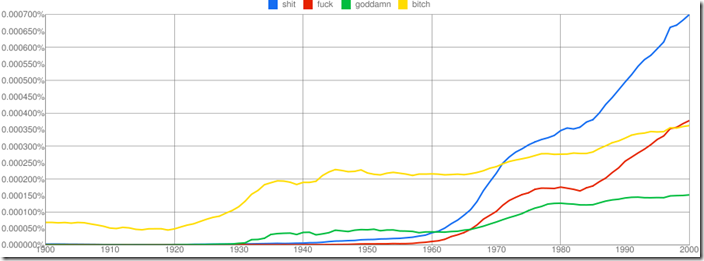
For 6 years, Google has taken 5 million books (!) and turned them digital. Thanks to the internet and the ability to quickly search through millions of books in seconds, this lets us do some interesting experiments that would not have been possible in previous generations.

The experiment I want to run is on the obscenities used in pop culture in the last 100 years. And what better way to measure than than by looking at the common media form in use for this last century: books!

So, has obscenities increased in our books? Or is my prudish mind just imagining things?

obscenitiesInBooks

Amusing, ain’t it? Up, up, and away! To Obscenity Boulevard we go!

Particularly amusing is the “s***” and “f***” lines (blue and red, respectively), showing a heavy increase in usage with the advent of the 1960s. It’s also worth noting a steady increase in all those obscenities since the 1960s.

That timing shouldn’t be surprising. As I wrote in Atheist Contempt,

In some ways, our current culture is an inheritance of the values of the 1960s: politically left, free love, drugs, free everything. But now the sexual liberation has been extended, and the “spirit in the sky” is now a myth of the ancients.

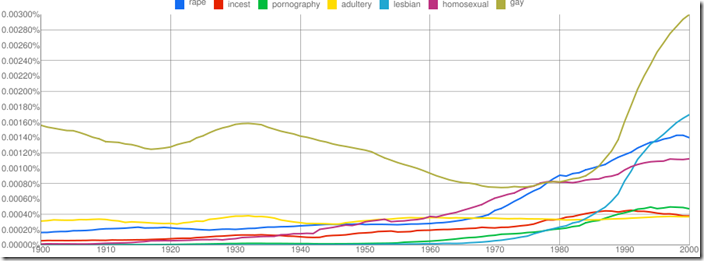
Sexual terminology, especially taboos, have likewise increased:

sexualObscenitiesInBooks

Rape has greatly increased. References to pornography has increased steadily since the 1960s, with a major increase during the 1980s. This timing may be explained by the invention of the internet, which put pornography at everyone’s fingertips.

The increase in references to homosexual terms is also interesting, picking up the largest gains since the 1980s, even more than pornography. The term “gay” increased as well, but there was already significant usage of that term prior to 1960s, due its alternate, innocuous meaning (“happy”).

Amusingly, the only one that hasn’t increased much is adultery, perhaps due to it being a longstanding and perhaps more common sin in western society. Or perhaps I’m just using the wrong search terms.

One thing is certain: obscenities and violence and sexuality is increasing in our pop culture, in our books, movies, music, games, and media. Our culture is in a downward spiral.

And if you don’t agree, you’re #!$%ing blind.

Atheist Contempt for Judeo-Christian Values

“Salvation Army is an Anti-Gay, Pro-Life Evangelical Christian Organization”

…so don’t donate to them.

The above headline was taken from Reddit, one of the most popular sites on the web, self-described as “the voice of the internet.”

The site draws me for its tech news and amusing internet time-wasters.

But it’s also a popular hub for atheists, reddit.com/r/atheism, and for homosexual people: reddit.com/r/lgbt. These sub-websites give an amusing look into a world most religious folks are blissfully ignorant of.

Take a peek for yourselves at these choice quotes from the above article:

Helping people is clearly a secondary goal of [the Salvation Army’s] church. Which is what they claim themselves as in order to bypass anti-discrimination laws so they don't have to have any pesky gays around.

SA refuses to employ gays, and claims itself as a church to bypass anti-discrimination laws. They clearly have helping people as a secondary agenda, and even threaten to pull themselves out of places in order to sway legislation. They are using their helping people as political leverage.

[Salvation Army is] blatantly bigoted. Why give money to them?

If you are gay you can't help those starving or homeless. It is more important to them to force religious agendas rather than help people.

They may not deny services to specific people whose actions they find morally objectionable. But they certainly hate gay people enough that they're willing to do whatever it takes to deny them equal rights. Why not give your money to an organization that does good work without pushing a fucked up hateful agenda?

[Charities like SA] …are immoral. It's disgusting bigotry against other people, and they're getting our money to do it.

It doesn't cancel out the good things they have done, but it's a mitigating factor. It would be like learning that the local soup kitchen is run by the modern-day Klan.

Someone might say "Look, they're just forcing any poor or homeless black people to listen to lectures about the inferiority of the black race before they get to use their services. So what if it's bad; think of all the good they're doing!"

Read hundreds of comments like these, you start to get a sense of the real bitterness and hate coming out of the atheist and homosexual cultures.

Salvation Army has a “fucked up, hateful agenda”? The Salvation Army is akin to the Ku Klux Klan? Really?

Tell that to the few commenters, including a handful atheists, who were bold enough to speak up:

I grew up in a dirt poor single mum family. We had a small house and that was it. Mum was doing all she could but we lived off 50c noodles. And every year without fail, the salvos gave us Christmas.

That. fucking. meant. so. fucking. much.

It was just a box with some tinned veg etc, a bottle of sauce and a roast with some little toys and clothes for myself and my sisters. And it meant. so. fucking. much.

They didn't judge us. They didn't ever give us sermons. Hell, they didn't even ask if we were Christian. And it wasn't just Christmas. The old ladies at the salvo store would hunt for an hour or so to find us fitting clothes. They gave us books (kids ones). They gave us bread when things got a bit to lean. They did so much for us and asked nothing back.

They were there for us when no one else was. And now I have grown up, and I have a job so I have money to spare. I donate. I suggest you do too. They make the world so much more worth living for so many people, don't just circlejerk at them because they don't agree 100% with you. These people make a difference.

Personally, I am now avoiding joining these discussions. The frenzied blitz of propaganda and hatred is almost impenetrable and ultimately stifling. It’s like trying to speak softly to a person screaming in your face.

It’s far worse than anything I’ve seen in the religious world, even with its extra helping of dumb people. The “agree with us or be an anathema” mentality is far worse than religious cults.

It is helpful to describe the worldview that characterizes this atheist part of our culture:

  • Religion must be overthrown, religious people are backwards, ignorant hypocrites, and God is a myth.
  • LGBT FTW! – lesbian, gay, bisexual, transgender. You are member of this group, or support their agenda. Anything less is outdated moral bigotry and intolerance.
  • Drugs should be legalized, starting with cannabis.
  • Virtually all forms of human sexuality are valid.
  • Fuck the moralizers, live and let live.
  • Porn is awesome!
  • There’s no such thing as right and wrong, there exists no real evil, it’s all relative.
  • Business is the devil, most everything should be free.
  • Politically to the extreme left.
  • Separation of church and state is great, except when it comes to the state interfering with the church, in which case they favor state interference.)

In some ways, it’s an inheritance of the values of the 1960s: politically left, free love, drugs, free everything. But now the sexual liberation has been extended, and the “spirit in the sky” is now a myth of the ancients.

Defend God and faith? You’re a deluded Evangelical -- maybe even a laughable Young Earth Creationist, bwaahahaha! -- who just needs to read some Dawkins.

Defend pro-life causes? You’re a freedom-suppressing, anti-choice chauvinist. (And you’re probably a man, so you’re a sexist, too.)

Do you think homosexuality is morally wrong? You’re bigoted, hateful, intolerant religious whacko.

Either way, this sub-culture will flame you, down-vote you off the page, or find some way to silence you and make a caricature out of you.

Remember, they are the intelligent ones, the enlightened moderns, the open-minded of our generation. And it is you religious people who are backwards, bigoted, close-minded, and stupid.

Whatever your view, if it counters their agenda, you’re given a label.

  • Think it’s a bad idea to kill human embryos prior to birth? Your label is Sexist.
  • Think race should be ignored when it comes to employment and schooling? Your label is Racist.

A powerful thing, these labels.

Once you’ve been labeled, debate and thought and introspection has been rendered unnecessary. Your ideas need no assessment.

All that remains is to make a caricature of you. Let the mocking begin, you Homophobic Racist Sexist Intolerant Xenophobic excuse for a human being.

That is the predominant worldview of this subculture in the United States: politically left, stifling religion in all forms (even charities), morally backwards, calling evil good, calling good evil.

That is not to say all atheists follow each of these views, but this is the general worldview and value system of the politically left-of-center, atheist world, with varying degrees of extremity.

I’ve seen it now for 10+ years on big internet hubs like Reddit and Digg, heard it espoused on left-wing political radio here in Minnesota, have seen it on television nationally. Heard it first hand from atheists friends and relatives.

This is not a new phenomenon, however. I’m strangely comforted by that. This is a problem that was around 2000 years ago, something the first disciples had to address directly, whether in idolatry or simple denial of God:

God's angry displeasure erupts as acts of human mistrust and wrongdoing and lying accumulate, as people try to put a shroud over truth. But the basic reality of God is plain enough. Open your eyes and there it is! By taking a long and thoughtful look at what God has created, people have always been able to see what their eyes as such can't see: eternal power, for instance, and the mystery of his divine being. So nobody has a good excuse. What happened was this: People knew God perfectly well, but when they didn't treat him like God, refusing to worship him, they trivialized themselves into silliness and confusion so that there was neither sense nor direction left in their lives. They pretended to know it all, but were illiterate regarding life.

Worse followed. Refusing to know God, they soon didn't know how to be human either—women didn't know how to be women, men didn't know how to be men. Sexually confused, they abused and defiled one another, women with women, men with men—all lust, no love. And then they paid for it, oh, how they paid for it—emptied of God and love, godless and loveless wretches.

Since they didn't bother to acknowledge God, God quit bothering them and let them run loose. And then all hell broke loose: rampant evil, grabbing and grasping, vicious backstabbing. Look at them: mean-spirited, venomous, fork-tongued God-bashers. Bullies, swaggerers, insufferable windbags! They keep inventing new ways of wrecking lives. They ditch their parents when they get in the way. Stupid, slimy, cruel, cold-blooded. And it's not as if they don't know better. They know perfectly well they're spitting in God's face. And they don't care—worse, they hand out prizes to those who do the worst things best!

I am convinced that what Paul, a Jewish disciple of Jesus, described so long ago also describes this generation.

While it may also describe previous generations to a degree, it seems to be snow-balling: what is acceptable today was unthinkable yesterday. It keeps getting worse.

I don’t mean to sound like Auntie Prude, but hell, our TV, our music, our books are filled with things that would be morally shocking to our parents’ generation, a generation not prudish by any measure.

I am trying to imagine what exactly my kids will receive in the next generation – what will be so revolting that it would be obscene even to today’s generation? (Bestiality? Drugs? Pedophilia? Public suppression of religion? Violence towards the religious?) Whatever it is, history shows the next moral obscenity, whatever they think up, will be acceptable by the next generation, God help them.

Know that I’m not some old fart going on about the good ol’ days of yesteryear. I’m 27 years old, and I see it clearly in my generation.

What the hell is happening to the world? And where are we headed?

How has it gotten so bad that people are demonizing charities and convincing others to stop donating to them in the name of No-God?

I'm Offended That You're Offended!

I've been offending a lot of people lately.

  1. Wezlo, a Baptist pastor of Christdot.org fame, was offended at my statement on Barack Obama's pastor, "Shame on the fools who equate the murdering of children with the acts of a nation against the murderers." I further suggested Israel is morally right in its war against the murderers of these kids, and that there are times when God uses righteous anger, even righteous violence.

    So offended was the Protestant pastor that he ended up deleting several posts, closing the comments on one blog post, and finally hinted it as a reason to close his blog. "That was out of line", he tells me. "You're coming here trying to pick a fight", he asserts. "You should have said, 'I think it's foolish...' rather than 'Shame on the fools...'", so as not to offend anyone, he tells me in a now-deleted post.

  2. A pluralistic man of the secular world was offended after I mentioned that the names of the months of our western calendar are named after "false gods". "False gods?", he asks, "How is my god any more false than yours?!"

    I suspect his was a rhetorical question; there are not too many people nowadays worshipping Aphrilis, namesake of the month of April.

  3. Pakistani Muslim and long time acquaintance Adnan Siddiqi and his Muslim friends were offended by the implication that the Jewish people have survived 4000 years thanks to God's preservation, despite at least 8 different civilizations attempting to destroy them. I then suggested that Hamas et al will go the way of the dodo, as did the groups prior that tried to destroy the Jewish people. Needless to say, that didn't soothe his wounds.

  4. Even some Jewish friends took offense after I pointed out the modern Jewish calendar differs from God's calendar in Scripture. All-around nice guy, dad of 8 kids, and friendly Messianic Jewish rabbi Derek Leman, found it wise to publicly distance himself from me for my remarks on the Jewish calendar.

    [Update: in the comments to the same post, another Jewish reader, Gene Shlomovich, is engaged in a debate with me over the merits of Messianic Israel theology, the theology that states both Jews and gentiles are part of Israel, either by descent or by Messiah's grafting-in.]


Combine those with the respectful theological disagreements with a Christian friend, Brian, regarding the dissolution of the Levitical priesthood, a debate with comments long enough to write a short novel, a debate which continued on privately for a few more back-and-forths.

In addition, I've recently discovered another Christian friend privately took deep offense at the recent assaults on Easter, finally admitting he "didn't want to hear anymore about it". Ignorance is bliss!

In the last few weeks, I've offended at least 4 Christians, 2 Jews, 2 Muslims, and a man who in all likelihood is an atheist. And those are just the people who've spoken up. :-)

All that said, here's some more red meat for the easily-offendable. :-) I suspect it will offend Jews, Muslims and atheists more than Christians, for it contains something most Christians believe, something I consider the Christians to be absolutely and entirely correct in. (Shocking, ain't it? Not too often I can agree with Christianity!)

It's a quote from an intellectual Jewish man, a former atheist, who turned to Messiah in his mid-life, Art Katz. He had this to say regarding the easily-offendable nature of the pluralistic western world. In some ways, it gives me reassurance through all these debates and arguments and offend-ings and disagreements,

Have you heard of pluralism? The whole modern western world is pluralistic. That is to say, "many paths to God." There's no single truth.

Jesus made a remarkable statement: "If you see me, you see the Father, I and the Father are one. No man comes to the Father but by me. If any man comes any other way, that man is a thief and a robber." You guys realize what a scandal the gospel is? You realize how abrasive the gospel is? Do you realize that God has chose the foolish things? That there's nothing about the gospel that's intellectually credible? God has given us something calculatingly foolish, compared to the wisdom of the world. The world that is pluralistic and likes to consider many paths to truth has got to contend with a gospel that insists upon itself, and the Jesus of that gospel, as the only truth. It is uncompromising in its insistence. It is absolute in its expression. And the very question of absoluteness and singularity itself runs right across the whole tenet and grain of the modern world. You understand that? Do you understand how pluralistic the whole mindset of the world is, how many options -- I don't know's, the maybe's, the grey's, who's to say's -- and into that whole mucky world of vagaries, and choices, and nuances, comes one statement out of the heart of God: "I am the way, the truth, and the life, and no man comes to the Father but by me."

If I hear anything from my Jewish kinsmen in conversations I have been involved with my people, invariably they bring up, "What about the other people of the world? What about Buddhists, what about Muslims, what about Hindus? Don't they have a religion, isn't it a world faith? Aren't there redemptive elements in these religions? And you feel a blush coming up to the roots of your being, when you have to insist and say, "No, these are satanic deceptions and false alternatives that lead unto death." To insist on the singularity of the gospel, to insist on the absoluteness of it: this is not just an issue of religion, it's hitting the world head-on in a confrontation of wisdoms, of moral systems, of mentalities.

I've found this to be true, that one bold statement goes against the grain and tenet of the world and induces all kinds of anger and offense: No man comes to God but through Yeshua the Messiah. Speak that truth, and you're a bigot by the world's standards. The world will slander you and attack you and mock you to no end should that tiny statement be uttered in public. It is the ultimate offender in this easily-offendable, politically correct world.

For the record, I'd like to say that none of the disagreements have created a cold between myself and any of you who know me personally. I always prefer clarity to agreement, and I think honest debates help bring about that clarity.

So if you're offended or disagree with me, I want to hear from you, I want to discuss it, I want to find the truth of the matter. Even if we can't attain agreement, at least we can find clarity in exactly where each side stands.

What this world needs... (video)

...is for men to wash one another's feet.

Art Katz, the cynical Jewish atheist, deeply intellectual, vehement anti-religionist and anti-Christian was radically apprehended by a God whom he was not seeking.

In the video below, Art explains how it all went down -- his US army assignment to Germany, the place and people he despised for the Holocaust, his visiting the concentration camps, the people he met along the way that led him out of hatred and finally how God radically changed him. It's really an amazing story, please watch it or at least give it a listen. The video is low volume and poor quality; don't let that turn you off -- please give it a listen, I promise it will be worth your while.


"There's no way to describe what I was as a Jewish atheist and radical. I was not just mildly contemptuous of religion, I was an avid and vehement opponent of religion. And of all faiths, Christianity was the most abhorrent, because I equated Christianity with the Holocaust; it came out of and was issued from a Christian nation. So, any attempt to communicate [religion] with me was met with vehement refusal.

It took a crisis of my life being broken at its foundations to make me be void of my own clutter, my own vocabulary, my own convictions, my own categories, my own petty cause. It put me in a place to hear, for the first time, this still, small voice.

The first thing I did at the earliest Yom Kippur of my time in Germany was not to go to a synagogue -- an atheist does not attend a synagogue -- I went to Dachau. It took the enormity of the concentration camp -- the barbed wire, the barracks that yet remained and have since been removed, the place of annihilation, the place of cremation, the ovens -- to break something in me. I can remember leaning my hand on this smoke stack, and something broke. The magnitude of what I was touching was greater than my categories.


The cremation ovens at the Dachau Nazi concentration camp, which Art describes in the video above. Jews were hung from the rafters and burned in the ovens. God used this experience to break Art at his foundations, the first in a series of steps God used to bring Art, an adamant atheist, back to Him.

Please listen to this man's story; whether you're an atheist, Jew, or Christian, it's a moving story, and I think you'll be changed for the better.

----------------
Now playing: Marty Goetz - V'Ahavta
via FoxyTunes

To the Jew First (audio)

A frequent reader and commenter to this blog, Lou Vasquez, pointed me to one of the best teachings I've heard in a long time, which I've posted below. The teaching covers humanism, secularism, Judaism and the revolutionary thing that is the Good News, the gospel.

In particular, it asks, why is it that Scripture -- even the gentile's favorite New Testament author, Paul -- commands us to spread the Good News of Messiah to the Jew first, then the gentile? Why is that? Why would God prefer one race over another? Isn't that racist?

The answer is in this teaching by a Jewish man, a former Maxist and atheist, turned believer in Christ named Art Katz. This man of God, I've just recently learned, passed away only 5 months ago, on June 28th, 2007. His teachings live on...


Please give it a listen. It is simply one of the most direct, confrontational teachings I've heard in some time. You can even hear his gentile audience squirming at the non-politically-correct, bold assertions he makes. Please, please give it a listen.

"To the Jew first" is a statement that makes many gentile Christians uncomfortable; here we are with 1/3 of the whole world having received Messiah and the God of Israel, but the only things Israel and the Jews have received is hatred, persecution, anti-semitic pogroms, the Crusades, the Inquisition, and the Holocaust, mostly at the hands of supposed Christians! To say we have failed the "Jew first" commandment would be an understatement.

Some choice quotes on Judaism and Jewish life, giving a background to why the gospel is "to the Jew first":


"You would do well to avoid Jews. Not only do they have an historical case against you, they happen also to be bright, and intellectual, and formidable. And if ever you want to feel the full extent of your inadequacy, try confronting one. It's one thing to bring the gospel to some slob and drunk gentile in the gutter, who went to Sunday school as a kid and knows that he should be saved, but it's another thing to knock on the door of an erstwhile Jew who has 2 or 3 university degrees and is an impeccable man, morally and ethically, as many if not most Jews are, who has never so much raised his voice once to his wife -- to tell that man he's as lost as that drunkard slob without your Christ, in whose name he has been persecuted for 2000 years. Got the picture?

Judaism is not just another world religion. It's the embodiment of a wisdom. It's predicated on humanistic principles. It makes certain assumptions about man and his intrinsic virtue. It believes that man is innately good. It does not subscribe to the Scripture or doctrine that says, "There is no man good, not one." It rests on the premise of human virtue and good works, under righteousness of man, rather than the righteousness of God.

And what we need to understand also is, what we call Judaism today is not a Biblical faith so much as it is a rabbinical faith. With the destruction of the Temple, when there is no possibility again of continuing in a Biblical Judaism with a priest-oriented worship, some kind of substitute had to be found, so that the Jewish community could have a coherence and a continuation. And that was provided by the same class that saw to Jesus' execution. It became a rabbinical class. The Judaism that is practiced today has its origin with them. It is more Talmudic than it is Biblical.

But underlying all of that -- even with the references to Scripture -- is a philosophical premise as an understanding about man that elevates man in his own righteousness and sees him as perfectible. We Jews are the ultimate humanists of the world, even when we are religious. We are the ultimate secularists, even when we are religious.

As for example, when I was invited as a missionary to the Jews to come to a Jewish classroom in New York City, who wanted to hear about this Jews for Jesus phenomenon, I got into a confrontation with the Jewish teacher. Van Dyke beard and yarmulke -- kippa, the head covering -- and deeply Orthodox and religious. We went out into the hall when the period ended, and as we were having our discussion, I all of a sudden squinted my eyes and said, "Excuse me a minute," I said, "do you believe that God parted the Red Sea and made it as a dry ground that we should go over in safety and closed up the seas and engulfed the pursuing Egyptians?" He hesitated and choked and spluttered, and finally he said, "It was a confluence of tides." He began to give me a rational explanation, a natural explanation for a supernatural event.

And then I asked, "What about the birth of Isaac? If you can't believe for the birth of Jesus, how about the birth of Isaac?" And again he gave me a rational and natural explanation. So what the Lord was showing me, and I think that it is basically true, is there's a deep-seeded, rational and natural component of Jewish life and thought, which is really an expression of a world itself which is at enmity with God, and that has an abhorrence for supernatural explanation, even while it speaks about God and is fastidious in its religious observance about what to eat, and how to eat, and other kinds of ritual things that are performed.

It brings me to another point: if we are ruled by the things that are visible, rather than the things that are of God, we are likely to find ourselves applauding such a people who have an ethical quality of life, an impressive religious quality of life, that is historically impressive, that has a liturgy that leaves us in the shade, and by every natural appearance, seems to support what they say! That they are moral, ethical, and righteous, whereas we're the ones who are coming apart at the seams. We're the ones that are struggling to keep our spiritual heads above water and have our marriages somehow to be coherent, and are struggling against sin and against temptation, and they seem to be walking through the world whistling Dixie."


As a Jew myself, I relate deeply to that last sentiment. I have found myself applauding and am often drawn towards the beautiful Jewish lifestyle, even with its faults, as I find it more Scriptural that the way most Christians are living! (gulp, I'm gonna get hell for that one in the comments!) Yes, Jews don't get it all right, as Katz mentions, but they often live much better than many Christians do, as far as religion and moral teaching goes. Katz summed it up nicely: here Christian evangelicals have one of the highest divorce rates in the United States, yet this lowly, erstwhile Jew has not once raised his voice at his wife.

Indeed, the anti-Torah lifestyle of most of backwards, idolatrous western Christianity only pushes me in that direction -- more Jewishness, less Christianity! I am constantly pulled towards Judaism merely by appearance and pushed -- by Christians! -- away from Christianity. (In fact, I was recently told by a Christian man that I am not a Christian because I throw out church tradition and instead opt to celebrate the Feasts of the Lord.)

Wisdom has taught me that all have sinned and all are dirty inside, no matter how clean one looks from appearance alone. That applies to all religious people, no matter how pious, no matter how devout, all sin. So do the most Orthodox Jews, no matter how strictly they outwardly observe Torah. This wisdom has kept me from abandoning all ties to gentile Christianity.

Like the Pharisees, I suspect many Jews aren't clean inside as they are on the outside; all the wonderful moral practices and regulations and commandment-keeping does nothing for you if you aren't alive with the Spirit of God, really living for God on the inside as much as the outside.

I also recognize that loving God and loving others trumps all. This is something straight from the mouths of both Moses and the Messiah, something Jews and Christians can agree on. The beautiful Jewish lifestyle currently misses Messiah, and even though I have contempt for the idolatry in Christianity, and though I cringe at the sight of Constantine's anti-Jewish, anti-Torah version of Christianity being preached today, I trust that God doesn't want hatred towards those practicing and preaching the faults of gentile Christianity. The Lord is so good, he doesn't let his anger rage against us when we fail, but instead corrects us out of love and brings us back to him. The least I can do is imitate that kind of love.

And it's us Jews that need this love and need to hear about Messiah, not about your misguided gentile church traditions, or how I need to become a Baptist, or Lutheran, or Catholic, in order to truly know my own God, the God of Israel.

To the Jew first, and to us with the Good News of the revolutionary Jewish Messiah, not the Lukewarm News of Gentile Christianity.

To the Jew first, because we are the tough guy that spits out what pagans so readily accept.

To the Jew first, because God chose us and revealed himself to us while gentiles were still worshipping hand-crafted idols.

To the Jew first, because we've held fast to God's commandments for 4000 years, while the gentile world traded that in for man's traditions, despite immense pressure and persecution to do otherwise, often by men in the name of Christ.

To the Jew first, because we are the litmus test for the gospel.

If you want to hear more of Art, please see his podcast teachings on SermonIndex. Also see BenIsrael.org.

Custom comments