Import jQuery

Showing posts with label apologetics. Show all posts

Controversial 1st century passage about Jesus’s resurrection might be original after all


Wonderful news of illuminating new scholarship by religious studies professor T.C. Schmidt on Josephus and Jesus.

The Jewish historian Josephus (AD 37-100) is one of the most important historical sources of Jewish life, war, and religion in the 1st century. A member of the Jewish priestly class and military general in the failed war against Rome, he wrote over a half million words about Jewish life, including a controversial paragraph about Jesus.

Scholars have long thought that Josephus' writing about Jesus, called Testimonium Flavianum, was a later addition or editorial by Christian scribes. It seems too Christian for a non-Christian Jew like Josephus to write.

But new scholarship gives evidence that Josephus' famous Testimonium Flavianum is original and not a later addition as once thought. 

What's the new scholarship? 4 new pieces of evidence.

1. Manuscript evidence: Early Syriac and Latin translations of the original Greek attest to an original reading in which Josephus says Jesus was thought to be the Messiah.

2. Literary evidence: Computer literary analysis confirms the style, grammar, and word choices of the passage as authentic; a literary fingerprint unique to Josephus.

3. Greek evidence: When Josephus says Jesus appeared to his followers on the third day, he used the Greek word phaino, which connotes "something seeming to appear". This fits the style of Josephus and renders a non-committal take on the resurrection of Jesus; not out of place for a non-Christian Jew.

4. Insider Evidence: Where did Josephus get his information from? New scholarship shows it's from first-hand sources. Josephus' wartime commander was Ananus II, who Josephus records as having executed Jesus' half-brother James. He was the son of Ananus I, the same high priest who presided over Jesus' interrogation, and who's son-in-law was Caiaphas. Both appear in the Gospels (Luke 3 and John 18).

I'll give more details on each of these below. But first, for context, here's today's translation of Testimoniam Flavianum:

Now there was about this time Jesus, a wise man, if it be lawful to call him a man; for he was a doer of wonderful works, a teacher of such men as receive the truth with pleasure. He drew over to him both many of the Jews and many of the Gentiles. He was the Christ. And when Pilate, at the suggestion of the principal men amongst us, had condemned him to the cross, those that loved him at the first did not forsake him; for he appeared to them alive again the third day; as the divine prophets had foretold these and ten thousand other wonderful things concerning him. And the tribe of Christians, so named from him, are not extinct at this day.

It sounds very Christian. This has led scholars to suggest it's inauthentic; a later Christian addition or edit.

But T.C. Schmidt proposes that given this new evidence, Testimonium Flavianum should read as an authentic writing from Josephus:

And in this time, there was a certain Jesus, a wise man, if indeed one ought to call him a man, for he was a doer of incredible deeds, a teacher of men who receive truisms with pleasure. And he brought over many from amongst the Jews and many from amongst the Greeks. He was thought to be the Christ. And, when Pilate had condemned him to the cross at the accusation of the first men amongst us, those who at first were devoted to him did not cease to be so, for on the third day it seemed to them that he was alive again given that the divine prophets had spoken such things and thousands of other wonderful things about him. And up till now the tribe of the Christians, who were named from him, has not disappeared.

1. Manuscript Evidence

In the traditional Testimonium Flavianum, the statement “He was the Christ” is the giveaway, so it was thought, that this couldn’t have been written by a non-Christian Jew like Josephus. The expression “a (mere) wise man” earlier in the paragraph fits Josephus’s likely view, but a declaration of messianic identity is out of place.

But Schmidt gathered all Latin and Syriac translations of Josephus' Antiquities. In these, he notes that Latin and Syriac manuscripts of this passage don’t have the clear affirmation “He was the Christ” but instead the more doubtful “He was believed to be [Latin] / thought to be [Syriac] the Christ.”

Given the early date of these renditions—AD 300s—and the unlikelihood that any Latin or Syriac Christian copyist would demote Jesus, it seems reasonable to conclude this was what Josephus wrote. In the Greek copying tradition, a single verb (legomenos, “called,” perhaps) appears to have dropped out, either by accident or intent.

2. Literary Evidence

A mathematical, computer-assisted literary analysis of the author's vocabulary and syntax suggest Testimonium is original.

Schmidt found that Josephus used a unique term every ~87 words throughout his corpus. Having a unique word, and a couple of rare words, in a 90-word paragraph is exactly what we’d expect. Schmidt even examined Josephus’s rate of using common words such as "and", "or", and "the"—and the Testimonium shows the same frequencies as the rest of his nearly half-million-word output. Josephus’s fingerprints are all over this contested paragraph.

3. Greek Evidence

Schmidt offers a Greek-language insight into the most obvious Christian interpolation: the statement typically translated “he appeared to them alive again on the third day.” The key verb is phainō—"to appear." Many scholars have reasonably noted that a non-Christian Jew like Josephus would never have said Jesus actually "appeared alive." -- too Christian!

But Schmidt argues that phainō in this context carries one of its other connotations, well attested in Greek writings from Plato (fourth century BC) to Origen (third century AD)—namely, to indicate "something seeming or appearing to be so (but which may not actually be so)."

That would mean Josephus isn’t claiming Jesus really was alive, any more than earlier in the paragraph he was claiming Jesus was actually the Christ. Rather, he’s reporting, in a noncommittal or even skeptical way, that “it seemed” to Jesus’s followers he was alive, just as they "believed" or "thought" Jesus to be the Christ. Schmidt gives examples of this usage in Josephus.

4. Insider Evidence

But even if Testimonium is original to Josephus, it doesn't mean Josephus got it right. After all, Josephus could just be reporting rumors he heard, or official stances from one or more groups.

But Schmidt argues convincingly that Josephus got his information about Jesus and the resurrection from first-hand sources.

Josephus moved within the priestly dynasty directly connected to both deaths. His wartime commander was Ananus II (Ananus the Younger), the high priest who ordered James’s execution. Ananus II was the son of Ananus I, Ananus the Elder, the former high priest who presided over Jesus’s interrogation (known as Annas in John 18:13). Ananus the Elder’s daughter married Caiaphas, the high priest named in the Gospels. Ananus II was therefore Caiaphas’s brother-in-law. Luke 3:2 and John 18:13 place Ananus and Caiaphas together at the apex of the priestly establishment.

Josephus twice calls Ananus II "the oldest of the chief priests" and notes his death in AD 68–69. Ananus II was likely in his 70s or 80s when he died, making him in his 30s or 40s around AD 30, fully adult and influential at the time of Jesus’s trial.

Therefore, Schmidt plausibly speculates that Ananus II (the Younger) might even have been a member of the Sanhedrin that handed Jesus over to Pilate. Whatever we make of that suggestion, Schmidt is right to note that Jewish law required families to keep the Passover meal in the patriarch’s house. This means Ananus II would have been at his father’s house on the night Jesus was brought there for questioning (John 18:13). Therefore, Schmidt writes, "Ananus II surely would have observed the portion of the proceedings held in his family’s patriarchal residence."

Conclusion

Absolutely fascinating new evidence that Josephus' words about Jesus are essentially authentic. It renders Josephus non-committal about Jesus; only saying he was called the Messiah and that it appeared to his followers that he was raised from the dead.

However, even this is remarkable, early attestation of Jesus and claims of his resurrection. Today, many atheists want to claim that Jesus was either entirely fabricated, or that his claims of messiahship or resurrection were later innovations or exaggerations.

The authenticity of Testimonium works against those claims. Remarkable!

Very grateful to T.S. Schmidt's work and its review by John Dickson in The Gospel Coalition.

The Big Bang is Christian

Dubbed the "Pillars of Creation", this photo was taken in 2022 by the James Webb telescope, showing massive columns of gas -- 66 trillion kilometers tall! -- in the Eagle Nebula, about 6,500 light years from earth. The nebula is called a stellar nursery, as new stars are actively forming within it. View the full res (70MB) photo.

Today I came across this post by well-known Christian conservative commentator Allie Beth Stuckey:

The part that got me was, "absurdly illogical belief that the universe was initiated by a big bang."

This is a common sentiment in the conservative Christian world. I suspect many in the Messianic and Hebrew Roots world feel the same. 

But a dirty little secret about the Big Bang theory is, it's Christian.

The Big Bang theory was developed by a devout Christian and the theory itself supports the Biblical idea that the universe had a beginning. It was initially combatted by atheist scientists because it too closely aligned with the Bible.

A devout Catholic priest and physicist by the name of Georges Lemaitre proposed the theory in 1927. 

Prior to this time, the scientific consensus was that the universe was eternal; it had always existed. But working off the theories of his contemporaries Edwin Hubble and Albert Einstein, Lemaitre theorized that the universe is expanding, with a definite point in time and space where it came into existence. In other words, the universe had a beginning.

Lemaitre's theory, which he called the primeval atom theory, was initially rejected by many atheist cosmologists. British astronomer Fred Doyle mocked the idea and coined the term "big bang" as a pejorative, claiming the theory too closely resembled the Book of Genesis.

But today, nearly 100 years later, scientists almost unanimously agree the Big Bang theory accurately describes the beginning of the universe. 

What changed their minds? 

A number of discoveries with powerful evidence:

  • Cosmic Microwave Background (CMB) radiation. In the 1960s, scientists discovered faint radiation left over from the beginning of the universe. This radiation has been since observed to be stretched out due to the expansion of the universe, shifting visible light to different frequencies, aligning with predictions of an expanding, finite universe.
  • Hubble's discovery of the expanding universe. Edwin Hubble discovered that galaxies are moving farther apart, suggesting the universe originated at a single point in space. This couldn't be true of an eternal universe.
  • Abundance of light elements. The Big Bang predicted formation of precise amounts of hydrogen, helium, and lithium. Observations of old stars confirm these predictions.
  • The reality of a dark sky. If the universe were eternal, the night sky should be very bright. Instead, it's mostly dark, suggesting a finite past.
  • Distant galaxies' difference from our own. Observations of galaxies far away -- and thus, very old -- are made up of extremely bright stars, suggesting that the universe was much different than it is today, and suggesting that it had a precise beginning, not an eternal past.

The Big Bang is probably true, and it is Christian in its origins and Biblical in its implications. 

It's painful to me, then, that many uninformed Christians today reject the Big Bang categorically, as if it implies atheism. It does no such thing. It theorizes that the universe suddenly exploded into existence. 

In Biblical terms, "Let there be light!"

The universe isn't eternal, it had had a beginning: an instant of creation. And doesn't an instant of creation imply the existence of a Creator?

Jesus and the Sabbath Show Up on Joe Rogan Experience


This week, the world's most popular podcast, the Joe Rogan Experience (JRE), hosted Christian apologist Wesley Huff. 

Wes is a historian, author, researcher, expert in Biblical manuscripts and early Christian writings, PhD candidate, and defender of the authenticity of the Gospel accounts. I've followed Wes' writings and videos for years, so I'm happy to see him get some major exposure on JRE.

Here's the full episode:

Why is this significant? Protestia explains that this episode is likely to be the furthest reaching gospel broadcast in history.

Huff’s message went out to Joe Rogan’s 14 million regular listeners. Even moderately popular episodes enjoy over 11 million downloads, and some far more. In a month’s time, Rogan’s downloads exceed 190 million in the course of a month (which is more than the number of Americans who watched the moon landing). It’s more than those who watched the Beatles on Ed Sullivan. It’s more than those who watched Nixon’s resignation speech. It’s more than those who watched the Chiefs beat the Eagles at ‘23 Super Bowl. It’s more than those watched the O.J. Simpson verdict. It’s more than those who watched JFK’s funeral, or the wedding of Prince William and Kate Middleton.

As an example of the podcast's influence, just before days before the 2024 election, President Trump appeared on JRE, and it resulted in a last minute bump towards Trump, leading to an election victory. 

These unscripted, long form conversations are powerful. The podcast has some 14 million listeners and avid followers from a variety of backgrounds and persuasions.

Wesley Huff appears on the podcast to talk about God and the truth of the Bible. He did a fantastic job of defending common objections to the historicity of Jesus, specifically his death and resurrection. Questions like, "How do we know Jesus really died when he was crucified?", "How do we know Jesus appeared to people alive after his crucifixion?", Wes handles it well and gives the evidence.

I want to zero in on a question where the Torah comes up and dive a bit deeper on it. (After all, friends, this is the Kineti blog!)

Wes argues in this clip that Jesus was against moralism:

Here's the interesting bits:

Huff: I actually think that Jesus condemns moralism. And ultimately what I see [Jordan] Peterson doing is looking at Jesus as a moral example. And if Jesus is nothing but a moral example, then you can save yourself and you don't need a Savior. I think Jesus would critique that, because Jesus is very against moralism.

Rogan: How do you define Jesus being against moralism? What do you mean by that?

Huff: Jesus looks at the religiosity of his day, with particular groups like... the Pharisees who are like lay scholars, and Sadducees who are professional priest scholars, and he's constantly critiquing the fact they have this hypocritical religiosity to them. They're constantly doing things like, uh, tithing their mint leaves to make sure they get all...this is where we get letter of the law vs. intention of the law. Jesus critiques them for that because he says, 'You're trying to do everything right, and you're missing the point.' One of the things he says is, if one of your donkeys falls in a ravine on the sabbath, do you pull it out? Or is that work? What's the point of the sabbath? 

Rogan: Hmmm.

Huff: Is it to not do any work? Like, is it to make sure you're not working too hard, because you might be breaking the sabbath? Or like, what is the point? And he says, the sabbath was made for man, not man for the sabbath. And there's this intention -- and this is the whole Sermon on the Mount, Matthew chapter 5 -- is he keeps saying, "You have heard it said, but I say..." and he's referring to the Mosaic Law. And it looks like he's critiquing the Mosaic Law, but he's not actually. He's getting back to the intention of the Law. So when he says, "You've heard it said, 'Do not commit murder', but I say to you anybody who harbors hate for their brother in their heart has committed murder." - what he's getting at is, what is the intention, what's the meaning of the Law that God gives to you?

This is really great and I applaud Wesley for telling millions of listeners God is real, the Bible is true, and giving evidence for Jesus' resurrection. I love that Wes explained that Jesus isn't critiquing the Law, he's getting to the purpose of the Law. This is a profound truth and many lay people in Christianity miss it.

Wes' comments on Jesus and the Law goes well with my recent teaching, The Law of Christ is the Law of Moses Kept in a Christlike Way. Jesus isn't critiquing "You shall not murder", he's saying that the true goal of that law was to prevent hatred in your heart, and that having hatred in your heart is actually breaking the Torah. Likewise for the law against committing adultery: its true aim was to prevent sexual immorality even in the mind and the heart; merely lusting after someone other than your spouse is actually breaking the Torah.

OK! But there's a wriggle here. I don't blame Huff for not addressing it, because the Rogan podcast audience is not ready for deep theology. But maybe you are, dear reader.

The wriggle is the sabbath and its true meaning.

Huff says, 

"One of the things [Jesus] says is, if your donkey falls in a ravine on the sabbath, do you pull it out? Or is that work? What's the point of the sabbath? Is it to not do any work? Like, is it to make sure you're not working too hard, because you might break the sabbath?"

Let's put these in a table to illuminate the issue:

Torah commandmentTrue meaningTrue meaning aligns
with plain meaning
Do not commit murderDo not have hatred in your heart.
Do not commit adultery.Do not lust in your heart.
Do not work on the sabbath; keep it holy.

See the issue? Huff states there's a true meaning behind the commandments in the Law. But note that the commandments' plain meaning cannot be cancelled by their true intention:

  • No hatred in the heart doesn't mean we're now free to commit murder, of course.
  • Likewise, no lust in the heart doesn't mean we're free to commit adultery.
  • No work on the sabbath doesn't mean we're free to work on the sabbath or treat it like any other day.

That's the wriggle: Christianity largely does work on the sabbath and treats it like any other day.

If I'm being charitable, Christianity keeps the 1st day of the week, Sunday, as the new sabbath. That also contradicts the plain meaning of the commandment in Exodus 20:9-11. But even if we grant Sunday is the new sabbath and is considered holy by meeting with other Christians on the sabbath, work is still permitted on Sunday. There are notable exceptions, like Chik-Fil-A restaurants. But it's the exception that proves the rule. The Christian world, whether Catholic, Protestant, or Orthodox, works on the sabbath even if we move the sabbath to Sunday. This again cancels the plain meaning of the text.

And there's another mystery here. What is the true meaning, the real intention, of the law about resting on the sabbath and keeping it holy? Is there a true meaning, one deeper than the plain meaning?

Jesus doesn't explicitly give us one like he does for murder and adultery. 

He gives an example that saving the life of an animal on the sabbath is permissible. (Judaism's concept of pikuach nefesh.) He heals a man on the sabbath and tells us that it's permissible to do good on the sabbath. Jesus says the sabbath is made for man. Here are the prominent sayings of Jesus on the sabbath. Make good note of what is, and isn't, there:

Jesus' statement Implied true meaning
"Which of you, with a son, or even an ox, falling into a well on the sabbath, will not immediately pull him out?" Healing a person or saving their life is permissible on the sabbath.
"Haven’t you read in the Torah that on the sabbath the priests in the Temple break the sabbath and yet are innocent? I tell you that something greater than the Temple is here." A divine priority: Messiah is greater than the Temple, and the Temple is greater than sabbath. "Violating" lesser priorities in service to a higher priority is no violation at all.
"Therefore it is permitted to do good on the sabbath." The sabbath is meant for good.
"The Son of Man is Lord of the sabbath." Messiah created the sabbath. The creator of the sabbath has authority to say what is permissible on it.
"The sabbath was made for man, and not man for the sabbath." The sabbath is intended for the benefit of humanity. The sabbath should be a joy and a delight, not a burden.

Is there deeper meaning to the sabbath commandments? Certainly. But I think these are a good start.

Notably missing from Jesus' sabbath statements are any claims that all work is permissible on the sabbath, or that the sabbath is done away with.

My conviction remains and is strengthened: Jesus did not wish his followers to do away with the sabbath. He wished to tell us that preserving life trumps not working on the sabbath. He wished to tell us that sabbath was created for us. He wished to tell us that doing good on the sabbath is permissible. But I'm convinced Jesus did not intend for a non-existent sabbath where anything is permissible.

Jesus' disciples should have a day of rest. It should be on the 7th day. You can do good works on it, and you can save someone's life on it. It should be a joy and not a burden; it was created for us. But it's a day of rest, not a day to work or catch up on your shopping. Christianity needs reform in this area.

C.S. Lewis on Substitutionary Atonement

God providing a sacrifice in place of Isaac

How does Messiah's death reconcile us to God? 

It's a central argument of Christian faith: people should follow Jesus and turn from their sins because his death reconciles us to God. 

But how does it reconcile us to God?

A common answer to this question is substitutionary atonement. In this theory, God, being a just judge, must punish sin. A judge who doesn't punish criminals isn't just, after all. This theory says Jesus died in our place: people deserve death because of their sins, and God, being a righteous judge, has to punish sin. But Jesus voluntarily took the punishment instead. God's wrath and justice are satisfied, and humans are reconciled back to God.

Making my way through C.S. Lewis' Mere Christianity, he addresses this in a way that surprised me.

C.S. Lewis says the important part isn't the way Jesus reconciles us to God, the important part is the reality that Jesus has reconciled us:

Now before I became a Christian I was under the impression that the first thing Christians had to believe was one particular theory as to what the point of this dying was. According to that theory God wanted to punish men for having deserted and joined the Great Rebel, but Christ volunteered to be punished instead, and so God let us off. Now I admit that even this theory does not seem to me quite so immoral and so silly as it used to; but that is not the point I want to make. What I came to see later on was that neither this theory nor any other is Christianity. The central Christian belief is that Christ's death has somehow put us right with God and given us a fresh start. Theories as to how it did this are another matter. A good many different theories have been held as to how it works; what all Christians are agreed on is that it does work.

You might ask, what good is Jesus' death if we don't understand how it reconciles us to God?

Lewis answers with an analogy. A man can eat his dinner without understanding exactly how food nourishes him. A man can accept what Christ has done without knowing how it works: indeed, he certainly would not know how it works until he has accepted it.

This is one of those, "Well, rationality and intellect must bow to God too" moments. I don't care for these moments. But I don't want to make my rationality into God, so it must bow too.

Lewis elaborates,

We are told that Christ was killed for us, that His death has washed out our sins, and that by dying He disabled death itself. That is the formula. That is Christianity. That is what has to be believed. Any theories we build up as to how Christ's death did all this are, in my view, quite secondary: mere plans or diagrams to be left alone if they do not help us, and, even if they do help us, not to be confused with the thing itself. 

He digs a bit deeper into the substitutionary atonement theory:

The one [theory] most people have heard is the one I mentioned before - the one about our being let off because Christ had volunteered to bear a punishment instead of us. Now on the face of it that is a very silly theory. If God was prepared to let us off, why on earth did He not do so? And what possible point could there be in punishing an innocent person instead? None at all that I can see, if you are thinking of punishment in the police-court sense. On the other hand, if you think of a debt, there is plenty of point in a person who has some assets paying it on behalf of someone who has not. OR if you take the "paying the penalty", not in the sense of being punished, but in the more general sense of "standing in the racket" or "footing the bill", then, of course, it is a matter of common experience that, when one person has got himself into a hole, the trouble of getting him out usually falls on a kind friend."

Ha, alright C.S.! I don't find his "why didn't God just forgive straight away" line of thinking convincing - it seems to me the answer is clear: because God must punish sin for Him to be just. 

But I do like Lewis' reasoning that is it like footing the bill. The "kind friend" aligns well with the idea often championed in Messianic Jewish circles: that the merit of Messiah is credited towards us in our standing before God. We are in debt to God by our rebellion, but if we are in Messiah, God views us through the merit and righteousness of Messiah.

My big takeway here is the reduced importance of substitutionary atonement theory. In my mind's eye, I had always understood that to be crucial to understanding the work of Messiah. But I find convincing Lewis' argument that what matters is that Christ brings us near to God by erasing our sins. Theories about why this is true are of secondary importance.

C.S. Lewis on Arguing Theology Over the Internet


I've started reading Mere Christianity, C.S. Lewis' monumental apologetic work.

In the opening pages, he says something that applies to internet arguments. Of course, Lewis lived long before the internet existed. But the warning he issues to believers are especially relevant for our internet age:

"Ever since I became a Christian I have thought that the best, perhaps the only, service I could do for my unbelieving neighbours was to explain and defend the belief that has been common to nearly all Christians at all times. I had more than one reason for thinking this. In the first place, the questions which divide Christians from one another often involves points of ecclesiastical history, which ought never be treated except by real experts. I should have been out of my depth in such waters: more in need of help myself than able to help others. And secondly, I think we must admit that the discussion of these disputed points has no tendency at all to bring an outsider into the Christian fold. So long as we write and talk about them we are much more likely to deter him from entering any Christian communion than to draw him into our own. Our divisions should never be discussed except in the presence of those who have already come to believe that there is one God and that Jesus Christ is His only Son." 

Years ago in the early days of the internet, there was a Christian site called ChristDot that I participated in. On that site, we argued theology with one another almost daily. Over many months, a Christian leader of the site decide he was no longer a Christian. (And, of course, not a single non-believer became a Christian because of our arguments.) I remember a post asking him, "Did all our arguing on Christdot contribute to your unbelief?" And as I recall, the answer was, to a degree, yes.

On this blog of 20 years, I've seen several people vehemently argue about everything from the relevance of the Torah, the age of the earth, the deity of Yeshua, the meaning and context of Old Testament commandments, and a million other things. I've argued with a Messianic rabbi who later committed repeated sins and left his congregation. I've argued with family members who left the faith. For a few years I argued with a Jewish believer who later denied Yeshua.  I've argued with other Messianics about the role of Gentiles in the Messianic movement. I've argued with Karaites, Christians, Jews, conspiracy theorists, anti-vaxxers, flat earthers, Muslims, atheists, gay-affirming Christians. 

To what end? 

Maybe it's good to discuss theology with other believers. For me at least, it helps clarify and shape my thinking. It's been a real purpose of this blog.

Lewis argues that theology disputes have no tendency to bring in people to the faith. He even says it deters people from entering the faith. In my experience, it can even lead people away from their faith, especially as people tend to be less gracious vicious when hidden behind a screen and keyboard.

This speaks to me: arguments about high theology in the public sphere are dangerous: if non-believers see us arguing about them, it is likely to push them away from God.

The Victims of Benny Hinn: 30 Years of Spiritual Deception

This week, Christian apologist Mike Winger published a meticulously detailed documentary (4+ hours long!) of televangelist Benny Hinn's fake healings, false prophecies, faux repentance. It is difficult to watch.

Failed Prophecies

In it, Winger shows Benny Hinn's own videos of his failed prophecies. Winger begins documenting these at 46:28 in the video.

In one instance from early 2020, Hinn prophesied in the name of God that COVID will kill no more than 5,000 people. A month later, after 10,000 had died of COVID, Hinn prophesied COVID would disappear by Easter 2020.

In reality, COVID is still a problem today, 4 years after Hinn's failed prophecy to come to pass. Over 7 million people have died of COVID. Even if you think that number is inflated, no one argues it's less than 5,000.

In another recent example, September 2023, he prophesied in the name of the Lord that Israel and Saudi Arabia will sign a peace agreement, the Middle East will experience a new regional peace between Jews and Arabs, and it will result in a wealth transfer from unbelievers to Christians by 2024. 

In reality, just a month later, not only did the unprecedented peace and wealth transfer not occur, but the opposite did: Hamas attacked Israel on October 7th, launching the region into war. Jewish-Arab tensions reached new heights.

It turns out Hinn prophesied the exact same thing back in the 1990s: unprecedented peace and a transfer of wealth from unbelievers to Christians as soon as Israel signed a peace agreement with Syria. Hinn's own video shows him saying the Lord has spoken it; "It's guaranteed!" This too turned out to be a false prophecy from Hinn.

False Healings

Winger documents how Hinn made false claims of healing and even resurrections. This was probably the hardest part of the video to watch.

In one case, Hinn convinced an elderly mother and adult son, both of whom had stage 4 cancer, that they had been healed. In a later interview with the mother, she believed she was healed, despite still showing symptoms. Shortly after, her son died of cancer. The mother was still convinced she was healed. But a month later, the mother too died of cancer. Heartbreaking.

In another case, Hinn claimed a man in Africa had risen from the dead at one of his meetings. When an investigation was launched, a manager of Hinn's TV program claimed Hinn was repeating something they heard, and they made a mistake in repeating it without verifying it.

But then later Hinn is shown speaking about the same resurrection, claiming it was witnessed by "200,000 to 300,000 people." Hinn even gave additional details about the supposed event, saying the man raised in front of the audience while Hinn's back was turned.

In one of many more instances, Hinn claimed in a book that he went into a Catholic hospital and anointed patients with oil. Something like an earthquake occurred, and there were many miraculous healings, Hinn's book claimed.

But after a secular investigation, the hospital confirmed that while Hinn did preach at the hospital chapel, there was no earthquake, reported healings, and they confirmed that not a single patient had left the hospital that day.

In what I can only guess to be hiding the truth, later reprints of Hinn's book removed the claim of the miracles at the hospital.

Harmful theology

In front of a crowd of 10,000 people, Hinn said that God is 9-in-1. He claimed the Father is body, soul, and spirit. As is the Son. As is the Holy Spirit. "There's 9 of them!" Hinn says to his congregation.

When confronted about this by other Christian leaders, Hinn backpedaled, saying he was repeating something he had read elsewhere, and that "When I said it to the congregation, I could sense tension in the room. So I made a joke and said there was 9 of them and people laughed." 

But we have video of the preaching, and there was no joke or laughing. He lectured on for several minutes about it.

In another teaching, he claimed that human beings are "little-g gods", because just like animals reproduce after their kind, when God created humans it meant that humans are a kind of god.

Recently, Hinn claimed that the spirit of God revealed to him that women were meant to give birth out of their sides (???!).

And perhaps above all, Hinn has for decades preached the prosperity gospel: that if a person "sows a seed" into the Kingdom of God (that is, a person donates to Benny Hinn's ministry), then God will multiple and increase that person's finances. 

Faux Repentance

Much of this was not news to me; I've always kept Hinn at arms' length because I am a hopeful skeptic. When I hear reports of miracles, I am hopeful but skeptical. Hopeful knowing God is able, skeptical knowing people are bad.

But what was news to me was that Hinn's recent repentance in 2019 wasn't really repentance at all.

In 2019, Benny Hinn repented for preaching the prosperity gospel. In one clip, a remorseful Hinn in front of a live audience says, 

"If I hear the phrase, 'Break the back of debt with [a donation of] $1,000', I'm gonna rebuke them. I think it's buying the gospel, it's buying the blessing, that's grieving the Holy Spirit. The Gospel is not for sale. The blessing of God is not for sale. And miracles are not for sale. And prosperity is not for sale."

I had heard about this back when it happened, and I thought, "Wow, great, Benny Hinn is turning a new leaf."

(In retrospect, I notice Hinn's phrasing makes it sound as if others are preaching the prosperity non-gospel, not Hinn.)

But then in October 2023, Hinn is on stage again saying, 

"Tonight, you're gonna give. Prove yourself faithful to God. To God! I know you paid [for this conference]. But your payment is not a seed. What you paid to get into this conference was [for] a chair, not a harvest. God cannot trust you with the wealth of sinners and the abundance coming with your $10 donation. You insult Him! Low giving keeps you at low levels, low altitudes. You give sparingly, you won't be loosed from that sparing life of yours. Give! Give! Give! And watch what God will do with you." 

It turns out, Benny Hinn had a similar faux repentance, saying essentially the same things, all the way back in 1993. Here we are some 30 years later and Hinn is doing the same thing he supposedly repented for.

Manipulation

Winger documents several ways how Hinn manipulates people.

Hinn will say things like "Why have people lost their healings? Because they didn't believe." This manipulates believers into thinking they're healed even if they aren't. (You don't want to lose your healing, do you?) And if they still have symptoms, they refuse to believe they aren't healed.

Winger showed from Hinn's own videos where, if a person doesn't fall down ("slayed in the spirit") when Hinn swings a hand or a jacket, Hinn forcibly pushes the person down. In one heartbreaking case, a frail woman in great pain due to cancer asked Hinn "please be gentle" - Hinn pushes her down repeatedly.

How is Hinn "slaying" dozens of people in the front row of his meetings? Winger shows that Hinn chooses who sits in the front row of his meetings in order to find willing participants and weed out anyone who is skeptical of Hinn's miracles. Winger showss how it's similar to fraudulent martial artists (referred to as "bullshido" artists) who claim supernatural abilities to levitate, throw invisible energy balls, or take down opponents using only their mind. These involve a deceptive or self-deluded teacher but also students who are eager and willing to believe the hypnotic master.

Winger shows evidence of this when, in one of Hinn's videos, he is facing a group of several people. They are all facing Hinn, except one woman who got turned around. When Hinn "slays" them, the people facing Hinn all fall down. But the woman who had her back turned, who didn't know she was supposed to fall down, remained standing.

Hinn uses manipulative tactics to donate to his ministry. "Give sparingly and you won't be loosed from that sparing life of yours", he says to a live audience in one of his videos after his supposed repentance from prosperity gospel preaching. On multiple occasions, he has prophesied falsely about a coming "transfer of wealth from sinners to the believers", but that one must first sow into Hinn's ministry to be a part of this transfer. He uses this sense of urgency and fear-of-missing-out to manipulate people, usually elderly Christians without much money, into giving more to his ministry.

Hinn should step down 

Watching the whole 4-hour video documenting Hinn's actions - yikes! It appears to me Hinn is deliberately misleading and manipulating people. 

I rarely post negative things about specific individuals in our faith. Had you asked me last week my thoughts on Benny Hinn, they'd be cautious but optimistic, and I'd have told you he recently repented for his prosperity gospel teachings. Last year my church hosted Benny Hinn at a revival service during Easter. (I didn't attend, but I neither felt the need to rebuke anyone who did.)

But after watching this video and seeing Hinn's troubling behavior, I felt it necessary to add my voice to the growing chorus calling for Hinn to step down from ministry.

In the best-case scenario, he is a genuine but misguided Christian who has falsely prophesied. The Bible tells us that we should not fear such people. That means we should not revere them or give them a platform to speak.

In the worst case, he's not a believer at all. He's a conman working a grift to steal funds from mostly elderly Christians with a fake signs and wonders, false promises of wealth, deceiving millions of people to enrich himself.

Either way, if Hinn is serious about repentance, we'll know by his actions. A false prophet should no longer prophesy; Christians should not give him a platform, nor should he seek one. He would return donations or give them to the poor. There is no question Hinn must stop prophesying; even if all the healings were true, the Bible demands he stop prophesying. The Scriptures require that we no longer give such people a platform.

Thanks to Mike Winger for putting together such detailed documentation exposing Hinn's bad behavior.

Answering Euthyphro's Dilemma

Plato arguing with himself

Is something good because God wills it? Or does God will something because it is good

If the former, "good" is arbitrary; God could have willed that hatred is good, and we would have been morally obligated to hate each other.

If the latter, morality is independent of God. Murder would be wrong not because God said it, but because it's intrinsically wrong. God would be constrained by morality, precluding His omnipotence.

This is Euthyphro's Dilemma, a 2400 year old argument that undermines objective morality, the idea that there is absolute right and wrong. This ultimately undermines God: if moral values and moral duties are not grounded in God, then ultimately all morality is subjective. Murder, rape, torture and other obvious forms of immorality are not truly immoral. Indeed, Charles Darwin wrote in The Descent of Man,

"If ... men were reared under precisely the same conditions as hive-bees, there can hardly be a doubt that our unmarried females would, like the worker-bees, think it is a sacred duty to kill their brothers, and mothers would strive to kill their fertile daughters; and no one would think of interfering."

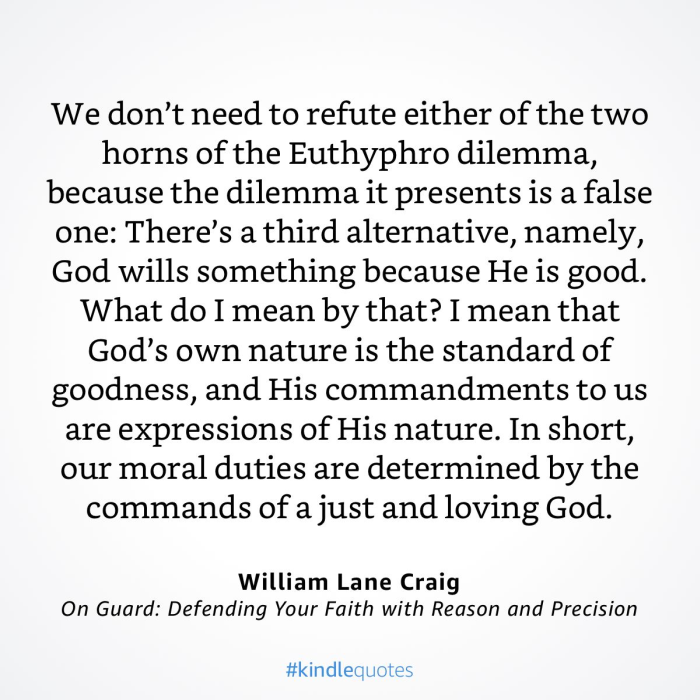
What's our answer to Euthyphro's Dilemma? In his book, On Guard: Defending Your Faith with Reason and Precision, William Lane Craig writes,


Craig argues that the dilemma isn't a true dilemma. Rather, there's a third option: something is good because God is good. If God is good, his commands are downstream of His goodness. 

He notes that a common atheist objection is, "If God were to command child abuse, would we be obligated to abuse our children?"

Craig answers that the objection is nonsensical in the vein of "Could God create a rock so heavy that even He can't lift it?", or "If there were a square circle, would its area be the square of one of its sides?"

There's no answer because the objection is logically impossible.

Bonus content: Jewish Theological Seminary graduate and musical composer Hannah Hoffman created this jazzy take on Euthyphro's Dilemma:

Answering "Who Created God?" and Other Objections to the Cosmological Argument


The kalam cosmological argument for God's existence says that:

  1. Everything that begins to exist has a cause. (Things don't pop into existence from nothing.)
  2. The universe began to exist. (Cosmology science confirms the universe had a beginning: the "Big Bang" and the evidence for it like redshifts and cosmic background radiation.)
  3. Therefore, the universe has a cause. (An immaterial, timeless, extraordinarily powerful cause.)

"But what caused God?" is the usual atheist retort. 

When I first had read about the cosmological argument and talked to an atheist work colleague about it, this was his exact objection. What's our response?

In his book, On Gaurd: Defending Your Faith With Reason and Precision, William Lane Craig says this atheist objection is a misunderstanding of the first premise:

At this point the atheist is likely to retort, "All right, if everything has a cause, what is God's cause?"

I'm amazed at the self-congratulatory attitude of students who pose this question. They image that they've said something very important or profound, when all they've done is misunderstand the premise. Premise 1 does not say that everything has a cause. Rather it says that everything that begins to exist has a cause. Something that is eternal wouldn't need a cause, since it never came into being.

[11th century Islamic philosopher] Ghazali would therefore respond that God is eternal and uncaused. This is not special pleading for God, since this is exactly what the atheist has traditionally said about the universe: It is eternal and uncaused. The problem is that we have good evidence that the universe is not eternal but had a beginning, and so the atheist is backed into the corner of saying the universe sprang into being without a cause, which is absurd.

Objection: Maybe things do pop into existence without cause?

Craig addresses a few other common objections to the cosmological argument. Atheists sometimes claim that premise 1 is invalid because subatomic particles come into being from nothing. Craig writes,

Sometimes skeptics will respond to this point by saying that in physics subatomic particles (so-called “virtual particles”) come into being from nothing. Or certain theories of the origin of the universe are sometimes described in popular magazines as getting something from nothing, so that the universe is the exception to the proverb “There ain’t no free lunch.”

This skeptical response represents a deliberate abuse of science. The theories in question have to do with particles originating as a fluctuation of the energy contained in the vacuum. The vacuum in modern physics is not what the layman understands by “vacuum,” namely, nothing. Rather in physics the vacuum is a sea of fluctuating energy governed by physical laws and having a physical structure. To tell laymen that on such theories something comes from nothing is a distortion of those theories.

Objection: The universe really popped into existence from nothing

Craig writes that he was surprised to see atheists most often go after premise 1 as it empirically true:

When I first published my work on the kalam cosmological argument back in 1979, I figured that atheists would attack premise 2 of the argument, that the universe began to exist. But I didn’t think they’d go after premise 1. For that would expose them as people not sincerely seeking after truth but just looking for an academic refutation of the argument. What a surprise, then, to hear atheists denying premise 1 in order to escape the argument! For example, Quentin Smith of Western Michigan University responded that the most rational position to hold is that the universe came “from nothing, by nothing, and for nothing”—a nice close to a Gettysburg Address of atheism, perhaps! 

This is simply the faith of an atheist. In fact, I think this represents a greater leap of faith than belief in the existence of God. For it is, I repeat, literally worse than magic. If this is the alternative to belief in God, then unbelievers can never accuse believers of irrationality, for what could be more evidently irrational than this? 2. If something can come into being from nothing, then it becomes inexplicable why just anything or everything doesn’t come into being from nothing. Think about it: Why don’t bicycles and Beethoven and root beer just pop into being from nothing? Why is it only universes that can come into being from nothing? What makes nothingness so discriminatory? There can’t be anything about nothingness that favors universes, for nothingness doesn’t have any properties. Nor can anything constrain nothingness, for there isn’t anything to be constrained!

I like that note: A belief that the universe magically came into existence without cause or creator is "a greater leap of faith than in the existence of God." Empirical evidence and everyday experience confirm that things don't come into existence out of nothing. To believe it about the universe itself is atheism's great leap of faith.

Objection: The universe doesn't need a cause

Another objection is, while everything in the universe has a cause, maybe the universe itself doesn't need a cause. Craig writes this too is fallacious,

I’ve heard atheists respond to this argument by saying that premise 1 is true of everything in the universe but not of the universe. But this is just the old taxicab fallacy that we encountered in chapter 3. You can’t dismiss the causal principle like a cab once you get to the universe! Premise 1 is not merely a law of nature, like the law of gravity, which only applies in the universe. Rather it’s a metaphysical principle that governs all being, all reality.

 Craig concludes,

Common experience and scientific evidence confirm the truth of premise 1. Premise 1 is constantly verified and never falsified. It’s hard to understand how anyone committed to modern science could deny that premise 1 is more plausibly true than false in light of the evidence.

So I think that the first premise of the kalam cosmological argument is clearly true. If the price of denying the argument’s conclusion is denying premise 1, then atheism is philosophically bankrupt.

Objection: The cosmological argument is true, but that doesn't necessarily imply God's existence

Another objection I've heard is, "It's true that things must have a cause, it's true that the universe had a beginning, and it's true this means the universe was caused. But that doesn't mean God exists!"

Put another way, the cosmological argument proves something caused the universe to exist, but that doesn't mean God is the cause. Maybe there's something outside of the universe that's not God that caused the universe.

Craig has answered this elsewhere: 

When you do a conceptual analysis of what it is to be a cause of the universe, you arrive at a being which is an uncaused, beginningless, timeless, spaceless, enormously powerful, personal creator of the universe.

That is to say, whatever caused the universe to exist must be:

  • Uncaused. Otherwise we get into a regression of causes. Aristotle's Unmoved Mover argument states there must be a first cause that brings everything else into existence, and we assume that first cause is the thing that caused the universe.
  • Timeless. The reality of the universe is space and time. Whatever caused the universe to exist isn't governed by the universe's dimension of time.
  • Spaceless. Immaterial. Whatever caused the universe to exist isn't made up of the stuff of the universe.
  • Powerful. What kind of energy is required to make a universe? Energy so powerful its unfathomable to humans. Whatever caused the universe to exist set into motion the expansion of the universe and ultimately all its outcomes: the spinning of the galaxies, the fiery burn of stars, the rotation and orbit of planets. Enormously powerful, whatever caused the universe to exist.
Craig argues this is best described by God. Indeed, humans have long described God as eternal, outside of time, spirit/non-corporeal, omnipotent and all-mighty. 

It's true that this doesn't require it be God! But if you believe in something uncaused, timeless, spaceless, immeasurably powerful that created everything, well, that's little different than God.

My experience

The atheist colleague I mentioned previously challenged me, "Who created God?"

I explained that God doesn't have a beginning, and there is no requirement that He have a cause. 

He responded by changing his argument: "OK. I concede we don't know why the universe came into existence. But we will eventually, and like everything else, there will be a natural explanation."

This answer seems reasonable on the surface: everything in nature has a natural explanation. But on further thought, this requires a leap of faith, doesn't it? "I don't know, but eventually we will have a naturalistic explanation" is a statement of faith; a belief. 

Even if it seems true of the natural world, the origin of nature itself -- why there is something rather than nothing -- may not have a natural explanation. Indeed, this might be a category error to think otherwise: there are natural explanations for natural phenomena, but the very existence of natural things cannot be caused by nature. The universe cannot cause itself. 

The existence of nature doesn't demand a natural explanation, as nature cannot cause itself.

Conclusion

I've only just started reading this book by Craig, and there is so much here that is valuable to defending faith in God. So often I hear from folks in the technology space, "There is no evidence for God. Zero. None."

This is so obviously false to me, but so many people genuinely believe it.

I think this book will help me speak to such folks.

"Thoughts and Prayers": On School Shootings and the Good Samaritan

Superhero Flash praying

Last week in the US, a teenager took a rifle into an elementary school and murdered 19 people, mostly children.

Senseless.

And this is just one of a long string of school shootings that have plagued this nation since the 1990s.

After the tragedy, social media was flooded with citizens and politicians offering sympathy,

“My thoughts and prayers are with the families.”

Maybe you wrote something similar on your Facebook page?

This generated a great backlash of secular cynics, many politically motivated, who responded:

"We don’t need your useless thoughts and prayers! How many kids have to die before you shut up and actually do something to prevent the next shooting?

On Reddit, one atheist wrote in a wildly upvoted post,

“Thoughts and prayers” is the equivalent of thinking you are doing something to contribute, without having to do anything at all at the same time.

There’s some truth to what they’re saying.

At shabbat dinner this week, I talked to my kids about this and asked if they had heard people mocking “thoughts and prayers”. Indeed, they had heard.

What’s our answer; are “thoughts and prayers” as useless as “sending good vibes”?

To answer, I read to my kids the parable of the Good Samaritan.

You already know the story. In the parable, a man is robbed, beaten, stripped naked, and left for dead along the road.

A kohen sees the beaten man along the road. But he doesn’t help, and instead walks to the other side of the road.

A Levite walks by. He sees the man, but likewise doesn’t help.

Finally, a Samaritan sees the man. He applies medical treatment, transports him to the nearest inn, and pays for his stay and expenses.

What does this have to do with school shootings?

This parable in its original context was to show who is our “neighbor” in the context of the Torah mitzvah, “Love your neighbor as yourself". Yeshua explains the parable: the true neighbor is the one who showed compassion.

But this parable also means that we as God’s people must be people of action. “Thoughts and prayers” are not enough. In the parable, it was the person who took action that was deemed righteous. Even more righteous than the ultra-religious, fervently praying Kohen and Levite.

Likewise, we must be people of action. If we don’t take action, we’re not really serious in our thoughts and prayers. And if our thoughts and prayers aren’t genuine or backed by action, secular cynics are right to critique it as meaningless babble.

I told my kids that God wants us to be people of action, not merely airy religious fluff sending people good vibes through social media. Prayer and action. Faith and works.

Yeshua’s half-brother Ya’akov/James says the same thing:

If a brother or sister is naked and lacks daily food, and one of you says to them, “Go in shalom, keep warm and well fed,” but you do not give them what the body needs, what good is that?

It’s not enough to well-wish, even in prayer. We need action, otherwise prayer is dead.

A rational mind will ask, “If action is what matters, why pray at all?”

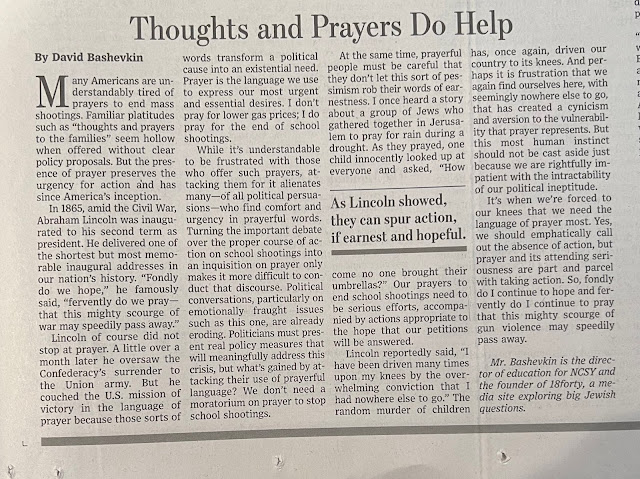
David Bashevkin proposes a beautiful answer in today’s Wall Street Journal:

Screenshot of David Bashevkin's article on the Wall Street Journal

He notes that when Abraham Lincoln addressed the nation during the US Civil War, he asked the nation to pray that war would cease:

Fondly do we hope, fervently do we pray – that this mighty scourge of war may speedily pass away.

Lincoln prayed to end the war, and he waged war against the Confederates. He was a man of both prayer and action. But why pray at all if action is what matters? Bashevkin writes,

[Lincoln] couched the U.S. mission of victory in the language of prayer because those sorts of words transform a political cause into an existential need. Prayer is the language we use to express our most urgent and essential desires. I don’t pray for lower gas prices; I do pray for the end of school shootings.

Catch that? He is saying that earnest prayer drives a whole people, even a whole nation, to action. 

Good vibes don't do that. Prayer does. 

Prayer is fuel in the engine of action.

I’d add to Bashevkin’s statements: We sincerely believe that a people united in earnest prayer, willing and ready to act, can move the heart of God.

(And sometimes, we the faithful and prayerful are the very means of God’s intervention in the world.)

James, the same one who wrote that prayer without action is meaningless, also writes, “The effective prayer of a righteous man is powerful.”

To be effective, prayer must be earnest and fervent. To be righteous, a man must take action.

Earnest, hopeful, fervent prayer combined with ready action. In King James lingo, this availeth much.

Making it real: what can we do in tragedies like this?

If I’ve convinced you that we need to be people of action, you might ask what’s the next step. How do we help people affected in the recent school shooting?

One way is charity, which is considered a mitzvah – a commandment and good work – in both the Hebrew Bible and the New Testament.

Unlike any other time in history, it’s easy to give to charity around the world thanks to the internet.

Some other ways to help: if you run a small business, you could donate a portion of profits, or ask customers to donate on checkout. If you work for a large company, you can donate and ask your employer to match your donation.

Change can also be on the individual level. A change of mind, a change of heart. Let me ask a hard question, dear reader: is it time to reconsider your views about guns? I’m not asking you to go woke here. I’m asking you to consider Scriptural ethics above political concerns. Our allegiance is to God, not any political party.

Are your views on guns informed mainly by the ethic of Scripture, or by the talking points on political talk shows and podcasts? Given the Bible’s overarching theme of pikuach nefesh - preservation of life above almost all else - might we consider a more balanced approach to guns and gun access?

If your answer is, “Any gun reform is veiled leftism!”, you probably have a blind spot here.

Change can also be on the political level. Write to politicians to take action to prevent school shootings. Maybe you feel posting armed guards at schools would help. Maybe better security measures at schools. Maybe stricter gun access laws. Maybe better background checks. Maybe laws to restrict access to high powered guns. Maybe it’s better mental healthcare for disturbed individuals. Tell your elected leaders how you feel. Tell them what you believe must be done. Petitioning political power is also a form of action, and Biblical figures from Esther to Nehemiah to Paul used it to accomplish good.

Dear Kineti reader, can you earnestly pray and take action to end school shootings? Let’s make progress on this, little by little. I’m going to agree with Mr. Bashevkin in fervent prayer and action that this mighty scourge of violence in schools would come to an end. Will you do the same, dear reader?

Does Revelation's 'Pharmakia' Refer to Vaccines and Modern Medicine?

A few snippets from my Facebook feed. Anti-vaxx friends claiming you can't get sick with COVID if you celebrate Passover. Others saying all vaccines are evil sorcery, and that getting vaccinated will result in capital punishment. Still others suggest believing in Jesus prevents COVID. All of these are great misinterpretations of the Bible. The resulting damage is palpable: COVID deaths of many believers including 4 Messianic leaders in the last 4 months.

Many believers on the fringes of Christianity and the Messianic movement push the idea that vaccines are not only harmful, but evil. Some claim the Bible itself is anti-vaccine and anti-modern medicine.

How so?

They point to the Greek text of Revelation 18:23, how it uses the word ‘pharmakia’ to describe an evil characteristic of Babylon the Great.

Here’s the verse in context:

Then a mighty angel picked up a stone like a great millstone and threw it into the sea, saying:

“So shall Babylon, the great city,
be thrown down with violence,
never to be found again!
And the sound of harpists and musicians,
flautists and trumpeters,
shall never be heard in you again
And the sound of a mill
shall never be heard in you again!
And the light of a lamp
shall never shine in you again!
And the voice of the bridegroom and bride
shall never be heard in you again
For your businessmen were the tycoons of the world,
for all the nations were deceived by your sorcery [Greek: pharmakia]
And in her was found the blood of the prophets and kedoshim
and all those slaughtered on the earth.”

- Revelation 18:21-24

These folks point out that ‘pharmakia’ is where we get our modern English words “pharmacy” and “pharmaceutical”, so, they argue, Revelation is stating Babylon the Great is evil because it is pushing pharmaceutical drugs like vaccines. And thus, the Bible is anti-vaccine and anti-modern medicine.

Messianic Jewish apologist, author, and Biblical languages expert Dr. Michael Brown refutes this argument in his latest post. He writes,

Speaking of the fall of “Babylon the Great” in the 18th chapter of the Book of Revelation, verse 23 states that “all nations were deceived by your sorcery,” but the Greek word for “sorcery” here is pharmakia. Was it possible, a caller asked me on Friday, that this was speaking of the large pharmaceutical companies? My answer was absolutely, categorically not. […] To argue that Revelation 18:23 is speaking of modern pharmaceutical companies — in particular, with regard to vaccines and the like — is completely untenable from the viewpoint of sound Greek scholarship. Not the slightest chance."

Here’s the clip in question, where a caller on Dr. Brown’s show, The Line of Fire, suggested that ‘pharmakia’ refers to drugs, specifically modern medicine:

Dr. Brown notes if we interpreted the Bible by this method, we would have to resort to all kinds of Scriptural acrobatics. He gives an example: the Gospels record Yeshua healed the sick with dunamis, the Greek word from which we get the modern ‘dynamite’. Jesus didn’t explode the sick with dynamite, but rather, healed the sick with divine power.

The ancient word in the Greek text doesn’t mean the same thing as the modern English word.

So it is with ‘pharmakia’.

Dr. Brown rightly notes that ‘pharmakia’ refers not to vaccines or modern pharmaceuticals, but to idolatry and sorcery. Enchantment with (all-natural!) drugs for the purpose of inducing idolatrous trances. Ancient pagan sorcery.

Dr. Brown demonstrates this truth by showing how the ancient Greek translation of the Old Testament, the Septuagint, translates the Hebrew text of the Book of Exodus, where it speaks of the Egyptian sorcerers and “secret arts”, translating these as “pharmakia”. Likewise, the Septuagint translates Nahum 3:4, speaking of sorcery and idolatry, as pharmakia.

Clearly, the Biblical ‘pharmakia’ – whether in the Old Testament Septuagint or in the Greek New Testament – refers to pagan magic, spellcasting, sorcery, and divination. Not modern medicine or vaccines.

“But modern medicine is magic sorcery and divination!”, some protest.

This too is faulty thinking. Dr. Brown points out,

There is nothing in the context of Revelation 18 that connects directly to Big Pharma, which, despite its great wealth and influence, is not casting spells all over the world. And, to be perfectly candid, to read Big Pharma back into the Bible is like reading Elvis back into the Bible because, after all, David sung songs, and Elvis sang too.

From the viewpoint of someone who has worked with the biblical languages and engaged in serious biblical study for close to 50 years, interpretations like this can be very frustrating, especially when people then base whole theologies on impossible readings of the Hebrew and Greek predicted fall of Babylon.

That being said, the simple takeaway from this article is this: Revelation 18 is not the place to go if you want to launch an attack on Big Pharma. Nor is it the place to go to decide whether to be vaccinated.

Believers can disagree about vaccine mandates and even vaccines. It’s OK to differ on these issues; there is room for both views in the body of Messiah.

But if we are people of truth, we must not claim the Bible is anti-vaxx, or that its use of ‘pharmakia’ refers to vaccines or modern medicine.

Playing word games like this to read modern ideas into the ancient text is a bad way to go about understanding the Bible.

Ravi Zacharias, Luminous Defender of Faith, Has Passed Away


We lost a great luminary today: Ravi Zacharias, the great apologist and defender of faith and Judeo-Christian values passed away this morning. ♥  
Ravi was a remarkable mind who engaged with university students, professors, leading atheists, philosophers -- the worlds' greatest thinkers -- arguing persuasively for God's existence and God's revelation to humanity through the Messiah.

Here is the announcement and beautiful tribute from Ravi's family:

"Ravi perpetually marveled that God took a seventeen-year-old skeptic, defeated in hopelessness and unbelief, and called him into a life of glorious hope and belief in the truth of Scripture—a message he would carry across the globe for 48 years."
Here's a fantastic recent video of Ravi, where the Orthodox Jewish Ben Shapiro interviews him and they grapple with the Law, the Prophets, redemption, and ultimately, the Messiah.

In the above video, when Ben challenges Ravi, "What does Christianity add that was missing in Judaism", Ravi responds first with a fun note about Jewish and Christian brotherhood:

"I remember [conservative Jewish luminary] Dennis Prager's comment when the two of us we were talking about this, he said, 'When messiah comes, there will be just one question: have you been here before?'"
He then speaks about how the Tenakh has always been filled with God being the redeemer -- appealing to the first of the 10 commandments where God says he brought Israel out of Egypt -- and how this central theme of God redeeming humanity plays out its fullness through the coming of Messiah, Jesus. 

What a great blessing the Lord had sent us in Ravi Zacharias!

In lieu of flowers, the family is asking for a donation to the Ravi Zacharias memorial fund. I just donated, and I hope you will too.

The Two Greatest Logical Arguments for God’s Existence

Summary: William Lane Craig, a leading defender of belief in God, says the most persuasive arguments for God’s existence are the Cosmological Argument and the Moral Argument. What are they? I explain below.

There is perhaps no greater living defender of faith than William Lane Craig. A trained expert in both philosophy and debate, he’s amplified the logical arguments for God’s existence in the public sphere: debating leading atheists, speaking at hundreds of universities, influencing millions of students, authoring dozens of books, most recently On Guard: Defending Your Faith with Reason and Precision.

Craig sat down for an hour-long interview with Ben Shapiro, an Orthodox Jew and prominent young political conservative:

At 7:59, Shapiro asks Craig what he thinks is the most convincing proof of God’s existence. In it, Craig explains the Cosmological Argument:

Shapiro: What in your opinion is the most reasonable proof of God? What have you found to be the most convincing proof of God’s existence?

Craig: I think those are 2 questions. For me, my favorite argument for the existence of God, the one I find most compelling, is a version of the Cosmological Argument which goes like this:

  1. Whatever begins to exist has a cause. (Something can’t just come into being from nothing.)
  2. The universe began to exist. (We have both good philosophical and scientific evidence for the finitude of the past.)
  3. Therefore, the universe has a cause.

When you do a conceptual analysis of what it is to be a cause of the universe, you arrive at a being which is an uncaused, beginningless, timeless, spaceless, enormously powerful, personal creator of the universe.

For anyone who’s followed Craig over the years, this answer was no surprise: he’s the leading proponent of the Kalam Cosmological argument, as defined above.

I want to examine that argument a bit and the usual objections to it before we move on to the 2nd argument.

Cosmological Argument part 1:
Whatever begins to exist has a cause

This first assertion, called the Causal Principle, is empirically true: everything we see in nature has a cause to its existence. That tree exists because of a seed. The seed exists because the parent tree has DNA that instructs it to build seeds and release them. And so on. Ditto for inorganic matter like roads, rocks, stars, planets, and so.

The common atheist objection to this first step is, “Then what caused God?” If everything has a cause, then God has a cause; we haven’t solved anything. (There would have to be a thing or being which created God, and a being which created that being, and …)

Shapiro plays devil’s advocate and uses this exact objection at 10:11:

Shapiro: The [atheist biologist and author] Richard Dawkins comeback – the one you hear most frequently with regard to the finitude of time and the idea that everything has a cause – is, “Ok, well then, what caused God?”

Craig: It’s important to state the first premise correctly, Ben. It’s not “Everything has a cause.” It is, “Everything that begins to exist has a cause.” Something cannot come into being without a cause. But if something is eternal, never began to exist, there’s no need for a cause. So that objection to the argument is simply based on a misunderstanding of the first premise.

The problem with this objection is it’s a misstatement of the premise. The premise isn’t “Everything has a cause.” The premise is “Everything that begins to exist has a cause.”

This is an important nuance: everything that begins to exist has a cause. The corollary to this is the truism, “Things that are eternal do not have a beginning.” Thus, eternal things don’t necessarily have a cause.

And for the first half of the 20th century, scientists believed the universe itself was that eternal thing. That is, until scientific evidence arose during the 1960s showing that the universe definitely began to exist; it had a beginning. More on that in the next step.

A more sophisticated objection: “Why must we believe everything which begins to exist has a cause?”

One answer is, because that is what we observe in every circumstance and every measure of the natural world. We observe that there exists a cause for everything that comes into existence in the natural world. Science is the study and observation of the natural world; if we can’t theorize an idea which is observably true 100% of the time, then all our theories must be thrown out for lack of certainty.

Proponents of this objection rely on an earlier argument from 18th century philosopher David Hume that says “Effects without causes can be conceived in the human mind, and that which is conceivable in the mind is possible in the real world.

But proponents of this objection often overlook that Hume himself agreed with the Causal Principle, stating in a letter in 1754, “But allow me to tell you that I never asserted so absurd a Proposition as that anything might arise without a cause.

From everything we observe in the natural world, everything that has a beginning has a cause for its beginning.

Cosmological Argument part 2:
The universe began to exist

The atheist physicist Stephen Hawking called this the most remarkable discovery of 20th century cosmology:

All the evidence seems to indicate that the universe has not existed forever, but that it had a beginning, about 15 billion years ago. This is probably the most remarkable discovery of modern cosmology. Yet it is now taken for granted.

-Stephen Hawking, physicist

For the early part of the 1900s, scientists believed the universe must be eternal. If it’s eternal, it had no beginning. And if it had no beginning, it had no cause for its existence. Problem solved!

But not all scientists were convinced. In the early 20th century, scientists theorized that if the universe did have a beginning, we’d see some evidence for that in the form cosmic microwave background radiation; an audible echo of the instant of creation.

And in 1964, American astronomers Robert Wilson and Arno Penzias discovered a faint background noise in the space between stars and galaxies. This was later confirmed as electromagnetic relic radiation, a corroboration of the instant the universe began. This discovery, for which Wilson and Penzias received Nobel prizes, overturned science’s understanding of the universe’s finitude.

Today, modern science affirms the universe had a beginning; this is well-accepted and not at all controversial.

Philosophically, it’s also on solid ground. Craig elaborates the problems with an eternal universe at 10:56:

Shapiro: Must we posit an eternal being? Or could we just have an infinity of regressive causes?

Craig: That’s the 2nd premise: the universe began to exist. There are deep philosophical problems with the idea of an infinite past. For example, how did we get to today if you had to go through an infinite number of prior events one at a time? That would be like trying to count down all the negative numbers one at a time ending at zero; an absurd task.

Moreover, we have remarkable scientific evidence from the Big Bang expansion of the universe, and the thermodynamic properties of the universe, which suggest the universe cannot be infinite in the past, but must have had a beginning around 13.8 billion years ago.

So I think that 2nd premise is very powerfully supported both philosophically and scientifically.

Cosmological Argument part 3:
Therefore, the universe has a cause

Step 1 was an assertion based on observable reality: anything that has a beginning has a cause. Step 2 was a statement of scientific fact: the universe has a beginning. Step 3, the final step, arrives at a conclusion based on the previous 2 steps: since the universe had a beginning, and since everything that begins to exist has a cause, then the universe has a cause.

Since the universe can’t cause itself, the thing that caused it must be outside of the universe: immaterial.

Time, we believe, is a property of the universe. So the thing that caused the universe must be outside of time; timeless and eternal.

Timeless and eternal things don’t necessarily have a cause (see step 1). Thus, the thing that caused the universe must be uncaused.

Finally, whatever caused the universe to come into existence had to produce all the energy we now witness in the universe, for all of history. From the excitement of molecular particles to the eventual planets spinning in motion and stars bursting into flames: the thing that caused the universe must be extraordinarily powerful.

Cosmologists and philosophers are left with a remarkable question: what immaterial, timeless, eternal, uncaused, and extraordinarily powerful thing could create the universe?

The Moral Argument

Craig says the Cosmological Argument is his favorite and most compelling to him personally. But he says the argument that is most persuasive to students he speaks with is the Moral Argument for God’s existence. Craig explains at 9:00:

Craig: I find that with university students [the Cosmological Argument] is not the most convincing argument. You can ignore philosophical arguments for the finitude of the past, or even scientific evidence for the beginning of the universe. But the argument they find the most compelling is what I call the Moral Argument. It goes like this:

  1. If God does not exist, then objective moral values and duties do not exist. (That is to say, in the absence of God, everything becomes socio-culturally relative.
  2. Objective moral values and duties do exist. (There are some moral absolutes, some objective values and duties.)
  3. Therefore, God exists.

This is an argument which is impossible to ignore because everyday you get up, you answer by how you treat other people, whether you regard them as having intrinsic moral value, or whether they’re mere means to be used for your ends.

The Moral Argument says that if God doesn’t exist, we should not see any absolute or objective moral values; it’s purely relative. What’s bad for you may be good for another: relative morality.

But, because we do see objective, absolute moral values in the world, objective morality exists, and if objective morality exists, then God exists.

Craig says this argument tends to hold more weight with most people, especially university students, because doing good (moral absolute good) is something every person grapples with each day.

One common objection to this argument is the idea that primitive moral values (e.g. protection of kin) are seen in other mammals, and therefore must be programmed in biologically; no God needed.

At 11:53, Shapiro raises this objection:

Shapiro: The other argument, the Moral Argument, in contravention of that: [there is] an argument made by [leading atheists] Dawkins, Harris, and evolutionary biologist Brett Weinstein that there is a certain sense of morality that is innate to mammals that you see even in species that are not our own. A sense of primitive altruism, a sense of kinship protection, for example. So is it possible that morality is embedded on a very basic level in behavior of mammals beyond the idea of an objection morality that we think about and enact? That it’s just embedded in the natural code?

Craig: This response [to the Moral Argument] is almost a textbook example of the genetic fallacy. The genetic fallacy is trying to invalidate a point of view by showing how that point of view came to be held. Even if evolution and social conditioning has programmed into us a certain set of moral beliefs, that does nothing to show that those beliefs are false. Indeed if moral values are gradually discovered rather than gradually invented, then our gradual and fallible apprehension of the moral realm no more undermines the objectivity of that realm than our gradual, fallible comprehension of the physical world undermines the objectivity of the physical realm.

In the absence of some defeater, it seems to me that we’re perfectly within our rights in believing that there is an objective realm of moral values and duties, just as we’re within our rights in believing there is a world of physical objects around us.

It’s worth clarifying: by “objective” morality, we mean something that is true, regardless of circumstance or the person uttering it. For example, “rape is immoral” is a statement of absolute morality; there’s not a case where rape is could be moral for you, but immoral for another. It’s always absolutely wrong (a sin) to do so.

Craig’s response in a nutshell is that when atheists claim there is no objective morality because we see primitive morality programmed into intelligent mammals, it does nothing to invalidate the claim of objective morality. Craig is saying that even if objective morality is gradually discovered by humans, or even shared on some level with mammals, objective morality still exists.

Humanity’s gradual discovery – rather than invention – of objective morality doesn’t invalidate objective morality. (By the same measure, says Craig, our gradual discovery of objective morality is just as valid as our gradual discovery of the natural world.) Even if some morality is pre-programmed biologically, that doesn’t invalidate the reality of objective morality.

(An anecdotal aside: preaching from Romans at my local Messianic congregation this year, I argued precisely this: that there is programmed into every human being basic morality. I believe the Apostle Paul makes that case in Romans 1. That basic or primitive morality comes biologically packaged doesn’t invalidate the existence of objective morality.)

Recap

Craig argues these two are the most persuasive logical arguments for God’s existence:

The Cosmological Argument

The Moral Argument

1. Whatever begins to exist has a cause. 1. If God does not exist, objective moral values do not exist.
2. The universe began to exist. 2. Objective moral values do exist.
3. Therefore, the universe has a cause. 3. Therefore, God exists.

I personally find the Cosmological Argument most convincing, because step 1 is empirically true, step 2 is scientifically true, and step 3 is a logical conclusion from those assertions.

(Meanwhile, I find the moral argument more based in emotion and perception, even though it is likely true that without a moral root – God – then morality cannot be objective or absolute.)

Are these compelling arguments to you, fine reader?

Custom comments