500 years ago today Martin Luther posted his now-famous 95 Theses on the door of the University of Wittenberg. It sparked a worldwide movement to reform Christianity, causing it to reject some of the anti-Biblical practices that had developed over the centuries. It produced a return to the teachings of the Bible in the form of the Reformation.
Messianic Judaism and the Hebrew Roots movement, of which I’m involved, sprang forth from the Reformation; we would not be here today if not for Luther and his 95 Theses. Messianic Judaism and the Hebrew Roots movement are ultimately an extension the Reformation, causing Christianity to return to its original form as a branch of Biblical Judaism, a faith living inside of the original Faith of Abraham. In that respect, we’re indebted to Luther.
 Given the 500 year anniversary of Luther’s work this week, I thought I’d look at Luther’s 95 Theses and add my layperson’s Messianic commentary to each. Examining each thesis was fascinating to me – out of it comes Luther’s hardcore, no-holds barred refutation of bad theology. Numerous jabs at his opponents are strewn throughout – hence the Thug Life Luther at right.
I gained insight and good wisdom as I went through the 95 Theses. I hope you do too, fine reader. Enjoy!
1. When our Lord and Master Jesus Christ said, “Repent'' (Mt 4:17), he willed the entire life of believers to be one of repentance.
Luther is hitting on something that the Church in his day had lost sight of: repentance was a core matter of faith. It had been replaced largely through sales of indulgences for the living and the dead.
Today’s evangelicalism is missing this, too. Evangelical and non-denominational Christianity have replaced this core message of repentance and instead turned it into a formula for going to heaven. “Ask Jesus into your heart so that you will go to heaven when you die” is a familiar message in today’s Evangelical world, but its one missing from the gospels.
Search the gospels for such a message, and you won’t find Jesus telling people to “ask me into your heart.” But you will find Jesus telling people to repent from their sins and return to God.
Likewise, search the gospels for Jesus telling people to believe in him to go to heaven. The closest you’ll find is Jesus talking about the Kingdom of Heaven – but that is the Messianic Era, not the airy spiritual place of disembodied souls. And John 3:16’s “all who believe in Him will have eternal life” speaks of resurrection life here on earth, not the place of fat cherubs plucking harps.
For both Jews and Christians, repentance is the core message of our faith. The prophets of the Hebrew Bible preached repentance. John the Baptist – Messiah’s Elijah – preached repentance. Messiah preached repentance. Peter – Messiah’s chief disciple – preached repentance. The author of the book of Hebrew lists 6 fundamentals of our faith – the first? Repentance.
Luther is right: because every person on earth sins, including believers in Messiah, we are called to be lifelong people of repentance.
2. This word [repentance] cannot be understood as referring to the sacrament of penance, that is, confession and satisfaction, as administered by the clergy.
In Luther’s day, the Catholic clergy administered confession of sins of the laypeople, and this was what laypeople knew as repentance.
This is, of course, still a practice today in the Catholic Church. The Catechism of the Catholic Church states,
“Those who approach the sacrament of Penance obtain pardon from God's mercy for the offense committed against him, and are, at the same time, reconciled with the Church which they have wounded by their sins and which by charity, by example, and by prayer labors for their conversion…It is called the sacrament of Penance, since it consecrates the Christian sinner's personal and ecclesial steps of conversion, penance, and satisfaction.”
Here Luther is saying, essentially, “Look – you know when Jesus and the disciples and the prophets and everyone else was talking about repentance? They’re not talking about that thing we call the sacrament of penance. It was something else entirely.”
And he’s right. There was no Sacrament of Penance during the time of the Hebrew prophets or even in the 1st century in Messiah’s day. The Church had invented a sacrament tangentially related to the Bible, called it repentance, and supplanted the Biblical concept for many laypeople.
To Luther, repentance began with inner contriteness of heart, not external sacramental confession to clergy.
3. Yet it does not mean solely inner repentance; such inner repentance is worthless unless it produces various outward mortification of the flesh.
Repentance, in Luther’s view, was neither the Catholic Sacrament of Penance, nor was it merely an inward feeling (e.g. “I feel sorry”). Luther’s examination of the gospels revealed to him that repentance required an outward, in-the-flesh tangible act; the fruit of repentance. I suspect Luther was inspired by gospel texts like Matthew 3, where John the Baptist questions the sincerity of certain Pharisees’ repentance:
But when he saw many Pharisees and Sadducees coming to his immersion, he said to them, “You brood of vipers! Who warned you to flee from the coming wrath? Therefore produce fruit worthy of repentance.
-Matthew 3
Producing fruit of repentance: it would involve things like change of personal behavior, making restitution to the wronged party, etc.
4. The penalty of sin remains as long as the hatred of self (that is, true inner repentance), namely till our entrance into the kingdom of heaven.
The penalty of sin – that everyone will die – still exists and thus does the need for real repentance. Luther is coming against a Catholic doctrine of his day – one that will subsume most of the remaining theses – the doctrine of indulgences.
Luther is saying that merely buying an indulgence won’t cover your sin, nor excuse you from its penalty. Divine forgiveness follows real, wholehearted repentance, not from purchasing letters of indulgence from the Church.
5. The pope neither desires nor is able to remit any penalties except those imposed by his own authority or that of the canons.
The idea of indulgences was that by purchasing a letter of indulgence from the Church, combined with a prayer or good work, a person would reduce by a certain number of days or years his punishment in purgatory.
Pay a little to the Church, reduce your purgatory sentence by a few days. Pay more, reduce it by years.
This concept is so foreign to the Bible, it’s hard to know where to start refuting it. Suffice to say, there is no Biblical concept where paying money to a religious organization can offset a person’s sin. That is a concept foreign to the gospels.
Additionally, the whole idea of purgatory doesn’t appear in the Hebrew Bible or the gospels. In fact, this focus on a disembodied afterlife, an obsession that still plagues modern Christianity – is absent from Jesus’ own teachings. The focus of Messiah and the disciples and the epistles is not going to heaven. The focus is resurrection of the dead.
Luther sees that only God can pardon divine penalties for sin, not the Pope. By his wording, I suspect he’s trying to place nice here with the Pope when he says, “The pope neither desires…to remit any penalties but his own”, suggesting that the Pope isn’t himself in error, but that those under him were preaching error.
6. The pope cannot remit any guilt, except by declaring and showing that it has been remitted by God; or, to be sure, by remitting guilt in cases reserved to his judgment. If his right to grant remission in these cases were disregarded, the guilt would certainly remain unforgiven.
Digging deeper into #5, Luther reiterates that penalties for sin – penalties instituted by God – can’t be forgiven by anyone except God himself. The Pope can only remit guilt in cases where the judgment is left to him. (For example: if the Church made a pact with another party, and the party failed to uphold their end of the deal, the Pope could forgive the debt if he so chose.)
Luther’s final statement seems like another olive branch to the Pope, suggesting that in cases where the Church has authority to remit penalty, it should be sought by believers.
It’s interesting that Luther’s followers today, and indeed virtually all of Protestant Christianity, do not practice this today. But this was the early days of the Reformation, during which Luther wasn’t divorced from the Church. And in these early days, it appears as though he wish to avoid a schism.
7. God remits guilt to no one unless at the same time he humbles him in all things and makes him submissive to the vicar, the priest.
Here Luther seems to be upholding the idea of a hierarchical Church, suggesting that God remits guilt only when humbling the person so as to make him submit to his Church elder.
This concept is lost on much of Protestantism today. In much of Evangelicalism, and in our Messianic faith as well, we’ve gone fully to the other side: total individualism, with Church elders having little to no authority over laypeople.
While a blessing in some ways – everyone is responsible directly to God – this has been a curse in many other ways. We suffer from Cowboy Religionists, where everyone is doing what is right in his own eyes, without submission to local leadership. As a Messianic lay leader in my own congregation, I feel this pain quite often.
8. The penitential canons are imposed only on the living, and, according to the canons themselves, nothing should be imposed on the dying.
Catholic indulgences promised to ease the suffering of loved ones who had died. Luther claims he heard a papal seller of indulgences say,
“As soon as the coin in the coffer rings, the soul from purgatory springs”
Whether factual claim or not, it is clear many Catholic clergy were abusing indulgences by guilting the living into paying money to the Church in order to ease their loved one’s afterlife suffering. Luther was rightfully revolted by this idea, and asserts that the “penitential canons” (which, I presume, refers to Catholic catechism regarding repentance) govern only the living.
He says these same canons themselves state they govern only the living. Thus, his criticism here isn’t of the canons of Catholic catechism, but wrongful application of them in Luther’s day.
9. Therefore the Holy Spirit through the pope is kind to us insofar as the pope in his decrees always makes exception of the article of death and of necessity.
Harping on #8 with regards to indulgences and Catholic rulings applying to the living only.
This statement from Luther again looks like an olive branch, saying that the Holy Spirit is working through the Pope. Most Protestants today would not likely agree. (I am certain that if I said such a thing at my local Messianic congregation, it would raise eyebrows and provoke opposition!)
10. Those priests act ignorantly and wickedly who, in the case of the dying, reserve canonical penalties for purgatory.
Luther clearly rejects that remission of penalty for sin can be done through indulgences. He is repulsed by the idea that Catholic clergy would abuse it further to enrich the church by guilting laypeople into paying to ease the suffering of their deceased loved ones.
11. Those tares of changing the canonical penalty to the penalty of purgatory were evidently sown while the bishops slept (Mt 13:25).
Luther’s usual stinging criticism sees these priests charging for purgatory-easing indulgences as the the “wicked enemy” who, in Yeshua’s parable in Matthew 13, sowed weeds among the wheat. In the parable, the weeds are “plucked, tied, and sent to the fire.”
One can see why Catholic clergy would so vehemently oppose Luther and the Protestant Reformation; Luther implied some Catholic clergy were going to hell.
12. In former times canonical penalties were imposed, not after, but before absolution, as tests of true contrition.
Penalties for sin were carried about before the full remission of sin, says Luther, in past times as tests of true contrition. I suspect he’s speaking of Church history, rather than ancient Biblical times.
13. The dying are freed by death from all penalties, are already dead as far as the canon laws are concerned, and have a right to be released from them.
The dead are not governed by the laws of the living, says Luther. This is reminiscent of Paul’s letters, saying the same of the Torah. What Paul says of the Torah – that is governs the living, not the dead, Luther says of Catholic catechism regarding penalties for sin.
14. Imperfect piety or love on the part of the dying person necessarily brings with it great fear; and the smaller the love, the greater the fear.
Luther begins building up an argument here about the dead already have punishment for their sin: fear of divine punishment.
15. This fear or horror is sufficient in itself, to say nothing of other things, to constitute the penalty of purgatory, since it is very near to the horror of despair.
Purgatory is the fear of death experienced by sinful dying people, seems to be Luther’s argument.
Again, from a Messianic perspective, and indeed from the perspective of Protestant Christians in general, purgatory is an invention of the Church. It doesn’t appear in the gospels or the Hebrew Bible.
Luther didn’t see it that way, but he does seem to say that purgatory is, at least in part, simply a sinful person’s fear in death.
16. Hell, purgatory, and heaven seem to differ the same as despair, fear, and assurance of salvation.
Luther’s larger point that he’s building up to is that those people who are dead can’t be affected by the living purchasing indulgences from the Church.
17. It seems as though for the souls in purgatory fear should necessarily decrease and love increase.
Luther is trying to undermine indulgences altogether, suggesting that the dead can still be made right with God through their own actions, rather than the indulgence-purchasing actions of their living relatives.
18. Furthermore, it does not seem proved, either by reason or by Scripture, that souls in purgatory are outside the state of merit, that is, unable to grow in love.
Bingo. He’s shown his hand now: the dead can still merit righteousness by growing in love. If this were true, indulgences would be undermined, as the dead could ease their own suffering without the need of the living to do anything for them.
19. Nor does it seem proved that souls in purgatory, at least not all of them, are certain and assured of their own salvation, even if we ourselves may be entirely certain of it.
The fate of the dead isn’t sealed after all, according to Luther. Perhaps by their growing in love in purgatory, they’ll receive salvation.
Despite all the nonsense about purgatory, there may be a lesson here for today’s Protestantism. Many Evangelicals seem certain that someone is going to heaven because they said the sinner’s prayer. But final judgment is reserved by God. He is the final arbiter of eternal destinies. And his judgment hasn’t yet taken place, but will at the end of time, when God raises the dead and judges every person according to his works.
20. Therefore the pope, when he uses the words ``plenary remission of all penalties,'' does not actually mean ``all penalties,'' but only those imposed by himself.
Yet another olive branch. “The Pope is wrong…but he doesn’t mean what you think he means, so he’s actually right.”
Connecting to the previous thesis, if the eternal destiny of a person isn’t sealed upon death, clearly the Pope can’t seal it either for salvation/heaven or damnation/hell. So the Pope’s “plenary remission of all penalties [of sin]” only apply to those penalties imposed by the Pope. '
This is a veiled way of saying the Pope doesn’t have authority to grant eternal salvation or damnation.
21. Thus those indulgence preachers are in error who say that a man is absolved from every penalty and saved by papal indulgences.
If even the Pope can’t absolve a person from God’s penalty for sin, then of course his underlings selling indulgences are merely snake oil salesmen.
22. As a matter of fact, the pope remits to souls in purgatory no penalty which, according to canon law, they should have paid in this life.
Further impotence of the Pope, but couched in words that make it sound friendly. The Pope can’t absolve a penalty for sins that should be paid while alive.
23. If remission of all penalties whatsoever could be granted to anyone at all, certainly it would be granted only to the most perfect, that is, to very few.
The grand promise of the indulgence seller is that a person is pardoned for all his sins, given a some coin in the indulgence box.
But Luther says that remission of all penalty would have to be granted by God, and one imagines, only to the most righteous.
24. For this reason most people are necessarily deceived by that indiscriminate and high-sounding promise of release from penalty.
Religious leaders are deceiving people when they claim their punishment for sin can be absolved through donations to the Church. #savage
25. That power which the pope has in general over purgatory corresponds to the power which any bishop or curate has in a particular way in his own diocese and parish.
Luther essentially arguing for limited Church government, rather than an all-powerful Church dictator. He is saying the Pope may have influence over souls in purgatory (a point he builds here and makes in the next thesis), but asserts the Pope does not have the authority to make final judgment. That instead is reserved for God.
26. The pope does very well when he grants remission to souls in purgatory, not by the power of the keys, which he does not have, but by way of intercession for them.
Luther seems to be striking at another precious doctrine of the Church, namely, that the Pope supposedly holds the “keys to the kingdom of heaven.” Luther claims the Pope doesn’t have the keys to purgatory; no final authority over souls there, merely influence.
This whole belief of the Church, even today, is so convoluted from the original gospels. The doctrine is based on Messiah’s words to Peter:
And I also tell you that you are Peter, and upon this rock I will build My community; and the gates of Sheol will not overpower it. I will give you the keys of the kingdom of heaven. Whatever you forbid on earth will have been forbidden in heaven and what you permit on earth will have been permitted in heaven.”
-Messiah, Matthew 16
Catholics understand Peter to be the first Pope, an historically dubious claim. If Peter is the first Pope, then he has the keys to Heaven. (And by extension, hell and purgatory.)
This is wrongheaded for several reasons. First, the “keys to the Kingdom of Heaven” doesn’t refer to Heaven, the place of disembodied souls. It refers to the Messianic Era, the olam haba, during which King Messiah reigns here on earth from Jerusalem.
And keys refers not to physical keys to unlock a door (e.g. to unlock the pearly gates, as some imagine it). Keys refers to authority, in this case, authority within the Messianic Era.
Luther doesn’t get into that, sadly. His reformation doesn’t do away with all of errors of the Church. Here he focuses on the error of indulgences and their supposed influence on souls in purgatory. Luther only goes as far as to say that the Pope can pray to God for such people, but is unable to offer final judgment.
27. They preach only human doctrines who say that as soon as the money clinks into the money chest, the soul flies out of purgatory.
Oh! #savagetheologian has now taken the gloves off. Bam! The Catholic indulgence sellers are not following the Bible, they’re inventing doctrines to enrich their greedy selves.
28. It is certain that when money clinks in the money chest, greed and avarice can be increased; but when the church intercedes, the result is in the hands of God alone.
What drives the theology of indulgences? It’s not the Biblical text, it’s human greed, says Luther.
And he asserts, then, that final judgment is left to God alone. The most the Church can do, he says, is pray and intercede.
Is interceding for the dead still a thing today in Protestantism? It most certainly doesn’t exist in the Messianic world; my own congregation would see it as a weak form of heresy. And the Evangelical, non-denominational church I attend also does not intercede for the dead, citing a lack of Biblical support for such a practice.
29. Who knows whether all souls in purgatory wish to be redeemed, since we have exceptions in St. Severinus and St. Paschal, as related in a legend.
Further attempting to undermine indulgences, Luther claims that some souls in purgatory do not wish to have their suffering eased. He cites St. Severinus, a 5th century saint who during his life slept on sackcloth and fasted for long periods of time. Luther is suggesting that St. Severinus would not wish his suffering to be eased, but rather would wish for his full due suffering to purify him before entrance into heaven.
If some saints do not wish their suffering eased, why pay indulgences?
Again, these views of the afterlife are largely not found in the Bible, and thus, largely absent from Protestant churches.
30. No one is sure of the integrity of his own contrition, much less of having received plenary remission.
Life experience has taught me something similar. I have often repented of some sin, but in the back of my mind, I wonder am I truly repentant? Is my heart actually contrite? Are my actions going to change, or will I return to that sin?
Luther says no man is certain of his own contrition, let alone total and total remission for all penalties of sin.
31. The man who actually buys indulgences is as rare as he who is really penitent; indeed, he is exceedingly rare.
A rare sight one who buys indulgences and is truly penitent.
32. Those who believe that they can be certain of their salvation because they have indulgence letters will be eternally damned, together with their teachers.
Wow. Put the sunglasses on, we’ve entered #thuglife territory.
Bought an indulgence letter? Certain of your salvation? You’re in for a surprise, says Luther, because both you and the indulgence seller will be sent to the fire.
33. Men must especially be on guard against those who say that the pope's pardons are that inestimable gift of God by which man is reconciled to him.
How are people set right with God? Not by papal pardon, asserts Luther. Luther’s commentaries on Romans some time later amplify this same view: we’re set right with God not by any human effort, but by the gift of God’s forgiveness of sin.
Luther abhors the idea that reconciliation with God must pass through a 3rd party. Paul’s letter to Rome influenced Luther otherwise: human beings are reconciled to God by a gift of forgiveness, which God gives to everyone who has faith in God. Justification by faith.
34. For the graces of indulgences are concerned only with the penalties of sacramental satisfaction established by man.
Indulgences have power only over penalties issued by humans. They are ineffectual against divine penalties for sin.
35. They who teach that contrition is not necessary on the part of those who intend to buy souls out of purgatory or to buy confessional privileges preach unchristian doctrine.
Luther saw an abuse in the Church, which taught that a contrite heart isn’t necessary for repentance, all that’s needed is a coin in the box.
Luther is right to call this an unchristian doctrine. Nowhere do we see Jesus or the disciples accepting money in order to forgive sin. It’s simply not a Biblical idea.
And to go further, it’s an anti-Biblical idea. We see in the book of Acts some believers trying to buy a spiritual gift, and they’re thoroughly rebuked by the disciples for it.
36. Any truly repentant Christian has a right to full remission of penalty and guilt, even without indulgence letters.
Again drawing on Paul and the letter to the Romans, Luther claims full absolution of penalty for sin and absolution of guilt is granted by God directly to individuals. No 3rd party, no church, no indulgence letter required.
37. Any true Christian, whether living or dead, participates in all the blessings of Christ and the church; and this is granted him by God, even without indulgence letters.
Absolving sin is something that only God can do, and he does it directly to individuals as a gift, and this applies to living and the dead.
38. Nevertheless, papal remission and blessing are by no means to be disregarded, for they are, as I have said (Thesis 6), the proclamation of the divine remission.
Aaaaaaand an olive branch again. It seems clear throughout these theses that Luther didn’t want to divide or leave the Church. Here he goes as far to say that the Pope’s offering of forgiveness of sin is to be upheld as a reflection of the divine forgiveness of sin.
This is a point that Protestants today would not generally hold.
39. It is very difficult, even for the most learned theologians, at one and the same time to commend to the people the bounty of indulgences and the need of true contrition.
Luther is highlighting the perverse incentive produced by indulgences: why have real repentance, if you can just purchase forgiveness on demand? Why obey the law when you have a get-out-of-jail-free card?
40. A Christian who is truly contrite seeks and loves to pay penalties for his sins; the bounty of indulgences, however, relaxes penalties and causes men to hate them -- at least it furnishes occasion for hating them.
More unintended consequences of indulgences: it makes people take less seriously the problem of sin. And it causes people to resent the whole thing.
41. Papal indulgences must be preached with caution, lest people erroneously think that they are preferable to other good works of love.
If indulgences caused 3 unintended consequences via perverse incentive, what further abuses might they produce? Luther suggests a slipper slope in which laypeople will purchase indulgences and neglect doing good works.
I’d suggest another lesson in this for today’s Protestantism. We have so embraced Luther’s sola fide, salvation by faith alone, that we’ve neglected good works. In some Evangelical Christian circles, “good works” are dirty words that cancel out God’s grace.
Yet Messiah’s own words in the gospels show that God requires good works for his people. Saved by grace, salvation and justification by faith need not be at odds with good works.
42. Christians are to be taught that the pope does not intend that the buying of indulgences should in any way be compared with works of mercy.
Luther assumes the good intentions of the Pope, but acknowledges the evil actions of those under him. He attempts to rectify the situation by telling Christian laity to teach that indulgences do not cancel good works; they’re not at all comparable.
43. Christians are to be taught that he who gives to the poor or lends to the needy does a better deed than he who buys indulgences.
Preach it!
This lesson is for today: a person who gives to the poor or lends to the needy is doing a better thing than someone who goes to church, says the sinner’s prayer, goes to a Bible study, etc.
I must say, for all I’ve heard of Luther and his supposed anti-works platform, he seems very pro-good works here in his 95 theses!
44. Because love grows by works of love, man thereby becomes better. Man does not, however, become better by means of indulgences but is merely freed from penalties.
Love grows by good works? Wow, Luther is on fire here! As a Messianic, why have I always heard and assumed Luther was anti-good works? Did Luther’s views later in life change, causing him to disregard good works? I will investigate this another time.
45. Christians are to be taught that he who sees a needy man and passes him by, yet gives his money for indulgences, does not buy papal indulgences but God's wrath.
 Oh! What a burn on his religious contemporaries!
See a man in need, and don’t do anything – so you buy indulgences to take care of that little problem. You’re all set, right?
Nope! You’ve just purchased for yourself God’s wrath.
Luther is calling it like he sees it, and it’s fantastic!
46. Christians are to be taught that, unless they have more than they need, they must reserve enough for their family needs and by no means squander it on indulgences.
I like this. Luther is putting family over Church. If your family has a need – food, clothes, etc. – take care of that need. Don’t spend it on indulgences, thinking you’re gaining some righteousness because of it.
This is a poignant rebuke of today’s prosperity gospel. I have seen and heard of people who have almost nothing, but a TV preacher tells them that if they just “sowed into the ministry” (i.e. send money to the TV preacher), that God will reward them tenfold. This is one modern equivalent of selling indulgences. Luther rebukes such nonsense, telling believers to take care of their own physical needs before giving money to the church.
47. Christians are to be taught that they buying of indulgences is a matter of free choice, not commanded.
You can see how Luther is trying to unwind this ball of unbiblical theology. “At least make it known to the people that there is no biblical commandment to buy indulgences.”
The Protestant daughters of Luther’s Reformation have forgotten this principle with regards to tithing. The Bible does not command we give 10% of our gross income to the church. But I bet you didn’t know that; it’s not often taught in churches, especially prosperity gospel-preaching churches.
Tithing appears in the Torah. (I thought Christians were not Torah-observant?) And it is intended for the Levites serving in the one-and-only Temple in Jerusalem, specifically because the Levites were the only Israelites without land allotment in Israel.
To apply tithing to today to give to church leaders? Well, it’s like indulgences. It’s an extrapolation from the text, and certainly not a Biblical commandment.
48. Christians are to be taught that the pope, in granting indulgences, needs and thus desires their devout prayer more than their money.
This feels almost like a challenge from Luther. “If the Church is truthful about indulgences not being about money, prove it! Tell the people that the Pope desires their prayers more than their money.”
49. Christians are to be taught that papal indulgences are useful only if they do not put their trust in them, but very harmful if they lose their fear of God because of them.
Adding to that challenge: then why not teach people that indulgences are actually harmful if they lose their fear of God? (Unspoken answer: the Church would be unwilling to do this, because it would decrease the church’s coffers.)
50. Christians are to be taught that if the pope knew the exactions of the indulgence preachers, he would rather that the basilica of St. Peter were burned to ashes than built up with the skin, flesh, and bones of his sheep.
I like what Luther is doing here. He is assuming, or at least pretending, that the Pope has good intentions. That the Pope isn’t motivated by money; that he desires righteous, repentant laity. Since that’s true (or so we’re led to believe), direct Church leaders to teach that the Pope would be grieved to know of how indulgences are practiced today.
 51. Christians are to be taught that the pope would and should wish to give of his own money, even though he had to sell the basilica of St. Peter, to many of those from whom certain hawkers of indulgences cajole money.
The Pope is pious and loves God more than money. (Right? Right?!)
So direct the teachers to teach that the Pope desires to give his own money to help the people swindled by the indulgence sellers, even if it means selling St. Peter’s Basilica.
52. It is vain to trust in salvation by indulgence letters, even though the indulgence commissary, or even the pope, were to offer his soul as security.
No matter the guarantees made by the greasy indulgence salesmen, there is no guarantee that a person is absolved of sin. (There can’t be, because absolution is up to God, not men!)
53. They are the enemies of Christ and the pope who forbid altogether the preaching of the Word of God in some churches in order that indulgences may be preached in others.
Truly remarkable that preaching the Bible was forbidden in some churches, replaced with preaching indulgences.
I can see it happening, though. Some churches will spend very little time studying the Torah, the Prophets, the Gospels, and instead spend numerous Sundays talking about tithing and robbing God by failing to put a dollar in the basket.
54. Injury is done to the Word of God when, in the same sermon, an equal or larger amount of time is devoted to indulgences than to the Word.
Yup! Protestant Churches today need to re-read Luther’s own statement here in Thesis 54! How much time does your church or congregation spend on giving money to the church? Is it equal or greater than the time spent on, you know, actually studying God’s Word? If so, isn’t that a problem?
55. It is certainly the pope's sentiment that if indulgences, which are a very insignificant thing, are celebrated with one bell, one procession, and one ceremony, then the gospel, which is the very greatest thing, should be preached with a hundred bells, a hundred processions, a hundred ceremonies.
I love how Luther uses common ground of even the indulgence sellers against them. “Indulgences are a small matter, and it’s nothing to do with money”, protests certain Catholic clergy. Luther responds, “Then why spend so much time and pomp on it? Since we agree indulgences are insignificant, spend 100 times the pomp and energy and time on the gospel, since it is the most significant matter of all.
56. The true treasures of the church, out of which the pope distributes indulgences, are not sufficiently discussed or known among the people of Christ.
Luther starts his persuasion on the “treasures of the Church” spoken of by indulgence sellers. What treasures is being spoken of? The treasure of grace and forgiveness heaped up by the church with God. Just give a little treasure on earth – some coin in the box – and receive some treasure of the church. So goes the promise of the indulgence salesmen.
Luther requires that the clergy teach what the treasures of the church actually are, to combat the indoctrination of indulgence sellers.
57. That indulgences are not temporal treasures is certainly clear, for many indulgence sellers do not distribute them freely but only gather them.
A little cutting jab by Luther: Everyone knows “treasures of the church” isn’t earthly treasure. The only ones getting earthly treasure are the indulgence sellers.
Ouch!
58. Nor are they the merits of Christ and the saints, for, even without the pope, the latter always work grace for the inner man, and the cross, death, and hell for the outer man.
The “treasures of the church” being sold in indulgences isn’t talking about Messiah’s merit, nor the merit of God’s people. Because we have those already, regardless of Pope or indulgence.
59. St. Lawrence said that the poor of the church were the treasures of the church, but he spoke according to the usage of the word in his own time.
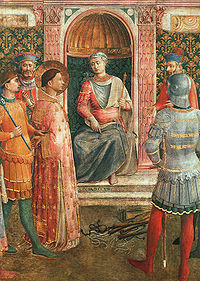 Luther is referring to St. Lawrence, a 3rd century saint who was responsible for taking the funds of the church and distributing it to the poor. According to legend, the Roman Prefect demanded tribute from treasures of the church. St. Lawrence responded by bringing the poor, to whom he had given everything the church had.
He stated to the Roman Prefect,
Behold in these poor persons the treasures which I promised to show you; to which I will add pearls and precious stones, those widows and consecrated virgins, which are the Church's crown.
…and the Roman Prefect was angered by this and had St. Lawrence roasted alive on a gridiron over hot coals.
Anyways. Luther is pointing to an early saint who said the “treasures of the church” were the poor themselves, who received all the funds the church could muster.
But this, too, isn’t what Luther sees as the “treasures of the church”. He elaborates in the next thesis.
60. Without want of consideration we say that the keys of the church, given by the merits of Christ, are that treasure.
The true “treasure of the church”? It’s the keys of the church. What do we mean by keys? Luther explains in #62 that the keys is the gospel itself. In short, the “treasure of the church” is the gospel. And the gospel can’t be bought or sold – so why are we selling indulgences?
61. For it is clear that the pope's power is of itself sufficient for the remission of penalties and cases reserved by himself.
Another “excuse me, Pope, I don’t mean to insult you; please don’t burn me at the stake while I undermine your authority” thesis. He again states the Pope, and indeed all clergy, cannot absolve penalty of sin. That’s left to God.
But he couches this subversion in a positive statement about the Pope being able to remit penalties that the Pope himself declared.
62. The true treasure of the church is the most holy gospel of the glory and grace of God.
There it is. The “treasures of the church”? It’s the gospel that says God forgives sin by His good grace. This is what is being sold by indulgence preachers.
63. But this treasure is naturally most odious, for it makes the first to be last (Mt. 20:16).
What a terrible treasure to peddle. “Here is what I’m selling: you don’t need me to sell you anything; it’s available for free directly from God.”
64. On the other hand, the treasure of indulgences is naturally most acceptable, for it makes the last to be first.
But this treasure is one the laypeople want and need: you have forgiveness of sin by God’s grace. No clergy or indulgence letter required.
65. Therefore the treasures of the gospel are nets with which one formerly fished for men of wealth.
This treasure of the Church, the gospel itself, was originally used to fish for men. But, wait for it….
66. The treasures of indulgences are nets with which one now fishes for the wealth of men.
Oh, snap! Yet another powerful jab from Luther.
Indulgence sellers have taken the real treasure of the Church, once used to bring men to God, and swapped it for a fake treasure, one used to bring in money to the Church.
67. The indulgences which the demagogues acclaim as the greatest graces are actually understood to be such only insofar as they promote gain.
The Catholic Church was proclaiming indulgences as the greatest thing; the treasure of the Church! But in reality, it’s insignificant.
68. They are nevertheless in truth the most insignificant graces when compared with the grace of God and the piety of the cross.
The real treasure of the Church blows away the false treasure peddled by the indulgence sellers. How much greater is the grace of God and the power of the death-defeating cross, than buying religious get-out-of-jail-free cards? No contest.
69. Bishops and curates are bound to admit the commissaries of papal indulgences with all reverence.
Luther playing nice again with the establishment, while ultimately subverting its authority.
Indulgences are trash theology…but they do reflect the commission of the Pope to absolve penalties…but only ones he instituted…as they are ineffective against penalties instituted by God.
It’s like Luther is walking on eggshells here, hoping to avoid otherwise certain excommunication.
70. But they are much more bound to strain their eyes and ears lest these men preach their own dreams instead of what the pope has commissioned.
The Pope certainly has good intentions with these indulgences, but too many of his underlings are abusing his pronouncements to offer salvation by money. Why? Greed, to further their own dreams of earthly riches.
71. Let him who speaks against the truth concerning papal indulgences be anathema and accursed.
Pope, I’m one of the good guys, honest!
It’s amusing, 500 years later, to look back on this and see the end result. Protestants do not agree with Luther here; Protestants do no accept papal indulgences at all.
(Indeed, the Catholic Church about 100 years ago finally did away with quantifying indulgences, no longer specifying how much time was removed from your sentence for an indulgence, among other reforms.)
As a Messianic believer, I give the Pope no thought at all. He is not my leader, he doesn’t speak for me, and he has no power to absolve my sin or guilt. I suspect the same is true for most Protestants.
72. But let him who guards against the lust and license of the indulgence preachers be blessed.
If we’re to take Luther at face value, he isn’t wishing indulgences to disappear. He’s wishing abuses of indulgences to disappear.
But reading between the lines, and looking at Luther’s life and the end result of the Reformation, it seems clear to me that Luther wanted indulgences to disappear altogether. His phrasing and occasional defense of them is him hedging his bets and attempting to avoid excommunication.
73. Just as the pope justly thunders against those who by any means whatever contrive harm to the sale of indulgences.
Luther is in a predicament: he acknowledges the Pope condemns those who speak against indulgences, and yet Luther himself is speaking against indulgences. He squirms his way out of this by saying he is only speaking against those going outside of the Pope’s commission regarding indulgences.
74. Much more does he intend to thunder against those who use indulgences as a pretext to contrive harm to holy love and truth.
The Pope is good and righteous – while he condemns those who speak against indulgences, how much more he speaks (or intends to, at least!) against those who abuse indulgences.
75. To consider papal indulgences so great that they could absolve a man even if he had done the impossible and had violated the mother of God is madness.
Was this an actual claim in Luther’s day, that even raping the mother of Messiah could be absolved through a letter of indulgence? Not quite, however, it’s not far from the truth.
In 1515, two years before Luther wrote his 95 Theses, Pope Leo financed the construction of St. Peter’s Basilica by granting a plenary (absolute, total) indulgence that applied to almost any sin, including adultery and theft.
Luther is taking this argument to the extreme, reductio ad absurdum: if indulgences really did pardon sin, it would mean that even extreme sins like rape could be pardoned merely by giving money to the Church.
And that, Luther rightfully says, is madness.
76. We say on the contrary that papal indulgences cannot remove the very least of venial sins as far as guilt is concerned.
In other words, indulgences and the Pope have no means to absolve even the tiniest of sin. Again, Luther says only God has that power.
This was a personal issue for Luther. After Johann Tetzel had received commission from the Pope to preach absolute indulgence for the financing of St. Peter’s Basilica, he began preaching indulgences near Wittenberg. When Luther’s parishioners returned for purchasing these indulgences, they told Luther they no longer needed to repent in order to be forgiven of sin.
Luther is taking that head-on here! Not even the Pope himself can absolve sin’s penalties.
77. To say that even St. Peter if he were now pope, could not grant greater graces is blasphemy against St. Peter and the pope.
I had to re-read this thesis a few times before understanding it.
The reason it’s confusing is because Luther again couches a subversion in positive language. “[Subversive] The Pope has zero power to absolve penalties of sin. [Positive] He has something greater – the gospel.”
Blasphemy against “St. Peter and the Pope”. This is amusing to me, because Protestants today, to my best knowledge, consider blasphemy only against God. It’s not possible to blaspheme your pastor, for example. It shows Luther’s ideas were taken far beyond than even he likely could have predicted.
78. We say on the contrary that even the present pope, or any pope whatsoever, has greater graces at his disposal, that is, the gospel, spiritual powers, gifts of healing, etc., as it is written. (1 Co 12[:28])
Clarifying the previous thesis, Luther states the Pope has far greater power than indulgences.
I don’t know, Luther, indulgences would be a pretty great power if they worked!
Luther appeals to Paul’s letter to Corinthians, where Paul says God has given many people different spiritual gifts (leadership, helping, healing, etc.)
79. To say that the cross emblazoned with the papal coat of arms, and set up by the indulgence preachers is equal in worth to the cross of Christ is blasphemy.
This might be a straw man argument. Luther claims indulgence preachers are saying their doctrine is equally important to the death-defeating cross. That may not be an actual claim of indulgence preachers in that day.
But even if this is an exaggeration for argument’s sake, the indulgence preachers did place high value on indulgences, spending more time teaching it than teaching the Bible itself.
80. The bishops, curates, and theologians who permit such talk to be spread among the people will have to answer for this.
Leaders in the Church are held responsible if they hear bad teaching but don’t put an end to it.
This speaks to me as a lay preacher in my own congregation. I often hear bad theology – about conspiracy theories, names of God, and more – but I don’t put an end to it for peace’s sake.
But bad doctrine leads to worse things, as in the case of indulgences. So also in our own congregations today.
81. This unbridled preaching of indulgences makes it difficult even for learned men to rescue the reverence which is due the pope from slander or from the shrewd questions of the laity.
Indulgences: the people are asking questions, and we there are no good answers. And this shames the reputation of the Pope and the Church, says Luther.
He gives some example questions in the next few theses.
82. Such as: “Why does not the pope empty purgatory for the sake of holy love and the dire need of the souls that are there if he redeems an infinite number of souls for the sake of miserable money with which to build a church?'' The former reason would be most just; the latter is most trivial.
Using their God-given brain, the laypeople are asking problematic questions. If the Pope has the power to empty purgatory via indulgences, why not just empty purgatory altogether? Why does he insist on money to do the right thing?
83. Again, “Why are funeral and anniversary masses for the dead continued and why does he not return or permit the withdrawal of the endowments founded for them, since it is wrong to pray for the redeemed?''
Yeah…and why doesn’t he just return the indulgence money once the person is redeemed?
Good questions indeed.
84. Again, “What is this new piety of God and the pope that for a consideration of money they permit a man who is impious and their enemy to buy out of purgatory the pious soul of a friend of God and do not rather, because of the need of that pious and beloved soul, free it for pure love's sake?''
The Pope accepts money from a wicked man to free a righteous man from purgatory….um, why not just free the righteous man because it’s the right thing to do?
85. Again, “Why are the penitential canons, long since abrogated and dead in actual fact and through disuse, now satisfied by the granting of indulgences as though they were still alive and in force?''
Luther is referring to the rulings of later Church councils and various bishops. Their rulings have been largely disregarded and no longer in use. Except now we heed them in the case of indulgences? How convenient.
The same could be said of virtually all churches today with regards to tithing. The Torah is largely considered in disuse and abrogated…except in the case of money and tithing, in which the Torah commandment about Levitical tithing is applied to the church today.
86. Again, “Why does not the pope, whose wealth is today greater than the wealth of the richest Crassus, build this one basilica of St. Peter with his own money rather than with the money of poor believers?''
Ohhhhhh….that is funny. Luther cracks me up. People are saying, “If the Pope wants to build a church – he already has the money to do so; he’s the richest person alive. Why not use his own money?”
Luther says we have no good answers to these laypeople questions.
87. Again, “What does the pope remit or grant to those who by perfect contrition already have a right to full remission and blessings?''
Laypeople are connecting the dots. If God absolves sin, what do we need indulgences for? (Unspoken challenge: what do we need the Pope for? What do we need the clergy for, exactly?)
Looking back on history, the answer is largely, “We don’t need indulgences, Pope, or clergy.”
This has been a blessing in some regards, as stated earlier, but also a curse in other ways, such as fierce individualism and Cowboy Religionists who are accountable to no one, are suspicious of all authority, and can’t get along with the community. And this is a problem plaguing the Hebrew Roots world today.
88. Again, “What greater blessing could come to the church than if the pope were to bestow these remissions and blessings on every believer a hundred times a day, as he now does but once?''
Since the Pope can absolve sin and bestow salvation, why not just do that on every believer right now, every day, multiple times?
One early Protestant commenter notes,
At this point one hears the most surprising things. Some imagine a common treasury which is increased by indulgences. Therefore if a man obtains plenary remission seven times a day, which can happen in Rome, so many more benefits will he receive. These men contradict themselves, for, according to them indulgences are expenditures of the treasury and not receipts. Others, moreover, think that sins are remitted forever by a continuous division, as wood is divided into even more divisible parts. Thus sins are remitted and are always still further remissable, although they become smaller and smaller. I confess that I don’t know what I should say about this.
89. “Since the pope seeks the salvation of souls rather than money by his indulgences, why does he suspend the indulgences and pardons previously granted when they have equal efficacy?''
By “suspend the indulgences”, he means the suspension of their effectiveness. Oh, you bought an indulgence? That was for yesterday. Today you need another indulgence!
The people are asking, if the Pope really is concerned about souls rather than money, why say indulgences must be repurchased?
90. To repress these very sharp arguments of the laity by force alone, and not to resolve them by giving reasons, is to expose the church and the pope to the ridicule of their enemies and to make Christians unhappy.
Luther states we can’t simply say, “Don’t talk about this. Stop asking questions.” He rightfully notes we must have an answer to these challenges. And the answers must be truthfully rooted in the Word of God.
Anything less lowers the reputation of Christianity.
91. If, therefore, indulgences were preached according to the spirit and intention of the pope, all these doubts would be readily resolved. Indeed, they would not exist.
If the Pope really is concerned about souls not money, prove it. Let the teachers teach it like I’ve said: works before indulgences, souls over money.
92. Away, then, with all those prophets who say to the people of Christ, ``Peace, peace,'' and there is no peace! (Jer 6:14)
“Quiet down, don’t cause a disturbance!” is a harmful message when an evil is at work. Indulgences and the evil they produced caused great harm to the Church and to the people, who assumed they could live wickedly as long as money was paid to the Church.
This is a good work for us today in the Hebrew Roots world, where all kinds of foolish doctrines, conspiracy theories, and more abound. We can’t be at peace when God’s people are led astray into harmful ideas.
93. Blessed be all those prophets who say to the people of Christ, ``Cross, cross,'' and there is no cross!
Instead of indulgences, preach the cross of Messiah, says Luther channeling his inner Apostle Paul.
94. Christians should be exhorted to be diligent in following Christ, their Head, through penalties, death and hell.
The threat of judgment is Biblical and real. Wicked people will receive their just punishment. No Pope, no indulgence, no priest can guarantee otherwise.
95. And thus be confident of entering into heaven through many tribulations rather than through the false security of peace (Acts 14:22)
Our eternal destiny is worked out with fear and trembling, forged through trials and tribulations. Indulgences give a false sense of security about one’s life with God.
Conclusion
Examining and commenting on Luther’s 95 Theses has been enlightening! It has showed me that Luther was so anti-good works as many people make him out to be. (Or at least, at this point in Luther’s life – whether he changed his views later on is something to examine in the future.)
Another surprising feature of Luther’s 95 Theses is that they almost all revolve around indulgences. I had previously assumed the 95 were a summary of all his qualms with the Church, the clergy, and the Pope. But in fact, it’s mostly just his qualms with indulgences.
Indulgences ultimately undermined a core component of Jewish and Christian faith: repentance. Indulgences undermined this component by giving Church approval to wicked behavior, in return for money. Luther rightfully and sharply opposed it on Biblical grounds.
As a Messianic believer in the Jewish Messiah, I have mixed feelings about Luther. On one hand, he did a monumental good work: reforming a Church that has so distanced itself from the teachings of Messiah, it would be near unrecognizable to a 1st century Jewish disciple like Peter or Paul.
On the other hand, Luther’s later anti-Semitism in his life, particularly his book On the Jews and Their Lies, demonstrated unrepentant wickedness in his own life. In lashing out in anti-Semitic hatred for Jews, Luther lashed out in hatred against his own Messiah, the Jew from Nazareth. It has left Luther’s legacy stained at best.
Despite Luther’s personal life, he did us all a marvelous service in aiding the Reformation of Christianity towards a more Biblical religion. His reformation of our faith we continue to this day, as we return to the Judaic, Torah-upholding original faith the apostles once practiced.
I hope you’ve enjoyed this rather lengthy analysis, fine Kineti reader. And more importantly, that you’ve gained some wisdom from it. Shalom.


