Import jQuery

Showing posts with label new testament. Show all posts

Authorship, dating, and target audience of each book of the New Testament

Fragment of an early New Testament manuscript

Messianic apologist J.K. McKee writes why the New Testament was likely originally written in Greek, rather than Hebrew or Aramaic.

He examines the opposing arguments and gave a fair treatment to both. (No surprise there; I’ve known J.K. over the years to be invariably fair, even when his peers are not. It’s his M.O. Smile)

Buried towards the end of his thorough analysis is an excellent resource: his compiled list of probable dates, authors, and audiences of each New Testament book, as derived from conservative scholarship. I’ve reproduced the list here:

Gospel of Matthew

Approximate date: early-to-mid 70s C.E., possibly into the 80s C.E.
Time period: the conception/birth of Yeshua to the ascension of Yeshua
Author: Matthew the disciple
Location of author: Phoenicia, Transjordan, Alexandria, Syrian Antioch (all debated)
Target audience and their location: the Jewish Diaspora, possibly Antioch

Gospel of Mark

Approximate date: late 50s or early 60s C.E.
Time period: the ministry of John the Immerser to the ascension of Yeshua
Author: John Mark, secretary of the Apostle Peter
Location of author: Rome
Target audience and their location: predominantly Roman, later Alexandrian

Gospel of Luke

Approximate date: late 50s to early 60s; or late 70s to early 80s
Time period: establishment of a more definitive history of the ministry and teachings of Yeshua
Author: Luke the doctor
Location of author: Rome or Achaia
Target audience and their location: Theophilus, and broad groups of Jews, Greeks, and Romans

Gospel of John

Approximate date: mid-to-late 80s C.E.
Time period: need to establish a doctrinal Gospel independent of the Synoptics (Mark, Matthew, Luke), focused on the relationship of Yeshua the Son to God the Father, and Yeshua to His Disciples and followers
Author: the Apostle John
Location of author: Ephesus
Target audience and their location: largely non-Jewish Believers in Asia Minor, and eventually throughout the Roman Empire

Book of Acts

Approximate date: after the Gospel of Luke, 60-62 C.E., late 60s C.E., or 70s-80s C.E.
Time period: establishment of a more definitive history of the expansion of the gospel in the ancient world
Author: Luke the doctor
Location of author: Rome
Target audience and their location: Theophilus, and broad groups of Jews, Greeks, and Romans

Epistle to the Romans

Approximate date: 56-58 C.E.
Time period: transition of Paul’s ministry work from the Eastern to Western Mediterranean
Author: the Apostle Paul with Tertius (secretary)
Location of author: Corinth/Achaia or Cenchrea
Target audience and their location: Jewish and non-Jewish Believers in Rome

First Epistle to the Corinthians

Approximate date: 52-55 C.E.
Time period: season of extreme growing pains for the Corinthian congregation, in the midst of idolatry, immorality, and factionalism
Author: the Apostle Paul
Location of author: Ephesus/Asia Minor
Target audience and their location: Jewish and non-Jewish Believers in Corinth

Second Epistle to the Corinthians

Approximate date: Winter 56 or 57 C.E.
Time period: season of extreme growing pains for the Corinthian congregation, in the midst of many challenging Paul’s apostolic authority
Author: the Apostle Paul
Location of author: Macedonia or Ephesus
Target audience and their location: Jewish and non-Jewish Believers in Corinth

Epistle to the Galatians

Approximate date: 48-49 C.E. or 50-52 C.E.
Time period: season of great confusion among many new non-Jewish Believers, and their integration into the community of faith
Author: the Apostle Paul
Location of author: Macedonia, Ephesus, or Antioch
Target audience and their location: mostly non-Jewish Believers in the province/region of Galatia

Epistle of Ephesians

Approximate date: 60-62 C.E.
Time period: season of great expansion of the gospel among those needing encouragement
Author: the Apostle Paul
Location of author: Rome
Target audience and their location: Jewish and non-Jewish Believers in Asia Minor, and eventually Ephesus

Epistle to the Philippians

Approximate date: 61 C.E.
Time period: first imprisonment of Paul
Author: the Apostle Paul
Location of author: Rome (majority view), Ephesus or Caesarea (minority view)
Target audience and their location: largely non-Jewish Believers in Philippi

Epistle to the Colossians

Approximate date: 60-62 C.E.
Time period: season of extreme error in parts of the Body of Messiah, during the first imprisonment of Paul
Author: the Apostle Paul
Location of author: Rome
Target audience and their location: Jewish and non-Jewish Believers in Colossae

First Epistle to the Thessalonians

Approximate date: 50-52 C.E.
Time period: season of severe difficulty for a young assembly of Believers, with misunderstandings about the end-times
Author: the Apostle Paul
Location of author: Corinth
Target audience and their location: Jewish and non-Jewish Believers in Thessalonica

Second Epistle to the Thessalonians

Approximate date: 51-52 C.E. (maximum of six months after 1 Thessalonians)
Time period: season of severe misunderstanding about the end-times
Author: the Apostle Paul
Location of author: Corinth
Target audience and their location: Jewish and non-Jewish Believers in Thessalonica

First Epistle to Timothy

Approximate date: 63-64 C.E. or 65-67 C.E.
Time period: growth of Messianic community with rise of Paul’s successors, in the midst of some false teachings and apostasy
Author: the Apostle Paul with Luke (secretary)
Location of author: traveling to, or in Macedonia
Target audience and location: Timothy in Ephesus

Second Epistle to Timothy

Approximate date: 66-67 C.E.
Time period: growth of Messianic community with rise of Paul’s successors, in the midst of some false teachings and apostasy, as well as rising persecution
Author: the Apostle Paul with Luke (secretary)
Location of author: Rome
Target audience and their location: Timothy in Ephesus

Epistle to Titus

Approximate date: 63-65 C.E.
Time period: growing pains of new Messiah followers in Mediterranean basin
Author: the Apostle Paul with Luke (secretary)
Location of author: Macedonia or Nicopolis
Target audience and their location: Titus in Crete

Epistle to Philemon

Approximate date: 60-62 C.E.
Time period: Paul’s first imprisonment in Rome, during an era of runaway slaves
Author: the Apostle Paul
Location of author: Rome (majority), Ephesus or Caesarea (minority)
Target audience and location: Philemon, from Colossae or Lycus Valley

Epistle to the Hebrews

Approximate date: 64-70 C.E.
Time period: immediately prior to, or during, the Jewish revolt in the Land of Israel
Author: unknown, but often favored to be Barnabas or Apollos (and/or Priscilla)
Location of author: the Jewish Diaspora, probably Corinth or Italy
Target audience and their location: primarily the Jewish Diaspora, probably Rome, Alexandria, Eastern Mediterranean

Epistle of James

Approximate date: 45-50 C.E.
Time period: prior to, or just after, the Jerusalem Council
Author: James the Just, brother of Yeshua
Location of author: Jerusalem or Judea
Target audience and their location: Jewish Believers in the immediate Diaspora: Phoenicia, Cyprus, Antioch

First Epistle of Peter

Approximate date: 64-67 C.E.
Time Period: immediately prior to the Jewish rebellion in Judea, possibly during the persecution by Emperor Nero
Author: the Apostle Peter, assisted by Silvanus
Location of author: Rome
Target audience and their location: Jewish and non-Jewish Believers in Pontus, Galatia, Cappadocia, Asia, Bithynia (Northwestern Asia Minor)

Second Epistle of Peter

Approximate date: 65 to 68 C.E.
Time period: spread of false teaching in the community of faith, and degrees of impatience about the Second Coming
Author: the Apostle Peter (possibly with a scribe’s assistance, and/or posthumously released)
Location of author: Rome
Target audience and their location: Jewish and non-Jewish Believers who are soon to face the absence of Peter, the same basic audience as 1 Peter

First Epistle of John

Approximate date: anywhere from 70-90 C.E.
Time period: period of transition in the early ekklēsia from Apostolic to post-Apostolic, with Believers facing threats from (proto-)Gnostic errors
Author: the Apostle John
Location of author: Ephesus or Asia Minor
Target audience and their location: Jewish and non-Jewish Believers in Asia Minor

Second Epistle of John

Approximate date: 70-90 C.E.
Time period: period of transition in the early ekklēsia from Apostolic to post-Apostolic
Author: the Apostle John
Location of author: Ephesus or Asia Minor (conservative), Syria (liberal)
Target audience and their location: a congregation of Believers (a “lady”)

Third Epistle of John

Approximate date: 70-90 C.E.
Time period: period of transition in the early ekklēsia from Apostolic to post-Apostolic
Author: the Apostle John
Location of author: Ephesus or Asia Minor (conservative), Syria (liberal)
Target audience and location: Gaius, a Believer in Asia Minor

Epistle of Jude

Approximate date: 50s or 60s C.E.; or 80s C.E.
Time period: intense season of instability and uncertainness
Author: Jude, the brother of James and half-brother of Yeshua
Location of author: Judea (early composition); Diaspora (later composition)
Target audience and their location: Jewish and non-Jewish Believers in the Mediterranean basin

Book of Revelation

Approximate date: 50s-70s C.E. or 80s-90 C.E.
Time period: deteriorating circumstances for the First Century Believers in the Roman Empire
Author: the Apostle John
Location of author: the island of Patmos
Target audience and their location: the congregations of Ephesus, Smyrna, Pergamum, Thyatira, Sardis, Philadelphia, Laodicea (all in Asia Minor)


These datings suggest the earliest book of the New Testament was written by Ya’akov (James), the brother of Yeshua, written 15 years or so after the resurrection. Paul’s letters and some of the gospels following shortly thereafter.

Quite remarkable, if you think about it. The defeated band of disciples were all that was left of the Yeshua movement, and they had even publicly denied knowing Yeshua for fear of their own lives. It was a shameful thing to be associated with a defeated messiah and a dangerous thing to be associated with Yeshua who had been crucified by the Roman government with approval from the corrupt religious leadership.

But days after his death, God raised up Messiah from the dead and the defeated band of disciples reversed course. Instead of hiding in fear of their lives, they openly and bodly proclaimed Yeshua of Nazareth as Messiah, producing the first Messiah-believing communities in Israel and the nations.

Within a few years, James, Paul, Peter and other leaders began writing letters to these communities. Others transcribed the oral accounts of Yeshua’s life and ministry. These letters and accounts were later canonized as the gospels and epistles, producing the New Testament we have today.
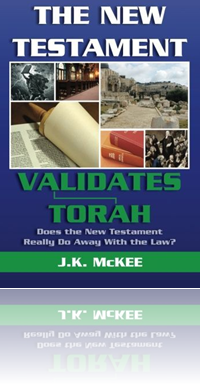
The New Testament Validates Torah

“When you are finished reading this book, you will be able to strongly defend the validity of Torah for born again believers.”

-J.K. McKee, The New Testament Validates Torah

imageI talk to a lot of newcomers to the Messianic movement – Hebrew Roots in particular is growing rapidly – and folks ask, “Where can I get sound Messianic teaching?”

I always point them to J.K. McKee’s TNN Online. McKee is one of the few souls I’ve come to trust over the years: grounded in the Scriptures, engaged with modern scholarship. Devoted to Messiah and Torah. In my years of knowing McKee, as well as his parents Mark and Margaret Huey, they’ve been gems in the rough, examples of Messiah both online and in the real world.

In his massive 430-page book, The New Testament Validates Torah, McKee presents a reasoned and convincing argument for Torah observance for Messiah’s followers today.

The book’s needed now more than ever. As it stands, fine Kineti readers, as of late 2012, the Messianic movement is…a bit of a mess. Plagued with “unscholarship” – teachers with no credentials, lack of scholarship, people with no knowledge of Hebrew claiming to know the only real name of God, shifting ministerial alliances, congregants majoring on the minors, even real heresies and apostasy.

McKee’s book goes against the grain and makes something beautiful: framed in the Scriptures and engaged with biblical scholarship, McKee presents the case for the ongoing validity of Torah for Messiah’s disciples.

Why Torah?

Believers today are facing a difficult road ahead.

The western world is growing secular and more hostile towards faith, and its Christian heritage in particular. We’re seeing our culture in the 21st century  grow more godless, more lawless: atheism is more popular than ever. Western nations are displacing faith with State and Darwin and anything-but-God, a legal and powerful homosexual agenda in media and in law, pornography commonplace, divorce and broken homes the norm. Christianity in particular is mocked and laughed at as outdated skygod myth from the old generation.

Meanwhile, a shallow pop Christianity aims to blend in with this same world, and while it attracts many, its impact is superficial and leaves us searching for something deeper.

What’s the answer?

The Messianic faith calls for a return to the foundation: The Torah, the Law, the first 5 books of the Bible. In it contains God’s commandments, the moral foundation of Judaism and Christianity, the very fabric and code of our faith. The Messianic call to Torah is ultimately a call to holiness: separation from the sinful world, a return to those things that the Apostle Paul called “holy and good and righteous.”

But is returning to Torah a Scriptural idea? If believers keep Torah, won’t we be practicing legalism? Won’t we be Judaizing? Isn’t Christ the end of the Law?

In The New Testament Validates Torah, McKee tackles these issues and presents the Scriptural case for a return to Torah for modern believers.

Practical, Scriptural rebuttals to anti-Torah beliefs

McKee’s arguments for Torah play out as responses to the arguments of a typical evangelical pastor who believes the Law is done away with. I found this technique practical. So many of us have heard these exact arguments preached from the pulpit and parroted by our Christian friends; having straightforward answers presented with detail and brevity gives us a solid base for defending our convictions.

The Law for ancient Israel only?

How is it that believers should keep the Law when it was apparently only given to Israel, and only for that ancient era at that? McKee notes how God’s law predated Moses and the revelation at Sinai. He argues from Scripture, citing how Abraham “obeyed Me and kept My charge, my commandments, My statutes, My laws”, and backs up this assertion from Jewish and Christian commentary. This lays a foundational understanding in which God’s Instruction is eternal, predating Sinai and still applicable to today’s believers.

The Law as a stopgap to Christ?

Many Christians reject Torah by citing Paul’s letters. Paul says in Galatians, for example, that the Law was added “until the seed would come to whom the promise had been made”, and Christians commonly interpret this to mean the Torah given on Sinai was a temporary measure until Christ arrived.

But McKee rightly points out that the Law could not merely have been a stopgap measure: he builds on the previous point of the eternal nature of the Torah, and bolsters this argument by citing Messiah’s own words that the Torah will last as long as heaven and earth exist. Instead, we should read these verses in light of the Torah’s powerlessness to provide final redemption and point us to the need for Messiah.

“No one can keep the Torah. So why try?”

Others argue that because no one can keep the Torah, there’s no point in trying, and instead we should just trust in the grace of Christ.

I find this argument silly, akin to a dieter saying, “No one can resist cookies. So why try?”

But McKee treats this argument fairly and more seriously that I would have. He goes to the Scriptures to prove that obedience – even if attempted and at times failed – is better than open rebellion. He shows that God’s grace should be given a response of obedience, not law-breaking, citing Paul’s rebuke that we establish the Law through grace (Romans 3:31). He also warns believers not to err as some early believers did, thinking Torah observance would bring salvation.

And this is really a great example of what you’ll find in the book: a balanced view set forth that doesn’t swing to one side with no abandon, but instead considers Jewish and Christian sources and discerns from the Scriptures a right path for Yeshua’s disciples.

But what about this verse?

The heart of the book deals with the Scriptures traditionally given against Torah observance. You know, things like,

  • “…the law was given through Moses, but grace and truth were realized through Jesus Christ. (John 1:17)
  • “…you are not under law, but under grace…” (Romans 6:14, 15)
  • “…Christ is the end of the law…” (Romans 10:4)
  • “…all things are lawful for me…” (1 Corinthians 6:12)
  • “…a man is not justified by the works of the law…” (Galatians 2:16)
  • “When He said, ‘A new covenant,’ He has made the first obsolete…” (Hebrews 8:13)

And many more! In fact, McKee addresses nearly 30 verses – literally every verse used against Torah observance I’ve heard in my 20 or more years in the Messianic movement – and provides answers that are engaged with modern scholarship, given in light of the Greek text, and supported in the broad view of the Scriptures.

Take for example his dealing with the difficult passage in Romans 8:2, “For the law of the Spirit of life in Christ Jesus has set you free from the law of sin and of death.”

Does this mean Jesus has set us free from the Torah?

McKee examines the Greek text to find “tou  hamartias kai tou thanatou” (the law of sin and death) may not actually refer to the Mosaic Law. But if it did, he reasons, it would then mean commandments such as “You shall not murder” – laws designed to prevent death, are somehow producing death. Non sequitur.

McKee suggests two alternative views of this Scripture

  • The verse as principles and spiritual constants: Yeshua’s rule is life, sin’s rule is death.
  • The verse contrasting the functional conditions of Torah: Life in the living Torah, Yeshua, but darkness and death in rebellion to this Torah.

Both interpretations do no harm to the Torah and fit within the Scripture’s broad view of the Torah.

He concludes by citing Christian scholarship, where N.T. Wright interprets the verse as the Torah remaining God’s law, not responsible for bringing death, but instead continuing to be active in a believer’s life (pp 113-114).

This same thorough, Scriptural analysis is typical in the book. For the nearly 30 verses traditionally presented against Torah observance, McKee gives a detailed response, answers that consult scholarship, examine the Greek text, and sit in harmony with the broad view of the Scriptures.

Under the Law?

How do we deal with the repeated “you are not under the law” passages of the New Testament (i.e., Galatians 3:23, 4:4-5, 21; 5:18; 1 Corinthians 9:20-22; Romans 6:14-15)? Does it mean to say we don’t have to keep God’s commandments?

The book’s answers were enlightening to me, fine Kineti readers (pp 293-340). McKee first consults Christian scholarship and shows that even various modern scholars do not always think the matter is conclusive, even noting a few doubts from Christian scholars like Douglas Moo who believe that the Mosaic Torah was decisively for the times before Messiah. McKee also looks at Messianic examiners and how they’ve tackled the “under the law” passages:

  • David H. Stern says “under the law” speaks of legalism.
  • Aaron Eby says “under the law” means relying on ritual conversion to Judaism as a means of salvation.
  • Tim Hegg says “under the law” means under the condemnation of the Torah, or those who rely on Jewishness for justification.

The book looks at these possible interpretations and tells you the truth, opened about the potential issues with these interpretations. McKee is honest: “I am not convinced any of these alternatives deals adequately with how hupo nomon [under the law] is used within the text.” (p 299)

But with that same honesty, he asserts that the traditional Christian view that “under the law” means “obedience to God’s Torah” is likewise unsustainable in light of Yeshua’s pro-Torah statements and the broad view of the Scriptures.

He suggest that the best reading of “under the law” – one that fits in contrast to the “under grace” statements and with the whole of Scripture – is one defined as subject to the Torah’s condemnations and penalties on lawbreakers. He argues that Yeshua’s disciples, because of God’s grace, are not subject to the Torah’s harsh penalties for lawbreakers.

How to become Torah observant

If the New Testament is not against keeping God’s commandments in the  Torah, but in fact upholds the Torah, where does that leave us as believers today?

For many Christians, the realization that the New Testament is not anti-Torah is an eye-opener. It challenges our faith life: we’re to walk in holiness according to God’s commandments as Messiah did. This is a revelation that changes a person’s life moving forward, going against the grain, viewing Messiah in a Jewish light, no longer antagonistic towards the Torah, the Jewish people, Israel.

Where we go from here is key. The author recommends a gradual approach, growing in the faith by honoring God’s commandments more and more in your life. Taking on the feasts, the kosher diet, and the sabbath while steadfastly remembering first Messiah’s amplification of loving God and neighbor (Deuteronomy 6:5; Leviticus 19:18; cf. Matthew 19:19; 22:39; Mark 12:31; Luke 10:27; Romans 13:9; Galatians 5:14; James 2:8). Above all, the book teaches Torah observance not as a means to be saved or to appear Jewish, as some have, but encourages Torah obedience out of a desire to live as Yeshua the Messiah lived and to grow in your faith.

“Arguably, we have not seen these numbers of believers in Messiah following the Torah since the days of the First Century. We live in exciting times where Moses’ Teaching surely is going forth and greater shalom and well being are experienced by the saints. The realization that the New Covenant really does involve a supernatural transcription of the Law on to the hearts of the redeemed is becoming quite conscious to many! The Messianic movement has much to accomplish in the future!” (pp390-391)

The New Testament Validates Torah is a guide for the believers seeking holiness in God’s commandments. Scriptural and engaged with biblical scholarship, it equips believers with the truth of God’s Torah and amplifies your ability to defend your convictions from the Scriptures. Grab the book and see for yourself.

Is the New Testament reliable?

As Messianics, we sit perched between the religions of Judaism and Christianity.

We love Judaism because we know it to be the religion of Israel, God’s people, which produced the patriarchs, the Torah, the prophets, the apostles, and Messiah himself. Israel has been used by God to bring light to the world. In a sentence, Israel = God’s vehicle for all things righteous. If it weren’t for Israel, the gentile world’s religion would be little more than foolhardy men bowing to sexually-exaggerated figurines. I love Judaism, even with the painful acts of a few who shame it.

At the same time, we love Christianity. Yes, even with all its warts. It embraced Messiah when the leadership of Judaism has largely rejected him. That counts for something. Even with its ugly parts, its misrepresentation of Messiah, its past persecution of Jews, and all the violence and wars it has produced in the name of Christ, the Church has nonetheless produced men of God that led otherwise-lost gentiles to Messiah and the God of Israel. People that love God and love Israel and live righteous lives. That doesn’t get talked about much in anti-Christian circles.

Sitting between Christianity and Judaism produces for us much anguish. We are constantly pulled in either direction to be authentic: either real Jews, whom we are told cannot hold Yeshua as Messiah, or real Christians, throwing off that Jewish nonsense, after all, we are not under the law, and are free in Christ Jesus.

Christian draw

I was sitting around a table playing cards with some Christian friends awhile back. I was asked, “You don’t really believe in that Jewish stuff, right? Messy-uhnic you call it?”

I’ve been told “you’re preaching another Jesus!” and “Jesus fulfilled the law. Jesus freed us from that. Why are you living under it?” Or my favorite, “You believe in Jesus and you still follow those traditions?” (cue sad trombone)

The allure of Christianity is strong. Even more so around the holidays of Christmas and Easter. Can’t we be part of the larger Church? Can’t we fit in for once? With a family of mixed Christians and Messianics, Jews and gentiles, this draw is even stronger still.

Judaism’s draw

The flip side is the draw towards Judaism.

The pull is strong: I can be more authentic, more real, as a Jew if I follow standard Judaism. Maybe I’ll just keep my hope in Messiah to myself, and I’ll fit in better with greater Judaism.

It doesn’t help that some Messianic groups have an inferiority complex, one that doesn’t see this Messianic movement as legitimate until the greater Jewish world gives us the A-OK. (Hint: barring extraordinary supernatural events, it’ll never happen.)

And when one inundates himself in the rabbis of Judaism, in the Talmud, the siddur, in the Zohar, in the people and Scriptures of Israel, and he lives a righteous life as Judaism would see it, he might sympathize with the arguments of Judaism against Christianity. After all, Christianity has historically misrepresented Messiah.

And with the arguments against Christianity comes arguments against Christ, whom we know in more authentic view as Yeshua the Messiah of Israel.

A critical view of the New Testament

One such argument against Messiah-faith is that the New Testament is not reliable, and is merely the result of hundreds of redactions built atop the exaggerated imaginations of Jesus’ followers centuries later.

It’s hard to believe, but some Messianics sympathize with this view, or at least part of it.

For example, a few years ago, a prominent Messianic teacher claimed the New Testament book of Hebrews contained factual errors regarding the Tabernacle, and thus was not inspired by God, and ought not be considered part of the canon.

And before that, there was talk among several Messianic leaders regarding Paul’s letters to the gentiles, which comprise a significant slice of the New Testament. Maybe they’re not Scripture, they said, since they seemingly contain rants against God’s Law. Maybe they’re not inspired by God. Maybe they’re just the ramblings of an ex-Jew who hated his former religion. Maybe they shouldn’t be in the canon, some argued.

I’ve even heard some question the gospels and Acts, as they contain different retellings of the stories of Messiah:

  • In Acts, Yehuda of Kerioth (“Judas Iscariot”) is killed by falling headlong in a field, but in Matthew, Judas hangs himself.

  • In another instance, Paul describes himself as escaping the commander of the army of Aretas in Damascus, but Acts records Paul escaping a mob of angry Jews.

  • And more famously, the genealogy of Messiah as recorded in in Matthew 1 is different than the genealogy of Messiah as recorded in Luke 3.

These points, and others, are regularly raised by counter-missionaries in an effort to discredit the New Testament and disprove the messiahship of Yeshua.

Some Jewish followers of Messiah sympathize: maybe the original Hebrew texts of the New Testament don’t contain these corruptions. Maybe some of the early Church Fathers, many of whom were anti-Semitic, edited the New Testament to be damning to the Jews, they say. Maybe the New Testament should be viewed more as we view the Talmud: extra-biblical writings that contain some truth, but are not Scripture like the Tenakh (that is, what Christians call the Old Testament).

Setting the record straight

It should first be noted that many difficulties in the New Testament can be harmonized with explanation.

For example, it is possible to be hanged from a cliff and still fall headlong into a field through botched hanging. And the commander in Damascus may have tried to capture Paul because the angry mob demanded it. And some of the inconsistencies between genealogies can be explained through telescoping, a practice that the Tenakh itself uses.

However, rather than harmonizing through speculative explanation, I want to highlight empirical faults in the arguments against the New Testament, and from that, you can draw your own conclusions.

Interpretation double standards

When counter-missionaries bring up inconsistencies in the New Testament, invariably they are confounded when I show them that the same textual difficulties exist in the Tenakh. For example,

  • In one book of the prophets, a genealogy of priests is given which differs from genealogies given earlier in the Tenakh, paralleling the Luke/Matthew genealogical difference.

  • In another instance, Samuel records Satan tempting David, while Chronicles records it was God who tempted David.

  • And in another humorous instance, one of apparent scribal exaggeration, the Masoretic text (MT), upon which modern Jewish bibles are based, records the Philistine warrior Goliath at about 6 cubits (9 feet) tall – a giant by any measure! But the Septuagint puts Goliath at 5 cubits, about 7.5 feet tall. Yet more surprisingly, the Dead Sea Scrolls, which predate the MT by several centuries, put Goliath at a mere 4 cubits – a mere 6.5 feet tall – not such a giant after all! And even the first century Jewish historian Josephus attests to Goliath not being much of a (ahem) goliath.

  • The stories of Noah and Job are suspiciously similar to ancient Mesopotamian tales that predate the Torah.

These are just a few from a sea of many inconsistencies and difficulties in the Tenakh. For every difficulty in the New Testament, I can give 10 in the Tenakh.

One may argue, “But Judah, these inconsistencies can be explained…” and I will respond, “Yes, and the same for the New Testament!”

Church father double standards

Some Messianics raise concerns that anti-Jewish Church fathers edited and compiled the canon, inserting their own theologies into the text.

However, these same people will often quote early Church Fathers to support their critical view of the New Testament. For example, they might say, “The early Church Father Eusebius records that the early Nazarenes used only the Tenakh and the original Hebrew text of Matthew as their Scripture.”

Notice the double-standard: “I believe the Church Fathers when they say X. And I have a critical view of the New Testament because the Church Fathers likely edited it.”

Quick to believe Church Fathers when it proves my point, quick to dismiss the Church Fathers when it disproves my point. That’s a double standard.

Yes, it is likely the Nazarenes had a canon different than other believers in Messiah, but this argument fails in two areas: it doesn’t account for the varying beliefs in the Nazarene, Ebionite, and other early “Christian” movements; these groups disagreed with other groups and even within themselves as to what was considered canon. And secondly, it most certainly does not mean that Nazarenes rejected Acts, Luke, Paul’s epistles, or other apostolic writings. It is possible, even probable, they were unaware of some of these writings.

After all, information did not flow freely then as it does now, this was in the very early days of God picking for himself a people from the nations.

Self-defeating arguments

Counter-missionaries, and indeed some of Messiah’s followers who sympathize with them, use arguments like this one:

“The New Testament records Jesus doing X. And yet Christians don’t do this today – big problem! Now I’ll go on to discredit the New Testament...”

2 concrete examples that come to mind are:

  • “Jesus told his disciples to keep the Law and the Prophets, which is what Jews are doing. But you Christians have turned him into a god, and invented your own anti-Jewish bible.”

  • “Jesus said that, to be saved, you have to keep the commandments. That’s what Jews are already doing. But you Christians have this nonsense about believing in Jesus to be saved, coming from your Greek-translated, highly-redacted New Testament!”

Notice the self-defeating arguments here: “Jesus said X [as recorded in the New Testament], and Christians aren’t doing this because they have a corrupted/inauthentic/redacted New Testament.”

To all of Messiah’s followers, I will say this: if the New Testament is not a basic, reliable text of Messiah’s words and deeds, then how is it that you belong to Messiah? You found Messiah through these texts, and now you seek to discredit this text? How soon before you forget about those missing original Hebrew texts, and just discard the New Testament altogether?

This is the road to abandoning hope in Messiah. Counter-missionaries know this, and is why they are repeating this lie that the New Testament is an inauthentic and unreliable document.

Dispelling Myths

Here are some faulty assertions made by those with a critical view of the New Testament:

  • It was composed centuries after the actual events.
  • No one who witnessed the events actually wrote a New Testament book.
  • It was highly redacted by Church Fathers.
  • Paul was an agent of Rome, and corrupter of the original teachings of the rabbi Jesus.
  • The New Testament was originally written in Hebrew, and all we have today is corrupted Greek and Syriac manuscripts.

I will to address these concerns below.

Composition

While what became the modern canon formed later on, many of the books of the New Testament were actually written in the first century, immediately following the Messianic events that transpired.

For example, some Biblical scholars put the gospel of Luke at around 40 AD, only 4-8 years after Messiah’s death. One bit of evidence in support of this view is how Luke’s gospel is addressed to “Most Excellent Theophilus”:

Many have undertaken to draw up an account of the things that have been fulfilled among us, just as they were handed down to us by those who from the first were eyewitnesses and servants of the word. Therefore, since I myself have carefully investigated everything from the beginning, it seemed good also to me to write an orderly account for you, most excellent Theophilus, so that you may know the certainty of the things you have been taught.

-Luke 1

Some scholars suggest the “most excellent Theophilus” mentioned here may refer to Theophilus ben Ananus, the High Priest of Israel between 37 and 41 AD. Even among scholars who hold a later dating of Luke put his gospel well within the 1st century.

The other gospels are also 1st century material: Matthew around the destruction of the Temple in 70 AD, Mark between 70-90 AD, and John between 90-100 AD. Mark has the unique trait of being found among the Dead Sea Scrolls, with a fragment of Mark 6 having been found at the Qumran caves.

As for Paul’s writings in the New Testament, scholars believe he lived between 5-67 AD, making him a contemporary of and witness to Yeshua as Messiah and all the events recorded in Acts and the gospels.

Edits?

Are there redactions to the New Testament? Yes, certainly.

For example, the famous Lord’s Prayer reads differently in earlier manuscripts, with the additional stanza,

“…for thine is the kingdom and the glory and the power, forever and ever, amein.”

… not appearing in Luke’s gospel, nor does it appear in earlier manuscripts of Matthew. (There is a way to harmonize this, such as it being included as doxology for congregational worship, but we digress…)

But while the New Testament certainly contains redactions, one must also concede that there are redactions in the Tenakh as well.

For example, while many religious Jews favor the conservative view that Moses wrote the entire Torah, this has virtually zero academic support. Even the most conservative Biblical scholars believe only in basic Mosaic authorship, allowing for later edits by Joshua, Ezra, and others. After all, do we really believe Moses would have written the self-contradicting statement, “Moses was the most humble man on earth”? And he certainly didn’t write about his own death and the events that transpired afterwards!

It should be noted that many scholars favor a very liberal, secular view of the Torah, the JEDPR (Jahwist, Elohist, Deteronomist, Priestly, Redactor/Harmonizer) view, which suggests the Torah is little more than a collection of independent fables of ancient Israel, with centuries of redactions and harmonizing edits years later, before the Torah reached its final form 400CE. (I do not hold this view! But Jews and Christians should be aware of it, lest it catch you surprised on the History Channel. ;-))

But the Torah is only the tip of the iceberg. The modern Jewish bible contains edits, concatenations, and truncations in Daniel, Esther, several of the prophets, and even the historical books. And those are just the ones we know about.

Paul – corrupter of Christianity?

One founding father of the United States, Thomas Jefferson, once wrote,

Paul was the great Coryphaeus, and first corrupter of the doctrines of Jesus.

-Thomas Jefferson

Despite this theory falling out of fashion in modern times, still many Jews today look at Paul as a corrupter of Jesus’ real teachings. Paul, they say, started a new anti-law, anti-Judaism religion, whereas Jesus was interested in being a good rabbi of Judaism and nothing more, and certainly not the messiah.

Some Messianics sympathize with this, but for different reasons. They see ugly statements about the “works of the law” coming from Paul’s letters, and some then suggest, maybe Paul wasn’t really inspired, and shouldn’t be included in the canon.

Our response to this is, where is the proof that Paul is this ugly corrupter of Messiah’s teachings? A handful of statements from Galatians that seem to contradict Messiah can be, and have, sufficiently explained through proper understanding of the gentile culture and era to which it was addressed.

Extraordinary accusations require extraordinary proof – and the only thing offered are self-defeating arguments that use the New Testament to disprove the New Testament.

Waiting for the Hebrew New Testament

Some Messianics have a critical view of the New Testament because, they say, we only have corrupted Greek manuscripts, and that the original Hebrew is lost. They discard our current manuscripts as redacted Greek, holding out hope for the sexy Hebrew/Aramaic originals to make their appearance.

These are extraordinary charges. My question is, where are the Hebrew texts? And where is evidence that there were originally Hebrew texts to begin with?

The best evidence we have is a quote from a Church father that suggests Matthew was originally written in Hebrew.

All other evidence reports are more speculation than evidence.

So while certainly Matthew and perhaps a few other books may have been Hebrew originally, there is zero academic support for the idea that all the New Testament was written in Hebrew. It is quite plausible that Luke, the epistles, and others were written in Greek. A vast majority of scholars agree.

And even for the parts that were originally Hebrew, I ask, what makes you think the Greek manuscripts are so terrible so as to discard them? I suggest that this bias against Greek texts likely stems from the “all things Greek are evil” fundamentalist mindset that some Messianics seem to have, probably borrowed from a Judaic backlash against Hellenism. We must mature out of that.

Conclusions

  • If we are to believe that redactions make a text completely unreliable, then we must not only throw out the New Testament, but also the Torah and numerous books in the Tenakh. 

  • Many biblical difficulties can be explained; they just aren’t black and white simplistic like we want them to be.

  • There are more difficulties in the Tenakh than the New Testament.

  • Counter-missionary arguments against the New Testament are often uneducated and contain a double-standard. If we apply the same critical view to the Tenakh as they apply to the New Testament, we’d all be atheists.

  • You can’t have your cake & eat it too. Having a critical view of the New Testament, then quoting the New Testament to support your critical view, is self-defeating. Ditto for quoting early Church fathers.

  • The New Testament is largely a first-century work by men who knew, or knew of, Yeshua, in his generation and the next.

  • As far as we know, the New Testament was written largely in Greek.

  • Theologically, Paul and Yeshua were buddies. :-)

A final word

Some years ago, I personally struggled with the idea that anti-Jewish Church fathers compiled what became the New Testament. It really shook my faith to the point I actually considered agnosticism: the belief that we cannot really know whether there is a God.

Perhaps to stop me in my tracks, God gave me peace in this area. Through prayer I heard, “What is here today is by My hand.”

At first, I wanted to ask what that means, exactly. “Even the edits, oh Lord?” would have been a near-comical reply, but it’s what I wanted to ask.

But a peace settled in. Through all the redactions, the compilers of the canon, even with some of them having less-than-good intentions, the harmonizers… it doesn’t matter. God totally used them, like tools. And what we have today is here by His hand.

I know that’s not scientific proof. And I know it’s not intellectually stimulating. But it’s enough for me.

Jewish book, gentile eyes

Great quote from Rabbi Scott Sekulow,

The New Testament is a continuation of -- not a departure from or a replacement of -- the Hebrew Scriptures (Torah, Prophets, Writings). It maintains continuity with the prior words of an unchanging God. Did you know that of the 404 verses in the book of Revelation, 278 are direct references to the Old Testament? This is equally true of the rest of the books of the New Testament, where the Old Testament is either quoted or alluded to or where Hebrew concepts are taught.

A fundamental problem which has produced massive Christian misunderstanding of the Bible has been the fact that those who have attempted to interpret it have not done so with the Hebrew mindset and world view with which it was written. We have been reading a Jewish book with Greek, Latin, German, Spanish, African, Chinese or American eyeglasses and, therefore we have a distorted view of biblical reality.


----------------
Now playing: Inspired Faith Broadcasting - Live from Israel
via FoxyTunes

Upon This Disciple I'll Create My New Religion?

I've recently been debating with a Catholic man, Ariel, in the comments to Catholic Relevance.

Ariel is rather peculiar religious person, in that he went from a child under Catholicism, to agnosticism, to Evangelical Christianity, to Messianic Judaism, then back to Catholicism. (Wow!) He is now a chief contributor to IsraelCatholics.com.

In the little debate, Ariel points to us to his testimony and lays out the span of events that led him to believe that "Messianic Judaism is not biblical enough and [that] Catholicism really is truly Jewish and truly the faith of the Bible."

He further states,
"Messianic Judaism usually uncritically accepts the two pillars of Protestantism: sola scriptura (the Bible as sole source of authority) and sola fide (salvation by faith alone). Yet both of these doctrines are neither Jewish, neither biblical, nor genuinely Christian!"


Ariel and I debate these points and many others in the comments to Kineti Le'Tzion - Catholic Relevance. The points made are so important, however, I feel this debate deserves more visibility than dueling comments in a buried blog post!

To keep things reasonable short and concise, since so many of you [ahem, Gary] refuse to read long posts, I'm going to address only a single issue today:

Should we have a Pope?

Ariel states the Catholic position this way:

The fact that Jesus appointed Peter to be "the rock on which I will build my Church" is quite clear from the NT. See the wealth of other scriptures and quotes from the early church (way before Constantine!) in this presentation.


Ariel is referring to the following Scripture, Matthew's record of the gospel, ch. 16,

Jesus replied, "Blessed are you, Simon son of Jonah, for this was not revealed to you by man, but by my Father in heaven. And I tell you that you are Peter, and on this rock I will build my church, and the gates of Hades will not overcome it. I will give you the keys of the kingdom of heaven; whatever you bind on earth will be bound in heaven, and whatever you loose on earth will be loosed in heaven."


It is from this Scripture that Catholics claim the Roman Catholic Church is the only true church of Jesus Christ. Indeed, Catholics claim Peter was the first Pope in a succession of popes leading up to the current Roman Catholic Church head:


While Catholics claim the Apostle Peter was the first Pope, the current Pope is Joseph Ratzinger, now called Pope Benedict XVI, a former Hitler Youth (though it's claimed he had no choice in the matter), is seen above wearing the Mitre (religious headgear), which some folks speculate is the pagan Dagon fish hat, although that is contested.

So, are the Catholics correct? Was Peter the first Pope? Did Jesus give authority to Peter to be the first Pope? Did Jesus authorize the creation of a church built on Peter in Rome?

Let's examine the evidence and come to a conclusion.

The first matter is the very Scripture itself. A few things strike me about this quotation:

  • "You are Peter, and upon this rock..." - This is Greek word play. The Greek "Petras" means rock or stone, so it appears Jesus is playing a word game by saying "You are Petros, and upon this petras..."

  • "I will build my church" - This translation and understanding is based on the faulty assumption that Jesus is starting a new religion. After all, we think of "church" as a big building with a steeple symbolizing organized religion, or perhaps a large religious organization itself like the Catholic Church. However, Jesus did not come to start a new religion, and this is evident in the fact that word "church" here is the very same Greek word "ekklesia", which means an assembly of people. Ekklesia is found elsewhere in the Bible -- even the Old Testament! -- but only in the New Testament is it translated in this way, perhaps intentionally as a way for the Church to validate its existence, sadly.

  • "The gates of Hades will not overcome it" - I always get a kick out of this. Why would Jesus, a Torah-observant Jewish rabbi, talk about the pagan Greek god of the dead, Hades? Given that speaking the name of false gods is a sin according to Torah, if Jesus really did say this, he would not have been sinless - very consequential to Christian doctrine. Interesting! More on this in a moment.
So, what's the deal with all this? Is Jesus starting a new religion founded on Peter? Did Jesus break a Torah mitzvot by speaking the name of Greek god of the dead, thus sinning? The answer lies in the original text.

The book of Matthew was originally written in Hebrew, a document attested to by the early Church fathers Clement of Alexandria, Origen, Jerome, Papias, and Irenaeous. (Despite this evidence, some modern scholars debate Hebrew Matthew's existence.)

In any case, we no longer have the original Hebrew Matthew, it has since been lost. We do, however, have a Hebrew manuscript of what is believed to be the original Hebrew, in the form of a medieval document written by a Spanish Jewish physician, Shem Tov ben Isaac ben Shaprut. This Hebrew version of Matthew is dubbed Shem Tov's Hebrew Matthew.

(It should be noted there is debate among scholars and Christians as to whether Shem Tov's Matthew is a manuscript from Hebrew or a translation from Latin or Greek. In the very least, there exists in Shem Tov's Hebrew Matthew some rabbinic Judaic bias, such as writing Messiah's name blasphemously1.)

I wanted to get my hands on this and see what the Hebrew Matthew had to say about Jesus building a church on Peter. 2 weeks ago, I did just that, and began studying Shem Tov's Hebrew Matthew. Unsurprisingly, using the Hebrew names1, it reads much differently than the Greek:

[Y'shua] said to him, "Blessed are you, Shimon ben Yochanan, because flesh and blood has not revealed this to you, but my Father who is in heaven. I say to you: you are a stone and I will build upon you my house of prayer. The gates of Gehenna will not prevail against you because I have given you the keys to the kingdom of heaven. Whatever you bind on earth will be bound in heaven; whatever you loose on earth will be loosed in heaven.


Now this is interesting. In the Shem Tov's Hebrew Matthew, we see that no longer is Messiah saying he'll build a church, which implies Jesus is creating a new religion. He instead says he will build a house of prayer, which does not imply a new religion or anything foreign to the Jewish faith.

What did Messiah mean when he said he'd build a house of prayer, you ask? Is He talking about building the Catholic Church? No, it seems obvious what he meant: since Messiah later revealed to Peter that the gentiles are to be included in the faith of the God of Israel, Peter was the foundation of what became a massive gentile following of Jesus that we have today. That gentile following of Messiah is the house of prayer. It does not speak to one particular denomination, Catholic or otherwise. Thus, whether Peter visited Rome or founded a church there -- a debatable point Catholics and Protestants have argued over for centuries -- is irrelevant.

Another interesting bit about this Scripture is how the difficult problem of "Hades" goes away in the Hebrew. While Hades was a Greek god of the underworld, Gehenna was a real place outside Jerusalem that became essentially a garbage dump where fires were burned continuously to consume the refuse of the city. Canaanite pagans had previously sacrificed their children to their false god, Santa Clause Molech, in the valley of Gehenna, so there was also a dark evil associated with the place.

Another interesting bit is how the Hebrew says, "the gates of Gehenna will not prevail against you", as opposed to the Greek reading, "the gates of Hades will not prevail against it [the Church]". The Hebrew is saying Gehenna will not prevail against Peter, the Greek is saying the gates of Hades will not prevail against the Church.

Given this understanding, I see no Scriptural evidence supporting the idea of a Pope, who presumes himself to be Jesus Christ on earth, infallible. On the contrary, I see Scriptures that indicate such presumption to be haughty, if not blasphemous.

The final idea we need to address -- because this confronts both Catholic and Protestant Christianity head on -- is the idea that Jesus came to start a new religion.

Some Christians deny this, saying it is the Jews who created the new religion, or that true Christianity is not different than the original faith in the God of Israel.

But these same Christians betray themselves by saying the Torah is passed away, that Jesus' grace replaces God's Law, or that we safely ignore God's Law because Jesus "nailed it to the cross". Indeed, my father-in-law once said to me, paraphrasing here, "Judah, Israel doesn't matter anymore -- everything changed with Jesus."

Do you Christian folks who profess such things understand what you're saying?

  • If Jesus did away with the Law, then he is a false prophet who would receive capital punishment for leading people away from God.

  • If Jesus did away with the Law, he started a new religion in which the Law is relegated to the back seat, and the Jews would be correct in rejecting Him.

  • If Jesus did away with the Law, or even diminished it in any way, he contradicted his own words and his own actions.

  • If Jesus made less meaningful even the slightest commandment in Torah, he failed to fulfill the messianic prophecies in the Tenakh (Old Testament), thereby rendering his Messianic status a lie.

  • If Jesus replaced Israel with the Church, then Jesus made God out to be a liar; for Jesus would be revoking something God promised to be irrevocable: the Torah will be an everlasting covenant between Himself and Israel.

  • If Jesus "changed everything" such that Torah is diminished, then He did indeed create a new (false) religion, and a Protestant is merely a lesser, misled form of a Catholic, the highest form of follower in this new religion.

Let me spell it out in plain words for you: by claiming Jesus somehow diminished the Law, you are unwittingly stating that Jesus is both a false messiah and a false prophet.

Stop with your foolish claims that Jesus somehow diminished the Torah, you're leading people astray.

Greek Jesus vs Hebrew Yeshua

Let's be frank. If the Greek peacenik adonis Iesous Kristo started a new religion, where we're supposed to have big Churches with steeples, celebrate these new holidays called Easter, Christmas, Lent, and Ash Wednesday, Sunday mass, and all the paraphernalia associated with a new religion, then the Catholic Church is right, and we should all convert to Catholicism.

On the other hand, if the Torah-observant, Jewish rabbi Yeshua HaMoshiach didn't start a new religion, then we need to clean up the mess that was created not 100 years after his death, which culminated in the creation of an official state religion in 325 CE, when the Roman Emperor Constantine declared himself the 'Holy' Roman Emperor and Sol Invictus (invincible sun god) and formalized what is today the Roman Catholic Church, complete with its Sun-day based worship.

So, who do you believe in? The Greek Iesous Kristo? Or the Hebrew Yeshua HaMoshiach? They are not one and the same; one is a perversion of the other. Which is it?

Our English Jesus Christ descends from the Greek understanding of Him, not the Hebrew understanding. We have a Greek mindset in these things -- it's no wonder Jews find Jesus so foreign and repugnant! He's tainted with Greek, pagan undertones in all we say about Him, everything from the western 'Christian' holidays, to his supposed diminishing of Torah, to the very halo we paint around His head.

We need to return to the teachings of this Jewish Messiah -- Sabbath, the Feasts of the Lord, Torah -- and get away from the man-made, Hellenized bastardization of these things that we have now in the Roman Catholic Church and its Protestant offspring.

Do we need a Pope to govern The Church? When one realizes the church in its current form is a religious invention of men, the answer becomes clear. What we do need is a return to our being Israel -- a holy, set apart people for God, different from the world -- grafted in not by race, but by belief in the God of Israel who gave Messiah so that both Jews and gentiles can be clean.


1. Shem Tov, himself a devout Jew being persecuted by the church, unfortunately substituted Yeshua's name in the Hebrew Matthew text with the shorter acronym YSH'W, which is a Hebrew acronym that meant to slam Jesus. The acronym's full form is Yemach Shemo Vezichro (literally meaning 'May his name and memory be obliterated'). It is an ancient rabbinic word play on Jesus' Hebrew name Yeshua, and Shem Tov used this shameful name in his manuscript of Hebrew Matthew.

----------------
Now playing: Steve McConnell - Ki T'Hilati Attah
via FoxyTunes

Custom comments