Import jQuery

Showing posts with label life. Show all posts

Some Thoughts for the Graduating class of 2026 by Aaron Hecht


We're in the season of graduations from both high school and college. A few years ago I wrote a blog addressed to college graduates and as I was re-reading it this afternoon I found that it was still pretty relevant so if you or someone you know is graduating from college this spring, I invite you to take a look at it by clicking HERE.

But in this blog, I want to address specifically high school graduates. A guy I was in college with posted pics from his son's high school graduation this week and it prompted me to think about my own high school graduation, which happened kind of a long time ago now, but it was also just the day before yesterday.

If I could go back in time and tell my 18-year-old recently graduated self a few things, it might go a little bit something like this.

First of all, I'd tell 18-year-old me that it's really important to make plans and stick to them, and the more specific those plans are, the better things are likely to turn out. Decide what you want, and every time you have any kind of decision to make, big or small, take a moment to consider which options will bring you closer to your goals and which will push those goals further away, or maybe even lower the chances that you'll ever reach them.

Going through life without goals means you'll just kind of drift from one thing to the next without ever actually accomplishing anything and waking up one day to the realization that you've wasted a lot of time going nowhere. The later in life you come to this point, the harder it'll be to redeem whatever time you've got left.

Second, I'd tell 18-year-old-me a few things about what it's like looking back on high school later in life, and what it's NOT like.

I never went to any of the reunions my fellow graduates because...well...I just didn't. I distinctly remember thinking I would, but in the event, I never did. As they approached, especially the first one at 10 years out, I seriously considered the possibility of going. But the expense in time and money to make the trip just didn't seem worth it, because I would rather spend that time and money on other things. I had things I'd accomplished since I graduated, and there were things I hadn't quite accomplished. There were people I'd like to try and impress with my accomplishments, and there were other people I might not want to admit the things I hadn't accomplished yet. But that's not what kept me away. I just had better things to do with my time and money, especially since I was able to keep in touch with the people I really wanted to, very easily, since email had just been invented around the time we graduated together and Facebook came along a few years later.

This brings us to my first life lesson for you graduates, and it's something most of you might have a hard time believing, but it goes like this.

The things that are really important to you right now will not be as important to you later in life. That even includes things you NEED right now, like the friends you've spent your childhood and teenage years with. There's some truth to the saying that "the older you get, the more you need the people you knew when you were young" but that doesn't mean you'll be "friends forever" with everyone you shared your school years with.

As you grow older, you'll make new friends and develop new interests, and the connections you have now with people, places and circumstances will become less important. Even the relationships you keep will change. For instance, there's a couple of people who I was in school with who I still stay in touch with over Facebook, despite the fact that I never really liked them much back then. But as we got older and things changed, especially after I got married and had children, I started to have more in common with these individuals than I did when we were kids. Some others who I was really good friends with back in the day are now people who I have very little in common with.

Another closely related point is how many of the things I expected to happen in my own life, and the lives of my friends, that didn't happen, or they happened but it didn't lead to the expected results.

In particular, when the time came for my 30-year reunion, people began exchanging news and updates about each other and I heard about a guy I'd been casual friends with who had made a pretty big mistake back in high school, he'd gotten his girlfriend pregnant. She was pregnant most of our senior year and she had her baby just a couple of days after we graduated. They got married that summer and he took an entry-level job with a company owned by one of his dad's friends. It was a pretty inauspicious start to their lives, and I remember being kind of sad for them because they'd both wanted to go to college and now they couldn't. I also remember thinking that having started off in such an unpromising way, it was unlikely that their marriage would last.

But I turned out to be wrong, because they are still together, and they have had several more children. Despite not going to college, he eventually started his own business, and it was very successful.

The lesson here is that although it's better not to make mistakes, if you DO make them, it doesn't mean your life is over. Even big mistakes can be redeemed, and in the case of my casual friend, the fact that he had parents and siblings who helped him and his new wife and child made a big difference.

That's another lesson dear graduates, about the importance of family and community. Invest in yours, if you're blessed to have them. If you're not blessed to have them, find one that you can join yourself to. It makes all the difference. Some people who DIDN'T make any big mistakes nonetheless had a very difficult time in life simply because they didn't have any family or community to help them when they inevitably had problems or issues that they needed help with.

I ESPECIALLY want to urge you to be nice to your parents. Some of you are overjoyed to "finally" be free to go out into the world beyond the authority of your parents. Some of you might have had parents who were abusive, or if not abusive then just not very helpful. If that's your situation, I'm sorry, and I hope you can find some way to redeem those relationships.

But if you've got parents who did their best and who can still be helpful to you in the future, be nice to them. It's not easy watching the child you've raised and still love very much (and worry about) leaving the nest. Even if your parents know you're ready, they still worry, so be nice to them. With the exception of God Himself, you'll never have anyone who wants to help you succeed more than they do.

That brings me to another point, that life can take a LOT of very unexpected twists and turns.

For instance, the people who were voted "most likely to succeed" in the senior yearbook ended up not doing anything very special. One works as a mid-level manager at a small bank in a town a few hundred miles up the interstate from the town we graduated in while the other one moved to Chicago and taught at a small university there. Both of them got married and had children and no one would say they didn't "succeed" in life, but no more than most of the rest of us.

So if you weren't voted "most likely to succeed" in the senior yearbook, or even if you were, that's just an old custom (which maybe they don't even do anymore) and it doesn't mean anything in particular.

Once again, my graduating class includes people who had all kinds of stories.

Most of us went to college and most of those who started college finished and got their degrees, while a few dropped out of college. Some moved back home to live in the town where they grew up while others moved to other towns, other states, or like me, other countries, to pursue different careers. Very few of us ended up working in jobs that we thought we'd be working in when we were in high school. Only a few married the person they thought they wanted to marry when we were in high school.

One girl went to New York after we graduated to pursue her dreams of making it big in the fashion industry. She never came to any reunions either and she never sent any messages updating us on anything, so I don't know if she accomplished her dreams or not. I hope she did.

Another girl who was in the same Geometry class as me our junior year made some bad choices after graduation and ended up going to prison. She got out after serving several years but was back in prison within a few months and she's still there, having been denied parole several times. I sent her a letter once, trying to joke about old times, but she either didn't get the letter or she wasn't amused because she didn't respond. Maybe she was embarrassed, I don't know.

A few people joined the military and ended up fighting in the wars in Iraq and Afghanistan. One guy, who I remembered being very friendly and cheerful, got killed in action in Iraq. His little sister made a memorial website and I visit that website every year on Memorial Day. Every year it makes me cry, even though I didn't know him very well.

On that note, at the thirty-year mark, I was saddened to see that several of the people I graduated from high school with were already no longer alive. Most had died in car accidents or from diseases. One guy came to the thirty-year reunion although he hadn't been at the previous ones because, as he stood up and told everyone, he had a chronic condition which made it unlikely he'd be around for the 40-year reunion, and he wanted to see his old friends one last time. I wasn't there, but people who were told me that when he got up and made that announcement, two other people tearfully stood up and said they didn't expect to live long enough to come to the 40-year reunion either.

Some of the people who died lost their lives to the side effects of drug abuse, including some who had been into drugs already back in high school. Others were a big surprise, as they'd seemed to be pretty squared away and not the kind of people anyone would have thought would go down that path.

But, nonetheless.

The point I'm trying to make here, dear graduates, is that your life is just beginning, and it could be much better, or much worse, than anything you're even imagining or worried about right now. Making good choices and minimizing mistakes is very important, but neither is a guarantee of any outcomes, good, bad, or indifferent.

I took all the big tests when I graduated, including the SAT and the ACT and the ASVAB and a few others. My scores placed me in the top ten percent of graduating seniors in the United States that year, but literally millions of people who scored lower than me have had more successful careers and made more money than I ever did. 

I never abused any drugs, but some people who did have had more success in some areas of life than I have had, while many others have had less. I once worked for a man who casually talked about all the party drugs he'd done when he was a young man. In the years that I worked for him, I watched him make all kinds of bad decisions that were probably at least partially explained by impaired cognitive function from all those drugs he'd done. But he was my boss, and for the years I spent in that job, I just had to cope with it as best I could. That's how things had fallen into place.

So dear graduates, in conclusion, I want to congratulate you for reaching this milestone in your young lives, and wish you all the best in whatever comes next.

Just remember...

Making plans, setting goals, saying no to everything that doesn't help you accomplish your goals and minimizing damage to your life from mistakes are all very important. 

Take care of your health, physical, mental, emotional and spiritual. 

Don't forget to honor your father and mother, and don't forget your Heavenly Father. You'll need God, and your parents, far more in the years ahead than you can possibly imagine at this stage in your journey. 

Be careful with whatever money you're blessed to have, and don't go any deeper into debt than you absolutely have to.

Be realistic, and don't be so sure of yourself. It's a rare person who doesn't look back on their life as they get older and realize that they were wrong about many things. 

Be willing to admit it and apologize when you realize you were wrong, or made a mistake. The person who admits it when they're wrong, or made a mistake, or lied, or otherwise did something that was hurtful to others, will gain the respect of those they hurt. Those who don't admit it will be resented by those they hurt and it'll cause all kinds of problems for both parties.

On that note, you should always forgive people when they make mistakes, even if they don't apologize, not for their sake but for your own. But be careful not to trust that person again, because if they didn't apologize the first time they abused your trust, they'll probably do it again.

Above all my friends, manage your expectations. Remember these stories I've told you in this blog about all the expectations I had when I was in your shoes, graduating from high school lo these many years ago. Almost nothing I thought the future would hold, for myself or for my friends, ended up going the way any of us thought it would. Some people we expected to crash and burn ended up doing great. Some people we expected to soar with the eagles ended up crashing and burning. 

Most of us turned out just fine.

I hope you do too, and I hope you enjoy the journey as much as I've enjoyed mine so far.

Observation from the Frying Pan: Don't Glorify Your Victimhood


Friends, 

These last six months have been the most difficult time of my life.

A family member in my home has been going through addiction. It's thrown our home life into disarray. During this time, I've been repeatedly lied to, gaslighted, betrayed, manipulated, taken advantage of, had kindness thrown back in my face. I've spent tens of thousands of dollars to help this person and have little to show for it. People I had respected were found to be aiders and abettors that hurt me and my family.

If it continues, I am certain our family will fray, our finances will go into the red, the relationship with our kids will be broken. I'll likely lose my home. Broken family, broken lives, if this continues.

I have good reason to consider myself a victim in this.

But I've found that glorifying my victimhood -- woe is me, "look at all the bad that's happened to me" -- actually makes things worse. 

Maybe you're a victim too. Maybe someone sexually abused you as a child. Maybe your spouse mistreated you or assaulted you. Maybe you were deeply wronged by a close friend. Maybe your business partner took advantage of you. Maybe you have real reasons to consider yourself a victim.

But I would encourage you not to glorify your victimhood or make it a key part of your identity.

Making your victim status a key part of your identity multiplies frustration and anger. It slows down your forward progress in moving beyond the hurt that was caused. It stymies your relationship with God and people.

For me, when I was alone in the car or at home, I found myself rehearsing speeches I'd make to my addicted family member. It never helped and usually made things worse; it'd just build up anger for the person internally. Eventually that anger spills out, as Yeshua told us,

For out of the heart come evil thoughts—murder, adultery, sexual immorality, theft, false testimony, slander. These are what defile a person. 
-Matthew 15

I found myself talking to trusted friends about the things that have happened to me. But talking about all the things the addicted family member did grew my resentment for them. My conversations with my trusted friends soon became dominated by my victimhood. I think it was unhealthy for me and for the people I was talking to. I was becoming Judah the Poor Victim.

It's not that we can't talk about the things that have happened to us. It's not that we can't grieve about it before God or with close friends. In fact, I think talking to God about them is one of the best things you can do with victimhood. 

But if you make that victim status a key part of your identity -- Judah the Victim -- then it crosses into an unhealthy territory. What was done to you will never fully go away. If your victim status is a key part of your personality, a key part of you will always be broken. Then the evil done to you has a new foothold and gained new territory: your identity.

Identity built around victimhood is unhealthy.

As for me, bad things have happened to me, but my identity is in the Lord. Yeshua is my identity, and I am a child of God, much beloved and not forgotten. He has seen all that's happened, and He is my reward.

I don't know why I'm writing this post, other than to take note of this observation from the frying pan. Maybe it will help you too.

A Holy Encounter at 3am in the Kansas City Airport


It was around midnight and I was driving to the airport on my way back from Proclaim Messianic Music Festival.

My flight wasn't until 5am, but I didn't like the idea of sleeping an hour or two only to wake up and drive at 2am. So I resolved to drive to the airport early and try to sleep in the airport or on the plane. 

I arrived to the airport around 1am and went to check my one piece of oversized luggage: my guitar case. But at this hour in the morning, no flight attendants were at the check-in counter. I saw several people sitting on a nearby bench and realized they were all waiting to check their luggage too.

I walked over there and sat down, trying in vain to get some sleep. 

(I'm convinced modern airport benches are specially designed to prevent people from sleeping in them. They're rock solid, no cushion, no head rest. First-world problem I know, but still! 😅)

Unable to sleep, I grabbed my luggage and went to the restroom and drinking fountain.

I returned to the bench with my luggage and guitar case in hand.  That's when a stranger sitting near the bench asks me,

"You playing music for us tonight?" 

I laugh and we get talking about guitars. He tells me his name is Mike. He pulls out his phone and shows me pictures of his guitar collection. The guy has a dozen or so beautiful, expensive guitars. A guitar collector and music lover.

He asks if he can see my Gretch, so I take it out of the case.

"Mind if I play?" 

I give it to him. (And, for a brief moment in the back of my mind, I thought, "Oh man, I hope this isn't a crazy guy who'll run off with my guitar...")

He plays a blues tune. He's clearly talented. He talks to me about his interests in blues and punk rock. Throws some names of bands that, to his amazement, I've never heard before.

He hands the guitar back to me and asks me to play something.

I played a bit of one of my favorites, Mi Kamocha El Shaddai by Micha'el ben David. Simple song in English and Hebrew taken from the psalms.

Mind you, this was all a little weird and out of my comfort zone. The people around us on the bench definitely raised some eyebrows!

He asks about that music I'm playing. I tell him I'm a follower of Jesus with a Jewish background. I play a lot of Jewish Christian music.

We get talking about God and religion.

"No, I don't believe in God. I've read the Bible. A lot. I don't believe it, man. I believe in people, not in God.", he tells me.

I don't argue. I just listen.

He tells me stories about his past. Some time ago, he was in church and someone told him dinosaurs never existed (?!) and that proved to him religion wasn't for him. He gave me some examples of religious abuse. They had merit; there have been a lot of bad religious people.

After hearing Mike's objections, I said,

"Mike, all those things you said may be true. But you know, it doesn't change whether God is real or not.", I told him.

He nodded a bit and we talked more about it. I told him there's good evidence God exists, and evidence that Jesus was raised from the dead. I told him about the basic evidence for Jesus' resurrection

He didn't seem impressed.

The topic changed and I asked him why he's travelling and where to.

"My son just dropped me off here at the airport tonight."

"Oh cool. Spending some time with him over Father's Day weekend then?"

"No man. My son doesn't like me, Judah. He just dropped me off here."

He goes on to tell me about his family trouble. His wife had left him. His kids resent him because he hasn't been there for them. When his wife left, he was depressed, couldn't focus. His employer ended up firing him.

He felt guilty about all this. "My kids hate me. My wife left me. I'm unemployed. I'm a monster."

"No, man. You're going through a hard time. Don't tell yourself you're a monster; don't believe that lie."

"I don't mean to lay all this on you. It's not your problem", he tells me.

"So with all this, Mike, why are you flying?"

"Judah, I'm in a meatgrinder!", he says and pauses.

"Everything is falling apart. I can't take it anymore. I'm flying to my mom's."

He never mentioned suicide, but there was real distress in his voice.

We talked for another hour about family, life, and more.

It was around 3am, and finally a flight attendant approaches the counter to check us all in. People start getting up and heading to the counter.

Mike turns to me and says, "Man, we could've been sitting alone staring at our phones like everyone else. But we met and talked for hours instead."

He smiles.

"Good meeting you, Judah."

Mike reaches out to shake my hand.

I shake his hand and say, "So glad I met you, Mike! Can I pray for you, right now?"

He pauses. "Ah...ok."

While still holding onto Mike's hand in the middle of that airport, I pray out loud a short prayer. I ask God to help him make it through. To repair the broken relationship with his kids. To give Mike what he needs.

I open my eyes. Mike has tears in his.

He hugs me and says goodbye.

Readers, I'm convinced this was a God-orchestrated appointment. God used it to plant a seed of the Gospel in this man. 

Pray for Mike, friends. I think the Lord wants him.

(Thank you, Lord, for divine appointments! Save Mike and bring your son back.)

A rare Messianic find at a Seattle thrift shop

Last night I took my daughter Kess out for a dad-daughter date night. We went out to a movie, dinner, ice cream, and shopping at a thrift store. We had a great time! And some much needed reconnection. ♥

While at the thrift store, I saw they had some vintage vinyl albums from the 1970s and '80s. As I was thumbing through them, I found this gem:


This is the 1972 album of Lamb, the music group that pioneered the Messianic music genre. This was their first recording! 😎 Indeed, one of the very first Messianic albums ever recorded. (Possibly Liberated Wailing Wall had the first recorded Messianic album? Or did this come first? Maybe someone knows.) 

What a treasure to find this!

Here are the tracks for this golden oldie. Give it a listen! 

  1. The Judge
  2. Hatishkach התשכח
  3. Baruch Hashem ברוך השם
  4. The Sacrifice Lamb
  5. Time is Running Out
  6. Dracheicha דרכיך
  7. The Least I Could Do
  8. The Night is Far Spent
Some of the tracks have kind of a funky '70s vibe to them: The Judge, The Least I Could Do, The Night is Far Spent. 

Many have aged well: The Sacrifice Lamb, Baruch Hashem, Dracheicha, The Night is Far Spent. The Sacrifice Lamb in particular has been covered by other Messianic artists and is still commonly used in worship services at Messianic congregations across the world.

When I posted this to the Chavah Messianic Radio Facebook page, folks chimed in about it:


This album is pretty special to me because I grew up listening to Lamb. The first song I learned to play on the guitar was a song from this album: Baruch Hashem - here are the guitar chords for it

Another song from this album is very special to me: The Night is Far Spent. Some years ago, I had a vivid dream about life and death, involving myself and my family members saying goodbye to each other and stepping into graves. (And now that my younger brother has died since then, it is even more meaningful to me.) I'm convinced this dream was from God. It showed me the shortness of life, told me to get sin out of my life before it's too late because the Lord is coming soon. 

When I woke from the dream in tears, The Night is Far Spent was inexplicably playing from my PC. The lyrics go:

The night is far spent
The day is close at hand
When Jesus comes
As the son of man ... 
Let us walk honestly in His sight
Shedding the old ways
The ones we did in the night
Let's put on new clothes
The armor of His light
And let's do His word
Before the end of night

So why do we slumber
When it is time to rise?
Awake all you sleepers
His coming draweth neigh

It was no coincidence. As The Judge puts it, "He'll find you in your dreams" ♥ 

This album is very special, friends! Perhaps God was giving me a unique blessing finding this rare gem at a little thrift shop near Seattle. I was blessing God for it last night. 😊

Atomic Habits, Part I: Want to change your outcomes in life? Fix your identity

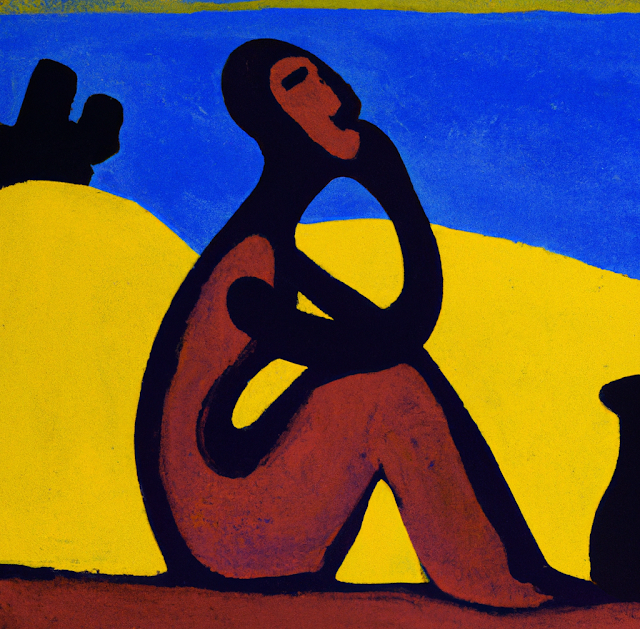
Painting of a man thinking about his identity. Courtesy of OpenAI's Dall-E

I've been reading Atomic Habits, a book that's opened my eyes to how people's lives are dictated by their habits. 

The more good habits you have -- eating right, exercising, learning a new language, reading books, writing a journal, etc. -- the better your outcomes in life. You'll be healthier, more mentally sound, financially stable, fit, sociable, interesting, joyful.

Conversely, the more bad habits you have -- drinking, smoking, nail biting, fast food, watching porn, binging Netflix, frivolous spending -- the worse off you are. Sick, tired, emotionally drained, anxious, empty, depressed, broke.

The book gives a new framing to an old problem of how to kick bad habits and stick to good habits. In it contains a unique lesson for believers. The reframing of this old problem has a life-influencing message for parents. It has broader implications for society. I don't think the author intended any of those meanings explicitly, yet there they were. I want to pass them on to you in this post, dear Kineti readers.

The old problem every person on earth has faced

First, what is the old problem? It's, "How can I stop doing [bad thing] and stick to [good thing]?"

How can I stop binge eating and lose weight?

How can I stop wasting so much time on TikTok and instead do something useful with my life?

How can I stop smoking and get good health?

etc.

That's the old problem. 

We have an urge to better ourselves. We have an idea where we're falling short in life. We try to fix it -- lose 20lbs, start eating vegetables every day, cut social media, go to the gym 3 times a week -- but these habits quickly fail.

Anecdote: I saw this firsthand a few years ago. When the new year arrived, I resolved to go to the gym once a week. In January, the gym was packed! By February, it was half empty, and by March, it was nearly abandoned. Everyone resolved to do good, but their resolution quickly failed with time.

Reframing the old problem

Atomic Habits says the reason our goals often fail is we are too focused on the outcome. Lose 20lbs. Quit smoking. etc. We must reframe the problem to one of identity:

  1. To change our outcomes, we must first change our habits. One cannot expect to reach a different outcome (lose 20lbs) while living the same way (eating fast food 3x a week).
  2. For the new habits to stick, we must change our identity.
The three ingredients here -- outcomes, habits, identity -- are like layers of an onion:

A picture of an onion with 3 layers. Outermost layer is labelled "outcomes", next layer is "habits", and the innermost layer is "identity"
Atomic Habits shows that a great way to change outcomes is by changing your habits. To effectively change your habits, you change your identity.

Everybody focuses on the outer layer: outcomes. Stop smoking. Stop drinking. Get fit. Read more. So we start a new habit -- go to the gym every week -- but we have trouble sticking to good habits and kicking bad ones.

Our habits return to old behavior as our motivation naturally wanes over time. Our resolutions fail and we return to our old ways.

The author explains a key to changing all this is going back another layer: identity.

Who are you? Are you a smoker? Are you a binge eater? A porn watcher? Is that who you are? That's identity. 

Identity is the key to changing your habits and sticking to them.

He refers to several studies for support. One study in particular struck me: a group of smokers who wanted to quit smoking was broken into two groups. The first group was told anytime they were offered a cigarette, they must respond, "No thanks, I'm trying to quit." The second group was told to respond, "No thanks, I'm not a smoker."

Can you guess which group did better at quitting?

The group that identified as non-smokers did far better than the first group. Their self-identity changed their habits. "I am not a smoker, so I will not be going on a smoke break. That's not who I am."

Want to stop doing X? Be the kind of person who doesn't do X.

Want to stop being late to everything? Be the kind of person who leaves 15 minutes early. Shape new habits accordingly: set your alarm to leave earlier. Make sure your car has gas before it's time to leave. Prepare your clothes the night before. Prepare a quick breakfast you can heat and eat in the morning. Best yet, your motivation to stick with these habits will last longer because you're not the kind of person who's always late. That's not you. 

As your consistently keep these habits, they go auto-pilot mode: you'll do them almost without thinking, as routine as getting dressed in the morning. And when you do those habits consistently, you become the person of your identity and your outcomes change. You're no longer the person who's always late. Victory.

It's not magic, but it's powerful. Identity is powerful. The author gives several such example studies where identity is a major component to changing habits and thus producing better outcomes in life.

I've begun to apply these in my own life, with some success: 

  • I want to read the Bible every morning. 
  • I want to stop browsing my phone while in bed when I should be sleeping. 
  • I want to stop scrolling social media in the morning when I need to get up for work. 
  • I want to stop biting my fingernails. 
  • I want to learn Hebrew. 
  • I want to write more (hence this post!)
  • I want to practice guitar more.

So, I shape my identity accordingly: I'm the kind of person who takes the Bible seriously. I'm the kind of person who doesn't miss Hebrew lessons. I'm the kind of person who is serious about improving his guitar skill. Now I've been shaping my habits accordingly, and it's going...good. I think I'll see some good fruit from all this.

Every time I carry out my habit of Bible reading, Hebrew learning, writing, is a vote for the kind of person I want to be. (And if I miss a lesson, skip reading? Well, that's a vote in the other direction.)

This key to fixing problems in your life by shaping your identity made me consider the importance of shaping the identity of our kids. 

Are you telling your kids they're stupid? Ugly? Dumb? "Clearly not a math major!" Suck at science? Calling them names when they do bad stuff? Swearing at them? This reinforces a negative identity in them at a time when their identity is in its earliest, most pliable stage. That identity sticks with them for life, friends.

There's a lesson to parents in there. I'll cover this in Part II soon.

Thanks for reading, folks.

What I Accomplished in 2021

Shalom friends.

As 2021 has come to a close, I thought I’d inventory what has been a good year for me, despite COVID and all the craziness.

In this post you’ll find some photos of myself and my family, our adventures, some Messianic things I’ve accomplished this year, and more.


And some personal highlights from 2021:

🎹 Added 16 new Messianic albums (240+ new Messianic songs!) to Chavah Messianic Radio
🎶 Raised over $15,000 for Messianic musicians via Messiah’s Music Fund
💰 Raised over $10,000 for Israeli charities through my non-profit, Bless Israel
👩‍💻 Rewrote MessianicChords.com from the ground up
📢 Created MessianicChords iOS app, Android app, and Windows app
📝 Added 100+ new chord charts to MessianicChords
🔯 Wrote a dozen or so articles on faith and life on this blog
😅 Got COVID and recovered
🎉 Spent a lot of time with my kids!
💗 Went on lots of dates with my wife!
🥾 Took a few hiking adventures, some by myself and some with the whole fam
💪 Began a daily exercise habit - 15-20 minutes, full sweat, every weekday
🕎 Practiced Hebrew with Duolingo each day of year, extending my streak to 1390 consecutive days of learning Hebrew
📖 Grew closer to God through Scripture study, family Bible lessons each week, prayer, church, worship, and church small groups
🏜 Read Dune
🔉 Launched a podcast with John K. McKee of Messianic Apologetics
🏄‍♂️ Went surfing for the first time
🎻 Joined the Proclaim Music Fest leadership team
🎸 Learned a dozen new songs on the guitar
💻 Got tech press articles on my work at Microsoft
🏈 Went to a Minnesota Vikings game and a Seahawks game
⛪ Joined the worship team at my church and led worship a few times
⚾ Joined a new softball team and made some new friends
😎 Helped a friend get hired at Microsoft and saw our friendship grow over the last year
⚡ Played a ton of Age of Mythology with my wife and son
🍿 Had game night or movie night with my family nearly every week of the year

This blog, the Kineti blog, also saw some love. I’m most proud of these posts:

Not too shabby! Here’s to a joyful, fruitful, good and upright טוב וישר year, friends. 🥂

Please pray for Aaron - his condition has worsened

Shalom friends,

Some of you know my younger brother Aaron drowned near his home in Israel. He has been in a coma since August.


We just got word from the embassy this morning that Aaron's condition has worsened and that he may die within weeks.

But life and death are ultimately in God's hands, so I ask you to pray for him. Proverbs tells us to "Trust in the Lord with your whole heart, and lean not on your own understanding." I don't know why Aaron drowned or why he is in a coma. I don't know why he would die. There's no understanding tragedies like this. So I trust that the Lord is good and does what is right.

I know that God has the power to raise up a person from the dead, let alone from a coma. But it's not our will, but God's.

There are numerous documented cases of God healing people from comas. My grandmother recently shared this article, referencing an article from USA Today where a young woman in a coma was declared brain dead and taken off of life support. Before she died, a family friend prayed for her, and to the surprise of her doctors, she woke from her coma and lived.

Of course, the other side is also true: numerous instances where a person in a coma was prayed for, and God sends no healing. God isn't a celestial butler to whom we make demands. We only ask His will.

And that's what I ask for you, friends: please pray for Aaron and ask God's will be done with his life. And read a psalm over Aaron, would you? I was reading Psalm 38 this morning after I received the news. The psalms were a huge influence on Aaron -- Aaron wrote many songs of yearning and longing based on the Scriptures -- and I think praying the Word of God over Aaron is good and right and holy.

With all that said, if Aaron lives, I'll bless God. And if he dies, I'll bless God.

Thank you, friends.

God wants us to enjoy the pleasures of the world

Quick, what is the first biblical commandment related to eating?

Most people, even those familiar with the Bible, will answer, "Do not eat from the Tree of Knowledge", referring back to Genesis 2. But this is incorrect. The first commandment is to eat from all the other trees, a commandment given in the first chapter of the Bible.

Jewish conservative luminary Dennis Prager argues this shows how people focus on the negative -- what we shouldn't do -- more than the positive. In his book, The Rational Bible: Genesis, Prager remarks:

This is like a parent taking a child to a supermarket and telling the child to take anything he or she wants....but then adding that one item, and only one item, is off limits. Human nature is such that most children -- and adults as well -- would focus on the negative prohibition. But God wants us to partake of the world's pleasures. The Talmud is quite emphatic about this: "In the future world, a man will be required to give an accounting for every permitted pleasure he could have experienced but refused to." (Kiddushin 4)

-Dennis Prager, The Rational Bible: Genesis

A great many Jews and Christians focus on the negative: don't eat this, don't do that, avoid this, stay away from that. We should avoid divinely forbidden things and for good reason; God understands what's ultimately good for humanity better than we do. But I wonder, are we falling prey to the same instinctual human tendency to focus solely on the negative?

And yet, God wants us to enjoy the permitted pleasures of the world. While there are 365 "you shall nots" in the Torah, there remains 248 "you shalls." Are we neglecting the latter?

This is a weird post for me to write because the world without God is all in favor of pleasure to do anything you want. But there seems evidence enough to explore seriously the idea that God wants us to enjoy the world.

Recently, two posts on social media had me thinking about this question of whether we should enjoy the pleasures of the world or forego them. I figure it's a good motivator for posting about it. 😊 Here are the posts:

1. 

2.

Both of these Facebook friends posted something about diet, and I found myself commenting on both of them. You've undoubtedly witnessed similar things in your own circles, whether the prohibition is against meat, soda, fat, sugar, lactose, gluten, carbs, or something else in the long list of once-permitted pleasures.

The first post about veganism is by a Messianic Judaism adherent who is giving up meat in the belief that "Adam through Noah didn't eat meat", and how "that's the way God intended us to live in the beginning", saying "I've always wondered why pre-Flood people lived so long."

The second post about soda is by a Jewish believer friend, and author of Messianic Meow satire site, who linked to a Washington Post article claiming that drinking soda leads to an early grave.

I don't mind that people eat vegan or skip soda. The New Testament addresses vegetarianism in Romans: "Let each man be fully convinced in his own mind." That's my philosophy about veganism, soda, and other disputable matters.

(With regards to the soda article, I am skeptical of such dietary research claims on the internet because of the combined problems of conflicting research conclusions and perverse commercial incentives from both researchers and publishers. That's a story for another time.)

When I see articles like these, I must ask, doesn't God want us to enjoy the world?

I don't mean forbidden things; whoring around, "enjoying" addictive vices, etc. Shooting heroin for the first time has been described as "being kissed by God", but the end result of heroin addiction is a satanic death grip that quite literally destroys your life.

When I say God wants us to enjoy the pleasures of the world, I of course mean permitted pleasures: hiking a beautiful mountain, eating tasty foods, boating on a pristine lake, enjoying a glass of wine, having sex with your spouse, meeting new people, eating a good bar of chocolate, listening to great music. Aren't these the sorts of things God wants us to enjoy?

Yet here we religious people stand, banning all kinds of things permitted by God. Some religious communities forego...

  • Electricity - Amish Christian
  • Mobile phones - Ultra Orthodox Judaism
  • Modern medicine - Amish, Ultra Orthodox Judaism
  • Blood transfusions - Jehovah's Witnesses
  • Bathing suits - fundamentalist Christian sects
  • Alcohol - Mormonism, Islam, certain Christian sects
  • A woman showing any skin besides her eyeballs - fundamentalist Islam
  • Hearing a woman sing - Orthodox Judaism
  • Mingling of men and women - Ultra Orthodox Judaism
  • Touching (e.g. shaking hands with) a woman besides your wife - Chabad Orthodox Judaism
  • Music - various Christian sects
  • Meat of any kind - various Christian and Hindu sects
  • Smoking - various Christian sects
  • Seeing the hair of any woman besides your wife - Ultra Orthodox Jewish sects, Islamic sects
  • Dancing - various Christian sects (heck, we have a Hollywood blockbuster devoted to this 😂)
  • No rubber on buggy wheels, so as to avoid making this life too easy - Amish Christian sects
...I could keep going, but you get the idea. Religious people like to forbid things that aren't forbidden by God. Isn't that a problem?

In the Torah, during the Biblical feasts when all Israel went up to the Temple, God commanded Israel to rejoice with eating rich foods and even commands Israel to enjoy strong drink for the holy days:

"[During the holy days] if [the Temple] is too far away for you to travel, then exchange your tithe for silver, and take the silver with you and go to the place the Lord your God will choose. Use the silver to buy whatever you like: cattle, sheep, wine or other strong drink, or anything you wish. Then you and your household shall eat there in the presence of the Lord your God and rejoice."

-Deuteronomy 14:23-27
One of God's commandments in the Torah is literally to eat some fresh red meat and drink strong alcohol, and thus, rejoice before God. That's not a message you'll likely hear on Sundays - or Saturdays!

The great preacher Charles Sturgeon seemed to have understood that it's good to enjoy life. He scheduled each day of his life down to the hour, so as not to waste any time the Lord gave him. But every week on his Sunday schedule, he allotted one hour to "smoke a cigar to the glory of the Lord." 😂

Likewise, Spurgeon is recorded to having eaten like a king, received excellent healthcare, vacationed in southern France, and traveled first-class. A laypreacher once confronted Spurgeon about this "decadence" during a chance encounter on a train. "I'm travelling third-class, saving the Lord's money", said the laypreacher. "I'm traveling first-class, saving the Lord's servant", replied Spurgeon.

Will eating lots of red meat shorten your lifespan? Maybe. Will drinking copious amounts of Coca Cola bring you to an early grave? It's entirely possible.

But, I'm personally willing to trade a little time in old age -- which may not be all that enjoyable anyways -- for a little joy here today. No diet, no lifestyle, no foregoing of life's pleasures will prevent your inevitable demise. As the comedian Redd Foxx once said,

"Health nuts are going to feel stupid someday, lying in hospitals dying of nothing."

Now, excuse me while I go eat a juicy, seasoned, medium rare T-Bone. Heaven requires it!

Holy Kvetching! When It’s Good to Complain to God

Summary: Don’t let religious façades fool you: not all complaining is bad. The psalms are filled with complaints to God about the broken state of things. When it’s OK to complain to God.

complaining

Ever notice how there are 2 kinds of complaining in the Bible – one wicked and one righteous?

Unrighteous complaint

Righteous complaint

The people of Israel were grumbling in the ears of Adonai about their hardship…

The grumblers began to have cravings, so the children of Israel began to wail repeatedly, saying, “If we could just eat some meat! We remember the fish that we used to eat in Egypt, for free—the cucumbers, the melons, the leeks, the onions, and the garlic! But now we have no appetite. We never see anything but this manna.”

-Numbers 11

God of my salvation,
day and night I cried out before You. For my soul is full of troubles, and my life draws near to Sheol.

You have laid me in the lowest places, in dark places, in the depths. Your wrath lies heavily on me.

You have put all my friends far from me. You have made me repulsive to them. I am shut in and I cannot go out. My eye fails from affliction.
..
Friend and loved one You took far from me. Darkness has become my companion.

-Psalm 88

In the first example, Israel is complaining about limited food selection while on the journey from Egypt to Canaan. The complaint is unrighteous; God’s anger burns against the people.

In the second example, the psalmist is complaining about his life troubles. The complaint is righteous; God listens to the psalmist’s prayer.

What’s the difference? When is it acceptable to complain to God?

Righteous complaining

Rooted in Torah’s Ryan White spoke at my congregation recently on life in the psalms. He showed how the Psalms reflect human reality; they’re not all joy and praise and happiness.

  • In Psalm 69, the psalmist lays bare his hardships to God, likening his life to a man slowly drowning. He keeps calling out to God for help; but his voice is weakening. He keeps looking for God, but his eyes are failing.
  • In Psalm 94, he calls on God to rise up and take vengeance on wicked people. How long will wicked people win; how long will good people continue to be walked on? People laugh and mock and say God pays no attention. Will the God who formed the ear not hear? Will the One who crafted the eye not see? Rise up, God! Pay back the wicked for all they’ve done!
  • In Psalm 137 – oh boy this is a doozie – the psalmist is utterly grieved by the Babylonians razing Jerusalem, destroying the Temple, and taking Israel captive. At the start of the psalm, he laments he can’t even sing God’s praises anymore. By the end of the psalm, he’s praying for the death of his captors and their progeny, blessing those who would kill even their children.
  • In Psalm 88 – which I jokingly call the Goth Psalm – is totally dark without any resolution at all. The whole psalm is a complaint, beginning to end. It concludes with the Simon & Garfunkle-esque, “Darkness has become my companion.”

In Psalm 94, the psalmist points out that the wicked are breaking God’s own laws: They slay the widow and the orphan and the foreigner – and they laugh about it, saying there’s no God to judge them. Where are you, God? Where’s Your justice? Rebuke their arrogant mouths! Rise up!

Who can blame the psalmist for asking where God is in that mess? There’s no wrong being done here.

The Psalmist calls out to God to keep his promises: God, they are afflicting your people, they crush your precious inheritance – won’t you speak out? Will you remain silent while your own people are destroyed before your eyes?

There’s no sin here. This is a righteous complaint.

In Psalm 88, the Goth psalm Smile, the psalmist is holding his hands out to God all day with all his troubles: God, don’t you care? I’m about to die! If things don’t change, I’m going the grave; everyone’s abandoned me, even my friends. God, help me!

What sin is there bringing these legitimate burdens to the Sustainer and Comforter?

In Psalm 137, the psalmist tells God to call to mind the evil that took place and to bring justice: Remember, Lord, what Babylon did when Jerusalem fell! Remember how they said, ‘Raze it to the ground! Strip it to its foundations!’ Oh God, aren’t you the Judge of the earth? Pronounce death on them for their utter contempt of your holy place!

You can’t blame the psalmist for this complaint. God set his name in Jerusalem forever, yet here are a bunch of idolatrous brutes razing it to the ground, raping and killing its inhabitants and having a good laugh about it. Bringing this to God in prayer is a righteous complaint.

Complaints reflect the brokenness of life

Some people might ask why these complaining psalms are even in the Bible. Isn’t the life of a follower of God all joy and happiness and provision?

Nope.

There’s a perception in the religious world, especially in the Christian Prosperity movement, that we’ll be blessed by God with possessions and money and prosperity.

God made no such promise.

While God does give joy and provides, to say we’ll be without needs or cares or troubles is a selective, narrow reading of the Bible.

And more importantly, it doesn’t reflect the reality of our own lives. I’ve never met a religious person who is all joy and no troubles. I’ve never seen a believer without hardships and problems, some of them so deep rooted and ingrained that there’s even a sense of hopelessness when you talk to them.

In such cases, people complain to God and are entirely justified doing so.

Being trampled on by bad people? Complain to God, tell him to make good on his promises.

Your enemies are doing whatever they feel like, while you’re maintaining a faithful life with God? Complain to God, tell him you want to see justice, and that you’re still waiting for vindication.

Has your life been one mess after another, despite all your prayers and faithful service to Him? Complain to God; why should wicked people live joyfully and securely while the righteous suffer? Call on God to keep his promise that he will listen to the cries of the troubled. Tell him to keep his promise that he’ll take vengeance on those who afflict the oppressed.

There’s no shame in these complaints because they’re calling on God to be faithful and rectify the situation.

Wicked complaining

By contrast, when Israel complained to God during the exodus, their complaints were not justified:

The people of Israel were grumbling in the ears of Adonai about their hardship…The grumblers began to have cravings, so the children of Israel began to wail repeatedly, saying, “If we could just eat some meat! We remember the fish that we used to eat in Egypt, for free—the cucumbers, the melons, the leeks, the onions, and the garlic! But now we have no appetite. We never see anything but this manna.”

-Numbers 11

It should be obvious why this is a wicked complaint. In case it’s not, let me rephrase the quote:

“Whaaaaaaaaa! I want meat! Not this stupid old food that is divinely provided from heaven every night by the hand of God who delivered us from Egyptian slavery and certain death.”

God already provided, and you’re complaining about that provision. That’s an unrighteous complaint.

(Nevermind that these people *would not have even been alive* had God not intervened, opened the sea, closed it on the pursuer, provided water and food, a fire by night and a pillar of cloud by day…)

And religious people today are too quick to complain with these illegitimate complaints. In Stop Your Religious Whining!, I argued that we often complain about illegitimate things.

  • “This chicken wasn’t raised in a cage-free environment! Don’t eat it!”
  • “Look at evil Big Pharma! I refuse to get medical treatment by modern witchcraft!”
  • “The government is so terrible! I want to hole myself up in my basement with my lifetime supply of toilet paper and prepper canned foods. When it all comes crashing down, I’ll be laughing from my heavily fortified concrete underground bunker.”

10980740_914054298634637_7494392940844601319_n

These complaints aren’t righteous.

Unlike the righteous complaints in the Psalms, there is no calling on God to keep a promise. No crying to God for help. No demands for justice.

These are nit-picky, first-world personal preferences made up in religious wrapping paper. They produce little good. I’m not saying you can’t be selective about your food or medical treatment. But don’t dress it in self-righteous religious wrapping when you abstain from that chicken that wasn’t raised in a cage-free, free roaming environment. Smile

God’s provided so much, we can default to gratefulness.

I won’t complain about food, because God’s provided an abundance and we’ve never had to live through a famine.

I won’t complain about medicine, because God’s provided it and we don’t suffer from devastating plagues of yesteryear.

I won’t waste my breath on the government; God’s provided such that we can actually practice our faith openly without persecution.

Faithful complaining brings complaints to God, but unlike faithless grumbling, it calls on God to keep his promises, deliver, heal, rise up and avenge; to rectify otherwise hopeless situations.

I cry aloud with my voice to Adonai.
With my voice I seek favor from Adonai.
I pour out my complaint before Him,
before Him I tell my trouble.

Psalm 142

The Spirit of Our Times

The German word zeitgeist describes the spirit of a period of history, the status of society and where it’s heading.

image

Consider where our culture is at today, in the 21st century United States. What is the spirit of our times; what are the ideals and philosophies driving us forward?

I’m no cultural expert, but I do have finger to the pulse of the culture – I’m a public speaker, a news junkie, an entrepreneur, a technologist, a congregation leader, an avid reader of subjects ranging from science to technology to religion. Through these mediums, one can sense the spirit of our times.

As I see it, the spirit of our times is:
  • Increasingly secular, if not atheist. Science is pitted as the enemy of religion and faith in public discourse and in Hollywood media. People of faith are portrayed as ignorant weirdo bigots, unwilling to progress with the times.

    This, despite many of the scientific pioneers of the West being devout religious men, including Newton, Kepler, Copernicus, Bacon, Galileo, Descartes, Pascal, Faraday, Mendel, and a host of others. Likewise for medicine, with many hospitals founded and staffed by devout men and women of faith.

    In the past, science has not been the enemy of faith. Why now?
     
  • Antagonistic towards religion. Despising forms of absolute morality, especially the Judeo-Christian perspective. The only morality permitted is the relativistic, make-up-my-own-as-I-go morality which is regarded as no worse than the the respected, detailed moral systems that produced Western Civilization.
      
  • Irreverent of human life. Lovers of abortion; making it quick, easy, and legal to murder an unborn child for almost any reason.

    Worse still, recent undercover investigation revealed that Planned Parenthood, a leading abortion provider in the United States, actually profits from taking whole unborn children, extracting and killing them, then selling their body parts to the highest bidder, roughly $120,000 month for one local Planned Parenthood operation.


    What great irreverence of life! That we’re willing to not only abort an unborn child for almost any reason at almost any point in the pregnancy, but we’re also profiteering off the human remains of the bloody butchery.
     
  • Suppresses the proliferation of life. The spirit of our times regards the traditional life-creating family of a man and a woman as passé, and instead amplifies as equal the non-traditional unions which are unable to produce life.

    Despite nature’s central role for women in childbearing and rearing, being a female homemaker today is frowned upon. Career equality with men is amplified instead, resulting in an a generation with much education and skill, but little wisdom. A low birth rate, a high abortion rate, and the amplification of alternative lifestyles that do not produce life has resulted in dozens of nations experiencing a decline in population.
    image
     
  • Cheapens human rights. The founders of the United States wrote that “man is endowed by his Creator with certain inalienable rights”, ascribing a divine origin to human rights.

    By contrast, today’s “social justice warriors” remove the divine origin from human rights and reassign that role to government, create new rights out of thin air, dole them out to whomever demands them, and demonize as backwards bigots those who question the newly-minted “rights.”
     
  • Celebrates drunkenness and foolishness by favoring the legalization of drugs and downplaying -- often ignoring! --the societal side effects of a healthy and productive population now seeking to get high on marijuana and other illicit drugs. It seems to me the public favoring drug legalization is in part a result of a media which glorifies drug usage.

    image

    It is difficult to imagine a mother of 4 getting high in front of her kids. Hard to imagine the destructive effect that would have on a family. And yet, it’s already legal in several US states and will likely push through the remaining states within the next 5 years.
     
  • Covertly despises Israel. Because Israel is a symbol of traditional values and the source of the hated Judeo-Christian morality, the one that birthed both Judaism and Christianity, the spirit of the times produces a double standard that singles out Israel and the Jews, resulting in anti-Semitism veiled as political activism.

    This happens on an individual, societal, and national levels.

    imagesIndividual: last month, after pressure from the anti-Semitic BDS movement, a Jewish music artist was disinvited from a multi-national music festival unless he issued a public statement defaming Israel.

    National: the UN repeatedly singles out Israel and condemns the world’s only Jewish state for human rights violations. Meanwhile, the UN remains silent on real human rights violations in North Korea and among the Palestinian terror groups; revealing a double-standard against Jews, a classic anti-Semitic play:


    Societal: it happens through old fashioned anti-Semitism, veiled today as anti-Zionism. I didn’t have to search too hard to find this top-rated commented on the above video of the Israeli Prime Minister:

    image
     
    And again on the international level:


  • imageIncreasingly lazy; promoting a weak work ethic through government handouts and assistance. The welfare system in the United States has grown unruly and gargantuan – costing citizens nearly $680,000,000,000 (Six-hundred eighty billion dollars) in 2013 alone.


    For many struggling families, especially those broken homes with absent fathers and single mothers, this reliance on the government has produced a perverse incentive in which it is more cost effective to receive heaps of government welfare than to attempt to work for a living.
    “A democracy will continue to exist up until the time that voters discover that they can vote themselves generous gifts from the public treasury.”
    To further the laziness, the fringes of the technology community has begun to advocate Basic Income: the idea that the government should just pay us all a basic income for doing nothing. No need to work!

    If the spirit of our times despises work and a hard work ethic, it’s no surprise, then, to see a socialist running for the 2016 US Presidential ticket, promising “free” government-supplied handouts as a key platform initiative in his run for the head office of the United States.
     
  • Considers nothing holy. Sacredness, holiness, and the beauty of something sanctified – set apart for a higher purpose – is lost through the irreverent spirit of our times. The internet has produced an irreverent and mean-spirited people. I stumbled on a great example of this while writing this post: the 2nd Google image search result for Declaration of Independence is a defaced image with a hand-drawn penis over it, with “faggot” scrawled over the top. (Thanks, Reddit!)

    Nothing is sacred because the spirit of our times says morality doesn’t exist. Holiness is a superstitious idea from ancient fools with no place in the modern world. And while irreverence isn’t a new problem, it is amplified today via the internet.
      
  • Feigns goodness but practices wickedness.
    • Social justice has become the term post-religious people use to make themselves feel better about living a life separated from God.
       
    • Social justice warriors fight for an ever-increasing number of newly minted "rights" which are granted not by the divine – as the US founders asserted in the Declaration of Independence – but are manufactured by the very ones demanding them. They are warriors for faux rights imagined by a lawless society aiming to justify its rebellion against God.
       
    • Hating downwards (poor, minorities) is passé, but hating upwards (wealthy, police, authority, God) is in vogue. Social justice warriors in self-righteous rants harp on eliminating downwards hate, meanwhile they practice and glorify upwards hate.
        
  • Unwilling to confront actual evil. The spirit of our times says morality is subjective, and thus, real evil doesn’t exist. Because evil doesn’t exist, there’s nothing to stand against.

    A person with no moral compass and nothing to stand against – what is such a person to do?

    Instead of confronting real evils – such as Iran’s fanatical ayatollah who openly calls for the murder of  all the world’s Jews – people busy themselves fighting make-believe evils like carbon emissions and income inequality.
      
  • imageContemptuous of the wealthy; covetous. Those who have worked hard to build their wealth are demonized as “the 1%”, a conspiratorial-like, faceless cabal who by devious means extract the wealth of the world from the rest of us. They hoard and flaunt their wealth over the have-nots, and are unwilling to pay their fair share of taxes.

    Meanwhile, no one can define what “fair share” actually amounts to, everyone wants the other guy to share his wealth, but no one wants to share their own wealth. The media harps on about the perceived evil of income inequality, resulting in hatred and contempt upwards; covetousness.
     
  • Promotes sensuality through the normalization of promiscuity, pornography, and homosexuality. Through print, television, and movie media, sexual deviancy is normalized, while those who see these as great moral failures are demonized as backward bigots who need to mind their own business.
     
  • Hates discourse and suppresses opposition. Are you pro-life? The media labels you anti-choice and against women; Sexist. Are you a supporter of the traditional family, a life-creating man and woman with their children? Your label is Intolerant and Homophobe.

    Once one of the 7 Demon Labels has been applied – Sexist, Intolerant, Xenophobic, Homophobic, Intolerant, Racist, Bigot, or SIXHIRB – no discourse nor engagement is required with you, you intolerant bigot! Just label and demonize, and voila, you’ve suppress your opposition without having to engage the subject matter.

    This effective form of the ancient practice of societal shaming has resulted in people unable to speak and act their conscience for fear of being shamed and their names dragged through the mud. After all, who wants to be called a bigot?
     
  • Despises law and societal order through the demonization of the police force. Riots and year-long protests arise because a policeman shot and killed a law-breaking thug, yet one is not allowed to speak this reality for fear of being labeled a racist.

    image
    Riots in Ferguson, Missouri. A fair trial and a jury of peers found the police officer who shot a man in self-defense to be innocent of crimes. Even so, the protestors turned violent, characterized by looting of businesses and destruction of property.
      
  • Loving the obscene; our magazines and media are covered in sexualized, objectified women, with banners of gossip, obscenities, and sensationalist garbage that slanders public figures.

A write this not as a complaint – I feel utterly blessed to live in this age.

Rather, I write this because it’s helpful to understand where we are today. To survey the obstacles and figure out where we need to go. Only then can we move forward, beyond the so-called progressive – better called regressive – agenda of the spirit of our times.

The spirit of our times is increasingly secular, hates discourse, loves the obscene, promotes sensuality, despises work and covets the possessions of those who work, is unwilling to confront evil, feigns goodness, considers nothing holy, celebrates drunkenness, hates Israel and the Jews, cheapens human rights, and does not revere human life.

This is how I see the spirit of our times, the zeitgeist of 2015. How do you see it? Sound off in the comments.

Custom comments