Import jQuery

Showing posts with label gospel. Show all posts

Messiah's Divinity in the Opening Verses of Mark's Gospel

One of the oldest manuscript fragments of the Gospel of Mark, known as P.Oxy LXXXIII 5345, estimated to be some 1800 years old.

Last week I was reading the gospel of Mark, widely believed to be the oldest of the gospels, and  stumbled on something I'd never seen before. 

In the opening verses of Mark's gospel, he shows Yeshua is God. Here's the verse in question, see if you spot it:

The beginning of the Good News of Yeshua ha-Mashiach, Ben-Elohim. As Isaiah the prophet has written,
"Behold, I send My messenger before You, who will prepare Your way. The voice of one crying in the wilderness, 'Prepare the way of ADONAI, and make His paths straight.'"
John appeared, immersing in the wilderness, proclaiming an immersion involving repentance for the removal of sins. All the Judean countryside was going out to him, and all those in Jerusalem. As they confessed their sins, they were being immersed by him in the Jordan River.

Those are the opening verses of Mark. Do you see the reference to Yeshua's divinity?

Folks tend to focus on the "Yeshua the Messiah, son of God" statement.

But notice Mark's quote from Isaiah. In fact, it's a quote from Malachi (Mal. 3:1) and Isaiah (Is. 40:3). Let's break it down:

"Behold, I will send My messenger before You, who will prepare Your way."

This is a quote is from Malachi 3:

הִנְנִ֤י שֹׁלֵ֙חַ֙ מַלְאָכִ֔י וּפִנָּה־דֶ֖רֶךְ לְפָנָ֑י וּפִתְאֹם֩ יָב֨וֹא אֶל־הֵיכָל֜וֹ הָאָד֣וֹן ׀ אֲשֶׁר־אַתֶּ֣ם מְבַקְשִׁ֗ים וּמַלְאַ֨ךְ הַבְּרִ֜ית אֲשֶׁר־אַתֶּ֤ם חֲפֵצִים֙ הִנֵּה־בָ֔א אָמַ֖ר יְהֹוָ֥ה צְבָאֽוֹת׃ 

Behold, I am sending My messenger to clear the way before Me, and the Sovereign you seek shall come to the temple suddenly. As for the angel of the covenant that you desire, he is already coming.

Notice in Malachi, God is sending a messenger before "Me" -- before God himself. Mark is saying, "God has sent a messenger to prepare the way for Himself."

Mark then quotes Isaiah 40:3:

קוֹל קוֹרֵא--בַּמִּדְבָּר, פַּנּוּ דֶּרֶךְ יְהוָה; יַשְּׁרוּ, בָּעֲרָבָה, מְסִלָּה, לֵאלֹהֵינוּ

A voice rings out:
“Clear in the desert
A road for the LORD!
Level in the wilderness
A highway for our God!
Who is the road being cleared for? The LORD. The text is unmistakable on this point: it uses the divine name יהוה here and calls him "our God" אלֹהינו.

Mark says John the Baptist appeared as this messenger who would prepare the way for the LORD our God.

In Mark, John the Baptist is the messenger, and Yeshua is the LORD our God.

All in the opening verses of our oldest gospel. 

I have read the Gospels many times but never noticed this. 

Keep reading the Bible, dear Kineti readers, there is new insight and wisdom to be found even if you've read it a hundred times before!

Theological Overlap between Maccabees and the Gospels

There is some interesting theological overlap between II Maccabees and the Gospels.

Intro to II Maccabees notes,

"It is a very Jewish book; its basic interpretative model is the Song of Moses, according to which God providentially cares for the Jews but hides his face when they sin, thus allowing foreigners to persecute them until the shedding the blood of his servants works atonement..."


In Maccabees, the blood of God's servants works atonement and God's anger against Israel relents.

In the Gospels, the blood of God's servant messiah works atonement and God's anger against mankind relents. 

A Holy Encounter at 3am in the Kansas City Airport


It was around midnight and I was driving to the airport on my way back from Proclaim Messianic Music Festival.

My flight wasn't until 5am, but I didn't like the idea of sleeping an hour or two only to wake up and drive at 2am. So I resolved to drive to the airport early and try to sleep in the airport or on the plane. 

I arrived to the airport around 1am and went to check my one piece of oversized luggage: my guitar case. But at this hour in the morning, no flight attendants were at the check-in counter. I saw several people sitting on a nearby bench and realized they were all waiting to check their luggage too.

I walked over there and sat down, trying in vain to get some sleep. 

(I'm convinced modern airport benches are specially designed to prevent people from sleeping in them. They're rock solid, no cushion, no head rest. First-world problem I know, but still! 😅)

Unable to sleep, I grabbed my luggage and went to the restroom and drinking fountain.

I returned to the bench with my luggage and guitar case in hand.  That's when a stranger sitting near the bench asks me,

"You playing music for us tonight?" 

I laugh and we get talking about guitars. He tells me his name is Mike. He pulls out his phone and shows me pictures of his guitar collection. The guy has a dozen or so beautiful, expensive guitars. A guitar collector and music lover.

He asks if he can see my Gretch, so I take it out of the case.

"Mind if I play?" 

I give it to him. (And, for a brief moment in the back of my mind, I thought, "Oh man, I hope this isn't a crazy guy who'll run off with my guitar...")

He plays a blues tune. He's clearly talented. He talks to me about his interests in blues and punk rock. Throws some names of bands that, to his amazement, I've never heard before.

He hands the guitar back to me and asks me to play something.

I played a bit of one of my favorites, Mi Kamocha El Shaddai by Micha'el ben David. Simple song in English and Hebrew taken from the psalms.

Mind you, this was all a little weird and out of my comfort zone. The people around us on the bench definitely raised some eyebrows!

He asks about that music I'm playing. I tell him I'm a follower of Jesus with a Jewish background. I play a lot of Jewish Christian music.

We get talking about God and religion.

"No, I don't believe in God. I've read the Bible. A lot. I don't believe it, man. I believe in people, not in God.", he tells me.

I don't argue. I just listen.

He tells me stories about his past. Some time ago, he was in church and someone told him dinosaurs never existed (?!) and that proved to him religion wasn't for him. He gave me some examples of religious abuse. They had merit; there have been a lot of bad religious people.

After hearing Mike's objections, I said,

"Mike, all those things you said may be true. But you know, it doesn't change whether God is real or not.", I told him.

He nodded a bit and we talked more about it. I told him there's good evidence God exists, and evidence that Jesus was raised from the dead. I told him about the basic evidence for Jesus' resurrection

He didn't seem impressed.

The topic changed and I asked him why he's travelling and where to.

"My son just dropped me off here at the airport tonight."

"Oh cool. Spending some time with him over Father's Day weekend then?"

"No man. My son doesn't like me, Judah. He just dropped me off here."

He goes on to tell me about his family trouble. His wife had left him. His kids resent him because he hasn't been there for them. When his wife left, he was depressed, couldn't focus. His employer ended up firing him.

He felt guilty about all this. "My kids hate me. My wife left me. I'm unemployed. I'm a monster."

"No, man. You're going through a hard time. Don't tell yourself you're a monster; don't believe that lie."

"I don't mean to lay all this on you. It's not your problem", he tells me.

"So with all this, Mike, why are you flying?"

"Judah, I'm in a meatgrinder!", he says and pauses.

"Everything is falling apart. I can't take it anymore. I'm flying to my mom's."

He never mentioned suicide, but there was real distress in his voice.

We talked for another hour about family, life, and more.

It was around 3am, and finally a flight attendant approaches the counter to check us all in. People start getting up and heading to the counter.

Mike turns to me and says, "Man, we could've been sitting alone staring at our phones like everyone else. But we met and talked for hours instead."

He smiles.

"Good meeting you, Judah."

Mike reaches out to shake my hand.

I shake his hand and say, "So glad I met you, Mike! Can I pray for you, right now?"

He pauses. "Ah...ok."

While still holding onto Mike's hand in the middle of that airport, I pray out loud a short prayer. I ask God to help him make it through. To repair the broken relationship with his kids. To give Mike what he needs.

I open my eyes. Mike has tears in his.

He hugs me and says goodbye.

Readers, I'm convinced this was a God-orchestrated appointment. God used it to plant a seed of the Gospel in this man. 

Pray for Mike, friends. I think the Lord wants him.

(Thank you, Lord, for divine appointments! Save Mike and bring your son back.)

What Technology, Science, And Medicine Can’t Solve

image

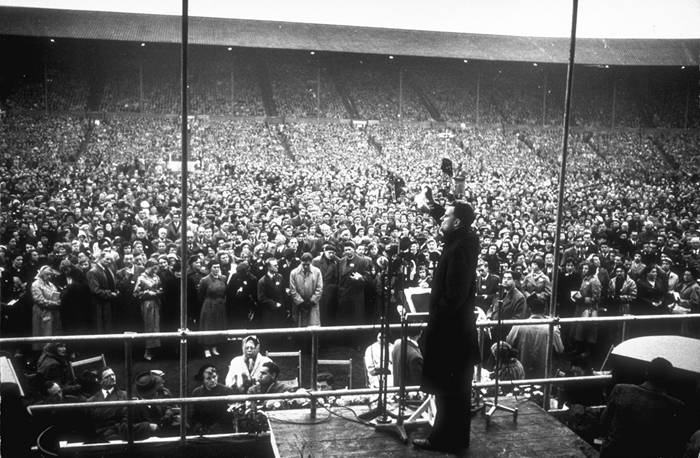
The Reverend Billy Graham passed away this morning at the age of 99. I think the world has lost its greatest servant of God.

Even for the non-religious, Graham is a remarkable figure. He spoke to more people than any other human being who has ever lived, reaching over 42 million people in person, preaching the message of the Jewish Messiah in 105 nations. He reached many kinds of people in different walks of life.

Graham reached me in the strangest of places.

Several years ago he gave a fantastic TED talk to a group of Silicon Valley technologists:

As a technologist myself, I was first surprised to see a preacher giving a TED talk! TED talks are for the technological, the futurists, the skeptics, the thinkers – what could an old fashioned preacher possibly say to this audience?

I was cringing before the video began, figuring it would be cliché old-hat religious pitches.

But Graham’s short 15 minutes on stage was something else entirely.

He first put me at ease with his gentleness and honesty. He acknowledged and praised the wonders of technology and modern medicine – noting how he personally benefited from science and medicine. Of the even-greater potential for technology and medicine, Graham says, “I would like to live in that [great future] age, but I won’t, because I’m 80 years old, and my time here is brief.”

Graham spoke a truth that was hard for me to swallow. In his gentle way, Graham broke a delusion that, I think, holds sway over many lovers of technology, science, and medicine. A delusion that has often held sway over my own thinking.

That truth? He showed that technology won’t – indeed, can’t –  address the worst problem humanity has. Science, technology, and medicine – for all it’s wonders and good – cannot address the human heart and its propensity for evil.

We technologists don’t like to hear this. We self-delude ourselves into thinking technology will solve virtually every problem humanity has.

For example, Google co-founder Larry Page (#9 on the world’s wealthiest people) has funded a company intended to solve death and make humans live indefinitely.

Microsoft’s Bill Gates is eradicating the last holdouts of polio around the world, and is tackling malaria next.

Amazon’s Jeff Bezos has made virtually every product available to any person with a tap of a finger.

SpaceX’s Elon Musk is bringing humanity to Mars and beyond.

Tech startups aim to disrupt nearly every industry, making life better and easier and more convenient.

Modern medicine has solved numerous diseases through antibiotics, vaccines, and new novel treatments for everything from cancer to heart disease to AIDS.

Science has helped us understand germ theory, the need for sanitation, decreasing illness and containing plagues that would otherwise kill thousands.

Science has shown us how to produce bigger crops yields, reduce draughts and prevent famines through crop irrigation, pest control, automated farming, genetic editing, and more.

The most optimistic thinkers among us believe that science-based medicine will eventually cure nearly every human disease.

And they might be right.

But you know what cannot be cured? The human heart and its bent towards evil.

Graham argues,

“Have you ever thought about what a contradiction we are?

On one hand we can probe the deepest secrets of the universe, we dramatically push back the frontiers of technology…we’ve seen under the sea, three miles down, we’ve seen hundreds of billions of years out into the future [through cosmology].

But on the other hand, something is wrong… [at this moment] we are ready to go to war with Iraq. What’s wrong with this? Why is it there are wars in every generation, in every part of the world?… We can’t get along with other people, even in our own families? We find ourselves in the paralyzing grip of self-destructive habits we can’t break. Racism, injustice, violence sweep our world, leaving a tragic harvest of heartbreak and death. And even the most sophisticated among us seem powerless to break this cycle.”

Why is it that no matter how advanced we are – and what wonders of science and technology and medicine we’ve achieved! – why is it that we’re so evil? Even increasingly so.

Why is it that in the 20th century – in which we saw the invention of the car, human flight, the computer, the internet, the eradication of polio and smallpox and a host of other diseases – why is it that we also experienced the greatest evils the world has ever seen in Nazi Germany and the brutal Communist dictatorships responsible for the death of over 100 million people in a single century?

Where is the disruptive tech startup that fixes human evil?

Where is the vaccine that prevents human wickedness?

(Or, on a smaller scale but more recent headline, why is it that 70% of the worst domestic shootings in US history occurred in the last 20 years, most recently last week’s Florida school shooting which killed 17 kids?)

Why isn’t technology addressing that?

Where is the disruptive technology startup that fixes human evil?

Where is the vaccine that prevents human wickedness?

All silly questions of course: science, technology, and medicine do not and cannot address the worst problem humanity has: the propensity for evil. It doesn’t even attempt to.

“I would like to see Oracle [the technology company] or some other technological geniuses work on this problem: how do we change man so that he doesn’t lie and cheat. So that our newspapers aren’t filled with stories of fraud in business, labor, athletics, and wherever else.”

Graham notes the real origin of the problem, and says that it cannot be addressed by science, technology, medicine, or any other future innovation.

“The Bible says it’s within our heart, without our souls. Our problem is, we’re separated from our Creator, who we call God. And we need to have our souls restored: something only God can do. ‘Out of the heart comes evil thoughts.’ Murder. Sexual immorality. Theft. False testimony. Slander.”

But he doesn’t just quote the Bible to this secular rationalist audience. He cites the rationalist’ own chief prophet, the atheist Bertrand Russell,

“The British philosopher Bertrand Russell, who was not a religious man, said, ‘It’s in our hearts that the evil lies, and it’s from our hearts that it must be plucked out.’”

I wonder how many of today’s rationalists could even agree with Russell’s statement about evil. I suspect very few could without apologizing and redefining terms. In my experience, many rationalists to try to muddy the waters by claiming there is no real evil, no real good. (One prominent atheist author stated that without a Commander, the commandment is useless; without a Lawgiver there is no real law, and morality is subjective.)

Graham mentioned his meeting Albert Einstein, and how Einstein too saw the problem of real evil:

“Einstein made this statement: ‘It’s easier to denature plutonium than to denature the evil spirit of man.’”

He shows that beneficial technology can be used for remarkable evil. Technology can be twisted to into something corrupting. Graham noted the early internet and viruses as examples – 20 years later, I’d say it’s worse than that: I am thinking of internet porn, the objectification of women enabled by it (and the corresponding bad fruit of rampant sexual misconduct we are experiencing today), blackmailing ransomware attacks, digital theft, online harassment that has caused people to commit suicide, and the nasty verbal abuse enabled by the anonymity of the web.

Technology is great, but can be used for great evil, Graham says.

The problem is not technology. The problem is the person using it. King David said he knew the depths of his own soul. He couldn’t free himself from his personal problems and evils that included even murder and adultery.

Graham says our heart and our soul is something not measured by science, not addressed by medicine, left untouched by technology.

“And it yearns for God, and something more than technology. And it’s that part of you that yearns for meaning in life, and it seeks for something beyond this life. It’s part of you that yearns for God.”

It was Graham’s yearning for God that led him, in the early 1950s, to desegregate the churches and assemblies where he was speaking. At one notable event, Graham himself walked down and cut the ropes segregating the white and black sections of the audience, and told the people that Christianity is neither white nor black, and that the Messiah is Lord over all.

Graham’s own death today, remarkably, revealed the hearts of people, some for good, some for evil.

While past US Presidents praised Graham, others showed utter contempt:

Why the hate? Evil hearts.

Some folks, particularly secular leftists, felt condemned by Billy Graham’s Bible-based preaching. While Graham boldly preached in the 1950s that “there is no Biblical basis for segregation”, it’s with that same boldness he consistently spoke against sexual immorality as defined by the same Bible: adultery, promiscuity, and homosexuality. For this, some on the left demonize him and celebrate his death today.

Celebrating the death of a righteous man is, well, wicked.

This is the same wickedness of the human heart that is left unaddressed by science, technology, and medicine.

What addresses human evil?

God gives a tangible way to solve evil. It’s not easy. It’s not glamorous.

Evil – the problem unaddressed by science, technology, and medicine – is addressed by God in this way: each person must acknowledge the evil he’s done.

That takes humility. Acknowledging your own faults before God and people. It’s good for the soul.

Then, that person asks for forgiveness – both of God and the persons wronged.

Then, that person makes restitution – both with God and the persons wronged.

Then, that person – now with a softened and humble attitude – changes his behavior. The person is transformed from a wicked person into someone who reflects God’s own character. An angry and abusive alcoholic becomes a gentle, soft-spoken and clear-minded light for humanity. A drug addict turns his life around. A man turns a corner in his life.

We’ve seen this happen a thousand times; it actually works. It’s King David’s repentance. It’s Paul life-turn-around. It’s the message of Jesus and the Hebrew Prophets. It’s a cure for the worst problem humanity has.

And Billy Graham preached that message his whole life. To paupers and Presidents. And to everyone that would listen.

"Someday you will read or hear that Billy Graham is dead. Don’t you believe a word of it. I shall be more alive than I am now. I will just have changed my address. I will have gone into the presence of God."

-Billy Graham

The world has lost – for now! – one of its greatest servants of God. His hope in the resurrection – a hope that Jews and Christians share – will one day be realized in full for the great Reverend Billy Graham. May his memory be a blessing for you as it is for me, fine Kineti reader.

Thinking outside the religious box on universal healthcare

Performing a checkup

Here’s a little thought experiment which might lead to some unpopular-but-righteous directions: should disciples of Yeshua support universal healthcare? And if so, who provides and pays for that care?

Followers of the Jewish Messiah have a religious obligation to support universal healthcare:

For I was hungry and you gave me something to eat, I was thirsty and you gave me something to drink, I was a stranger and you invited me in, I needed clothes and you clothed me, I was sick and you looked after me, I was in prison and you came to visit me.’

“Then the righteous will answer him, ‘Lord, when did we see you hungry and feed you, or thirsty and give you something to drink? When did we see you a stranger and invite you in, or needing clothes and clothe you? When did we see you sick or in prison and go to visit you?

“The King will reply, ‘Truly I tell you, whatever you did for one of the least of these brothers and sisters of mine, you did for me.’

-Messiah to his disciples, Matthew 25:35-45

Universal healthcare – the idea that healthcare should be provided to everyone – is an idea with some support in the gospels. Is a brother or sister ill? Then we are to take care of them and visit them when they are sick. Think of this as the original “universal healthcare.”

Does this require us to support social justice policies such as government-enforced universal healthcare? The question has been on my mind lately, given the recent introduction of universal healthcare in the US and the leftist politicians who are promising to further that policy.

Before we can answer that question, we must first clarify what we mean by universal healthcare, severing political ties in the process. Political bias clouds the mind, so let’s analyze this issue outside of politics and look at it from a strictly moral perspective. Let’s pretend no political party is affiliated with universal healthcare; let’s look at it with fresh eyes from a Biblical perspective.

Universal healthcare. “Universal” is hyperbole, of course: it’s more accurately called “worldwide healthcare.” (I’m always amused by titles involving the universe, such as “Miss Universe.” SmileI digress.)

When we in the US talk about worldwide healthcare, we’re actually talking about healthcare specifically for this nation. While the political left may desire healthcare implemented worldwide, when we speak of universal healthcare in the US, we’re really just talking about it in our nation; it is more precisely called national healthcare.

And it isn’t enough to call it national healthcare, because what we’re really talking about is national healthcare provided by and paid for by the US government. We’ll call this government-sponsored national healthcare: the idea that every person in the nation should receive healthcare, and the government pays for that.

Should disciples of Messiah support government-sponsored national healthcare?

Alas, we’re still not done severing the politics from this one. The simple person will stop here and say, “The government wants to pay for something I previously had to pay for? Are you kidding? Why not!”

But the wise person understands the government has no money to pay for anything. It’s like saying your dog is going to pay for your dinner at a fancy restaurant; you dine exquisitely, only to discover you are required to stay and wash the dishes. 

Let’s not wash the dishes. Since the government has no money of its own, the government must borrow money from someone to pay for it.

Unfortunately, the government doesn’t have to borrow. It can forcibly take money from its citizens. And since it writes the laws, the government can transform this form of theft into something legal: taxes.

So, the government is going to use the money it confiscated from its citizens to pay for government-sponsored national healthcare.

But wait! The government already used up all the money it confiscated from us; from whence cometh the coin to care for the health of 300 million citizens? Smile

The answer is new taxes and more confiscation.

Why would citizens ever allow their own government to increase their own tax burden? It’d be like seeing a proposition, “Will you permit us to take more of your money by force?,” and deciding to vote YES. Lunacy, yeah?

Ah, but the political left in the US has very effectively demonized a minority in the US to suit this very purpose, and they plan on confiscating money from that group and duping people to go along with it.

The group is, of course, “The 1%”, a faceless, conspiratorial-like cabal of super-wealthy people. By most measures, they’re people who earn $300,000/year or more in income, which is a lot of money to be sure. But since the Evil 1% are a tiny minority who have lots of money, the majority of the citizens feel it no great sin in coveting their wealth, demanding they share it with the rest of us. (It’s hard to call it sharing the wealth, since sharing implies a voluntary action.)

The 1% is a societal outgroup, a minority that society does not identify with and feels justified in persecuting. This outgroup is demonized, and we openly discuss passing laws that would make seizing their funds easy and legal, and thus, pay for the greater good of government-sponsored national healthcare for the rest of us.

With a outgroup in place and  thoroughly demonized by left-leaning media and politicians, many citizens are ready to pull the handle and vote YES on the Take Money Away From Citizens proposal, as long as that money is being taken from somebody else, and for the purpose of giving us free stuff.

So, we’re really talking about government-sponsored national healthcare paid for by confiscating money from wealthy citizens.

Does God require the righteous to support that?

We’re pretty sure God wants us to take care of people’s health, especially in our own communities. But the Bible is silent when it comes to the role of government in healthcare.

One could argue the Bible gives us the example of setting up a government (kings, judges, elders of Israel) with a military for the defense and wellbeing of a nation, and by a big stretch one could argue that’s a form of healthcare. But whether a government should also tax its citizens additionally in order to pay for that, there is no real example.

So, what are we to do when the Bible is silent on an issue?

The first step is to be honest. God is silent about government providing healthcare for its citizens. Since God is silent about this, we cannot claim, as some religious leftists do, that God commands government-mandated healthcare, or that this government-sponsored form of social justice helps create the Kingdom of Heaven.

(Side note: The socialist utopias leftists dream of and try to institute through government policy may, in fact, be an emanation of the deep-seated longing humanity has for the real Kingdom of Heaven, where suffering and injustice is taken away. But I digress again.)

So, we acknowledge it’s extra-biblical; an idea without biblical evidence for or against.

OK, but that still doesn’t answer whether followers of Israel’s Messiah should support it. To answer that, we must look at existing Biblical principals and apply them to our question.

Let’s do this by applying the biblical principal of charity. Charity is a great analogy to healthcare, because healthcare might be considered a form of charity, and because God requires of us both charity and healthcare, and because giving to charity is considered a righteous act by leftists and rightists alike, by Judaism and Christianity, it crosses political and religious boundaries. It might be considered a universal (wink) good work.

God explicitly commands charity in the Bible. One example:

Every third year, you must set aside 1/10th of all your produce and give it to the fatherless and the widow, the Levite and the foreigner, so that they may eat and be satisfied.

-God speaking to Israel, Deuteronomy 26:12

How can we apply this principal of charity to the question of government-funded healthcare?

Since God commanded both charity and healthcare, let’s play a game where we peer into the future and imagine the tables turned, swapping healthcare for charity.

City of the futureSuppose 20 years from now, in the year 2035, there is a movement among right-wingers called Universal Charity. An idea which provides a basic good – giving to charity – for all people in the United States. Everyone should give to charity; who can argue with that?!

But, there’s a problem. Not everyone has money to give to charity. Some people are too poor to give to charity; some cannot afford to give to charity at all!

How does the US Republican Right of the future implement Universal Charity? How can they pass the Affordable Charity Act of 2035?

They do so by having the government give to charity for you. On behalf of each citizen, the government will donate to a charity of its choosing. (The President at the time had promised, “Don’t worry, you can keep your charity, and use the charitable organization of your choice!”, but that turned out to be a false promise, a political play meant to pass the bill into law.)

Alas! In the year 2035, the government is inefficient and bloated and not very frugal; all of its monies are spent on other things. There is no money left for the Affordable Charity Act.

But the 2035 Republican Party had a solution to this, too: they would increase the taxes on the top 0.5% (half of the top 1%!). A tiny sliver of the population of the US, even in 2035. image

By requiring the top 0.5% to pay more taxes, citizens no longer have to give to charity; the government simply gives tzedakah for you. Now, everyone’s righteous! Everyone’s giving to charity!

Would this be a good thing? Would God deem a person righteous for giving to charity, seeing as how they taxed the top 0.5% and used that money to give to charity?

Well, it’s not really giving to charity at all, is it.

If I take your money and give it to charity, I’m not really giving to charity. I’m stealing from you and giving it away. The fact that I gave your money to charity does not cancel my theft of your dollars, no matter how rich you might be.

I think this answers our question.

“Should disciples of the Jewish Messiah support government-sponsored national healthcare by increasing taxes on the top 1% wage earners? No, clearly not.”

Should disciples of the Jewish Messiah support government-sponsored national healthcare by increasing taxes on the top 1% wage earners? No, clearly not. Just as a person taking your money and giving it to the poor does not fulfill the mitzvah to give to charity, neither does taking money from the top 1% and using it to fund national healthcare release a person from the divine command to visit and care for the sick.

Who should provide the healthcare?

I began this post by asking, “Should disciples of Yeshua support universal healthcare? And if so, who provides and pays for that care?”

We have answered the first question: we have a command from the Master to care for the sick, thus, we should support healthcare for at least those in our community, if not for all people.

As for the 2nd question, who provides and pays for that care, the answer is not the government. The divine command to care for the sick is on us, as individuals, not on the government. We cannot use the government as our crutch and say, “I pay taxes, therefore, I do not need to care for the sick.”

But this is an insufficient answer, then, isn’t it? We asked, “Who provides and pays for healthcare”, and we answered, “Not the government!”

OK, if not the government, then who?

Today, we have a problem that didn’t exist in the 1st century: healthcare is prohibitively expensive. Even wealthy people today would have difficulty paying for healthcare out of pocket. Treatment for serious diseases can easily surpass 10 years’ wages. So, we pay for healthcare insurance, which spreads the exorbitant cost over a lifetime. Contrast this with the 1st century, in which seeing a doctor may have cost some money, but not likely on the same scale as today.

In the 1st century, a man who was ill may have stayed at home and rested until he was well, or until he died. Hence Messiah’s words, “I was sick, and you looked after me”, speaking as though no one may be looking after the sick.

Some might argue, “Then we should not visit doctors or go to hospitals at all!”

But this is foolish and obtuse; physicians certainly existed in Biblical times – Bible scholars even suggest that Luke, author of the book of Acts and the gospel of Luke may have been a physician himself – and there is no biblical injunction against seeing physicians. Indeed, many Western hospitals were – and still are today – founded and staffed by the devoutly religious, and this is why we have hospitals named after saints image(“St. Thomas Hospital”), religious sects (“Minneapolis Methodist Hospital”) or righteous and holy things (“Sha’arei Tzedek Jerusalem Medical Center”). We even associate religious symbols with healthcare, such as the Red Cross, the snake raised on a pole, or Magen David Adom.

So the answer is not, “God doesn’t want us to have healthcare at all; just stay home and get well (or die).” This answer is foolish and disconnected with reality.

Some religious purists might argue that God intended healthcare to be faith healing. Heal all the sick through faith, the laying on of hands, anointing with oil, and prayer. But this doesn’t seem to align with the Bible, given that Messiah commanded us to visit and care for the sick. (Why would we visit and care for people we could simply heal through faith?) Nor does it align with reality: if faith healing worked this way, hospitals would be empty and religious people would not suffer, yet reality shows otherwise.

So the answer is not, “God didn’t expect anyone to remain sick; everyone should be healed through faith.” While God does command us to lay on hands and indeed God can and does heal people, the sick will always be among us. This is a reality of a world in an imperfect state.

We as individuals are still on the hook to keep Messiah’s command to visit the sick and care for them and their families in any way we are able, and that can include procuring professional healthcare by doctors and hospitals; often, they are your best chance at getting well, and throughout the Scriptures, God favors the preservation of life.

Who should pay for that healthcare?

Given that ultra-expensive healthcare is a phenomenon foreign to the original audience of the Bible, God is silent about who pays for healthcare. Can we apply a similar Biblical principal to give us an answer?

One example that comes to mind is how God does indeed account for the poor in the Scriptures: while a family was required to bring an offering to God – say, a whole ram, a valuable and expensive offering – a poor person was permitted to bring only a bird, or even grain in some cases.

Applying that principle, I’d suggest that if a person is unable to afford expensive healthcare, he should do what he is able. Sometimes this means fewer visits to the hospital, opting to stay home and avoid expensive treatments where possible. A man begging for food need not require organic filet mignon.

The principle in which the community helped their poor by directly giving 1/10th of their produce could also be applied here. Should an ill person require expensive healthcare – say, surgery – and he is unable to pay for it, it is our duty as the religious community to care for our own and come together to pay for the cost. Just as the community provided food for their own, so should the community provide healthcare for our own.

Keep in mind, this does not imply indirect care, such as paying taxes to provide care for others. Nor does this imply care through confiscation, such as raising taxes on others to provide healthcare for all. Rather, this is direct care, individuals helping individuals. No government or taxes or politics involved.

Finally, should both the individual and community be unable to pay for required medical care, righteous and responsible religious healthcare providers, such as the myriads of religious hospitals and doctors, should provide a final safety net and provide the care regardless of payment. (And the righteous individual receiving the care, and his religious community, should reciprocate by paying for the care over time.)

Conclusions on our thought experiment

We did a little thought experiment about healthcare. We followed that trail wherever it led, politics be damned.

In my honest observation, a righteous people who follow the God of the Bible ought to:

  • Be in favor of healthcare for all. Messiah commands us to care for the sick among us.
  • Ought not support the Affordable Care Act. Government-mandated healthcare paid for by the confiscation of wealth of others is neither righteous nor a divine command. It is the product of a covetous society that demonizes a minority group, the 1%, and wishes to confiscate their wealth. While its intentions – to provide healthcare for everyone – is indeed a noble goal, the means to this end is not. It is a human corruption of a divine ideal.
  • Visit and care for the sick, regardless of who is providing and paying for healthcare. This is an imperative from the Master; doing this is valued as though we were caring for and visiting the Messiah himself.
  • Lay hands, anoint with oil, and pray for our sick. James, the brother of the Messiah, commands that the elders of a community should practice this and the confession of sins to one another. These, coupled with the prayer of a righteous and faithful person, and God will heal the sick among us.
  • Get medical treatment as needed. The reality of a sinful and fallen world is that disease plagues humanity. This is a divine law set in place due to human sin, and this law that sickness will be upon mankind appears very early in Biblical history (in Genesis!) and isn’t taken away until the restoration of all things (in Revelation). Like the poor, the sick too will always be among us. If a person is ill and needs medical attention, we should seek to preserve life through medicine; there is no shame in doing so, and indeed modern medicine is a blessing from God which can alleviate suffering and even cure disease.
  • Get treatment within our means. The Biblical example is not that the poor pay nothing, but rather, that the poor pay what they are able. This is shown to us in how God accommodates, but doesn’t exempt, the poor in their offerings in the Temple.
  • Help pay for the medical needs of their community. The Biblical example is that the community took care of their poor directly, by setting aside 1/10th of their produce every 3 years and feeding them with that holy portion. Likewise, a Biblical community could set aside funds to help the poor within it by directly helping with medical care.

It seems to me universal healthcare is a good and righteous thing that should be provided for not by the government through confiscation of wealth, but by the righteous charity of individuals, religious communities, and religious hospitals.

What do you think? Sound off in the comments.

The gospel is not “Believe in Jesus so that you’ll go to heaven”

Quick: what is “the gospel”?  

In my corner of the religious world, I’ve often heard the gospel described as believing in Jesus so that you’ll go to heaven when you die.

That may be an outcome of the gospel – trusting in God's Messiah produces resurrection and eternal life – but it is not the gospel itself.

Look at the first 4 books of the New Testament – the gospels – you’ll find a different message:

John: “Repent! The kingdom of God is near.”
-Matthew 3

Yeshua: “Repent, for the kingdom of God is near.”
-Matthew 4

Peter: “Repent and be baptized, every one of you, in the name of Yeshua the Messiah for the forgiveness of your sin.”
-Acts 2

See a common theme? The Messiah, the Messiah’s Elijah, and the Messiah’s chief disciple share this message.

The gospel is actually a very old message, with a new urgency. In a nutshell, the gospel is: "Turn from your sins to God." This is the same message of the prophets in the Hebrew Bible. 

And the new urgency is: "Because the Kingdom of God is near."

The Kingdom of God: the Messianic Era

imageThe arrival of the long-awaited Messiah was a divine down-payment on the promises of the good things to come, an assurance that God's Big Plan, including the epic this-changes-everything Kingdom of God, was near. Therefore, we must turn from sin now and turn back to God.

The Kingdom of God is the final empire on earth in which all nations are in submission to God, with God’s Messiah reigning over all nations. This Kingdom of God, this Messianic Era, is drawing near, and the arrival of King Messiah himself is evidence of its nearness.

In the Messianic Era, atheism and agnosticism will cease to exist given the empirical evidence of God. World religions will crumble with revelation that there is only one God. The rebellious nature of humanity will be quelled as the world acknowledges God and recognizes the goodness in following God’s ways. Adultery, murder, theft, and other crimes decrease and finally cease, as the adversary is put away, no longer permitted to deceive humanity, producing humans that see clearly the folly and destruction of sin.

“In the Messianic Era, we will all ☪☮e✡i✝ under one King.”

In the Messianic Era, we will all ☪☮e✡i✝, but under one King: all people, races, nations, philosophies, science, religions, and ideologies will submit to the King of all Kings. The whole populace of earth will acknowledge God and worship him.

Humanity united under one king will produce real actual genuine world peace, instituted by the Prince of Peace, the great Jewish King reigning from Jerusalem, Yeshua the Messiah.

This is the Kingdom of God, this is the Messianic Era.

Knowing the Messianic Era is near means there’s no time to waste: turn back to God now. That’s the gospel. That’s the core message of Yeshua, John, the disciples, and Paul. It’s the old message of the prophets, but with a new urgency knowing that God’s making good on his promises, and with Messiah’s arrival, it’s all starting to happen now.

This is a snippet from my recent teaching at my local congregation:

Elementary Principles of Messianic Faith, Part III

Custom comments