Import jQuery

Showing posts with label eternal destinies. Show all posts

Eitan Bar: "When I was a Messianic, Catholics were pagans who will burn forever in hell"

I've written before about Eitan Bar, the Israeli evangelist who was fired from his role at One for Israel for having a romantic relationship with an employee under him. Since that time, Bar has written books and posts that run against the grain of the Messianic world, particularly against Christian sexuality, Calvinism, the doctrine of hell as eternal torment, and even Messianic Judaism itself.

On Facebook today, Bar wrote about the Messianic movement and its negative view of Catholicism.

It spurred comments from Jews and Christians, including some well-known Israeli Messianic Jewish leaders like Ron Cantor and Dan Juster.

He starts off with,

When I was part of the Messianic movement, a highly fundamentalist form of Evangelicalism, the message about Catholics was clear: they were pagans, God despises them, and they would burn forever in hell. We were discouraged from associating with Catholics, and the few who did often found themselves marginalized or boycotted.

My parents were both part of the Catholic Church and left it before I was born, so this post piqued my interest. Are Messianics too negative on Catholics and other Christian groups?

I grew up in the Messianic movement and can confirm the movement has a general negative feeling towards Catholicism. I haven't personally heard the extremes of Catholics burning in hell forever. But the core is probably true: Messianic believers generally view Catholicism negatively.

There are reasons for that. Catholic faith requires believing in a co-redeemer, Mary, alongside Jesus. It requires the prayer to saints, not just to God. It requires affirming Papal ex cathedra rulings as infallible. Some of that is dangerously close to idolatry. I admire many Catholics and have Catholic friends and consider them brothers in faith. Some significant parts of their theology are foreign to the New Testament and the original Jewish followers of Jesus. I am convinced it will be foreign when Jesus returns to Jerusalem as the Jewish Messiah. But it doesn't preclude salvation or fellowship.

How should we in the Messianic movement look at groups outside of our own? I believe two very important measures for that are salvation and fellowship. I say those two measures because they are two issues addressed in the early church in the New Testament (e.g. Acts 15 and Romans 10). Salvation and fellowship are still relevant for today.

Salvation: when you die, will you be with God?

Fellowship: can we spend time with you in religious settings? Are we family in God?

For Catholics, I answer yes to both questions:

  • Salvation: This is up to God, and not me, but the New Testament says, "If you believe in your heart that Jesus is Lord, and that God raised him from the dead, you will be saved." Catholics believe this; it's a core part of Catholic faith. 
  • Fellowship: Since Catholics are part of the family of God, they're fellow Christians and I can (and have!) learned from them. I could fellowship with them in religious settings, despite significant theological differences.
Even early Protestants, including Luther himself, did not advocate for a schism where Protestants could no longer fellowship with Catholics. That wall of division developed later through escalation, war, torture, and all sorts of horrible things committed by both sides in the last 600 years. I think that wall is a mistake.

I've long advocated for a big tent faith: expand your tent to allow many in. Better to have many with varying beliefs, than a tiny few with uniform beliefs. Yes, I think megachurches are superior to tiny, closed sectarian groups. Especially in light of the reality that every religious group is almost certainly wrong about something; no one has theology that perfectly aligns with heaven's reality. Better to love many, as love covers a multitude of sins.

But.

There's a limit to big tent theology.

I couldn't have a big tent with Hindus, for example. Hindus worship Krisna, Ganesh, and a plethora of false gods. The reason I can't welcome them into my tent of faith should be obvious: it would compromise core parts of my own faith. The Torah is jam packed with prohibitions on idolatry, with explicit commandments to destroy idols, to avoid supporting or defending idolaters, even commandments to burn idolatrous cities in Israel. Embracing people who worship other gods is a tent too big. What unity can God's people have with people who reject the one true God or worship other gods?

One commenter on Bar's post said in support of Bar's newfound love for Catholics,

I was taught and believe, "If you love Jesus you are part of the family".
I responded, "That sounds nice, but it would mean we must consider Muslims part of the family. They love Jesus and consider him an important prophet."

I can't take Muslims into my big tent of faith. They fail the salvation test and the fellowship test:

  • Salvation: Muslims don't believe Jesus is Lord, they believe him a prophet. They don't believe God raised Jesus from the dead; they believe Jesus wasn't crucified at all.
  • Fellowship: Muslims believe Christians and Jews are to be subservient to Muslims and must pay a special tax in any Muslim-controlled land. Those Christians and Jews who resist this were (and still are, in some parts of the world) put to death. 
Dan Juster, a leader in the Messianic Jewish movement, commented on Bar's post, suggesting that allegiance to Jesus is the most important matter:

There is a book by Matthew Bates, Salvation by Allegiance Alone. A great book argues that it does not matter what denomination one is part of, Catholic, Proestand, Orthodox, Messianic Jew, Pentecostal. In each stream allegiance is the central issue. Then we add, Jews who come to faith are the saved remnant of Israel, the sanctifying first fruits (Rom. 11:5, 11:16)
I replied to Juster, "Allegiance is important, but I wonder to what extent theology matters for salvation and fellowship. For example, Mormons hold allegiance to Jesus, but consider him one of many gods, alongside the Heavenly Mother, Satan and millions of others. Additionally, they are preaching a second gospel, the Book of Mormon."

Are Mormons saved? Can we have fellowship with them?

  • Salvation: This is up to God, but I suspect God will save them because they believe Jesus is Lord and God raised him from the dead.
  • Fellowship: Much murkier. I personally have no qualms hanging out with Mormons in a non-religious context; they tend to be morally upright and genuine people. But I couldn't fellowship with them in a religious context because of the idolatry in their faith. According to Joseph Smith, only Mormons are Christians. Mormons don't consider Christians to be true Christians. It's difficult to call them part of the family of God when they don't consider you the family of God.
Israeli Messianic leader Ron Cantor also chimed in, saying how he really has fought to maintain good relationships with Catholics and others outside of Messianic Judaism.

But all this newfound love and togetherness strikes me as false and shallow. 

For years, Juster and others have issued papers and spoke at conferences and urged their followers to avoid fellowshipping with Messianics of slightly different stripes. One Law Messianics, Two House Messianics, Hebrew Roots folks and others were blacklisted from Messianic events. Musicians who performed at One Law congregations were blacklisted. I personally had a leading Messianic Jewish congregation in Minnesota tell his congregants not to associate with me because I adhered to a different ecclesiology as he did. I had one Messianic rabbi, who is not Jewish, telling the IAMCS Rabbis forum to avoid associating with me at a Messianic music event because he affiliated me as a Messianic with a different stripe.

Heck, just a few years ago, I wrote about how one Messianic pastor in Israel labeled all forms of Torah observance as heresy. 🤪

I'm not bitter about that, and I forgive them and give it to the Lord. I only raise it to show that Messianic folks have likely been far too small-tent. I would welcome a change for big tent Messianic faith, even if it meant building bridges to Catholics and other Christian groups.

As for Eitan Bar, I don't know him or his situation personally. I've only read about it from him and from people tangential to the situation, so I could be misreading this. But it seems to me he's resentful of the Messianic movement because it called out his sexual sin. This is a game that has played out so many times in the Evangelical world Bar now rejects; there's even memes about it!


When an Evangelical pastor rebukes a member for adultery, pornography, homosexuality or other sexual sin, the member leaves and complains about church hurt. In reality, they're in denial about sin. I kind of wonder if that's playing a role in Bar's own distancing from the Evangelical and Messianic world. From my outside perspective, that's what it looks like. I suppose Bar knows the truth, as does the Lord.

Bar blasts Evangelical fundamentalism, but honestly, they're one of the few groups actually calling out sin. And calling out sin is a very Biblical thing to do.

Bar has one thing right, though: the Messianic movement has been too closed and too sectarian, too quickly condemning other Christians as unsaved and fit for hellfire. But Catholics are not going burn forever in eternal torment. That's just not what the original reformers had in mind, and frankly, contrary to the New Testament.

While Juster and Cantor and other Messianic Jewish leaders seem to agree and desire an more open Messianic Judaism, they need to start in their own camp: an openness to Messianic believers who have ever-so-slightly different ecclesiology, nomology, soteriology. 

Human Ageing in View of the Divine

Summary: Science-based medicine is inching closer to extending the human lifespan. If, in the distant future, people can live forever, does that change our faith and religion, given its promise of eternal life? Warning: This post speculates about a future that may never happen. Even so, it’s worth exploring.

image

I've been reading a fascinating book by Dr. Michael Fossel, professor of clinical medicine, Michigan State University. Fossel is an optimistic proponent of the telomere theory of ageing. This theory states:

  1. Humans age because our cells age.
  2. Cells age because they stop dividing after a certain number of divisions (called the Hayflick limit).
  3. Cells stop dividing because the caps of the chromosomes, called telomeres, shorten with each division.
  4. When telomere caps are too short, the cell ceases dividing and eventually breaks down, slows the production of energy, and releases excess garbage in the form of free radicals.
  5. When your cells are unable to repair themselves and remove cellular garbage, your skin, tissue and organs begin to break down.
  6. As your body stops repairing itself and your tissue breaks down, you eventually succumb to a disease of old age, such as cancer, heart disease, or Alzheimer’s.

This is the telomere theory of ageing in a nutshell. (I’m a layperson, not a medical professional, so take my simplified summary with a grain of salt.)

It should be noted there are other theories of ageing currently in scientific circles, such as the theory of damage accumulation, the theory of life force, the theory of free radicals, among others.

“Big if true…”

Suppose for a moment Fossel’s theory is correct. Fossel theorizes that extending your cells’ telomeres will actually reverse cellular ageing processes and help prevent the diseases of old age. He theorizes:

  1. Your cells will resume dividing like they did when you were young.
  2. Young dividing cells will better repair you skin, tissue, organs and immune system.
  3. With your body now repairing itself and recycling cellular damage, you’ll be less prone to diseases of old age, like cancer, heart disease, and Alzheimer's.
  4. A human body that is always fighting off diseases of old age will live longer if not indefinitely: you’re not limited to 70 or 80 years. Your lifespan would be limited only by external factors (e.g. getting hit by a bus).

Dr. Fossel cites experiments which he believes proves the telomere theory of ageing. He says if we take skin cells from an elderly person and grow them in the lab, it will predictably produce old skin: weak, thin, easily tearable. Likewise, taking skin cells from a young person and growing them produces young skin: thick, strong, rugged skin. The moment of truth came when Dr. Fossel took the elderly skin cells and extended their telomeres. The result? The elderly cells acted as though they were young, and produced young skin.

This has significant implications beyond removing skin wrinkles from the elderly. Diseases of ageing, like heart disease and cancer (currently the number top 2 leading causes of death in the West) can be combatted by this same technique.

Fossel recently founded a new medical company, Telocyte, to apply these techniques in modern medicine. Their first target? Alzheimer’s disease. This disease of old age is the result of a breakdown in cellular function that clears plaques from the brain. As this recycling breaks down in old age, plagues build up on the brain, killing brain tissue and reducing cognitive function, eventually resulting in death.

Fossel believes by lengthening the telomeres of cells responsible for the cleanup of plaques on the brain, we can not only prevent Alzheimer’s, but even reverse it in existing patients.

A healthy skepticismbrain-salt-l

Before I go any further, a word about critical thinking.

Disciples of Yeshua in the 21st century desperately need a healthy skepticism. The internet, for all its blessings, is also a curse: an overload of information. Many people believe what they want to believe, and the internet quickly supplies it.

In the Hebrew Roots movement in particular, I’ve seen many people believe all kinds of nonsense. Conspiracy theories, flat earth, all-natural elixir cure-alls and other quackery.

This skepticism should apply to medical science as well. I am skeptical of the claims of Dr. Fossel, and you should be too. While he may not be a quack selling brain salt elixir, his theory could be wrong, or too simple, or any number of variables could invalidate it. It’s too early to tell, and the proof will be in the pudding. If we see Fossel’s company curing Alzheimer’s disease by 2025, then we can start to get excited. But until then, it’s just another claim in a sea of (mis)information.

Humans are going to live longer regardless

Whether the telomere theory of ageing holds or not, one thing is certain: humans are living healthier, longer lives. In the last 250 years science-based medicine has more than doubled human life expectancy:

The advent of surgery, vaccines, and antibiotics has greatly increased human lifespan worldwide.

200 years ago, it would be rare to see a person live to 70. Today, it’s the norm and we think nothing of it.

If this trend continues – and it likely will barring an apocalyptic event such as World War III – future generations will likely enjoy a longer lifespan. Fewer instances of cancer, heart disease, and other diseases of old age.

Consider the present: humanity has already eradicated small pox, nearly eradicated polio, and we have a cure for Hepatitis C.

New medical innovations like CRISPR enable us to cure genetic diseases; last month (November 2018), the FDA approved an investigational new drug application that aims to cure Leber Congenital Amaurosis, the leading cause of childhood blindness.

Eventually, humanity may reach a point where human disease is all but eradicated. At that time, humans may live indefinitely.

Eternal life in Christianity and Judaism

If medical and scientific progress continue, it’s likely humans will eventually live very long, if not indefinitely.

This got me thinking:  What does it mean for people of faith if science-based medicine allows us to live forever?

Judaism and Christianity are united in hope of eternal life via resurrection. It’s so central to our faith that the Apostle Paul said our faith is in vain if there’s no eternal life:

“How can some of you say there’s no resurrection of the dead? If it’s true there’s no resurrection, then Messiah wasn’t raised. And if Messiah wasn’t raised, our faith is in vain.”

-Apostle Paul, Letter to Corinth

It’s central to mainstream Judaism as well. The fundamental 13 principles of Jewish faith include a confirmation of the resurrection:

“I believe with perfect faith that the dead will be brought back to life when G-d wills it to happen.”

-Maimonides, 13th principle of Jewish faith

This is the eternal life that Judaism and Christianity speak about: that one day, at the time God sees fit, God will raise the dead back to life and we will live with Him on earth. This is the “Kingdom of God” spoken of in the gospels; the Olam Haba (Age to Come) that Judaism is waiting for.

For us, this message of the resurrection is based on an actual historical event: Messiah was raised from the dead by God some 2000 years ago. It’s not merely a matter of faith, but also one of evidence. The early disciples of Jesus knew whether he was dead or not – if anyone hid the body or made a false claim about his resurrection, it would have been them – and yet, all of them went to their brutal deaths proclaiming it to be true, refusing to recant: this man Jesus literally rose from the dead and appeared to them in the flesh after his death.

The idea of eternal life has impacted to billions of believers through the ages.

For example, at Hanukkah we remember the Maccabees who firmly believed that “after our death Abraham, Isaac, and Jacob will receive us and all our forefathers will praise us” (4 Maccabees 13). It was this conviction of eternal life that empowered them to stand up to a wicked and brutal empire. “You may kill us today, but one day we will be living again.”

For Christians, it was this same message of eternal life – now tangible and nearer with Jesus’ resurrection – prodding on the early believers to preach the risen Jesus, even with the threat of torture and death through Rome’s sadistic brutalities.

And on the darker side of things, it’s the same hope of eternal life that animates Islamic extremists to commit suicidal terrorism, believing they will enter Paradise with Allah for murdering unbelievers.

The hope of eternal life is still powerful today.

The recently deceased President George H.W. Bush hoped for eternal life, anticipating seeing his wife and his 3 year old son “on the other side.”

Messianic Jewish pioneer and Rabbi Stuart Dauermann spoke of his conversation with a dying woman, a skeptic of eternal life:

The medical technician said, “Lady: that’s the biggest tumor I ever saw.” And it was on her liver.

Lillian didn’t have long to live, and we had a conversation.

She said to me, “Ah, what the hell. When you’re dead you’re dead.”

I responded, “Lillian, you don’t know that. You’ve never died before!”

That brought her up short.

I then went on to say, ”Look, Lillian. Yeshua said this,  ‘I am the resurrection and the life. Whoever believes in me, though he die, yet shall he live, and everyone who lives and believes in me shall never die.’ Now, if some guy standing on a streetcorner says this, or some other clown, you could dismiss it as the rantings of a fool. But when a person who lived the most remarkable life ever lived, and whose life and teachings have had compelling force for thousands of years says this, then it’s something else entirely.”

She was listening now. I went on.

“Lillian, it’s like playing a game of poker. You can take all your chips and put them on your proposition, ‘When you’re dead you’re dead.’  Or you can take those chips and place them on Yeshua who said that by believing in him and in what he said, you will continue living even on the other side of death. Which choice will you make?”

She gave a smart answer. No surprise. “Well, I don’t have much choice do I?”

I agreed.

Eternal life is a powerful hope indeed!

But what if Lillian had a choice? What if her choice was, “Keep being a skeptic of faith if you please; medicine will cure your cancer.”

If humans can one day attain eternal life without faith and religion, what does that do to faith?

Addressing religious objections to medical life extension

Some may think this is a non-issue. Some of you fine readers will say,

“The Lord will return before then.”

Maybe so, but maybe not. It’s been 2000 years. What’s another few hundred? No one knows.

“It’s not our place. Extending human lifespan is playing God.”

Maybe. But many religious people used to think that surgery was also playing God, but I bet none of you will turn down life-saving surgery today.

Additionally, God commanded humans to subdue the earth. Doesn’t that include subduing disease?

“This is crazy talk. We’ll never solve death.”

That’s entirely possible, even likely. But the trajectory of history shows an increasing lifespan thanks to medicine and science. If the trajectory continues, we’re looking at very long lifespans, possibly indefinite lifespans. You may think I’m crazy, and you might be right. But it’s my blog, and I get to think out loud even the wild-eyed thoughts! Smile

“It’ll never happen, because God decreed death as a curse in Genesis.”

God did curse humanity with death in Genesis. But that curse included men working by the sweat of our brows and women having great pain in childbirth, and both of those have been alleviated.

Let me tell you, friends, I work hard, but I don’t sweat and I don’t work the fields. I consider that a blessing. My God-given technological skills have allowed me to provide for my family without back-breaking field tilling. And even if I was a farmer, I’d utilize technology – GPS-guided tractors, engines, crop rotation, irrigation, and more – so that farming isn’t so terrible an existence.

As for the curse on women, my wife gave birth just last year. She didn’t have much pain in childbirth thanks to the wonders of modern medicine. Ditto for our other 2 children, both of whom are happy and healthy.

In short, the “curse on humanity” is still here – people are still dying, men are still working, and women still have pain in childbirth – but all those things have been alleviated by technology and medicine. Perhaps the curse of death can be alleviated as well.

Religious outcomes of medical eternal life

Maybe some of my readers will reject one or both, but suppose both are true:

  • Eternal life provided by God is real
  • Science-based medicine will provide eternal life, or something close to it.

Supposing both are true for a moment, what would religion look like?

The powerful message of eternal life that has animated so many Jews, Christians, and Muslims would probably be less impactful.

“Will you live forever?” will be answered with, “If I want to.”

That removes a reliance on God in some way.

Impactful statements from God will be less impactful. John 3:16’s famous, “All who believe in Me will not perish, but have everlasting life” would be rendered passé.

There will still be the desire to live with God – enter the Kingdom of Heaven, the Olam Haba – but that won’t be as powerful if death isn’t looming over every head.

So, I suspect religion and faith would be in decline because of one its central fruits would be duplicated by science and medicine.

On the other hand, it could make death even scarier for some. Like the man in a horror film running away from his tormentor, closing door after door on his pursuer, so too the person running from death through all kinds of medical interventions, trying everything to keep death at bay.

Maybe humans are designed to die, whether biologically or spiritually speaking. I spoke with my grandmother a few months before she died, talking to her about medical innovations that could extend human life. She told me, “I’d pass. I’m ready to die when the time comes, and I don’t want to live here forever.”

It took me by surprise. What I wish I would have asked her is, “Are you saying that because of all the pain and health trouble of old age? Would you still say that if you were healthy?”

As a healthy 35 year old, I want to live forever. I don’t want to die. But maybe time will change me.

Another interesting potential outcome of very long or indefinite lifespans is a good one: the accumulation of wisdom.

Young people are idiots who think they know everything. (I submit this blog post as evidence! Winking smile) Older generations have learned lessons that youth have yet to learn. The elderly have lived, experienced, and learned lessons difficult to pass on merely through words. And even if they could be transmitted by words, the young aren’t listening; they already know everything.

Having long-living people would likely increase humanity’s wisdom. Our leaders would likely be the more elderly people with more wisdom. Wisdom would dictate avoidance of war, because people who have experienced the hell of war would go to great lengths to avoid it. Culture would begin to see the elderly as wise, rather than as the nearly-irrelevant dementia-riddled burdens today’s culture views them as.

Long or indefinite lifespans would have repercussions worldwide; overpopulation would likely pressure us to move to other planets. Resource scarcity might produce war and famines. I won’t discuss these here, as I want to focus only on its impact on faith.

If science-based medicine can cure diseases, reduce suffering, and even give us eternal life, where does that leave faith? It will be a disruptive time.

Conclusion

The lame walk, the deaf hear, the blind see, all because of modern medicine. Some see this in an atheistic light – “Look what we did…without God!”

But maybe God is the platform here, and we are built atop it. God told us to take dominion over the earth and subdue it. Subduing disease surely falls in line, then, with God’s own commandment to humanity, one that predates even the curse of death.

The appearance of Messiah 2000 years ago changed the world forever; even our reckoning of time (BC/AD). It also ushered in an era where the Christian ethic reigns: compassion, healing, feeding the poor, caring for the needy, hospitals, medicine, food and more are in abundance. Perhaps modern medicine is an outgrowth of Christianity. Indeed, many western hospitals were founded by pious Christians; many hospitals still bear names like “Saint Joseph’s” or “Methodist Central.”

Viewed in that light, modern medicine and its ultimate goal of wiping out disease is of godly origins. I welcome it. But how will your faith be affected, fine Kineti reader, if you can achieve eternal life in the here and now through medicine alone?

What Technology, Science, And Medicine Can’t Solve

image

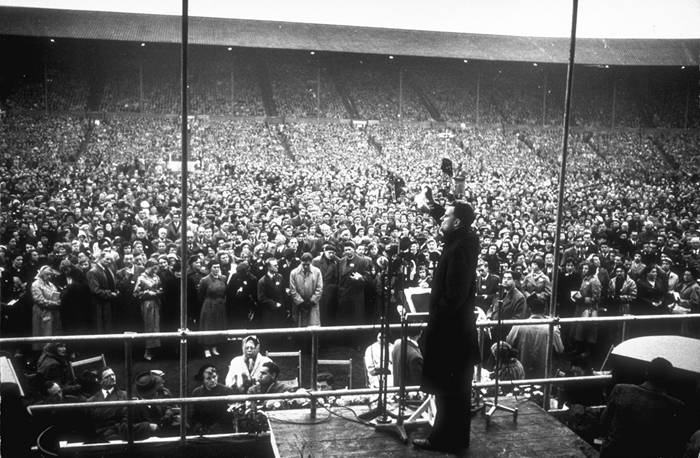
The Reverend Billy Graham passed away this morning at the age of 99. I think the world has lost its greatest servant of God.

Even for the non-religious, Graham is a remarkable figure. He spoke to more people than any other human being who has ever lived, reaching over 42 million people in person, preaching the message of the Jewish Messiah in 105 nations. He reached many kinds of people in different walks of life.

Graham reached me in the strangest of places.

Several years ago he gave a fantastic TED talk to a group of Silicon Valley technologists:

As a technologist myself, I was first surprised to see a preacher giving a TED talk! TED talks are for the technological, the futurists, the skeptics, the thinkers – what could an old fashioned preacher possibly say to this audience?

I was cringing before the video began, figuring it would be cliché old-hat religious pitches.

But Graham’s short 15 minutes on stage was something else entirely.

He first put me at ease with his gentleness and honesty. He acknowledged and praised the wonders of technology and modern medicine – noting how he personally benefited from science and medicine. Of the even-greater potential for technology and medicine, Graham says, “I would like to live in that [great future] age, but I won’t, because I’m 80 years old, and my time here is brief.”

Graham spoke a truth that was hard for me to swallow. In his gentle way, Graham broke a delusion that, I think, holds sway over many lovers of technology, science, and medicine. A delusion that has often held sway over my own thinking.

That truth? He showed that technology won’t – indeed, can’t –  address the worst problem humanity has. Science, technology, and medicine – for all it’s wonders and good – cannot address the human heart and its propensity for evil.

We technologists don’t like to hear this. We self-delude ourselves into thinking technology will solve virtually every problem humanity has.

For example, Google co-founder Larry Page (#9 on the world’s wealthiest people) has funded a company intended to solve death and make humans live indefinitely.

Microsoft’s Bill Gates is eradicating the last holdouts of polio around the world, and is tackling malaria next.

Amazon’s Jeff Bezos has made virtually every product available to any person with a tap of a finger.

SpaceX’s Elon Musk is bringing humanity to Mars and beyond.

Tech startups aim to disrupt nearly every industry, making life better and easier and more convenient.

Modern medicine has solved numerous diseases through antibiotics, vaccines, and new novel treatments for everything from cancer to heart disease to AIDS.

Science has helped us understand germ theory, the need for sanitation, decreasing illness and containing plagues that would otherwise kill thousands.

Science has shown us how to produce bigger crops yields, reduce draughts and prevent famines through crop irrigation, pest control, automated farming, genetic editing, and more.

The most optimistic thinkers among us believe that science-based medicine will eventually cure nearly every human disease.

And they might be right.

But you know what cannot be cured? The human heart and its bent towards evil.

Graham argues,

“Have you ever thought about what a contradiction we are?

On one hand we can probe the deepest secrets of the universe, we dramatically push back the frontiers of technology…we’ve seen under the sea, three miles down, we’ve seen hundreds of billions of years out into the future [through cosmology].

But on the other hand, something is wrong… [at this moment] we are ready to go to war with Iraq. What’s wrong with this? Why is it there are wars in every generation, in every part of the world?… We can’t get along with other people, even in our own families? We find ourselves in the paralyzing grip of self-destructive habits we can’t break. Racism, injustice, violence sweep our world, leaving a tragic harvest of heartbreak and death. And even the most sophisticated among us seem powerless to break this cycle.”

Why is it that no matter how advanced we are – and what wonders of science and technology and medicine we’ve achieved! – why is it that we’re so evil? Even increasingly so.

Why is it that in the 20th century – in which we saw the invention of the car, human flight, the computer, the internet, the eradication of polio and smallpox and a host of other diseases – why is it that we also experienced the greatest evils the world has ever seen in Nazi Germany and the brutal Communist dictatorships responsible for the death of over 100 million people in a single century?

Where is the disruptive tech startup that fixes human evil?

Where is the vaccine that prevents human wickedness?

(Or, on a smaller scale but more recent headline, why is it that 70% of the worst domestic shootings in US history occurred in the last 20 years, most recently last week’s Florida school shooting which killed 17 kids?)

Why isn’t technology addressing that?

Where is the disruptive technology startup that fixes human evil?

Where is the vaccine that prevents human wickedness?

All silly questions of course: science, technology, and medicine do not and cannot address the worst problem humanity has: the propensity for evil. It doesn’t even attempt to.

“I would like to see Oracle [the technology company] or some other technological geniuses work on this problem: how do we change man so that he doesn’t lie and cheat. So that our newspapers aren’t filled with stories of fraud in business, labor, athletics, and wherever else.”

Graham notes the real origin of the problem, and says that it cannot be addressed by science, technology, medicine, or any other future innovation.

“The Bible says it’s within our heart, without our souls. Our problem is, we’re separated from our Creator, who we call God. And we need to have our souls restored: something only God can do. ‘Out of the heart comes evil thoughts.’ Murder. Sexual immorality. Theft. False testimony. Slander.”

But he doesn’t just quote the Bible to this secular rationalist audience. He cites the rationalist’ own chief prophet, the atheist Bertrand Russell,

“The British philosopher Bertrand Russell, who was not a religious man, said, ‘It’s in our hearts that the evil lies, and it’s from our hearts that it must be plucked out.’”

I wonder how many of today’s rationalists could even agree with Russell’s statement about evil. I suspect very few could without apologizing and redefining terms. In my experience, many rationalists to try to muddy the waters by claiming there is no real evil, no real good. (One prominent atheist author stated that without a Commander, the commandment is useless; without a Lawgiver there is no real law, and morality is subjective.)

Graham mentioned his meeting Albert Einstein, and how Einstein too saw the problem of real evil:

“Einstein made this statement: ‘It’s easier to denature plutonium than to denature the evil spirit of man.’”

He shows that beneficial technology can be used for remarkable evil. Technology can be twisted to into something corrupting. Graham noted the early internet and viruses as examples – 20 years later, I’d say it’s worse than that: I am thinking of internet porn, the objectification of women enabled by it (and the corresponding bad fruit of rampant sexual misconduct we are experiencing today), blackmailing ransomware attacks, digital theft, online harassment that has caused people to commit suicide, and the nasty verbal abuse enabled by the anonymity of the web.

Technology is great, but can be used for great evil, Graham says.

The problem is not technology. The problem is the person using it. King David said he knew the depths of his own soul. He couldn’t free himself from his personal problems and evils that included even murder and adultery.

Graham says our heart and our soul is something not measured by science, not addressed by medicine, left untouched by technology.

“And it yearns for God, and something more than technology. And it’s that part of you that yearns for meaning in life, and it seeks for something beyond this life. It’s part of you that yearns for God.”

It was Graham’s yearning for God that led him, in the early 1950s, to desegregate the churches and assemblies where he was speaking. At one notable event, Graham himself walked down and cut the ropes segregating the white and black sections of the audience, and told the people that Christianity is neither white nor black, and that the Messiah is Lord over all.

Graham’s own death today, remarkably, revealed the hearts of people, some for good, some for evil.

While past US Presidents praised Graham, others showed utter contempt:

Why the hate? Evil hearts.

Some folks, particularly secular leftists, felt condemned by Billy Graham’s Bible-based preaching. While Graham boldly preached in the 1950s that “there is no Biblical basis for segregation”, it’s with that same boldness he consistently spoke against sexual immorality as defined by the same Bible: adultery, promiscuity, and homosexuality. For this, some on the left demonize him and celebrate his death today.

Celebrating the death of a righteous man is, well, wicked.

This is the same wickedness of the human heart that is left unaddressed by science, technology, and medicine.

What addresses human evil?

God gives a tangible way to solve evil. It’s not easy. It’s not glamorous.

Evil – the problem unaddressed by science, technology, and medicine – is addressed by God in this way: each person must acknowledge the evil he’s done.

That takes humility. Acknowledging your own faults before God and people. It’s good for the soul.

Then, that person asks for forgiveness – both of God and the persons wronged.

Then, that person makes restitution – both with God and the persons wronged.

Then, that person – now with a softened and humble attitude – changes his behavior. The person is transformed from a wicked person into someone who reflects God’s own character. An angry and abusive alcoholic becomes a gentle, soft-spoken and clear-minded light for humanity. A drug addict turns his life around. A man turns a corner in his life.

We’ve seen this happen a thousand times; it actually works. It’s King David’s repentance. It’s Paul life-turn-around. It’s the message of Jesus and the Hebrew Prophets. It’s a cure for the worst problem humanity has.

And Billy Graham preached that message his whole life. To paupers and Presidents. And to everyone that would listen.

"Someday you will read or hear that Billy Graham is dead. Don’t you believe a word of it. I shall be more alive than I am now. I will just have changed my address. I will have gone into the presence of God."

-Billy Graham

The world has lost – for now! – one of its greatest servants of God. His hope in the resurrection – a hope that Jews and Christians share – will one day be realized in full for the great Reverend Billy Graham. May his memory be a blessing for you as it is for me, fine Kineti reader.

Questions of salvation best left to God

Summary: Is this person saved? Is that person saved? Instead of debating (and dividing) over hypotheticals, just do what God requires of you, and leave questions of eternal destinies to God.

A local believing friend asked me,

“What’s your stance on once-saved-always-saved?”

And this person also asked,

“Do you believe in salvation by faith alone, or salvation through faith and actions?”

Candidly speaking, I consider these kinds of questions to be theological bikeshedding: everyone’s got an opinion, and none of them really matter.

Image result for opinion doesn't matter

Both questions could be sufficiently answered with, “It’s up to God.”

Here, let’s try it now:

Q. Is a person who was once saved always saved?
A. It’s up to God.

Q. Is a person saved by faith alone, or by faith and actions?
A. It’s up to God.

Wow, it really does work. Smile(I wonder how many theological questions could be sufficiently answered – and schisms avoided – by the same answer…)

The personal opinion of a human being on whether the Creator and Sustainer of the Universe will do this or that is totally irrelevant.

My opinion doesn’t matter. Your opinion doesn’t matter. Evangelical Christianity and Orthodox Judaism and every religion on the planet – their opinions don’t matter. Because you know who decides which people receive eternal life?


Who’s opinion on eternal life matters? Jim Carrey answers.

Human behavior affected by view on eternal life

Our opinions on this won’t change God’s mind about who receives eternal life.

Still, there is value in these questions because the answer affects how people live.

If once saved always saved is true, then I can just live my life however I want and stop worrying about all those pesky commandments.

If actions don’t affect my eternal status, LAS VEGAS HERE I COME!!!

(Or as the Apostle Paul said, if eternal life isn’t real then “Let us eat and drink, for tomorrow we die.”)

But if eternal life is real and my actions affect my eternal status, then my view about life after death matters; it will affect the way I live today.

So what’s the answer to these questions? What’s the Messianic position on these questions of salvation? Here’s my best stab at answering them from a Messianic perspective:

Answering Once Saved Always Saved

imageNo. Saying a sinner’s prayer in 1973 doesn’t excuse a wicked life lived afterwards. I know of people who have walked away from God after once believing; when they die, they probably won't be with the Lord.

Suppose I'm wrong (I hope I am!) - suppose God decides to save even the people that walked away in unbelief - OK, glory to God. But from what I know of God's character from the Bible, God will probably judge those people, rather than reward them with eternal life. That precludes "once saved always saved."

Answering Salvation by Faith Alone

Yes. The Bible shows that eternal life with God is a gift for anyone who trusts in Him. It's not an entitlement of people who do good works.

That said, faith includes works. Faith is faithfulness. If you actually trust in God ("have faith"), then you'll do what God said ("do works"). If a believer doesn't do the things the Lord told us to do, that person probably doesn't honestly believe in God.

Messiah's last words in the Bible include, "Behold, I am coming quickly to judge every man according to his works." If you believe that ("faith"), you'll do what He commanded ("works").

Our faith should make us better people. We are better people when we do what God told us to do. Keeping the 10 commandments is a good start. Messiah told us to expand on that and feed the hungry, clothe the poor, visit the sick. Those sorts of things are works. God’s people should be known by doing them.

Where hymns mislead us about life after death

You already know the gospel isn’t “believe in Jesus so you’ll go to heaven.”

But what does the Bible actually say about heaven? I’ve been a Messianic believer my entire life, yet “going to heaven” has always been fuzzy to me.

image

Pop religion has misled us into thinking Jesus is returning to earth in order to take us to heaven. It’s almost become a goal of Christian life: believe in Jesus so that you’ll go to heaven when you die. We think of heaven as the ultimate destination, as our eternal home.

While the Bible does tell us we will dwell with God after death, heaven is only temporary. Our eternal residence will be here on earth, not in heaven. It will be here on earth, with transformed and resurrected bodies, not in heaven as a disembodied soul.

Despite Judaism and Christianity sharing the hope of the resurrection -- as assured by the Tenakh and the New Testament -- many Christians mistakenly think Messiah is coming back only to bring us to heaven. In this perspective, resurrection is almost an afterthought; eternal life achieved by disembodied soul in heaven, rather than resurrected physical body on earth.

Renowned Christian scholar N.T. Wright comments that this unbiblical view of heaven has even made its way into traditional Christian hymns. He points out that many well-loved hymns in the church paint an unbiblical picture of Jesus returning to earth in order to take everyone to heaven.

In his book, Surprised by Hope, Wright says of the much-loved How Great Thou Art:

image

Wright is calling out misleading hymns that suggest Christ is returning to earth in order to take us to heaven. Such a view is contrary to the Bible’s picture of the Messiah’s appearance.

The Bible’s picture is Messiah coming to earth as king/leader/president/prime minister. It’s David’s descendant who will sit on the throne of Israel forever. This is the Kingdom of Heaven, the Kingdom of God. It’s not in heaven, it’s here on earth.

The Bible says he’ll be king over the whole earth: all nations will be folded into one nation: the nation of God, what the gospels call the Kingdom of God or the Kingdom of Heaven.

Messiah will bring us, his people, into that place – centered around Jerusalem, yes, the earthly Jerusalem in the land of Israel.

Going to heaven isn’t our final destiny.

It is true that when we die, we will be with the Lord. Paul says in the New Testament, “I desire to be absent from the body and be with the Lord.” 

Likewise, the Jewish Maccabees said of their eternal destinies, “For if we die, Abraham and Isaac and Jacob will welcome us, and all the fathers will praise us.”

But that’s only a temporary state. Going to heaven is not the end goal.

The end goal is to be with the Lord here on earth. He will be king over the whole earth, over all nations. This nation of God, this Kingdom of Heaven, with its capital in Jerusalem, ruled by the Jewish Messiah instituting world peace – this is our eternal home.

Dead? A miracle from God will resurrect you, transforming your body into a state without sickness, suffering, or death. Its pristine state. Then he’ll bring you to his kingdom in Jerusalem.

Alive? You’ll be caught up with Messiah in the air as he descends to the Mt. of Olives just outside Jerusalem’s gates, and you’ll join him with the saints in his coronation in Jerusalem.

That’s our eternal home. Not the airy spiritual place of disembodied souls.

Our eternal home is the earthly nation of God, where Messiah reigns as the Jewish king in Jerusalem over the whole earth, raises the dead, removes sickness and disease, puts death away forever, culminating in the restoration of all things.

That’s your eternal home, fine Kineti reader, and it will take place right here on earth, the place where God put you.

Custom comments