Import jQuery

Showing posts with label jewish christianity. Show all posts

Babylon Bee chief outed as Jewish, anti-Semites angry as usual

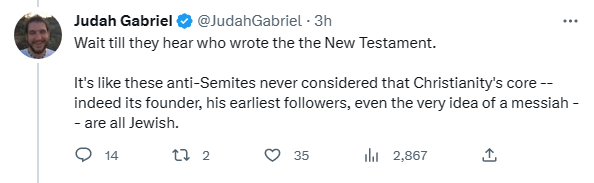
Babylon Bee CEO Seth Dillon was "outed" as Jewish this week.

I say outed loosely: Dillon is the one who publicly made it known he has Jewish heritage; it's not some secret that the anti-Semites uncovered through careful investigation.

Dillon replied,

I liked Dillon's response about not ceasing to be Jewish when following Jesus the Jew. I chimed in,


That triggered Christian anti-Semites to start chiming in with thoughtful replies like:

  • "There are Jewish Torah scrolls decorated with Satanic symbols!"
  • "Secular Jews are preaching the art of Satanism"
  • "Pretty sure Jesus called you lot the synagogue of Satan a few times tho right?"
  • "There is zero connection between Woody Allen and the ancient people of Judea that practiced the religion of the Second Temple."
  • "The satanic symbols on a jewish torah is used by the church of Satan today, which was founded by a jew. Connect the dots!"
  • "You're a zio-shill"
  • "the apostles didn't have a talmud"
  • "You're stupid and that's not my problem"
I didn't spend much time with those folks. People so caught up in wild conspiracies are rarely worth engaging. They live in a dark, make-believe world of their own imagining. They probably need supernatural deliverance, not unlike the kind you see in the Exorcist movie. 

But many other slightly-more-reasonable Christians chimed in to tell me God doesn't care about Jewish identity any more now that Jesus arrived. A few choice examples:


Among several others.

These folks aren't necessarily anti-Semites; they don't hate Jews. But they do think that the New Testament makes Jewishness irrelevant. There is no more chosen people. What's our answer?

Identity

It's reasonable to ask whether Jewish identity matters at all in the new era instituted by Messiah's arrival. In the New Testament, Paul does say there is "neither Jew nor Greek for you are all one in Christ."

My best answer to this uses simple logic.

In the same breath, Paul also says there is neither male or female in Christ. If Paul meant Jews and Gentiles literally don't matter anymore, he must also be saying that male and female don't matter anymore.

(And the only people saying such things are those poor souls infected by the woke mind virus.)

Since men and women exist, and since there are God-ordained distinctions between them, Paul cannot be saying male and female categories no longer exist, or that their distinctions aren't important.

I propose Paul is saying "no Jew nor Gentile, no male nor female" with regards to salvation: If you're a follower of Messiah, it doesn't matter what your class, race, gender is. (Sorry wokesters!) We're all his children and deeply loved by him, no matter one's background.

This doesn't mean, however, that all previous distinctions and categories magically disappear. God has a special calling for women often distinct from men. And God has a special plan of revival and restoration and calling for the Jewish people.

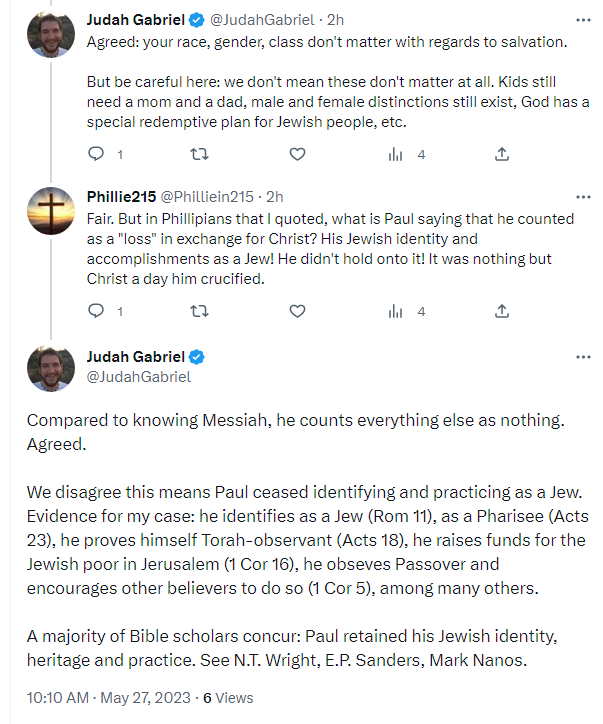
I went back and forth with one poster about this, and we finally reached some common ground of agreement. 

A final bit of evidence I use for my case is Paul's own words.

If Paul is saying Jewish identity is irrelevant, why does Paul speak about the importance and relevance of Jewish identity multiple times in the New Testament? Some off the top of my head:

  • He says there is "much advantage to being a Jew, and much value in circumcision", arguing God has chosen Jewish people to be entrusted with the Scripture itself. (Rom 3)
  • He calls himself a Jew in Romans 9-11
  • He calls himself a Pharisee in Acts 23
  • He takes a collection for the Jewish poor in Jerusalem among the Gentile congregations (1 Cor 16). 
  • He argues that Gentiles should share physical resources and money with Jewish believers, since Jews shared in spiritual inheritance with Gentiles.
  • He celebrates Jewish feasts and encourages others to do so (1 Cor 5)
  • He takes a Torah-prescribed vow in the Temple and pays for others to do the same "so that all will know there is no truth to these reports that you teach contrary to the Torah, but you yourself are living in obedience to it." (Acts 21). 
  • He says that while some Jews who reject Messiah act like enemies to Christians, "they are still loved by God for the sake of the patriarchs" and that God's calling on Jews is irrevocable. (Romans 11)
  • He says Jewish people specifically will receive mercy from God in the end (Romans 11)
  • He submits to Jewish religious discipline in Acts.
  • He says God has not rejected his own people, the Jewish people (Rom 11). 
Among others. 

If Paul is arguing Jewish identity doesn't matter, as these Christians claim, why does Paul appeal to Jewish identity so much? 

My answer is that Paul is arguing race/class/gender/etc don't matter to God with regards to salvation. He's picked people from every nation, class, gender, background to follow him and be called his children. 

He's not saying Jewish identity has become irrelevant.

This interpretation seems to better align with the logic of Paul's statements regarding male/female and Jew/Gentile. And it jives better with the whole context of Paul's writings. I'd argue it is in better harmony with the whole counsel of Scripture.

Counted all [Jewishness] as loss

Another reasonable objection I encountered was that Paul says he counted his past experience in Judaism as loss:


He's quoting Paul from Philippians 3 here:

If someone else thinks they have reasons to put confidence in the flesh, I have more: circumcised on the eighth day, of the people of Israel, of the tribe of Benjamin, a Hebrew of Hebrews; in regard to the law, a Pharisee; as for zeal, persecuting the church; as for righteousness based on the law, faultless.

But whatever were gains to me I now consider loss for the sake of Christ. What is more, I consider everything a loss because of the surpassing worth of knowing Christ Jesus my Lord, for whose sake I have lost all things. I consider them garbage, that I may gain Christ.  
-Paul, Philippians 3

The interpretation here is that Paul is saying Jewish identity and Jewish religious credentials don't matter. 

I do not think Paul is saying that, and for many of the reasons cited above. Rather, Paul is saying they don't gain you eternal life with God.

The context of this passage is important. Paul is addressing the Christian Judaizers who said you must be circumcised (convert to Judaism) to be saved and have eternal life with God. The opening verses of this chapter includes Paul's warning, "Watch out for those dogs, those evildoers, those mutilators of the flesh. For it is we who are the circumcision..." -- this is speaking about those Christians who were saying Gentiles must be circumcised and convert to Judaism before they could be considered Christians.

We're confident this was a major question in the early Church, attested to in Acts 15 and several other places in the New Testament: do non-Jews who follow the Jewish Messiah need to convert to Judaism (i.e. undergo circumcision) to be part of God's family? (And by extension, if a Gentile doesn't get circumcised, is he saved? Will he have eternal life with God?) That's the important context of this passage.

Paul's answer is a vehement no. New Gentile Christians do not need to convert to Judaism and undergo circumcision to be part of God's family.

It is in this context Paul says all his Jewish credentials -- his training in the synagogue as a Pharisee zealous for the law -- were worthless. He thought he was living righteously, but he was without Messiah. Paul is arguing outward religious acts and religious identity can't save that person from the wrath of God for our sins. Rather, those who believe and are indwelt by the Spirit of God -- it's those people who are saved. Everything else is counted as loss.

It's Paul's version of, "What good is it for a man to gain the world and lose your soul?" Paul "gained the world", Jewishly speaking, but had lost his soul in persecuting the followers of the real Jewish Messiah.

Takeaways

There are a lot of Christian anti-Semites on the web. I can confidently label them anti-Semites: they are part of "groyper" groups: white nationalists, far-right racists. Their profile pictures feature stereotypical Jews with long noses, but in lizard skin. (A combo of conspiracy theories!) Their tweets feature sympathy for Adolf Hitler, claims the Holocaust was fabricated, anti-Zionist propaganda, etc. From their responses, they don't have deep Biblical literacy. They mostly appeal to special interpretations of a handful of verses (synagogue of Satan, certain rebukes of Pharisees, etc.). Dig a little, and you'll find their well is empty.

Many Christians feel the New Testament does away with Jews, Jewish identity, Torah, the Old Testament, and Judaism itself. This is replacement theology, also called supercessionism. 

These folks are not necessarily anti-Semites, but have a certain view of Scripture that replaces Jews and Judaism with the Church and Christianity. These people are probably worth engaging in gentle discussion. Some of those I engaged proved fruitful discussions, finding some common ground even if we disagreed on details.

If there's something we can pray, it's that God gives all of us wisdom and discernment in this age of wild foolishness and rampant deception.

Responding to Eitan Bar's '10 Harmful Doctrines'


Eitan Bar is an Israeli evangelist who was recently fired from his ministry, One For Israel, for having a romantic relationship with another employee who worked under him. (Bar clarifies in a Facebook post that the relationship took place after his wife had divorced him.)

Bar has now published a new book that says Christianity has a fanatic ideology that has led to murder of a Christian woman in Israel. Specifically, the woman felt she couldn’t divorce her phsycially abusive husband since adultery hadn’t occurred. Later, the husband murdered her in a drunken rage. Bar suggests our faith community is too strict with regards to divorce, and that this woman could have been saved if she hadn’t felt pressured by Christian theology to remain with him.

In a blog post that reflects his new book’s sentiments, Bar cites 10 harmful doctrines that Christianity must outgrow:

  1. False doctrine: God hates you, He is furious with you and wants to kill you because you are finite and imperfect (aka: sinner), but hallelujah! Jesus saved you from His angry Father.
  2. False doctrine: We don’t deserve God’s love.
  3. False doctrine: You were born a sinner, therefore deserving of eternal punishment from day one, just because of who you are.
  4. False doctrine: Even if you lusted in your heart for one second, God must cast you to hell forever to satisfy His justice, and brings about His glory.
  5. False Doctrine: Salvation is free, but it comes with terms and conditions.
  6. False idea: The Word of God encourages to hit children as it will keep them from going to hell.
  7. False idea: When a Christian community-singing turns very, very, very long, it is considered a spiritual revival.
  8. False idea: You don’t need to study, learn or research the Bible and you don’t need to be helped by experts and scholars. Just pray before and read it for yourself.
  9. False idea: You have to go to church on Sunday.
  10. False idea: If you pray before you eat, God will substitute the sugars and trans fats in your McFamily Bundle meal into nutrients and vitamins.

I address each of these claims below.

Before I respond, let me preface by saying I’m not Israeli, I don’t hold a theological degree, and the Messianic Judaism of my practice likely varies a great deal from the Jewish Christian spheres Eitan works in.

Still, the issues raised by Eitan are worth thinking about and taking action on. And that’s my purpose here.

1. False doctrine: God hates you, Jesus saved you from the Father

Bar writes,

It is as if the godhead (of some preachers) extends two hands to us. The right hand represents the Father, who wants to strike us with wrath simply because we are imperfect. The left hand represents the Son; a soft, caring, gentle hand reaching out to hug us also because we are imperfect. It is the classic “good cop, bad cop” method we see in movies. But then, we are told that on the right hand’s way to strike us, the left hand interferes and gets struck by the right hand hard enough that it dies. Finally, the right hand can relax; its wrath was finally satisfied. May the left-hand rest in peace.

There’s a lot to unpack here.

Bar cites some popular reform preachers (Piper, Sproul, Driscoll, and others) who appear to say that God hates sinners. And since everyone sins, this logically means God hates everyone.

Just the other week I had highlighted a post by Christian apologist William Lane Craig. When asked whether Muslims worship the same God as Jews and Christians, Craig responded that a big difference between the Biblical God and the Quran's God is that in the Quran, Allah hates sinners:

And yet here Bar quotes reform preachers who claim the opposite, that God of the Bible hates sinners just like the God of the Quran. I guess we’re all Muslims after all! 😉

Eitan Bar notes that this would create a conflict between Messiah and God,

As a Jewish-Christian, I consider the idea that “Jesus saved us from God” to be wrong for several more reasons. Firstly, according to the Trinitarian doctrine, God is a triune being consisting of the Father, the Son (Jesus), and the Holy Spirit. Therefore, it would be irrational to say that Jesus saved us from God, since Jesus himself is God.

Bar also responds to proof texts about God hating sinners, like Psalm 5’s “You hate all evildoers”, saying that it likely refers to idolaters, not all humanity. I would not only agree with Bar here, but extend it further: the psalmist uses poetic language and license; we must not take every word hyper-literally. If this weren't true, Psalm 137 would indicate that God approves killing the infants of our enemies by smashing them on rocks.

He further notes that Biblical hate can mean covenantal rejection or avoidance. Thus when God says, “Jacob I loved but Esau I hated”, it means that God rejected Esau, not that God literally burned in hatred for him.

What’s the truth here?

I think Bar is framing it uncharitably.

God's wrath is rightly on sinful people, but it's been cancelled by God's own design. 

Look, friends, I’ve sinned so many times in my life. Lived a way that would not only displease God, but would bring shame on God’s name.

That probably describes you, too. It probably describes most of us. 

And one needs only to look at our culture to see it. School shootings, widespread sexual immorality, political corruption and bribery, censorship or imprisonment of political opponents, widely available pornography, high divorce rates, abusive marriages, abortion, sexualization of children, drug culture, mass confusion on gender, pedophiles in the church with leadership covering it up, honor killings and rapes, and more. We really do deserve God's wrath. 

(And this isn't just a religious proposition - there's a popular secular subreddit, /r/NoahGetTheBoat, that documents new instances of human depravity as tongue-in-cheek reasons why God should flood the earth again.)

God loves people and would rather not pour out his wrath (e.g. Ezekiel 18, Romans 2). God sends Messiah to reconcile sinners to Himself, and wrath is averted. This isn’t some fringe doctrine of Western Christianity. It’s a core truth of God’s work in the world. The fruit of it is billions of people have come to know and love God.

I suspect Bar still affirms this truth, but is pushing against some of the more extreme manifestations of that theology. Unlike Bar, I would not say that God is the angry right hand that is blocked by Messiah’s gentle left hand.

Rather, I’d frame it like this: God loves humanity so much that he doesn’t desire the death of anyone. So much that he gave his son to the world. Knowing full well what evil people would do, but transforming that evil to bring about the reconciliation of billions of people. That's the love of God. It's not wrathful Father fighting against loving Son. It's God cancelling his own wrath by his own design.

2. False doctrine: We don’t deserve God’s love

This is really an extension of the above. Bar states,

God’s love for us is not based on whether we deserve it or not. Just as parents love their children, God loves us unconditionally, regardless of our imperfections and mistakes. As it says in Romans 5:8, “But God demonstrates his own love for us in this: While we were still sinners, Christ died for us.” This verse highlights that even when we as sinners, God does finds us worthy of His love.

He cites Yeshua’s parable of the Prodigal Son, saying,

This parable Jesus told went against the very fundamental teaching of the Pharisees (of all kinds and eras) as it shows that God is not seeking to punish, take revenge, and outcast sinners, but to forgive, cover their shame, and assure them of their spiritual status as children of God! … Much like the Pharisees, some modern-day preachers teach that because we are not perfect (and God allegedly hates sinners), God must punish us, otherwise He can’t forgive. According to the logic of these passionate preachers, God created people who are limited and imperfect, yet it is because of their imperfections that He rejects them. “God only accepts absolute perfection" as it was put by pastor John MacArthur. What a contrast with the love of God for people that Jesus taught about!

Is Bar right, do we deserve God’s love? Are reform preachers like MacArthur wrong for saying God only accepts perfection?

Religious philosophical questions like these are complex because we could cite Scriptures for and against this view.

What I can say more concretely is, in my own life I have committed sins that would remove God’s presence from my life. If I was living in ancient Israel when the Temple was standing, I would be liable to be put to death for them.

With those sins in mind, do I deserve God’s love?

Speaking plainly, I would not expect love or even forgiveness from another human being for some of the things I’ve done.

On the other hand, I know and have experienced God’s deep love and grace.

Do I deserve God’s love? That’s for God to decide. I’m just thankful God has given and shown his love to me.

When people say we don’t deserve God’s love, I think of my own sin and know what they mean.

Bar would respond that God’s love is not dependent on our good behavior. I would agree with him. But I think it’s a moot question; God does love us, whether we deserve it or not.

3. False doctrine: You were born a sinner, therefore deserving of eternal punishment from day one, just because of who you are.

Bar writes,

I might be somewhat impatient if you nag me before my morning coffee or if I woke up sick. I am also more likely to be rude if it’s a hot and humid August day and you do not care enough to put on deodorant. However, if you came to me in the evening, smelling good and offering me a glass of delicious pinot noir and a ribeye steak, I would likely beam at you. It is not because I am evil in the mornings and righteous in the evenings. It’s because I am human. However, in the eyes of preachers such as John MacArthur, these are nothing but excuses because “God only accepts absolute perfection,” if to quote MacArthur once again (I wonder what kind of house MacArthur grew up in that led him to believe that God accepts only absolute perfection…). It’s no wonder that secular people view Christians as harsh, condescending, and legalistic. After all, what kind of father demands absolute perfection from his children or else denounces or kills them?

Bar then explains a few interpretations of the doctrine of original sin in Christian history and today.

He says that humans are finite and limited beings by design. Our shortcomings lead us to make mistakes and commit sins. But it’s our own shortcomings that cause us to be sinners. We're not sinners because we're children of sinful parents.

Again, there are Scriptures one could point to contradict this belief. David’s “Surely I was sinful at birth”, in his repentance psalm is one that comes to mind.

On the other hand, the Hebrew prophets show God holding each person accountable for his own sin, not the sin of his parents. (I am thinking of Ezekiel 18.)

I feel like this is theological bikeshedding, wasting time and energy on technical issues that don’t really matter.

Do I deserve God's wrath because I was born into sin? Or because of my own sin?

Well, friends, it doesn’t matter because I do sin. And so do you. And each person on earth likely deserves some divine correction and even punishment for what they themselves have done. “God reproofs those he loves.” If this wasn’t true, Israel would have never been punished and sent into captivity.

If I had to pick a side here, I’d side with Bar and say that we are guilty because of our own sin, not those of Adam and Eve or other ancestors. But it doesn’t really matter, does it?

The thing that matters is that we do have sin in our lives. Myself, Mr. Bar, and you, dear reader.

4. False doctrine: Even if you lusted in your heart for one second, God must cast you to hell forever to satisfy His justice, and brings about His glory.

In the Sermon on the Mount, when Jesus was teaching about adultery (Matthew 5:27-30), he said that it’s better to lose one body part, like your eye, than to have your entire body end up in “Gehenna” (Matthew 5:27-29). Was Jesus truly saying that if you were sexually turned on by looking at another person and fantasizing about them, even momentarily, you’d end up in hell forever? Was Jesus teaching us to literally dismember body parts, like our eyes, to ensure our salvation? If so, we would all be blind. Besides, doesn’t Jesus know that we don’t need eyes to imagine and fantasize? Also, since it is the universal experience that sexual impulses are uncontrollable, why would God create us this way to begin with and give us impossible standards? How is that fair? Or maybe this popular interpretation is all one big misunderstanding?

I really think Bar is being uncharitable here in his interpretation of what Christians believe. He argues that first, “cast into Gehenna” was really a euphemism for the religious casting 1st century adulterers out of society:

Imagine being a Jewish person in a society that would not tolerate any form of sexual immorality and would show no grace or forgiveness for any of it. Instead, they would take everything away from you, leaving you to scavenge for leftovers in the trash thrown into the Valley of Hinnom. In that religious society, being caught in adultery meant being ostracized and literally “thrown to hell.”

He then argues, tenuously in my opinion, that Gehenna was not God’s idea but religious legalists:

It is not God who caused people to end up in the Valley of Hinnom; it was people— a religious society. God, on the other hand, desires for sinners to live with dignity, be rebuilt, and become self-sufficient. It is Satan who is the prince of shame, and shame is an emotional acid inside your heart, gradually burning your soul.

Oh boy, that one sure feels like a stretch. If I’m understanding Bar here, he’s saying, “Yes, Jesus did say that it’s better to pluck out your eye than your whole body thrown into Gehenna. But really, the more important lesson here is that God forgives and religious people invented Gehenna.”

I think that’s wildly misinterpreting Jesus’ words. Whether or not Gehenna was man’s idea – whether or not shaming adulterers and the sexually immoral is in God’s plan – the more important lesson is that God forgives them?

God forgives sinners, yes. But I think this fluffy interpretation is turning Jesus’ clear warning against sexual immorality into a something it’s not.

And that’s coming from me, a man who’s committed sexual sin. I look at Jesus’ words and I’m glad there is forgiveness of my own sins. But I don’t pretend his words are not a warning against that sin.

I can’t help but wonder if Eitan Bar’s recent divorce, and the subsequent backlash from some Christians over the divorce and his post-divorce romance, are coloring Bar’s view of the New Testament. He’s experienced some religious people telling him that his divorce was wrong, or that his subsequent romance was wrong, and now he’s lashing out against those people.

One more important point to respond to. Bar says,

Also, since it is the universal experience that sexual impulses are uncontrollable, why would God create us this way to begin with and give us impossible standards?

I think Bar is venturing into a bad outlook on life and sin here. Sexual impulses are uncontrollable? Nah, hell no. I don't believe that for one second. Strong sexual urges, yes. Uncontrollable? Never. 

That's punting and giving up. If sexual impulses are uncontrollable, it renders sexual purity commandments pointless. 

"It's OK to look at porn; sexual impulses are uncontrollable." 

"It's OK to commit adultery because sexual urges can't be controlled."

Nah, I don't believe that for one second. It's defeatist. Self-control is evidence of God's spirit within. Not some impossible feat rigidly demanded by God.

Maybe I misread Bar here, maybe he was talking rhetorical. But let's be clear: the idea that sexual impulses are uncontrollable is false and has great potential to deceive struggling people.

5. False Doctrine: Salvation is free, but it comes with terms and conditions

Bar writes,

At the end of the day, much like many traditional churches, most members of Arminianism and Calvinism teach the same thing: if you don’t prove yourself through works (for too long), God will denounce and kick you out of His house. The only difference is that Arminianism front-loads works into the finished work of Christ, while Calvinism back-loads works into the finished work of Christ. Both schools of thought allusively teach salvation mixed with works, rather than real justification by faith alone. In other words, both worldviews see a connection between what you do and your salvation. In both cases, you are not saved if you live imperfectly for too long. Therefore, salvation is not a truly free gift but essentially something you earn or maintain by your deeds. Essentially, most of Christianity involves faith with works in one way or another. (Perhaps the Catholic vs. Protestant war wasn’t needed all along.)

He gives an analogy of a human family and whether we’d like that:

Imagine two children raised in two different homes: one in the “Calvinium” family, and the other in the “Arminius” family. When the children misbehave, their parents warn them about their bad behavior. In the Calvinium family, the child is warned by his parents that if he misbehaves for too long, it will prove that he was never really their child to begin with, and as a result, he will have to leave the house. In the Arminius family, the child is warned by his parents that they will no longer want to be his parents if he misbehaves for too long, and he, too, will be kicked out of the house.

Nobody wants such parents, yet many people think that their Father in heaven is like that.

Well, hold up brother. 😊 I have 3 kids, one of whom is an adult now. If one of my kids did something terrible, say, regularly stole from me to pay for a heroin addiction, I would kick him out of my house. I would still love him. Still try to get him support. Help him overcome his addiction. But he would not be welcome in my house.

Frankly, a parent who didn’t discipline their child, didn’t “kick them out of the house” after repeated, extreme bad works, well, that parent would just be an enabler of the bad behavior.

Faulty analogy aside, Bar does clarify,

People’s works were (and are) essential, but they had nothing to do with their salvation.

He goes on to argue that we must experience sin to know the depths of God’s grace.

I don’t really know what to say about that. It’s true that we wouldn’t know God’s forgiveness if not for us sinning. On the other hand, it feels like a tacit way of saying sin isn’t really all that bad. I’m not sure that’s what Bar is saying – I could be misreading him there – but that’s what this section comes across as.

Is salvation free? Absolutely not. It cost Messiah his life. Is it free to us? Yes, absolutely. Are there terms and conditions?

I think about the thief on the cross. There were no terms other than faith/trusting. That was enough.

The problem I have with “no terms and conditions” is that people often use this to mean we can live however we want. “I am already going to heaven, so I can live how I want. Begone, legalistic judger!”

I don’t know that’s what Bar had in mind here. But again, it feels like he’s lashing out against people judging him for his divorce. I would never say that Bar has lost his salvation – and shame on anyone who tells Bar that over his divorce or subsequent romantic relationship. But God…wants and expects us to live holy lives with good works.

It seems to me that Christianity’s main problem is not too many legalistic judgers. It seems to me our problem is that too many Christians are living however they want, claiming Christian liberty, but living like hell and producing ineffective disciples of Yeshua.

I can speak from my own life: sin makes me an ineffective disciple of Yeshua. Suppose I sloughed off my sin: “Ah, I’m just an imperfect man. God still loves me, and I haven’t lost my salvation.” Well, friends, I would be worse off. I would continue in sin, I wouldn’t take responsibility for my sin, and I would pretend my sin wasn’t serious. It is.

Salvation is without terms and conditions, but don’t live a life of sin. If you do, you abuse God’s gift and waste his sacrifice.

6. False idea: The Word of God encourages to hit children as it will keep them from going to hell.

Bar speaks against spanking and punishment of children, saying,

The preacher Michael Pearl and his wife Debi wrote the best-selling book “To Train Up a Child,” in which they teach parents to hit their children with plastic tubes, whips, paddles, canes and belts to “break their will.” They promote abusive tactics such as withholding food, giving cold showers, or leaving kids outside to shame them for disobedience. “To Train Up a Child” has sold over one million copies and has been translated into twelve languages. That means millions of children have been affected. Oy Vey!

He claims that spanking proponents advocate torture:

They are reading (and teaching) this verse as if saying, “If you don’t torture your child, he will end up being tortured by God forever.”

This is a wildly uncharitable interpretation by Bar.

I was spanked as a kid. The way my parents did it was, if I did something wrong, I’d get a whack on the butt. Not in anger, but in correction. They’d speak to me afterwards, I’d apologize, we’d hug, and we’d move on.

It worked.

Not done out of anger, abuse, trauma or torture. (Ridiculous to even use those terms!) But out of loving correction. If done right, it works.

Bar says that the “spare the rod” verse from Proverbs speaks to the comforting “rod and staff” of Psalm 23, where God’s staff guides and comforts. He says parents should use non-physical punishment to correct children.

I’m not sure this holds up under scrutiny. I’m not a shepherd or animal expert, but I understand a shepherd’s staff was used to physically correct sheep. Not abusively, of course, but still a physical correction. And as a parent of 3 children, one of whom is now a grown, well-rounded adult, sometimes physical punishment is necessary. Not out of anger, but love.

And if physical punishment is the wrong model, why did God physically punish Israel for sinning with multiple dispersions? A major theme of many of the Hebrew prophets is, “Stop sinning! Otherwise God is going to send [physical] punishment on you!” But maybe we’re comparing apples to oranges here. I’ll leave it at this: physical punishment, when done in love and not anger, with the goal to correct and restore and not to abuse, has been useful in my own life.

7. False idea: When a Christian community-singing turns very, very, very long, it is considered a spiritual revival.

Bar takes aim at the Asbury revival, I suspect.

What constitutes true revival is a question worthy of a post of its own.

From personal experience, I can say that I know people who have come out of the Asbury revival with new zeal, new projects to amplify God’s name, new works for the Lord.

It seems to me that worship revivals like Asbury are not worthless as they do inspire Godly action.

I don’t know if Bar intends to say they are worthless, but his words imply revival isn’t real unless good works like feeding the poor are involved.

He says,

Worship of God always involved sacrificing something, which taught the people of Israel an important lesson: if you want something, be prepared to give in return. In biblical times, the terms “worship” and “prayer” had a broader meaning than they do today. Most types of prayer and worship were not solely about communicating words to God; they also involved actions. However, our modern understanding of the words “worship” and “pray” has evolved to mean “talking and singing to God.”

in modern times, we associate “revival” and “worship” with music and songs. But a “worship night” should not just be about Christians going to an amplified concert with cool spotlights, whereby the crowd joins in singing words of praise. Instead, a worship night should be an evening whereby Christians go out to the streets to feed the hungry and cover the poor with a blanket. … ,Christianity also began to adopt this comfortable idea that worship is about words and is entirely disconnected from actions.

These are good works. God wants us to do good works. Bar argues that true revivals should produce good works like feeding the poor. Going further, he says good works should be part of our lives as Christians:

An error of modern-day Christianity is to think that in Christ, believers are exempt from making sacrifices. We don’t; we just redirect the sacrifices to offer them to society’s outcasts instead. When we pray before a meal, giving thanks to God, we should also ask ourselves if there is someone, perhaps even in our own neighborhood, who could benefit from more than just our prayers. This is how we truly worship God.

Going back to Bar’s earlier point about no terms and conditions for salvation, good works like feeding the poor are things God expects from us. We don’t lose our salvation if we don’t do them, but I would argue we are wasting Messiah’s sacrifice if we live wickedly. That includes withholding our resources from the poor.

Bar is right that disciples of Yeshua need to be doing good works. We should be known for it. But too many of us are caught up thinking that sin doesn’t really matter, how we live doesn’t really matter. So we become ineffective disciples.

I only disagree with Bar here that worship revivals like Asbury aren’t revivals.

But I suspect we agree on some important common ground: if worship revivals produce good fruit – feeding the poor, caring for the sick, people turning to God, new projects to amplify God’s name – that is indeed a revival. It’s the fruit, the tangible outcomes, that determines whether it’s a revival.

8. You don’t need to study, learn or research the Bible and you don’t need to be helped by experts and scholars. Just pray before and read it for yourself.

Hoo boy, he’s hitting on an important one here.

In our faith, so many people discard and disparage Bible scholarship. We downplay and even joke about experts who have devoted their life to study and understanding of the Bible. Instead, in our Protestant environment, everyone’s an expert. Profession Wright who's studied Biblical texts for 30 years is no more wise than Clem Gomer who just discovered that the Bible wasn't originally written in King James English.

 Bar writes,

If experts handle ancient texts with care, how much more should Christians be careful with the book of books, the Bible? Yet nowadays, Christians are often quick to preach and speak in God’s name about anything that comes to their mind. This results in an abundance of nonsensical ideas being widely spread. Of course, I am generalizing (and I am sure I have also contributed my fair share of foolishness to the pile).

Bar gives examples of language idioms, textual genres, cultural context that all impact one’s understanding. He concludes,

In summary, while personal prayer and individual Bible reading are crucial for spiritual growth, it is also essential to recognize the value of studying, learning, and researching the Bible and engaging with the insights of experts and scholars. This balanced approach can lead to a deeper understanding of the scriptures and foster spiritual growth and development.

100% agree. I have argued this exact thing from my decade as a laypreacher and worship leader at my local congregation: we are too quick to discard Bible scholarship and expert testimony. When everyone’s an expert, no one is, and chaos ensues.

9. False idea: You have to go to church on Sunday.

Bar argues we have lost the communal aspect of faith:

In most modern church meetings, believers have mostly no interaction with their fellow believers, which goes against the essence of community. The dynamic is usually unidirectional, with the message/worship coming solely from the pulpit. We sit quietly, passively, like spectators at a lecture or concert. But community involves living life cooperatively, not just sitting in the same room for an hour. This has been a trend of the last century. In the past, the weekly meetings were only the cherry on top of the cake, a supplement to the cake that was the communal aspect of living together. Today, we have held onto the cherry of weekly meetings but lost the cake of community living.

His arguments here may be more developed in the book, which I haven’t yet read. But his arguments here are meandering. He says we’ve become too individualistic. He says our Western Christian idea of community is not what the original believers understood it to be.

Yes, those things may well be true.

What does it have to do about going to church? It seems to me that not going to church would make one’s faith even more individualistic.

He’s right that we lack community in many of our modern congregations.

One thing that helped build community in my Messianic congregation was regular outings together outside of the congregation. Volunteer shifts at Feed My Starving Children. Going out to eat together. Coming over to each other’s homes for fun and games. Volunteering at Loaves & Fishes together. We built friendships and community that way. Some of the friendships we made persist even now, years later, despite the thousands of miles separating us.

But I still don’t understand Bar’s point here. Church, even in its current form, is better than no church. That the Western Church lacks something communally is not an argument for avoiding church.

10. False idea: If you pray before you eat, God will substitute the sugars and trans fats in your McFamily Bundle meal into nutrients and vitamins

Well, this one feels a little silly compared to his other points.

But Bar’s right that so many in our faith are confused about this. He says,

Evangelicals like to pray before each meal: “Lord, bless this food to our bodies!” This prayer never made sense to me, and it wasn’t just because the Torah only commanded the Israelites to pray after the meal. It was for another reason. I didn’t understand the blessing. “Bless this food to our bodies”? Is God about to supernaturally turn our junk food into nutritious food full of vitamins and minerals just because we prayed? This is great news! Now I can eat as many Big Macs and doughnuts as I want, and God will bless them into my body!

He ties this to the false claim that we Christians have “no traditions” and are pure Scripture-based:

As a Jew, I knew little about Christian denominations when I first came to know Christ as my Lord and Savior. I remember trying to figure out why so many in my faith community dislike traditional churches so much, and once I asked what the differences were between the traditional churches and us. I was told that, in contrast with them, we hold to “Sola Scriptura.” Scriptures alone! No traditions! As time passed, I realized every denomination has its fair share of traditions.

He goes on to show numerous traditions in our faith by people who claim to be Scripture-only. He notes traditions aren’t necessarily bad, but they can negatively affect our understanding of the Bible.

Look. In my house, we always thank and bless God for food. I’ve likewise never understood asking God to bless the food or make it good for us. It’s not a big deal, but yeah, we should get that sorted out.

Conclusions

Bar is likely going through a very difficult time. His wife asked for a divorce. He lost his job at One for Israel over a post-divorce romance. As a notable figure in the Israeli Christian community, he’s likely a target for many critics (his “legalists”) for his divorce, or for his subsequent romantic relationship.

His new book and critiques are likely to stir up more dispute.

Reading his posts, I found myself thinking, “He’s probably saying this as a response to his critics.” I suspect many of the points in his post and book are heavily colored by his recent experience. IMO, writing out of a place of a fresh wound sometimes produces sharper-than-needed criticism. I suspect Bar’s views will mature and gain some rounded edges in time.

I hope Bar can get through his difficult time and live his life as a pleasing sacrifice to God. I hope he can find meaningful community with Yeshua’s disciples despite our problems. I hope he sees Yeshua even though his Christian critics sometimes misrepresent him. But I also hope he’s humble enough to listen to counsel and accept gentle correction from trustworthy people of God.

One concerning theme I detect in his posts is a softness on sexual immorality. ("Sexual urges are uncontrollable", "We're imperfect and God created us this way", "Christian theology on divorce is too strict", "If you lusted in your heart, you're not liable for God's wrath", etc.) This may also be a response to his life situation and his religious critics. I hope he doesn't continue down that chaos-leading path.

My response here isn’t intended as a critique. He raises some important questions that our Messianic community would do well to wrestle with.


A Modern Day Golden Calf

Dear Kineti readers,

Below you’ll find a second guest post by Aaron Hecht, a friend and Messianic Jewish Israeli. This post is a follow-up to The Crisis in Israeli Democracy (and Christian Zionism). Here, Aaron argues the Christian Zionist groups in Judea and Samaria are in error for trying to bring Israeli believers under Orthodox Jewish authority and live Orthodox Jewish lifestyles.

Are Christian Zionist groups overstepping their purpose and allying themselves with opponents of the Gospel? Are they pushing Torah observance and Orthodox Jewish lifestyles onto the Jewish Christians in Israel? Aaron presents his case below. I have a few comments myself, so do check out the discussion in the comments below.


With the Biblical Feast of Passover approaching, the Philo-Semitic segment of the Church of Jesus Christ, including Messianic Jews, Hebrew Roots, and Christian Zionist folks, is gearing up to hold Passover Seder events that teach about the parallels between the story found in the Book of Exodus and the events described in the Gospels centering around the last week of Jesus’ life, especially what’s become known to history as “the last supper” and His subsequent crucifixion, death, burial, and resurrection.

All of that is to the good and I hope everyone reading this will find a Passover Seder meal that includes teachings about this subject.

However, with all due respect, I think there are many other lessons from the stories found in the Book of Exodus that are highly relevant for the Philo-Semitic segment of the Church, particularly Hebrew Roots/Christian Zionist folks, and I’d like to explore one of them in this blog.

I am speaking about the story of the Golden Calf, which is found in Exodus 32.

For those who haven’t read that passage and/or watched Cecille B. Demille’s “The Ten Commandments” recently, Moses went up on Mount Sinai to meet with God, accompanied by Joshua, and left his brother Aaron in charge of the large Israelite camp. The Bible doesn’t say precisely how long he was up on the mountain, but it couldn’t have been very long. But in that short period of time, the Israelites decided that Moses probably wasn’t coming back and that the God Moses had gone up the mountain to talk to had abandoned them. So these people who had, in the very recent past, watched the God of Abraham, Isaac and Jacob cast down and overcome all the idols worshipped in Egypt, asked Aaron to make them…an idol to worship.

Aaron, who I always felt an affinity for since I was a little kid reading these Bible stories because I had the same name as him, committed one of the most heartbreakingly stupid acts in the entire Bible and complied with this request. He told the people to bring him the gold they’d received from the Egyptians and he melted it down and forged a golden calf. He then told these people “here is your god, who brought you up out of Egypt” which, again, is one of the dumbest statements in all of human history, since Aaron and all the people who heard him say that knew very well from their own first-hand experience that it wasn’t true.

Why did they act as if they believed it? Why did they worship the Golden Calf? Why would they want an idol to follow when they still had fresh memories in their minds about the all-powerful Living God who had triumphed so convincingly over the idols of Egypt?

These are some of the most difficult questions posed by the entire Bible. But we shouldn’t be so harsh in judging these ancient people for their foolish mistakes, because we’re not much better. As we look around at the Philo-Semitic segment of the Church today, it’s impossible to deny the wide and deep popularity of so many silly, unscriptural ideas.

I’m not just talking about the deeply lamentable habit of indulging in ludicrously absurd conspiracy theories about GMO foods, Bill Gates, Elon Musk, etc. Those silly, unscriptural practices and ideas are bad enough and they cause plenty of damage. But there are some ideas and practices that are even more damaging.

One of the most popular golden calves that directly affect the Body of Messiah in Israel is the idea that Jews have a unique, God-given identity that is most perfectly fulfilled by the Modern Orthodox Jews who live in Judea and Samaria.

The groups which have gone the farthest in adopting this idolatrous idea have even taken to telling Jewish Believers in Israel that we are out of order for not bowing down and worshipping this golden calf that they’ve made for themselves. They seem to think that God made a mistake by appointing Jewish Believers who started fellowships in places like Tel Aviv and Ashkelon instead of moving themselves and their families to Jerusalem, Judea and Samaria. This mistake is compounded by these wayward Messianic Jews who usually don’t wear kippot, eat kosher, etc. In fact, if you go into most Believer fellowships in Israel, including the big ones here in Jerusalem where I live, you won’t see anything uniquely Jewish. It’ll look just like any Charismatic or Baptist Christian church anywhere in America.

Some of these Jewish Israeli Believers even go so far as to vote for political parties on the center-Left. They even sit in fellowship with Arab Believers and say these people have just as much right to live in this country as Jewish people do. Would you believe that some of these Jewish Israeli Believers don’t even support the Jewish communities in Judea and Samaria and occasionally petition the government to evacuate settlements?

The cosmic scandal of it all!

But those who have elevated the golden calf I’m speaking of will tell you that it can all be made right if wayward Messianic Jews like myself will just humble ourselves, cleanse our homes of bacon, put a kippa on and otherwise start living the way the Modern Orthodox Jewish settlers in Judea and Samaria do. Then God will bless us and together we can all move forward into the glorious future He has for us.

They’re showing us the way by living in Judea and Samaria themselves and adopting the dress code of the National Religious/Modern Orthodox, often keeping strictly kosher, and in many other ways imitating these people who are definitely living out their God-given identity and calling, which certainly doesn’t include accepting the Gospel. Dual Covenant Theology is an unavoidable component in this worldview, but if you ask them, the people who have and teach this view will deny that they hold to Dual Covenant Theology. But this is a topic that deserves its own, separate blog.

In any case, there is a great tragedy from the perspective of these groups because although they’ve been vigorously at work setting us this example they think we should follow for several years and have even sent emissaries to some of our congregations to try and convince us of the necessity of placing ourselves under the spiritual authority of these Modern Orthodox rabbis they’re so close to, most of us have not followed their example. Because of this, according to their view, we’re out of God’s will and thus unable to receive His blessing.

The very first part of this idolatrous set of ideas is true (all effective lies contain an element of truth in them) because Jewish people DO have a unique, God-given identity. But everything else in this narrative is utter nonsense, especially the last part.

The plans and purposes of God are being carried forward by the Israeli Believers, as imperfect as we are. Some of us are Jews, some are Arabs, and many more are Gentiles of various types. Very few of us wear kippot or keep kosher and only a small handful live in Judea and Samaria. We believe that Jews need the Gospel as much as anyone else does, and the Israeli Body of Messiah is making steady progress in our efforts to be salt and light, to share the gospel with our fellow Israelis, and otherwise be about our Father’s business.

We don’t pick many grapes, but we do save many souls.

Because of this, and despite our many failings, shortcomings, and imperfections, His blessings are being poured out on us. God most certainly is blessing us despite our refusal to bow to the golden calf that certain groups have fallen so desperately in love with.

These groups believe they’ve been called to come to Israel to do work that God has appointed them to do here, and I believe that’s correct. But what they get wrong is that they think they’re supposed to lead while the Israeli Believers should follow their example as they imitate the Modern Orthodox, while the truth is that it’s exactly the other way around. They should be following the lead of the Israeli Believers because this is our country, not theirs. God has appointed us to be the representatives of His Kingdom here, and instead of trying to tell us (and by extension, God) what to do, they should be getting behind what God is doing, even if it’s not what they think He should be doing.

With this in mind, the obvious question arises, why do these groups continue to believe in and teach these observably false doctrines and ideas? Why do they continue to bow down and worship this worthless golden calf they’ve made for themselves? Why do they continue to make common cause with, and even help the efforts of, groups that are actively and deliberately fighting against the Kingdom of Jesus Christ in Israel and trying to stop the sharing of the Gospel here?

The answer is as simple as it is tragic.

They’re deceived.

The truth is right in front of their faces but the spirit of anti-Christ, which is the same spirit that deceived Eve in Genesis chapter 3, and which deceived the Israelites into worshipping the original golden calf, has never stopped deceiving the human race ever since. This anti-Christ spirit infected the Church of Jesus Christ early on and has had an influence on various parts of it ever since, even infecting the Protestant Reformation and the Messianic Jewish movement when they emerged in Europe around the same time in the late 16th century.

Now it is at work in our beloved Hebrew Roots and Christian Zionist movements and has succeeded in deceiving many well-meaning people into putting tremendous efforts into things that don’t only not help the Kingdom of Jesus Christ, they actually oppose it.

I hope that reading this blog will help those who have not yet fallen under the influence of this golden calf to avoid it and maybe help those who have been bowing to the golden calf but are ready to try something else. If someone you care about is bowing to this golden calf and you’d like to help them get away from it, I can tell you from personal experience that when someone is under the spiritual influence of this particular golden calf, deprogramming them can be a long, difficult and heartbreaking process. But it can be done! I have met several individuals who saw the light and left this golden calf cult. As the Jews say, “tameed yesh tikvah, there is always hope.”

Just remember what Jesus said in Mark 9:29; “This kind comes out only through prayer.”

What Did the Early Christians Think of Abortion?

What did the early Christian community think of abortion? Might it influence our own views on abortion?

Outside of the New Testament, one of the oldest preserved Christian writings we have is the Didache, also known as the Teachings of the Lord Through the 12 Apostles to the Gentiles. It’s commonly dated to the late first century, written around the same time as the book of Revelation.

I grabbed my copy of the Didache, remembering it has a passage on abortion. I snapped the following:

The early Christian community living in the same century as Jesus and his disciples believed abortion to be murder and specifically commanded against it.

The Didache isn’t alone.

Nearly a dozen other writings from the early Christian communities call out abortion as a moral evil, a snuffing out of a soul for which we will be held accountable to God: (click to expand)

Letter of Barnabas, 74 AD
“The way of light, then, is as follows. If anyone desires to travel to the appointed place, he must be zealous in his works. The knowledge, therefore, which is given to us for the purpose of walking in this way, is the following. . . . Thou shalt not slay the child by procuring abortion; nor, again, shalt thou destroy it after it is born.”
The Apocalypse of Peter, 137 AD
“And near that place I saw another strait place . . . and there sat women. . . . And over against them many children who were born to them out of due time sat crying. And there came forth from them rays of fire and smote the women in the eyes. And these were the accursed who conceived and caused abortion”
Athenagoras, A Plea for the Christians, 177 AD
“What man of sound mind, therefore, will affirm, while such is our character, that we are murderers? . . . [W]hen we say that those women who use drugs to bring on abortion commit murder, and will have to give an account to God for the abortion, on what principle should we commit murder? For it does not belong to the same person to regard the very fetus in the womb as a created being, and therefore an object of God’s care, and when it has passed into life, to kill it; and not to expose an infant, because those who expose them are chargeable with child-murder, and on the other hand, when it has been reared to destroy it.”
Tertullian, Apology, 197 AD
“In our case, a murder being once for all forbidden, we may not destroy even the fetus in the womb, while as yet the human being derives blood from the other parts of the body for its sustenance. To hinder a birth is merely a speedier man-killing; nor does it matter whether you take away a life that is born, or destroy one that is coming to birth. That _is_ a man which is _going to be_ one; you have the fruit already in its seed.”
Tertullian, The Soul, 210 AD
“Among surgeons’ tools there is a certain instrument, which is formed with a nicely-adjusted flexible frame for opening the uterus first of all and keeping it open; it is further furnished with an annular blade, by means of which the limbs [of the child] within the womb are dissected with anxious but unfaltering care; its last appendage being a blunted or covered hook, wherewith the entire fetus is extracted by a violent delivery.
There is also [another instrument in the shape of] a copper needle or spike, by which the actual death is managed in this furtive robbery of life: They give it, from its infanticide function, the name of _embruosphaktes_, [meaning] “the slayer of the infant,” which of course was alive...
[The doctors who performed abortions] all knew well enough that a living being had been conceived, and [they] pitied this most luckless infant state, which had first to be put to death, to escape being tortured alive.
Now we allow that life begins with conception because we contend that the soul also begins from conception; life taking its commencement at the same moment and place that the soul does...”
The law of Moses, indeed, punishes with due penalties the man who shall cause abortion."
Minucius Felix, Octavius, 226 AD
“There are some women who, by drinking medical preparations, extinguish the source of the future man in their very bowels and thus commit a parricide before they bring forth. And these things assuredly come down from the teaching of your [false] gods. . . . To us [Christians] it is not lawful either to see or hear of homicide”
Hippolytus, Refutation of All Heresies, 228 AD
“Women who were reputed to be believers began to take drugs to render themselves sterile, and to bind themselves tightly so as to expel what was being conceived, since they would not, on account of relatives and excess wealth, want to have a child by a slave or by any insignificant person. See, then, into what great impiety that lawless one has proceeded, by teaching adultery and murder at the same time!”
Council of Ancyra, Canon 21, 314 AD
“Concerning women who commit fornication, and destroy that which they have conceived, or who are employed in making drugs for abortion, a former decree excluded them until the hour of death, and to this some have assented. Nevertheless, being desirous to use somewhat greater lenity, we have ordained that they fulfill ten years [of penance], according to the prescribed degrees.”
Basil the Great, First Canonical Letter, canon 2, 374 AD
“Let her that procures abortion undergo ten years’ penance, whether the embryo were perfectly formed, or not”
“He that kills another with a sword, or hurls an axe at his own wife and kills her, is guilty of willful murder; not he who throws a stone at a dog, and unintentionally kills a man, or who corrects one with a rod, or scourge, in order to reform him, or who kills a man in his own defense, when he only designed to hurt him. But the man, or woman, is a murderer that gives a philtrum, if the man that takes it dies upon it; so are they who take medicines to procure abortion; and so are they who kill on the highway, and rapparees.”
John Chrysostom, Homilies on Romans, 391 AD
“Wherefore I beseech you, flee fornication. . . . Why sow where the ground makes it its care to destroy the fruit?—where there are many efforts at abortion?—where there is murder before the birth? For even the harlot you do not let continue a mere harlot, but make her a murderess also. You see how drunkenness leads to prostitution, prostitution to adultery, adultery to murder; or rather to a something even worse than murder. For I have no name to give it, since it does not take off the thing born, but prevents its being born. Why then do thou abuse the gift of God, and fight with his laws, and follow after what is a curse as if a blessing, and make the chamber of procreation a chamber for murder, and arm the woman that was given for childbearing unto slaughter? For with a view to drawing more money by being agreeable and an object of longing to her lovers, even this she is not backward to do, so heaping upon thy head a great pile of fire. For even if the daring deed be hers, yet the causing of it is thine.”
Jerome, Letters, 396 AD
“I cannot bring myself to speak of the many virgins who daily fall and are lost to the bosom of the Church, their mother. . . . Some go so far as to take potions, that they may insure barrenness, and thus murder human beings almost before their conception. Some, when they find themselves with child through their sin, use drugs to procure abortion, and when, as often happens, they die with their offspring, they enter the lower world laden with the guilt not only of adultery against Christ but also of suicide and child murder”
Apostolic Constitutions, 400 AD
“Thou shall not slay thy child by causing abortion, nor kill that which is begotten. . . . [I]f it be slain, [it] shall be avenged, as being unjustly destroyed.”

It should be no surprise the early Christians rejected abortion as a great evil: early Christianity was once part of Judaism, and Judaism has long considered abortion to be forbidden in all but extreme circumstances. (See Is a Jew Permitted to Have an Abortion? for details.)

And why is Judaism against abortion? Because the key Torah principle of pikuach nefesh פקוח נפש, preservation of life. The whole Bible is concerned with preservation of life, such that nearly all other commandments may be broken if necessary to preserve life.

In alignment with this, the Torah states in Exodus 21 that if a man accidentally kills an unborn child, he is liable for damages. How much more so if done deliberately?

Thus, observant Judaism forbids abortion in all but extreme cases, such as when the life of the mother is in danger.

We Messianic believers affirm both the Torah and the New Testament - is it enough that the early Christians opposed abortion?

Perhaps not, but the early Christians opposed abortion because of the overriding principle of pikuach nefesh פקוח נפש found in Hebrew Bible and early Christian writings. In the New Testament, the Messiah said the Sabbath laws can be broken to save the life of an animal – how much more so the life of a human being in the womb?

It’s for this reason the early Christian communities opposed abortion: because a faithful reading of the Biblical texts informed their practice.

And what of Pro-Choice Christians and Jews?

I conclude that pro-choice Christians and Jews are not being faithful to the teachings of the Hebrew Bible or New Testament on this issue. And they're not in alignment with the original faith communities; neither the early Christians, nor the ancient faithful Israelites permitted abortion.

I suspect many pro-choice religious folks recognize this. To support their view, they don't appeal to textual faithfulness nor the practice of the original faith communities. Rather, they appeal to a modern reinterpretation of faith, one what concurs with a modern culture that celebrates abortion in the name of sexual freedom. 

In my estimation, such folks are following the crowd to evil, and calling that evil good. Their reinterpretation of faith in the light (darkness?) of modern culture has led them, ultimately, away from faithfulness to God and God's instruction.

Shelanu TV: Controversy Over Jewish Evangelism in Israel

God TV announcing the creation of Shelanu

Kehilat News from Israel reports the launch of Shelanu: a new Hebrew TV channel in Israel run by believers in Yeshua. 

Quick to follow up, some Christian Zionist organizations criticized the move, with one Evangelical leader urging Israeli Prime Minister Netanyahu to shut down the station, saying, "Any attempts to convert Jews or downgrade their religion will only sow undue hatred at a time when we should unite in the face of darkness."

And, unsurprisingly, the anti-missionary Tovia Singer slams the station, framing Shelanu as sneaking into homes to convert your children. Dr. Michael Brown reviews and responds to Singer below:


It seems to me this is a matter of uncertainty in the pro-Torah wing of the Messianic movement. Unlike Jews for Jesus or Chosen People Ministries, which certainly have no qualms about Jews becoming Christians, Messianic Judaism is more focused on bringing Yeshua into Judaism, rather than Jews into Christianity. 

For example, Messianic Judaism Rabbi Itzhak Shapira argued against Shelanu as well, saying

Shalom Friends, this is a sensitive post, but I have to make our position clear. Recently we all seen the news of the new Messianic Israeli station S'helanu that is trying to launch in Israel as a Messianic station in Hebrew. People asked me to give my feedback in public. I refrained in putting anything in writing. However now many asked me to comment and when I see so many negative comments I had to speak up.... When I saw the original video from God TV talking about bringing Jews to "Jesus-Christ" I was equally sad and horrified as this impact our work in Israel in a middle of things that you can't imagine that are happening that are truly incredible. How arrogant, proud it is of us to release a video like the one that was made to announce the channel. This is not the way to go about it friends.... For the record, I do believe that Yeshua is the Messiah, I have suffered more for this name than almost anybody due to the "Return of the Kosher Pig", and I continue to speak to my people about the real Jewish Messiah. I am not ashamed of that, and I will not hide it, but friends THIS IS NOT THE WAY. Ahavat Ammi as an organization exist for this reconciliation, but if I bring Jews to Christianity I have done nothing. Let us pray for the real unity in the body of Messiah where we develop culture of honor towards each other.

I understand his point -- this will draw some lines in the sand and stir division between some religious Jews and Christian Zionists -- but on the other hand, aren't we called to be emissaries of Messiah? If Yeshua is really the Messiah, shouldn't we make the case, even if it's more Christian and less Torah-observant than we may like?

Israeli Messianic leader: “Keeping Torah is Heresy”

Update 1: I spoke with Mr. Bass today and he clarified, “It is heresy if you believe that all believers should keep Torah…to be righteous.

This still presents a problem: while Paul says righteousness comes by trusting in Messiah, James continues that our righteousness is proven by works. I’ve asked Mr. Bass to clarify whether he considers “righteousness proven by Torah” to be heresy. I’ve also asked if he believes Torah plays any role for believers, aside from ethnic sensitivities. I’ll update this if I hear back.

Update 2: I asked directly whether Torah plays any role for believers in Yeshua, and Mr. Bass has replied with, “It is not incumbent upon believers -- whether Jewish or Gentile -- to keep the Law of Moses as it is written.”

Update 3: One of Mr. Bass’ defenders, Aaron Hecht, has now posted a new article, It’s Not a Sin, But…, in which he defends Mr. Bass’ view and points out issues in Torah observance. Some of his criticisms are true, and Aaron and I have a friendly conversation in the comments, in which we do find some common ground.

image

Messiah faith in Israel has a long way to go. As it stands today, it’s largely ethnic Evangelicalism. Ethnic evangelicalism isn’t bad – it turns people to God – but it is terribly short of Israel’s unique calling.

When I first came to Israel, I visited a large congregation that spent 2 minutes on reading the Torah, and the next 30 minutes on preaching about why we should give money to the congregation. They had really great worship music.

When I returned to Israel a few years later, I visited another well-known congregation in northern Israel. They spent about 60 seconds speed-reading a Torah portion – zero study or commentary – then preached for the next hour about how we have victory in Jesus.

I couldn’t help but feel the Torah reading was a token gesture.

Last week, Howard Bass’ new post in Kehila News downplayed Torah further, suggesting that Torah observance is actually heresy.

image

Howard Bass is the leader of נחלת ישוע Nachalat Yeshua (Yeshua’s Inheritance) congregation in Be’er Sheva, Israel.

His post on heresy included all the usuals: denying God, Messiah, the Bible, etc. But it also included – drum roll please – Torah observance as heresy.

According to Mr. Bass, the well-known and respected Israeli Messianic congregation leader, keeping Torah is heresy. Here’s the relevant piece of his post:

A heretical teaching does not line up with the plain teaching of the Word of God:

- YHVH is not the one and only true God…

- The Bible is not the authoritative written Word of God…

- Jesus was not fully human…

- Jesus was not fully God…

- Gentile and Jewish believers must keep the “Torah” in order to live as Jesus lived, and, therefore, be righteous, even if it is said by the false teachers on this subject not to be a salvation issue, and that we are saved by our faith in the name of the Son of God, the Lord Yeshua the Messiah. They are teaching another gospel, sowing confusion and division. This is heresy, which made the Apostle Paul very upset! (Acts 15:23-29; Gal) This is not the same as someone, for the sake of the gospel, living in a manner acceptable to an ethnic population or a religious group, in order that they might be more open to listen to the gospel. But Paul was also free among any people group for that very reason, and always under the law of Messiah. He never went against God’s word and wisdom in order to appeal to sinners. “Torah-keeping” does not promote the one new man in Messiah; and the Law of Messiah by His cross is the ‘one Law’ that all believers as a new creation live under.

I want to read Mr. Bass charitably and give him the benefit of the doubt, so I commented on his post. If I find out I’ve misinterpreted, I’ll update this post.

I want to look closer at Mr. Bass’ assertion that keeping Torah is a heresy.

Gentile and Jewish believers must keep the “Torah” in order to live as Jesus lived and, therefore, be righteous, even if it is said by the false teachers on this subject not to be a salvation issue, and that we are saved by our faith in the name of the Son of God, the Lord Yeshua the Messiah

There’s a lot to unpack in this long sentence.

Torah is for no one

His post uses the phrase “Gentile and Jewish believers”; this is interesting.

Here among Messianics in the US, there is a debate about whether Torah is only applicable for Jews (a position taken by e.g. Hashivenu and UMJC-types), or whether Torah is good instruction for all God’s people (e.g. Messianic Apologetics and Torah Resource.)

But few are the Messianic congregations that are Torah-negative for all people; doing so would result in a group little different than your local Evangelical church.

We Torah-positive Messianics see things differently. We see the Torah as God’s continuing standard for morality, a constitution for a holy people. As Jewish luminary Dennis Prager recently wrote,

The idea that the Torah is only for the Jews is as absurd as the idea that Shakespeare is only for the English, or that Beethoven is only for the Germans.

-Dennis Prager, The Rational Bible

What does Bass mean by “Torah”?

The heresy that…Gentile and Jewish believers must keep the “Torah”

I noticed Bass’ use of quotes around the term Torah.

Maybe I’m reading too much into this, but perhaps Mr. Bass is not so much against the Torah as he is Ultra Orthodox abuses of it?

He undoubtedly has seen the abuse of the Torah almost daily in Israel, where “Torah observant” people spit at, shout insults at, and kick people they don’t like.


Above: “Torah observant” religious people hurl insults, spit on, and kick a woman who helps a driver safely navigate through a Haredi protest.

I know that Mr. Bass’ congregation has been attacked by “Torah observant” Orthodox Jewish protestors. I know Nachalat Yeshua’s services have been interrupted by zealous young Jews with bullhorns, shouting and overturning furniture – all in the name of “Torah”.

So from Mr. Bass’ standpoint, “Torah” may seem like a negative. If this was the only Torah I saw, I’d probably hate Torah too. If this is the “Torah” that Mr. Bass calls heresy, then we agree.

But if by “Torah” Mr. Bass means the God-given commandments which have formed the basis of Jewish life for 3,000 years, the Torah which Yeshua said would remain as long as earth itself, the Torah which Paul upheld and preached, the Torah which the early believers in Yeshua were zealous for, if this is the Torah Mr. Bass calls heresy, then indeed what a grievous and shameful statement.

What kind of witness are we if we say to Israel, “The Messiah of Israel did away with the God of Israel’s commandments”? We make Messiah out to be the false prophet of Deuteronomy, and ourselves worshipers of a false prophet.

But we know from the Gospels Yeshua didn’t abolish the Torah, but upheld it. His disputes with religious leaders were on faulty application of the Torah, not on the Torah itself. This is why you see Yeshua rebuking religious leaders for, e.g. devoting all their resources to the Temple instead of caring for their parents. The Pharisees erred not in keeping the Torah, but in “nullifying God’s commandments by tradition.”

If Yeshua was really saying the Torah was done away with, he could’ve just said, “You Pharisees are keeping Torah. But it’s abolished now that I’m here.”

But he didn’t. Because Yeshua isn’t the false prophet of Deuteronomy 13. He’s the real prophet of Deuteronomy 18.

Torah keeping made Paul upset

Mr. Bass contends,

They [Torah teachers] are teaching another gospel, sowing confusion and division. This is heresy, which made the Apostle Paul very upset!

He cites Acts 15, in which the leaders of the nascent Yeshua movement write to non-Jewish believers saying that no greater burden than 4 commandments will be required of them.

The problem with that statement is many fold.

First, the 4 commandments specified include 2 dietary laws, which Christians don’t keep today. So if we’re serious about these being the only 4 commandments non-Jews have to keep, then why aren’t we keeping them? (Why aren’t the non-Jews at Nachalat Yeshua keeping them?)

A second problem is that this letter was addressed specifically to non-Jews: “To the Gentile brothers”. At the very most, some could claim this ruling is only for the non-Jews who were turning to God. But Mr. Bass goes beyond this and claims it is a ruling for everyone, for all time.

A third problem is that the letter was a response to a very specific question: whether non-Jews had to formally convert to Judaism through ritual circumcision. The contested matter is right there in the beginning of the chapter: “Some men coming down from Judea were teaching the brothers, ‘Unless you are circumcised according to the custom of Moses, you cannot be saved.’”

But Mr. Bass wants to apply this answer to a much broader question: should anyone, anywhere, anytime keep the Torah? To apply Acts 15 answer to this broader question is to misapply the text.

A fourth problem with this answer is it omits an important part of the ruling: that Moses is preached everywhere. The actual judgment is we don’t have to make new Gentile believers formally convert to Judaism in order to be saved. Why? “Because Moses is preached in every city from ancient generations, being read in the synagogues every Shabbat.”

Omitting this information is problematic, because the disciples laid upon new Gentile believers 4 Torah basics with the understanding they will eventually hear the whole Torah.

In Galatians 5, which I assume Mr. Bass was referring to with regards to Paul’s anger, Paul is angry that believers were undergoing conversion to Judaism, thinking this was required for salvation.

Torah as façade

Mr. Bass gives an out to those people who keep Torah for appearances’ sake.

“This is not the same as someone, for the sake of the gospel, living in a manner acceptable to an ethnic population or a religious group, in order that they might be more open to listen to the gospel.”

What is being said here is it’s OK to keep Torah if it’s for the purpose of Jewish conversion. And likewise for all ethnicities.

This deeply grieves me. Jews are not just another ethnic population. As Messianic Jewish pioneer Rabbi Stuart Dauermann said, “Jews are not just another non-Christian people, and Judaism is not just another non-Christian religion.”

When we encourage or even permit people to keep the Torah “so that some might be saved”, aren’t we just playing pretend? Doesn’t that lend credibility to the anti-missionary’s charge that we’re deceivers?

Folks often point to Paul’s words in Corinthians:

“To the Jews I became like a Jew, to win the Jews. To those not having the law I became like one not having the law…I have become all things to all people so that by all possible means I might save some.”

Does this include lying and a façade of who we truly are? God forbid! Lying and cheating your way to conversions is not what Paul had in mind! A more accurate interpretation is that Paul spoke with people on their level. It doesn’t mean he was a deceiver for Christ.

How will Israel be provoked to jealousy if we’re a bunch of fakers? Our Torah observance should neither be fake nor an emulation of Orthodox Judaism. Our Torah should be an emulation of Messiah’s own Torah observance. He’s our model. And our walk must be in sincerity, not as a façade meant to bring in more conversions.

What grieves me most about this section of Mr. Bass’ statements is that the only form of Torah observance that is acceptable is the kind exists solely for the purpose of conversion. What of obedience to God? What of faithfulness the covenant that God has used to preserved Jews for 3500 years?

Torah keeping and One New Man

Bass says that the One New Man in Messiah, comprised of Jews and Gentiles, is hindered by Torah:

“Torah-keeping” does not promote the one new man in Messiah; and the Law of Messiah by His cross is the ‘one Law’ that all believers as a new creation live under

That is yet to be seen. We’ve had nearly 1800 years of trying the other way: a Torah-free Christianity. It has produced unity – at the expense of erasure of Jewish identity. Even the Messianic Jewish luminaries of the 19th and 20th centuries, like Paul Philip Levertov, have ultimately lost their Jewish identity, their children now identify as Roman Catholics or otherwise absorbed into the gentile sea of the Church.

I do not believe it is God’s will for Jews to disappear. And the Church as it stands ultimately causes Jews to assimilate and lose their Jewish identity. If not them, then their children, and almost certainly their grandchildren.

Isn’t it time for something else? A pro-Torah Messiah faith reverses this, and upholds Jews as God’s special chosen people, with a unique calling. Some claim it makes gentiles into Jews, but in reality, in my experience, it makes gentiles into pro-Jewish, pro-Israel, pro-Torah Bible believers. I’ll take that over Jewish assimilation.

A plain reading of the Bible upholds Torah

Mr. Bass says a heresy is “a teaching that does not line up with the plain teaching of the Word of God.”

The amazing thing to me is that Torah keeping is a plain teaching of the Bible. The whole of the Tenakh is basically a cycle of:

  1. God giving a commandment
  2. People breaking the command and rebelling
  3. God sending judgment and exile
  4. People repenting to God for disobedience
  5. God divinely reversing the exile

Nearly every book of the Old Testament plays into this cycle. The Torah gives the commandments. The book of Joshua shows God’s people carrying out the commandments as they enter Israel. Kings and Chronicles covers the obedience (mostly disobedience) of early Israel, and God’s judgments on us for disobedience. Jeremiah, Isaiah, Joel and more call Israel to repentance. Nehemiah and Ezra are about the people returning in repentance and God undoing the exile.

Nearly every book of the Tenakh has to do with keeping God’s commandments defined in the Torah.

Clearly, keeping God’s commandments is a plain meaning of the Bible!

But it’s not just the Tenakh. The first few chapters in the Gospels show John calling people to repent, Matthew 3. Then, the next chapter, Yeshua telling people the same.

What were they repenting from? The same thing Israel has always repented from: breaking God’s commandments; sin.

Yeshua says plainly the Torah should be kept and taught until earth passes away. Only a non-plain, Scriptural acrobatics reading of the text says otherwise.

Paul proves he’s Torah observant in Acts 21. In his letters, Paul tells gentile congregations that God is writing Torah on our hearts, and that Torah is “good, holy, and pure.”

Even for the 2 congregations I visited in Israel, they at least read the Torah. How are we supposed to read the Torah but not live it? Doesn’t it take Scriptural acrobatics to say, “Well, this is the plain meaning of the text – to keep the commandment – but here’s a complicated reason why you you can disregard the plain meaning”?

An open plea to Pastor Howard Bass

Mr. Bass, as a brother in Messiah, I ask you to reconsider your view that Torah keepers are heretics. If Torah keepers are heretics, then Yeshua and the early church were heretics.

You said, "A heretical teaching does not line up with the plain teaching of the Word of God." Consider that keeping God's commandments in the Torah aligns with the plain meaning of the Word of God, both in our Tenakh and in the Gospels:

"Whoever keeps and teaches the Torah and the prophets will be called great in the Kingdom of Heaven."
-Yeshua, Matthew 5

And again in Acts:

"You see, brother, how many myriads there are among the Jewish people who have believed—and they are all zealous for the Torah. They have been told that you teach all the Jewish people among the Gentiles to forsake Moses, telling them not to circumcise their
children or to walk according to the customs. What’s to be done then? We have four men who have a vow on themselves. Take them, and purify yourself along with them and pay their expenses, so that they may shave their heads. That way, all will realize there is nothing to the things they have been told about you, but that you yourself walk in an orderly
manner, keeping the Torah.


-The early church speaking to Paul, Acts 21

I understand that seeing Orthodox abuse of Torah observance can create a negative perception of the Torah. And seeing persecution from Yad L'Achim and supposedly Torah-observant groups may cause a person to think the Torah is not of God, or not for today.

But the issue with those groups isn't that they keep Torah. It's that they keep Torah apart from Yeshua, resulting in a perversion. Their hard heart towards Yeshua is temporary, and their Torah practice will one day align with the King's Torah. We cannot taint our view of Torah by those who abuse it.

Please reconsider.

Custom comments